Kirjahaku
Etsi kirjoja tekijän nimen, kirjan nimen tai ISBN:n perusteella.
1000 tulosta hakusanalla OTTO HELLER
Gustav Adolfs Page Von Conrad Ferdinand Meyer
Otto Heller; Conrad Ferdinand Meyer
Nabu Press
2010
pokkari

Charles Nagel Speeches and Writings, 1900-1928, V1-2
Charles Nagel; Otto Heller
Literary Licensing, LLC
2011
sidottu
Charles Nagel Speeches And Writings, 1900-1928, V1-2 is a two-volume collection of speeches and writings by Charles Nagel, an American lawyer, politician, and diplomat who served as the Secretary of Commerce and Labor under President William Howard Taft. The collection covers a period of 28 years, from 1900 to 1928, and includes Nagel's speeches and writings on a variety of topics, including politics, law, economics, and international relations. The collection provides a unique insight into the thinking of one of the most prominent figures in American politics during the early 20th century. The two volumes are a valuable resource for researchers, historians, and anyone interested in the history of American politics and diplomacy.In Two Volumes.This scarce antiquarian book is a facsimile reprint of the old original and may contain some imperfections such as library marks and notations. Because we believe this work is culturally important, we have made it available as part of our commitment for protecting, preserving, and promoting the world's literature in affordable, high quality, modern editions, that are true to their original work.

Charles Nagel Speeches and Writings, 1900-1928, V1-2
Charles Nagel; Otto Heller
Literary Licensing, LLC
2011
nidottu

Unver nderter Nachdruck der Originalausgabe von 1871.

Unver nderter Nachdruck der Originalausgabe von 1871.




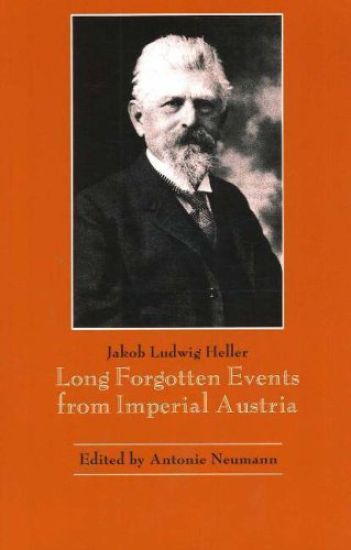
Long Forgotten Events from Imperial Austria
Jakob Ludwig Heller; Antonie Neumann; Otto (TRN) Naumann
Ariadne Pr
2006
pokkari
The time for autobiographies has arrived. Interest in authentic life stories seems greater than ever, even greater than well written works of fiction, because readers begin to recognise that nothing is more fantastic than the complicated reality through which we are forced to make our way. Accounts of everyday life have long since become a source of historic insight, and even historians are beginning to admit that concrete vignettes of an autobiographer's life are often better able to portray what the past was really like. All of this holds true for the memoirs of Jakob Ludwig Heller, who lived in the Austro-Hungarian Empire during the 19th and 20th centuries. The records that he left behind reveal that nostalgic individuals were not far wrong in viewing the Empire and its era as the quintessence of an intact world.Of course things were not as peaceful and happy for everyone in the Danube monarchy, but compared with today's world, Jakob Ludwig Heller's milieu was a true idyll, where marriages endured, family ties were strong, hard work was rewarded, and people rejoiced over simple social gatherings.Upbringing was strict, but caring, the children were well behaved, and earning a living was fun. Long live progress! The feeling that what he describes is lost forever is magnified further by the fact that he grew up in a Jewish, Central European milieu, where Jews perhaps did not live without tensions among neighbours of other faiths, but did live without being persecuted, robbed, and murdered. Not only Jewish readers will regret the loss of that normal way of life.Near the end of his memoirs, in retrospect the diarist complains about the inexplicable intrusions of lax morals, the disappearance of fixed norms, and the lack of the earlier, ever-present feeling of security and continuity. What would he say today? But what makes the reading of this simple story so rewarding, apart from the historic information, is the intelligent, humorous, warm-hearted man who is encountered on every page. His comments about the First World War are especially touching. Despite his extensive life experience, they betray his naive belief in Germany and Austria, in the government and the army.He is convinced that the Central Powers fight for a just cause at a time when Karl Kraus is writing "The Last Days of Mankind".But in those days the great satirist was still quite alone with his opinion. Most of the Jews, even most of the people, probably felt as did Jakob Ludwig Heller. And the waning of those certainties is the greatest tragedy of all, a sign of the insurmountable distance between our world and that of the past.