
Kirjahaku
Etsi kirjoja tekijän nimen, kirjan nimen tai ISBN:n perusteella.
1000 tulosta hakusanalla P T Barnum
First published in 1880 by P.T. Barnum, The Art of Money Getting is a short book encouraging the general public to aspire to wealth through proper economic means: building a savings, collecting on interest, operating business with integrity, learning the true value of money, working for what you earn, and foregoing extravagances in order to live a more modest lifestyle where saving money is the goal. Based on P.T. Barnum's own experiences as a showman and businessman, he outlines a way of life rather than a get-rich-quick scheme. Despite its 19th-century publication date, his advice is remarkably relevant, and will be of interest to young and old readers alike who desire to be more responsible with their finances.

First published in 1880 by P.T. Barnum, The Art of Money Getting is a short book encouraging the general public to aspire to wealth through proper economic means: building a savings, collecting on interest, operating business with integrity, learning the true value of money, working for what you earn, and foregoing extravagances in order to live a more modest lifestyle where saving money is the goal. Based on P.T. Barnum\'s own experiences as a showman and businessman, he outlines a way of life rather than a get-rich-quick scheme. Despite its 19th-century publication date, his advice is remarkably relevant, and will be of interest to young and old readers alike who desire to be more responsible with their finances.
The Art of Money Getting, or Golden Rules for Making Money
P T Barnum
Createspace Independent Publishing Platform
2018
pokkari
Phineas Taylor Barnum (July 5, 1810 - April 7, 1891) was an American showman, businessman, scam artist and entertainer, remembered for promoting celebrated hoaxes and for founding the circus that became the Ringling Bros. and Barnum & Bailey Circus.
In the United States, where we have more land than people, it is not at all difficult for persons in good health to make money. In this comparatively new field there are so many avenues of success open, so many vocations which are not crowded, that any person of either sex who is willing, at least for the time being, to engage in any respectable occupation that offers, may find lucrative employment. Those who really desire to attain an independence, have only to set their minds upon it, and adopt the proper means, as they do in regard to any other object which they wish to accomplish, and the thing is easily done. But however easy it may be found to make money, I have no doubt many of my hearers will agree it is the most difficult thing in the world to keep it. The road to wealth is, as Dr. Franklin truly says, "as plain as the road to the mill." It consists simply in expending less than we earn; that seems to be a very simple problem. Mr. Micawber, one of those happy creations of the genial Dickens, puts the case in a strong light when he says that to have annual income of twenty pounds per annum, and spend twenty pounds and sixpence, is to be the most miserable of men; whereas, to have an income of only twenty pounds, and spend but nineteen pounds and sixpence is to be the happiest of mortals. Many of my readers may say, "we understand this: this is economy, and we know economy is wealth; we know we can't eat our cake and keep it also." Yet I beg to say that perhaps more cases of failure arise from mistakes on this point than almost any other. The fact is, many people think they understand economy when they really do not.


The Humbugs of the World is an unchanged, high-quality reprint of the original edition of 1865. Hansebooks is editor of the literature on different topic areas such as research and science, travel and expeditions, cooking and nutrition, medicine, and other genres. As a publisher we focus on the preservation of historical literature. Many works of historical writers and scientists are available today as antiques only. Hansebooks newly publishes these books and contributes to the preservation of literature which has become rare and historical knowledge for the future.
Struggles and Triumphs - Or, fourty years recollections of P. T. Barnum is an unchanged, high-quality reprint of the original edition of 1875. Hansebooks is editor of the literature on different topic areas such as research and science, travel and expeditions, cooking and nutrition, medicine, and other genres. As a publisher we focus on the preservation of historical literature. Many works of historical writers and scientists are available today as antiques only. Hansebooks newly publishes these books and contributes to the preservation of literature which has become rare and historical knowledge for the future.
Reproduction of the original. The publishing house Megali specialises in reproducing historical works in large print to make reading easier for people with impaired vision.
Reproduction of the original. The publishing house Megali specialises in reproducing historical works in large print to make reading easier for people with impaired vision.
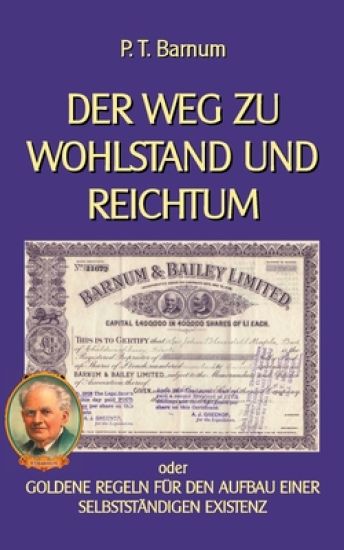
Der Weg zum Reichtum ist, wie einer der Gr nderv ter der Vereinigten Staaten sagt, "so klar wie der Weg zur M hle". Es besteht einfach darin, weniger auszugeben, als wir verdienen; das scheint ein sehr einfaches Problem zu sein. Wahre Wirtschaft wird dennoch oft falsch verstanden, und die Menschen gehen durchs Leben, ohne richtig zu verstehen, was dieses Prinzip ausmacht. Es gibt Menschen, die denken, dass die Wirtschaft darin besteht, K sest ckchen und Kerzenstummel zu sparen, zwei Pence von der Rechnung der Waschfrau abzuschneiden und alle m glichen kleinen, gemeinen und schmutzigen Dinge zu tun. Wirtschaft ist keine Gemeinheit. Was wahre Wirtschaft in Wirklichkeit ist, dar ber schreibt der ber hmte Schausteller und Politiker P. T. Barnum in diesem Buch und stellt die heute immer noch g ltigen Regeln auf, deren Befolgung zu Wohlstand und Reichtum f hren.
Reproduction of the original: The Humbugs of the World by P.T Barnum
Reproduction of the original: The Humbugs of the World by P.T Barnum

Reprint of the original, first published in 1866.