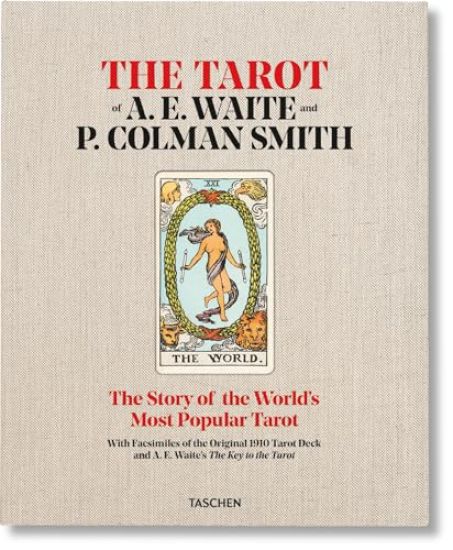
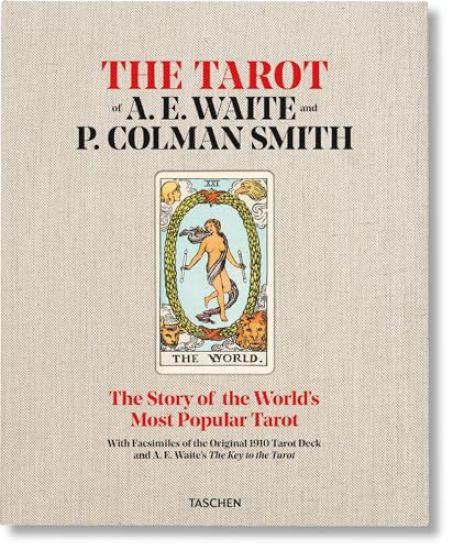
A unique edition of bright texts, brilliant images, and historic reprints, this kit provides everything that both beginners and advanced Tarot users might need and want to read cards for themselves and to study and experience this cultural gem in all its beauty and significance.The valuable collector’s box includes a complete deck of the Waite Smith Tarot cards and Waite’s famous companion book The Key to the Tarot. In this illustrated book, with texts and images compiled by Johannes Fiebig, the Tarot cards become psychological mirrors and signposts leading toward new answers and personal solutions. The fact that this works well can be attributed to certain advantages inherent to the Waite-Smith cards, and these points are illuminated in an essay by Rachel Pollack.All 78 cards are presented individually and in detail. The explanatory texts provide several dimensions and levels of interpretation, including concrete practical tips. Further, the book offers a new feature: the quick check. This presents a concise hint regarding the meaning of each card in each possible position of all the spread patterns featured in the book.When Arthur E. Waite and Pamela Colman Smith developed their Tarot deck in London in 1909, nobody could have predicted that it would have an overwhelming renaissance starting around 60 years later. What were the lives, works, and passions of these creators like? Pamela Colman Smith and Arthur E. Waite are brought vividly back to life in essays by Mary K. Greer and Robert A. Gilbert.
A unique edition of bright texts, brilliant images, and historic reprints, this kit provides everything that both beginners and advanced Tarot users might need and want to read cards for themselves and to study and experience this cultural gem in all its beauty and significance.The valuable collector’s box includes a complete deck of the Waite Smith Tarot cards and Waite’s famous companion book The Key to the Tarot. In this illustrated book, with texts and images compiled by Johannes Fiebig, the Tarot cards become psychological mirrors and signposts leading toward new answers and personal solutions. The fact that this works well can be attributed to certain advantages inherent to the Waite-Smith cards, and these points are illuminated in an essay by Rachel Pollack.All 78 cards are presented individually and in detail. The explanatory texts provide several dimensions and levels of interpretation, including concrete practical tips. Further, the book offers a new feature: the quick check. This presents a concise hint regarding the meaning of each card in each possible position of all the spread patterns featured in the book.When Arthur E. Waite and Pamela Colman Smith developed their Tarot deck in London in 1909, nobody could have predicted that it would have an overwhelming renaissance starting around 60 years later. What were the lives, works, and passions of these creators like? Pamela Colman Smith and Arthur E. Waite are brought vividly back to life in essays by Mary K. Greer and Robert A. Gilbert.
Thanks to the descriptive scenes that illustrate each of the Minor Arcana, the Rider-Waite deck distinguished itself from the centuries-old tradition of Tarots and became a reference point for every deck published from then on.
The 18th century was a wealth of knowledge, exploration and rapidly growing technology and expanding record-keeping made possible by advances in the printing press. In its determination to preserve the century of revolution, Gale initiated a revolution of its own: digitization of epic proportions to preserve these invaluable works in the largest archive of its kind. Now for the first time these high-quality digital copies of original 18th century manuscripts are available in print, making them highly accessible to libraries, undergraduate students, and independent scholars.Medical theory and practice of the 1700s developed rapidly, as is evidenced by the extensive collection, which includes descriptions of diseases, their conditions, and treatments. Books on science and technology, agriculture, military technology, natural philosophy, even cookbooks, are all contained here.++++The below data was compiled from various identification fields in the bibliographic record of this title. This data is provided as an additional tool in helping to insure edition identification: ++++Bodleian Library (Oxford)W030878Dedicated to William Smith.Philadelphiae: Typis Gulielmi & Thomae Bradford, M.DCC.LXXI. 1771]. 4],23, 1]p.; 8
A unique edition of bright texts, brilliant images, and historic reprints, this kit provides everything that both beginners and advanced Tarot users might need and want to read cards for themselves and to study and experience this cultural gem in all its beauty and significance.The valuable collector’s box includes a complete deck of the Waite Smith Tarot cards and Waite’s famous companion book The Key to the Tarot. In this illustrated book, with texts and images compiled by Johannes Fiebig, the Tarot cards become psychological mirrors and signposts leading toward new answers and personal solutions. The fact that this works well can be attributed to certain advantages inherent to the Waite-Smith cards, and these points are illuminated in an essay by Rachel Pollack.All 78 cards are presented individually and in detail. The explanatory texts provide several dimensions and levels of interpretation, including concrete practical tips. Further, the book offers a new feature: the quick check. This presents a concise hint regarding the meaning of each card in each possible position of all the spread patterns featured in the book.When Arthur E. Waite and Pamela Colman Smith developed their Tarot deck in London in 1909, nobody could have predicted that it would have an overwhelming renaissance starting around 60 years later. What were the lives, works, and passions of these creators like? Pamela Colman Smith and Arthur E. Waite are brought vividly back to life in essays by Mary K. Greer and Robert A. Gilbert.
Arthur E. Waite, a modern mystic, created together with Pamela Colman Smith the most influential Tarot deck. With a selection of more than 800 images and texts, the pioneer of Tarot history, Johannes Fiebig contextualizes this unique deck. The kit includes facsimiles of the 1910 original edition of the cards and of A. E. Waiteâ??s Key to the Tarot.
Min tolkning av A. E Waite / P. Colman Smiths Tarot-lek beskriver förutom informationen om hur Tarot-leken är uppbyggda på en sifferbasis, den Stora Arkanans koppling till arketyperna och människans psyke, samt den Lilla Arkanans koppling till vardagliga händelser och de fyra elementen(Luft, Eld, Vatten och Jord). Dessutom medföljer en tolkning av varje korts betydelse, färger ochsymboler, samt likheter mellan den Lilla Arkanan och en vanlig spelkortlek. Mitt intresse för Magi har givetvis också haft ett finger med i spelet, så därför förekommer det ett kapitel längst bak som tar upp olika kombinationer man kan göra mellan Tarot-korten och naturliga redskap, vilka mer utförligt återfinns i boken "Mitt Magiska Liv, Bok V - Mina Ceremonier, Ritualer och Besvärjelser.
The 18th century was a wealth of knowledge, exploration and rapidly growing technology and expanding record-keeping made possible by advances in the printing press. In its determination to preserve the century of revolution, Gale initiated a revolution of its own: digitization of epic proportions to preserve these invaluable works in the largest archive of its kind. Now for the first time these high-quality digital copies of original 18th century manuscripts are available in print, making them highly accessible to libraries, undergraduate students, and independent scholars.Medical theory and practice of the 1700s developed rapidly, as is evidenced by the extensive collection, which includes descriptions of diseases, their conditions, and treatments. Books on science and technology, agriculture, military technology, natural philosophy, even cookbooks, are all contained here.++++The below data was compiled from various identification fields in the bibliographic record of this title. This data is provided as an additional tool in helping to insure edition identification: ++++Library of CongressW005983Philadelphia: Printed by T. Lang, no. 21, Church-Alley, M DCC XCI. 179]1. 28p.; 8
Title: Blanche Heriot; or, the Chertsey curfew. A romance. By the author of the Hebrew Maiden i.e. T. P. Prest], etc. (From the drama by Albert Smith.).Publisher: British Library, Historical Print EditionsThe British Library is the national library of the United Kingdom. It is one of the world's largest research libraries holding over 150 million items in all known languages and formats: books, journals, newspapers, sound recordings, patents, maps, stamps, prints and much more. Its collections include around 14 million books, along with substantial additional collections of manuscripts and historical items dating back as far as 300 BC.The FICTION & PROSE LITERATURE collection includes books from the British Library digitised by Microsoft. The collection provides readers with a perspective of the world from some of the 18th and 19th century's most talented writers. Written for a range of audiences, these works are a treasure for any curious reader looking to see the world through the eyes of ages past. Beyond the main body of works the collection also includes song-books, comedy, and works of satire. ++++The below data was compiled from various identification fields in the bibliographic record of this title. This data is provided as an additional tool in helping to insure edition identification: ++++ British Library Heriot, Blanche; Prest, Thomas; 1851.]. 141 p.; 8 . C.140.e.32.(2.)
Tracing the historical development of partnerships between schools, universities, and communities, P-20 Partnerships: A Critical Examination of the Past and Future provides educators and policymakers with a framework for understanding how partnerships originated and their potential for the future. This book connects Dewey's lab schools, Goodlad's ideas about simultaneous renewal, and Professional Development Schools with today's next-generation P-20 partnerships and Cradle-to-Career networks. After examining the history and development of P-20 partnerships, we are able to categorize partnerships into three different types, depending on the purpose of their outcomes: partnerships to improve P-12 schools, partnerships to improve access to post-secondary opportunities, and Research-Practice Partnerships. Rather than categorizing partnerships by their activities and curricula, this book proposes that their goals for their students are what should define these school systems.
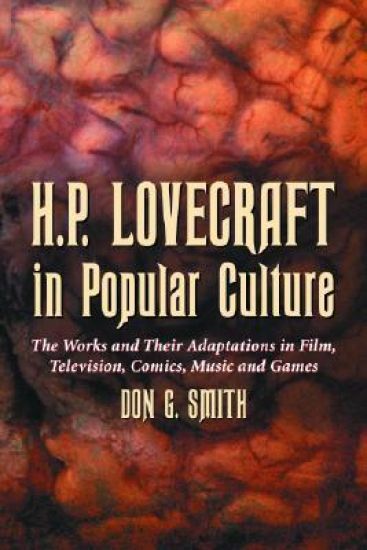
"This scholarly study highlights Lovecraft's profound impact on 20th century popular culture. Early chapters introduce his complete writings, providing an annotated bibliography of the author's horror and science fiction tales. The works are discussed inthe context of the Cthulhu Mythos, an invented mythology centering on ancient and alien beings interacting with the terrestrial world"--Provided by publisher.









![A digest of cases decided by the Supreme Court of Pennsylvania, as reported from 3d Wright to 5th P. F. Smith, inclusive [1861-1867] with table of titles and table of cases](/covers/9789353976071.jpg)
![Blanche Heriot; Or, the Chertsey Curfew. a Romance. by the Author of the Hebrew Maiden [I.E. T. P. Prest], Etc. (from the Drama by Albert Smith.).](/covers/9781241395995.jpg)