Kirjojen hintavertailu. Mukana 11 699 587 kirjaa ja 12 kauppaa.

Kirjahaku

Etsi kirjoja tekijän nimen, kirjan nimen tai ISBN:n perusteella.

273 tulosta hakusanalla Parvinder Kler

The Story of RSS

The Story of RSS

Parvinder Sharma; Gaurav Dhiman

SCHOLARS' PRESS
2026
pokkari
The Story of RSS: 100 Years of Journey chronicles the remarkable century-long evolution of the Rashtriya Swayamsevak Sangh, tracing its transformation from a small shakha in Nagpur in 1925 into a nationwide movement with global reach. This book explores the organization's ideological foundations, its disciplined cadre system, and its role in shaping cultural nationalism in India. Through fifteen detailed chapters, it examines the vision of Dr. Keshav Baliram Hedgewar, the consolidation under M. S. Golwalkar, the trials during pre- and post-independence, the challenges of Partition, the Emergency years, and the growth of the Sangh Parivar. It delves into the RSS's social service initiatives, educational programs, and engagement with contemporary Indian society, while also addressing debates, criticism, and public perception. Looking ahead, the book reflects on the RSS's vision, leadership, and strategic priorities as it navigates the complexities of the 21st century, offering readers a comprehensive understanding of one of India's most influential organizations.
Microservices and Containers

Microservices and Containers

Parminder Kocher

Addison Wesley
2018
nidottu
Transition to Microservices and DevOps to Transform Your Software Development Effectiveness Thanks to the tech sector’s latest game-changing innovations—the Internet of Things (IoT), software-enabled networking, and software as a service (SaaS), to name a few—there is now a seemingly insatiable demand for platforms and architectures that can improve the process of application development and deployment. In Microservices and Containers, longtime systems architect and engineering team leader Parminder Kocher analyzes two of the hottest new technology trends: microservices and containers. Together, as Kocher demonstrates, microservices and Docker containers can bring unprecedented agility and scalability to application development and deployment, especially in large, complex projects where speed is crucial but small errors can be disastrous. Learn how to leverage microservices and Docker to drive modular architectural design, on-demand scalability, application performance and reliability, time-to-market, code reuse, and exponential improvements in DevOps effectiveness. Kocher offers detailed guidance and a complete roadmap for transitioning from monolithic architectures, as well as an in-depth case study that walks the reader through the migration of an enterprise-class SOA system. Understand how microservices enable you to organize applications into standalone components that are easier to manage, update, and scaleDecide whether microservices and containers are worth your investment, and manage the organizational learning curve associated with themApply best practices for interprocess communication among microservicesMigrate monolithic systems in an orderly fashionUnderstand Docker containers, installation, and interfacesNetwork, orchestrate, and manage Docker containers effectivelyUse Docker to maximize scalability in microservices-based applicationsApply your learning with an in-depth, hands-on case study Whether you are a software architect/developer or systems professional looking to move on from older approaches or a manager trying to maximize the business value of these technologies, Microservices and Containers will be an invaluable addition to your library. Register your product at informit.com/register for convenient access to downloads, updates, and/or corrections as they become available.
Dangerous Designs

Dangerous Designs

Parminder Bhachu

Routledge
2003
sidottu
In late-1990s Britain, the salwaar-kameez or 'Punjabi suit' emerged as a high-fashion garment. Popular both on the catwalk and on the street, it made front-page news when worn by Diana, Princess of Wales and by Cherie Booth, the wife of UK Prime Minister Tony Blair. In her ethnography of the local and global design economies established by Asian women fashion entrepreneurs, Parminder Bhachu focuses on the transformation of the salwaar-kameez from negatively coded 'ethnic clothing' to a global garment fashionable both on the margins and in the mainstream. Exploring the design and sewing businesses, shops and street fashions in which this revolution has taken place, she shows how the salwaar-kameez is today at the heart of new economic micro-markets which themselves represent complex, powerfully coded means of cultural dialogue and racial politics. The innovative designs of second-generation British Asian women are drawn from characteristically improvisational migrant cultural codes. Through their hybrid designs and creation of new aesthetics, these women cross cultural boundaries, battling with racism and redefining both Asian and British identities. At the same time, their border-crossing commercial entrepreneurship produces new diaspora economies which give them control over many economic, aesthetic, cultural and technological resources. In this way, the processes of global capitalism are gendered, racialized and localized through the interventions of diasporic women from the margins.
Dangerous Designs

Dangerous Designs

Parminder Bhachu

Routledge
2003
nidottu
In late-1990s Britain, the salwaar-kameez or 'Punjabi suit' emerged as a high-fashion garment. Popular both on the catwalk and on the street, it made front-page news when worn by Diana, Princess of Wales and by Cherie Booth, the wife of UK Prime Minister Tony Blair. In her ethnography of the local and global design economies established by Asian women fashion entrepreneurs, Parminder Bhachu focuses on the transformation of the salwaar-kameez from negatively coded 'ethnic clothing' to a global garment fashionable both on the margins and in the mainstream. Exploring the design and sewing businesses, shops and street fashions in which this revolution has taken place, she shows how the salwaar-kameez is today at the heart of new economic micro-markets which themselves represent complex, powerfully coded means of cultural dialogue and racial politics. The innovative designs of second-generation British Asian women are drawn from characteristically improvisational migrant cultural codes. Through their hybrid designs and creation of new aesthetics, these women cross cultural boundaries, battling with racism and redefining both Asian and British identities. At the same time, their border-crossing commercial entrepreneurship produces new diaspora economies which give them control over many economic, aesthetic, cultural and technological resources. In this way, the processes of global capitalism are gendered, racialized and localized through the interventions of diasporic women from the margins.
100 Cases in Orthopaedics and Rheumatology

100 Cases in Orthopaedics and Rheumatology

Parminder Singh; Catherine Swales

Routledge
2012
nidottu
A 24-year-old woman attends rheumatology outpatients with an eight-week history of painful hands. On examination she is tearful and thin. You are the medic on duty...100 Cases in Orthopaedics and Rheumatology presents 100 scenarios commonly seen by medical students and junior doctors in orthopaedic and rheumatology clinics, or in the emergency department. A succinct summary of the patient's history, examination and initial investigations, with clinical and/or imaging photographs, is followed by questions on the diagnosis and management of each case. The answer includes a detailed discussion on each topic, with further illustration where appropriate, providing an essential revision aid as well as a practical guide for students and junior doctors. Making clinical decisions and choosing the best course of action is one of the most challenging and difficult parts of training to become a doctor. These cases will teach students and junior doctors to recognize important symptoms and signs and, where appropriate, their relationship to other medical conditions, and to develop their diagnostic and management skills.
Movers and Makers

Movers and Makers

Parminder Bhachu

Bloomsbury Academic
2021
sidottu
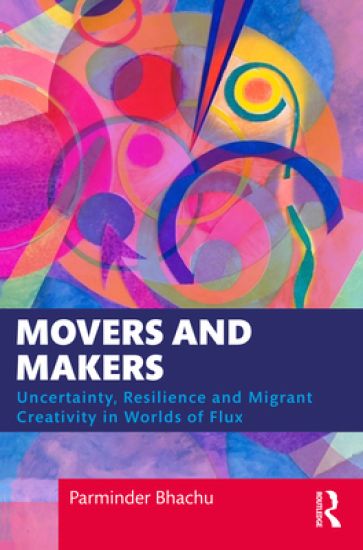
We live in times of extreme change. There could be no better time than now to interrogate the lives of new kinds of people, movers and makers, who navigate fragility and uncertainty to create with daring, often against great odds. Parminder Bhachu uses their dramatic life stories to uncover what makes for creativity and resilience in times of disequilibrium. What can be learnt from their creative moxie as innovators outside establishment powers? Why has their creative reach grown exponentially in our globally connected twenty-first century? How have their abilities to innovate been catalyzed without subscription to knowledge hierarchies and monopolies? These culturally dexterous movers who possess movement capital, advanced with every migration, have translated ancient maker and craft skills into transforming modern technology, science, design, architecture, and the arts. Generous, inclusive, and deeply collaborative, they are at the heart of open source sharing for collective intelligence, the common good, and the maker movement. They invigorate the economies they reside in greatly enhancing creative capacities and reach. Bhachu, herself a multiple-migrant maker, offers us a model for a hopeful way forward, bringing her unique ethnographic insights to illuminate what can be learnt about thriving in worlds of flux.
Movers and Makers

Movers and Makers

Parminder Bhachu

Bloomsbury Academic
2021
nidottu
We live in times of extreme change. There could be no better time than now to interrogate the lives of new kinds of people, movers and makers, who navigate fragility and uncertainty to create with daring, often against great odds. Parminder Bhachu uses their dramatic life stories to uncover what makes for creativity and resilience in times of disequilibrium. What can be learnt from their creative moxie as innovators outside establishment powers? Why has their creative reach grown exponentially in our globally connected twenty-first century? How have their abilities to innovate been catalyzed without subscription to knowledge hierarchies and monopolies? These culturally dexterous movers who possess movement capital, advanced with every migration, have translated ancient maker and craft skills into transforming modern technology, science, design, architecture, and the arts. Generous, inclusive, and deeply collaborative, they are at the heart of open source sharing for collective intelligence, the common good, and the maker movement. They invigorate the economies they reside in greatly enhancing creative capacities and reach. Bhachu, herself a multiple-migrant maker, offers us a model for a hopeful way forward, bringing her unique ethnographic insights to illuminate what can be learnt about thriving in worlds of flux.
Learning Vulkan

Learning Vulkan

Parminder Singh

Packt Publishing Limited
2016
nidottu
Discover how to build impressive 3D graphics with the next-generation graphics API—Vulkan About This Book • Get started with the Vulkan API and its programming techniques using the easy-to-follow examples to create stunning 3D graphics • Understand memory management in Vulkan and implement image and buffer resources • Get hands-on with the drawing process and synchronization, and render a 3D graphics scene with the Vulkan graphics pipeline Who This Book Is For This book is ideal for graphic programmers who want to get up and running with Vulkan. It's also great for programmers who have experience with OpenGL and other graphic APIs who want to take advantage of next generation APIs. A good knowledge of C/C++ is expected. What You Will Learn • Learn fundamentals of Vulkan programing model to harness the power of modern GPU devices. • Implement device, command buffer and queues to get connected with the physical hardware. • Explore various validation layers and learn how to use it for debugging Vulkan application. • Get a grip on memory management to control host and device memory operations. • Understand and implement buffer and image resource types in Vulkan. • Define drawing operations in the Render pass and implement graphics pipeline. • Manage GLSL shader using SPIR-V and update the shader resources with descriptor sets and push constants. • Learn the drawing process, manage resources with synchronization objects and render 3D scene output on screen with Swapchain. • Bring realism to your rendered 3D scene with textures, and implement linear and optimal textures In Detail Vulkan, the next generation graphics and compute API, is the latest offering by Khronos. This API is the successor of OpenGL and unlike OpenGL, it offers great flexibility and high performance capabilities to control modern GPU devices. With this book, you'll get great insights into the workings of Vulkan and how you can make stunning graphics run with minimum hardware requirements. We begin with a brief introduction to the Vulkan system and show you its distinct features with the successor to the OpenGL API. First, you will see how to establish a connection with hardware devices to query the available queues, memory types, and capabilities offered. Vulkan is verbose, so before diving deep into programing, you'll get to grips with debugging techniques so even first-timers can overcome error traps using Vulkan's layer and extension features. You'll get a grip on command buffers and acquire the knowledge to record various operation commands into command buffer and submit it to a proper queue for GPU processing. We'll take a detailed look at memory management and demonstrate the use of buffer and image resources to create drawing textures and image views for the presentation engine and vertex buffers to store geometry information. You'll get a brief overview of SPIR-V, the new way to manage shaders, and you'll define the drawing operations as a single unit of work in the Render pass with the help of attachments and subpasses. You'll also create frame buffers and build a solid graphics pipeline, as well as making use of the synchronizing mechanism to manage GPU and CPU hand-shaking. By the end, you'll know everything you need to know to get your hands dirty with the coolest Graphics API on the block. Style and approach This book takes a practical approach to guide you through the Vulkan API, and you will get to build an application throughout the course of the book. Since you are expected to be familiar with C/C++, there is not much hand-holding throughout the course of the book.
Service 4.0

Service 4.0

Parminder Singh Kang; Xiaojia Wang; Joong Y. Son; Mohsin Jat

Springer International Publishing AG
2024
nidottu
This book presents a systematic framework for Service 4.0, including service digitization, digitalization, and digital transformation, which is an integral part of Supply Chain 4.0 in coping with complex, dynamic, and interdependent systems. It provides a comprehensive state-of-the-art review of digital technologies to support Service 4.0 and Supply Chain 4.0, and discusses important pillars of customer-centric supply chain models. It then explains the role of big data in customer-centric service-based supply chains and links the different types of data needed to promote end-to-end transparency and value co-creation activities to promote these key pillars. Moreover, the book introduces practical models to support analytics for customer-centric supply chains and sheds light on how the industry practically uses existing models to promote service co-creation. A chapter of a case study on women's clothing e-commerce reviews and demonstrates how various data visualization and text mining methods can be used to uncover meaningful insights within the review data. The book is intended to help students and researchers quickly navigate through various technologies and future research directions in the areas of Service 4.0 and Supply Chain 4.0. It is also a valuable read for practitioners in this field.
Flavours of Indian Paneer

Flavours of Indian Paneer

Parminder Singh Dhillon

LAP Lambert Academic Publishing
2018
pokkari
The book contains everything about Indian Paneer, it's history, preparation and tongue tickling recipes like Paneer Tikka, Shahi Paneer, Paneer Pakora, Paneer Masala and Paneer Sweets. It also includes spices, herbs and condiments used in paneer dishes, garnishing food items, cooking equipment's used for preparing paneer dishes, paneer snacks, paneer salads and gravies, pastes, masalas used for Paneer dishes.