Kirjojen hintavertailu. Mukana 11 627 220 kirjaa ja 12 kauppaa.

Kirjahaku

Etsi kirjoja tekijän nimen, kirjan nimen tai ISBN:n perusteella.

1000 tulosta hakusanalla Paul V. Dutton

Römische Mikropolitik unter Papst Paul V. Borghese (1605–1621) zwischen Spanien, Neapel, Mailand und Genua

Römische Mikropolitik unter Papst Paul V. Borghese (1605–1621) zwischen Spanien, Neapel, Mailand und Genua

Julia Zunckel; Hillard von Thiessen; Guido Metzler; Jan-Christoph Kitzler

De Gruyter
2004
sidottu
Erstmals wird in diesem aus den Akten zahlreicher Archive erarbeiteten Buch die Untersuchung des politischen Einsatzes von Patronage-Klientel-Beziehungen und sozialen Netzwerken, das ist Mikropolitik, von den inneren Herrschaftsverhältnissen frühneuzeitlicher Gemeinwesen auf deren zwischenstaatliche Beziehungen übertragen. Konkret geht es um die vielgestaltige Interaktion zwischen der Römischen Kurie Papst Pauls V. (1605-1621) mit seiner Familie, den Borghese, und Spanien mit seinen Nebenländern Neapel und Mailand sowie dem Spanien nahestehenden Finanzzentrum Genua.
Die Außenbeziehungen der römischen Kurie unter Paul V. Borghese (1605-1621)
This collection documents the contributions made to an international colloquium organized in Rome in 2005 by the German Historical Institute on the subject of the international relations entertained by the Roman curia under Paul V Borghese. The proceedings were based on the three-volume edition of the main directives of this pontificate by Silvano Giordano published in 2003. Alongside more general issues (implementation of the reforms adopted at the Council of Trent, jurisdiction, military matters, the relationship between micro- and macro-politics), there is also discussion of the (confessional) political contacts between Rome and the main territories of the orbis catholicus (legations, nunciatures), including those outside Europe.
Kunst und Zeremoniell in Rom während des Pontifikates von Paul V. (1605-1621)
Im Zentrum des Buches steht die Frage nach dem Zusammenhang von Kunst und papstlichem Zeremoniell in Rom wahrend des Pontifikates von Paul V. (1605-1621). Erortert wird sie anhand der prachtvollen Festapparate, die fur die Kanonisationen Francesca Romanas (1608) und Carlo Borromeos (1610) errichtet wurden, und der Sala Regia des Quirinalspalastes (vollendet 1617) . Mittels einer Vielzahl von Text- und Bildquellen werden die untersuchten Werkkomplexe rekonstruiert und konsequent in dem Kontext verortet, fur den sie geschaffen wurden.
Some Original Letters of Bishop Bedell, Concerning the Steps Taken Toward a Reformation of Religion at Venice, Upon Occasion of the Quarrel Between That State, and the Pope Paul V
The 18th century was a wealth of knowledge, exploration and rapidly growing technology and expanding record-keeping made possible by advances in the printing press. In its determination to preserve the century of revolution, Gale initiated a revolution of its own: digitization of epic proportions to preserve these invaluable works in the largest archive of its kind. Now for the first time these high-quality digital copies of original 18th century manuscripts are available in print, making them highly accessible to libraries, undergraduate students, and independent scholars.The Age of Enlightenment profoundly enriched religious and philosophical understanding and continues to influence present-day thinking. Works collected here include masterpieces by David Hume, Immanuel Kant, and Jean-Jacques Rousseau, as well as religious sermons and moral debates on the issues of the day, such as the slave trade. The Age of Reason saw conflict between Protestantism and Catholicism transformed into one between faith and logic -- a debate that continues in the twenty-first century.++++The below data was compiled from various identification fields in the bibliographic record of this title. This data is provided as an additional tool in helping to insure edition identification: ++++British LibraryT115516Edited by Edward Hudson.Dublin: printed by and for George Faulkner, 1742. 8],80p.; 12
Psychosocial Scenarios for Pediatrics

Psychosocial Scenarios for Pediatrics

Paul V. Trad

Springer-Verlag New York Inc.
1987
nidottu
My interest in writing this book was sparked several years ago when I serv ed as a psychiatric liaison on a pediatric unit of a major urban hospital. I was asked to assess a 7-year-old Hispanic boy who had been admitted to the hospital several days earlier with complaints of chronic abdominal pain. Comprehensive physical evaluations of the child had revealed no organic abnormality or disease process, and the pedia­ tricians assigned to the case had begun to suspect that the little boy's symptoma­ tology sternmed from an emotional problem. After meeting with the child for several sessions, I learned that his abdominal pains had persisted for approximately 3 years, preventing him from attending school on a regular basis or from engaging in other activities. A detailed elinical history revealed that roughly 4 years earlier, the child's mother had remarried and this stepfather had moved into the home. The child's comments with respeet to this man were highly ambivalent. Nor was the nature of these conflicting feelings apparent to me at the time. Several days later, however, when the child had been told the date of his discharge from the hospital, I was informed that his anxiety had increased dramatically.
The Human and the Divine in History

The Human and the Divine in History

Paul V. Niskanen

BLOOMSBURY PUBLISHING PLC
2004
sidottu
The Human and the Divine in History investigates the possibility that the author of Daniel knew and drew upon the Histories of Herodotus. Daniel uses and develops Herodotean concepts such as the succession of world empires, dynastic dreams, and the focus on both human and divine cauration in explaining historical events. A comparative reading of these two texts illuminates DanielGCOs theology of history, showing it to be neither as exclusively eschatological nor as sectarian as is often supposed. Rather, it is specifically the end of exileGCounderstood as foreign dominationGCothat Daniel envisions for the entire Jewish people.
The Psychotheology of Sin and Salvation

The Psychotheology of Sin and Salvation

Paul V. Axton

T. T.Clark Ltd
2015
sidottu
Through the employment of the work of Slavoj Žižek and his engagement with the Apostle Paul, Axton argues that Paul in Romans 6-8 understands sin as a lie grounding the subject outside of Christ, and salvation is an exposure and displacement of this lie. The theological significance of Žižek (along with Sigmund Freud and Jacques Lacan) is his demonstration of the pervasive and systemic nature of this lie and its description as he finds it in Romans 7. The specific overlap of the two disciplines of psychology and theology is found in the psychoanalytic understanding that the human Subject or the psyche is structured in three registers: the symbolic, the imaginary and the real. These three registers function like a lie analogous to the Pauline categories of law, ego, and the 'body of death' which constitute Paul's dynamic of sin's deception. Axton argues that if sin is understood as a lie grounding the Subject, the exposure of the lie or the dispelling of any notion of mystery connected to sin is integral to salvation and the reconstructing of the Subject in Christ. While the lie of sin is mediated by the law, new life in the Spirit is not through the law but is a principle unto itself, which though it accounts for the law, is beyond the law.
The Psychotheology of Sin and Salvation

The Psychotheology of Sin and Salvation

Paul V. Axton

T. T.Clark Ltd
2018
nidottu
Through the employment of the work of Slavoj Žižek and his engagement with the Apostle Paul, Axton argues that Paul in Romans 6-8 understands sin as a lie grounding the subject outside of Christ, and salvation is an exposure and displacement of this lie. The theological significance of Žižek (along with Sigmund Freud and Jacques Lacan) is his demonstration of the pervasive and systemic nature of this lie and its description as he finds it in Romans 7. The specific overlap of the two disciplines of psychology and theology is found in the psychoanalytic understanding that the human Subject or the psyche is structured in three registers: the symbolic, the imaginary and the real. These three registers function like a lie analogous to the Pauline categories of law, ego, and the 'body of death' which constitute Paul's dynamic of sin's deception. Axton argues that if sin is understood as a lie grounding the Subject, the exposure of the lie or the dispelling of any notion of mystery connected to sin is integral to salvation and the reconstructing of the Subject in Christ. While the lie of sin is mediated by the law, new life in the Spirit is not through the law but is a principle unto itself, which though it accounts for the law, is beyond the law.
Silent Mars And Other Stories

Silent Mars And Other Stories

Paul V. Cwiakala

Silk Baron Independent Press
2016
nidottu
From the author of Fallen Saints and A Slave of the Bird Men, eight gripping all-new tales of Science Fiction, Fantasy, and Horror An astronaut questions his sanity after a mission gone awry. An ancient Dragoness awakens to find the humans who once feared her not quite so humble anymore. Haunting letters recount violent encounters with an unspeakable evil in the Canadian Arctic. A young man encounters a mysterious young woman in the forest. In Iran, an interrogator questions the only survivor of an alien spaceship crash-landed in the mountains. A man seeking a synthetic pet finds more than he expected.This and more in SILENT MARS AND OTHER STORES
Film and Religion

Film and Religion

Paul V. M. Flesher; Robert Torry

Abingdon Press
2007
pokkari
Focusing on American major-release films since World War II, the authors show how films use religious imagery, characters, and symbolism from primarily Christian, but also, Buddhist, Hindu, Jewish, and Islamic traditions. Ideal for classroom use, each chapter analyzes significant contextual issues through the lens of select films.
Fallen Saints

Fallen Saints

Paul V. Cwiakala

Silk Baron Independent Press
2014
nidottu
AN ANCIENT RELIC. POWERFUL FANATICS.A WOMAN AND HER GUN.Two thousand years ago, the Power of God and the ability to perform powerful magic were revealed to the world. Protected by the Church, only the powerful magic-wielding "Miracle Workers" today know these divine secrets.Now, in an American Old West where gunslingers and magic are facts of everyday life, Angie Grissom and her Cajun partner, Andrew Carnation, hunt down criminals for cash with little more than their wits and brawn. But when the hunt for a simple thief puts her in the middle of a religious blood feud between two factions of fanatical Miracle Workers and a battle over an ancient book with ties to the very origin of their powers, will Angie's quick draw be enough? Action and adventure await in a Wild West that never was
The New Era

The New Era

Paul V. Murphy

Rowman Littlefield Publishers
2016
nidottu
In the 1920s, Americans talked of their times as “modern,” which is to say, fundamentally different, in pace and texture, from what went before—a new era. With the end of World War I, an array of dizzying inventions and trends pushed American society from the Victorian era into modernity. The New Era provides a history of American thought and culture in the 1920s through the eyes of American intellectuals determined to move beyond an older role as gatekeepers of cultural respectability and become tribunes of openness, experimentation, and tolerance instead. Recognizing the gap between themselves and the mainstream public, younger critics alternated between expressions of disgust at American conformity and optimistic pronouncements of cultural reconstruction. The book tracks the emergence of a new generation of intellectuals who made culture the essential terrain of social and political action and who framed a new set of arguments and debates—over women’s roles, sex, mass culture, the national character, ethnic identity, race, democracy, religion, and values—that would define American public life for fifty years.
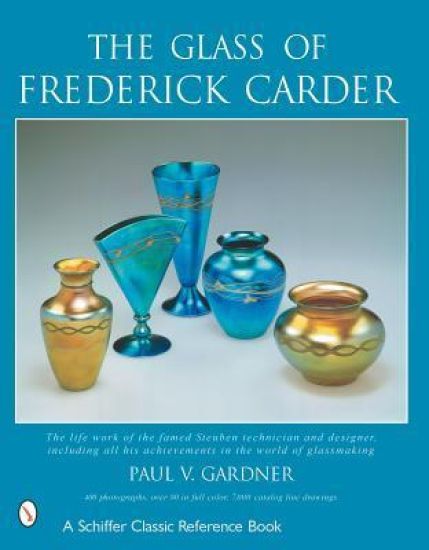
The Glass of Frederick Carder

The Glass of Frederick Carder

Paul V. Gardner

Schiffer Publishing Ltd
2001
sidottu
This reprint edition is the definitive book on the Steuben Glass Works and co-founder Frederick Carder. The special types of glass for which he was famed in the 1890-1930s era are presented, including Aurene, Tyrian, Verre de Soie, Cyprian, Ivrene, Cintra, Cluthra, Intarsia, Diatreta, and others, as well as all colors and the engraved, cut, and etched patterns. The photographs and line drawings from the Steuben catalogs bring the glass to life. A new Foreword by David Whitehouse and an Introduction by Paul N. Perrot, both of The Corning Museum of Glass, introduce this edition to a new generation of glass enthusiasts. The chapter on Carder’s “rediscovery” of the lost wax process and the reproduction of the various Steuben trademarks and Carder’s signatures help make this a superlative reference work for collectors, dealers, artists, designers, and historians.
Mrs. Hoover's Pueblo Walls

Mrs. Hoover's Pueblo Walls

Paul V. Turner

Stanford University Press
2004
sidottu
Two questions have intrigued observers of the Lou Henry Hoover House, built at Stanford University in 1919 by Lou Henry and Herbert Hoover and now the official residence of the university's president. Who was the building's architect? And what was the motive for its unusual, cubic, flat-roofed, undecorated form? Although professional architects were involved in the project, this book shows that the architect was actually Lou Henry Hoover herself, who conceived the design of the house and worked out its details, using her architects largely for technical matters and to produce the drawings and supervise construction. As for the design, the book argues that it was inspired mainly by the Native American Pueblo architecture of New Mexico and Arizona. Herbert Hoover, in fact, called it a "Hopi house," and Lou referred to her "Pueblo walls," but the Pueblo connection was later denied by others involved in the project. The book reveals that both of the Hoovers were interested in Native American culture, and that Lou, in particular, was fascinated with the "primitive" architecture of the non-Western world, which she had studied during the years when she and Herbert had lived and worked in Asia and elsewhere. Primitive forms did not appeal to her for their exoticism, as was typical at that time, but for the virtues she found in them. The Hoover House is a remarkable example of the contribution of non-Western or indigenous architecture to the development of modernism.
Taitaduhaan

Taitaduhaan

Paul V. Kroskrity; Rosalie Bethel; Jennifer F. Reynolds

University of Oklahoma Press
2002
cd
This interactive CD-ROM provides an introduction to the language and culture of the Western Mono Indians of Central California.