Kirjojen hintavertailu. Mukana 12 363 183 kirjaa ja 12 kauppaa.

Kirjahaku

Etsi kirjoja tekijän nimen, kirjan nimen tai ISBN:n perusteella.

1000 tulosta hakusanalla Peter F. Drucker

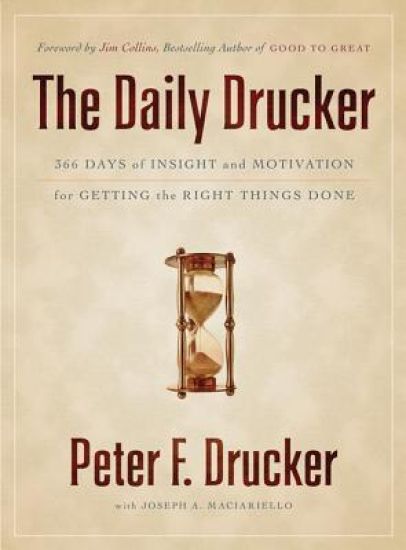
The Daily Drucker

The Daily Drucker

Peter F. Drucker

HarperBusiness
2011
sidottu
Revered management thinker Peter F. Drucker is our trusted guide in this thoughtful, day-by-day companion that offers his penetrating and practical wisdom. Amid the multiple pressures of our daily work lives, The Daily Drucker provides the inspiration and advice to meet the many challenges we face. With his trademark clarity, vision, and humanity, Drucker sets out his ideas on a broad swath of key topics, from time management, to innovation, to outsourcing, providing useful insights for each day of the year. These 366 daily readings have been harvested from Drucker's lifetime of work. At the bottom of each page, the reader will find an action point that spells out exactly how to put Drucker's ideas into practice. It is as if the wisest and most action-oriented management consultant in the world is in the room, offering his timeless gems of advice. The Daily Drucker is for anyone who seeks to understand and put to use Drucker's powerful words and ideas.
The Daily Drucker: 366 Days of Insight and Motivation for Getting the Right Things Done
Revered management thinker Peter F. Drucker is our trusted guide in this thoughtful, day-by-day companion that offers his penetrating and practical wisdom. Amid the multiple pressures of our daily work lives, The Daily Drucker provides the inspiration and advice to meet the many challenges we face. With his trademark clarity, vision, and humanity, Drucker sets out his ideas on a broad swath of key topics, from time management, to innovation, to outsourcing, providing useful insights for each day of the year.These 366 daily readings have been harvested from Drucker's lifetime of work. At the bottom of each page, the reader will find an action point that spells out exactly how to put Drucker's ideas into practice. It is as if the wisest and most action-oriented management consultant in the world is in the room, offering his timeless gems of advice. The Daily Drucker is for anyone who seeks to understand and put to use Drucker's powerful words and ideas.
Drucker's Basic Facilitator's Set

Drucker's Basic Facilitator's Set

Peter F. Drucker

John Wiley Sons Inc
2010
nidottu
A set of guides for those who want to actively contribute to a company's mission This set for leadership guidance includes these books: The Five Most Important Questions Self-Assessment Tool: Facilitator's Guide and The Five Most Important Questions Self-Assessment Tool: Participant's Workbook. The facilitator's guide provides tools for facilitators and leaders as they help others discover an organization's potential. The participant's workbook supports participants who want to drive results, respond to clients, and elevate their performance.
Drucker's Basic Workshop Set

Drucker's Basic Workshop Set

Peter F. Drucker

John Wiley Sons Inc
2010
nidottu
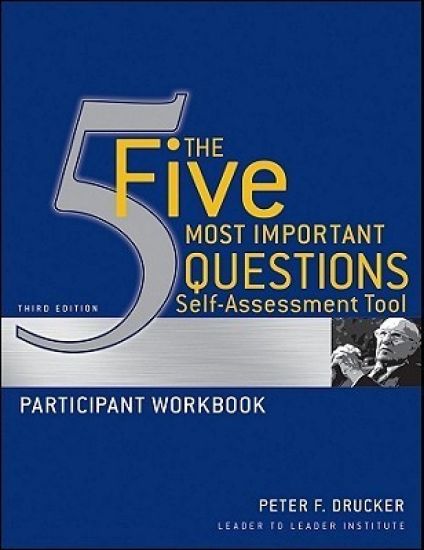
This transformational tool offers leaders a critical resource for better understanding their organizations and themselves, honing their skills to become accomplished long-range planners and strategic thinkers. By working through the Participant Workbook, leaders will gain the insight needed to plan for results, learn from customers and clients, and ascertain how to achieve extraordinary levels of performance. The Participant Workbook draws on Peter F. Drucker's The Five Most Important Questions and is grounded in his management philosophies that address the critical aspects that make organizations viable and valuable entities. When leaders answer these questions thoughtfully and address them with purpose, these questions take one down a path to organizational transformation and enlightenment. By leveraging these essential questions, the Participant Workbook challenges leaders to take a close look at the very heart of their organization and what drives it, giving them a means to assess: how to be and how to develop quality, character, mind-set, values, and courage. Drucker's The Five Most Important Questions lead to spirited discussions and action, inspiring positive change and renewed focus. Designed for today's busy professionals, this concise, clear, and accessible workbook for social sector, nonprofit, and socially minded business and government leaders can be used as preparation for a workshop, organizational self-assessment, or as a stand-alone leadership development tool for individuals looking to develop themselves and their organizations.
Drucker's Basic Facilitator's Set

Drucker's Basic Facilitator's Set

Peter F. Drucker

John Wiley Sons Inc
2010
nidottu
Uncovering an organization's potential and moving toward excellent performanceLeaders can guide others to serve a company's mission and its customers. This business set contains The Five Most Important Questions Self-Assessment Tool: Facilitator's Guide and The Five Most Important Questions Self-Assessment Tool: Participant's Workbook. The facilitator's guide offers tools to inspire facilitators, leaders, and consultants to guide others in discovering a company's potential. The third edition offers all types of leaders, including those in nonprofit sectors, business and government, a model for helping participants achieve, while furthering the company's goals. The participant's workbook is for participants to work through and discover insight that will help them drive results, listen to clients, and move toward elevated performance.
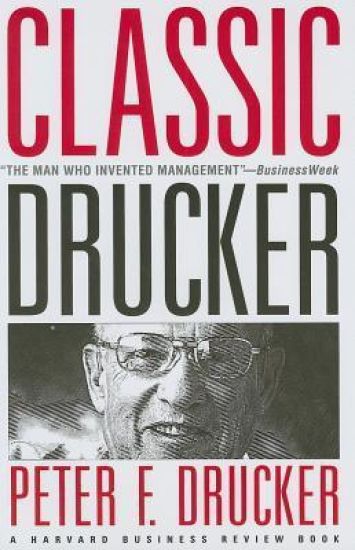
Classic Drucker

Classic Drucker

Peter F. Drucker

Harvard Business Review Press
2006
sidottu
For nearly half a century, Peter Drucker inspired and educated managers--and powerfully shaped the nature of business--with his landmark articles in Harvard Business Review. Here, framed by a thoughtful introduction from "HBR" editor Thomas A. Stewart, is a priceless collection of Drucker's most significant work. Through his unique lens, Drucker traces the evolution of the great shifts in organizations and the role of managers in the ongoing effort to balance change with continuity. He paints a clear, comprehensive picture of management thinking and practice--as it was and as it will be. Revealing a celebrated thinker at his best, Classic Drucker offers a wealth of insights and practical guidelines for managers seeking to address today's thorniest organizational challenges.For example, you'll find selections on how to enhance your company's innovative prowess, make effective decisions, raise knowledge workers' productivity, remain engaged and productive during a long work life, know when the assumptions on which your business was founded must change, and get the data you need to execute your company's competitive strategy. Doing what's right for your company will always be challenging. But thanks to the clear focus, broad vision, and practical wisdom of Peter Drucker, the task is now a little less daunting.
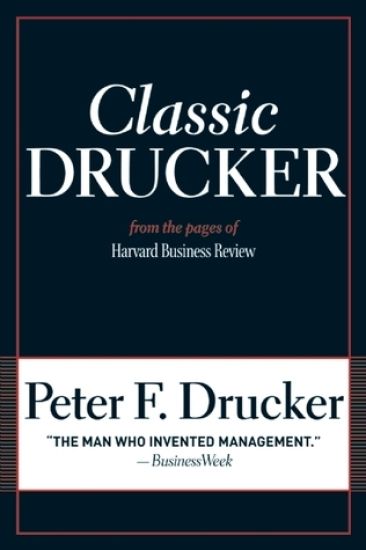
Classic Drucker

Classic Drucker

Peter F. Drucker

Harvard Business Review Press
2008
pokkari
For nearly half a century, Peter Drucker inspired and educated managers--and powerfully shaped the nature of business--with his landmark articles in Harvard Business Review. Here, framed by a thoughtful introduction from "HBR" editor Thomas A. Stewart, is a priceless collection of Drucker's most significant work. Through his unique lens, Drucker traces the evolution of the great shifts in organizations and the role of managers in the ongoing effort to balance change with continuity. He paints a clear, comprehensive picture of management thinking and practice--as it was and as it will be. Revealing a celebrated thinker at his best, Classic Drucker offers a wealth of insights and practical guidelines for managers seeking to address today's thorniest organizational challenges.For example, you'll find selections on how to enhance your company's innovative prowess, make effective decisions, raise knowledge workers' productivity, remain engaged and productive during a long work life, know when the assumptions on which your business was founded must change, and get the data you need to execute your company's competitive strategy. Doing what's right for your company will always be challenging. But thanks to the clear focus, broad vision, and practical wisdom of Peter Drucker, the task is now a little less daunting.
Management Cases, Revised Edition

Management Cases, Revised Edition

Peter F. Drucker

HarperBusiness
2009
nidottu
Longtime Drucker colleague, collaborator, and eminent management professor Joseph A. Maciariello has organised the material to be used in conjunction with "Management, Revised Edition", making the book particularly useful in undergraduate, MBA, and executive education classrooms.
The Effective Executive: The Definitive Guide to Getting the Right Things Done
A handsome, commemorative edition of Peter F. Drucker's timeless classic work on leadership and management, with a foreword by Jim Collins.What makes an effective executive?For decades, Peter F. Drucker was widely regarded as "the dean of this country's business and management philosophers" (Wall Street Journal). In this concise and brilliant work, he looks to the most influential position in management--the executive. The measure of the executive, Drucker reminds us, is the ability to "get the right things done." This usually involves doing what other people have overlooked as well as avoiding what is unproductive. Intelligence, imagination, and knowledge may all be wasted in an executive job without the acquired habits of mind that mold them into results.Drucker identifies five practices essential to business effectiveness that can--and must--be mastered: Managing time;Choosing what to contribute to the organization;Knowing where and how to mobilize strength for best effect;Setting the right priorities;Knitting all of them together with effective decision-makingRanging across the annals of business and government, Drucker demonstrates the distinctive skill of the executive and offers fresh insights into old and seemingly obvious business situations.
Managing in the Next Society

Managing in the Next Society

Peter F. Drucker

St. Martins Press-3pl
2003
nidottu
Analyzes dynamic trends in the new century's information-driven society including the "Global Baby Bust," "New Work Force," and "Knowledge Worker" to consider how managers can prepare for unexpected consequences. By the author of The Effective Executive. Reprint. 35,000 first printing.
The Five Most Important Questions You Will Ever Ask About Your Organization
With Peter Drucker's five essential questions and the help of five of today's thought leaders, this little book will challenge readers to take a close look at the very heart of their organizations and what drives them. A tool for self-assessment and transformation, answering these five questions will fundamentally change the way you work, helping you lead your organization to an exceptional level of performance. Peter Drucker's five questions are: What is our Mission? with Jim CollinsWho is our Customer? with Phil KotlerWhat does the Customer Value? with Jim KouzesWhat are our Results? with Judith RodinWhat is our Plan? with V. Kasturi Rangan These essential questions, grounded in Peter Drucker's theories of management, will take readers on a exploration of organizational and personal self-discovery, giving them a means to assess how to be--how to develop quality, character, mind-set, values and courage. The questions lead to action. By asking these questions, readers can focus on why they are doing what they are doing in their work, and how to do it better. Designed for today's busy professionals, this brief, clear and accessible book will challenge readers to ask these provocative questions and it will stimulate spirited discussions and action within any organization, inspiring positive change and new levels of excellence, helping all to envision the future of theirs' or any organization.
The Five Most Important Questions Self Assessment Tool
This transformational tool offers leaders a critical resource for better understanding their organizations and themselves, honing their skills to become accomplished long-range planners and strategic thinkers. By working through the Participant Workbook, leaders will gain the insight needed to plan for results, learn from customers and clients, and ascertain how to achieve extraordinary levels of performance. The Participant Workbook draws on Peter F. Drucker's The Five Most Important Questions and is grounded in his management philosophies that address the critical aspects that make organizations viable and valuable entities. When leaders answer these questions thoughtfully and address them with purpose, these questions take one down a path to organizational transformation and enlightenment. By leveraging these essential questions, the Participant Workbook challenges leaders to take a close look at the very heart of their organization and what drives it, giving them a means to assess: how to be and how to develop quality, character, mind-set, values, and courage. Drucker's The Five Most Important Questions lead to spirited discussions and action, inspiring positive change and renewed focus. Designed for today's busy professionals, this concise, clear, and accessible workbook for social sector, nonprofit, and socially minded business and government leaders can be used as preparation for a workshop, organizational self-assessment, or as a stand-alone leadership development tool for individuals looking to develop themselves and their organizations. Praise for the Participant Workbook Self-Assessment Tool "Time and again Drucker's The Five Most Important Questions have proven to be the most effective way for nonprofit organizations to conduct self-assessment and develop plans that will help them achieve real and lasting results."—Cathey Brown, founder and CEO, Rainbow Days, Inc., and 2001 Frances Hesselbein Community Innovation Fellow "The Five Most Important Questions Self-Assessment Tool is a gift to the social leadership sector from the late management guru, Peter Drucker, and the Leader to Leader Institute. It makes incredible sense, it is easy to use, and lays the foundation for strategic planning."—Irv Katz, president and CEO, National Human Services Assembly "A must-read for social entrepreneurs who are seeking to dramatically grow their organization's impact without losing sight of the heart of their mission."—Iris Y. Chen, president and CEO, "I Have A Dream" Foundation "High-performing organizations and individuals know that self-assessment through Drucker's The Five Most Important Questions is the starting point for defining today and making tomorrow."—Lee H. Igel, assistant professor, New York University, and president, Peter F. Drucker Society of New York City "This nuts-and-bolts guide has become my compass for urging leaders and managers to ask the right questions, to look beyond what they thought they knew, and to focus on being relevant tomorrow rather than resting on yesterday's achievements."—Lieutenant Commander Carla J. Grantham [U.S. Coast Guard, Retired], Congressional Liaison for Diversity Recruitment and Talent Management, U.S. Coast Guard
Adventures of a Bystander

Adventures of a Bystander

Peter F. Drucker

John Wiley Sons Inc
1998
sidottu
"It is [a] belief in diversity and pluralism and the uniqueness of each person that underlies all my writings . . . " —from the Preface. Regarded as the most influential and widely read thinker on modern organizations and their management, Peter Drucker has also established himself as an unorthodox and independent analyst of politics, the economy, and society. A man of impressive scope and expertise, he has paved significant inroads in a number of key areas, sharing his knowledge and keen insight on everything from the plight of the employee and the effects of technology to the vicissitudes of the markets and the future of the new world order. Adventures of a Bystander is Drucker's rich collection of autobiographical stories and vignettes, in which this legendary figure paints a portrait of his remarkable life, and of the larger historical realities of his time. In a style that is both unique and engaging, Drucker conveys his life story —from his early teen years in Vienna through the interwar years in Europe, the New Deal era, World War II, and the postwar period in America—through intimate profiles of a host of fascinating people he's known through the years. Their personal histories are, as Drucker tells us, the beads for which his own life serves as the string. A colorful group, these diverse, often unpredictable, always multidimensional individuals were chosen "because each of them, in his or her own highly personal way, reflects and refracts the thirty crucial years from the end of World War I to the first post-World War II decade—the thirty years that largely formed the world in which we now live." An amazing pageant of characters, both famous and otherwise, springs from these pages, illuminating and defining one of the most tumultuous periods in world history. Along with bankers and courtesans, artists, aristocrats, prophets, and empire-builders, we meet members of Drucker's own family and close circle of friends, among them such prominent figures as Sigmund Freud, Henry Luce, Alfred Sloan, John Lewis, and Buckminster Fuller. Playing to perfection their roles as those who "reflect and refract" the customs, beliefs, and attitudes of the times, these singular personalities lend Adventures of a Bystander a striking "you-are-there" feel. A brief encounter with Freud becomes the catalyst for an absorbing, multidimensional description of the economics, politics, and social psychology of pre-World War II Europe. Drucker introduces us to Fritz Kraemer, a brilliant, monocle-wearing eccentric who became an influential mentor to the young Henry Kissinger. His personal memoir of Henry Luce documents the development of modern journalism, while in "The Indian Summer of Innocence," he rescues and preserves the very heart of the American experience during the last New Deal years before World War II. Shedding light on a turbulent and important era, Adventures of a Bystander also reflects Peter Drucker himself as a man of imaginative sympathy and enormous interest in people, ideas, and history. These enthralling stories complement and complete the groundbreaking analytical writing for which he is so revered. Luminous autobiographical stories by one of the greatest thinkers of our time "The cast of characters among whom Drucker moves is superbly rich, and the informed glimpse he provides of a vanished social and political universe is an education in itself. Adventures of a Bystander is better than a novel, more lively than an essay, and as thoughtful as both at their best." —The Harvard Business Review. "Adventures of a Bystander is a virtuoso performance in which Drucker displays a dazzling diversity of personal interests and knowledge, an awesome power of recall, and a crisp, highly readable writing style." —BusinessWeek. "Adventures of a Bystander appears in a stroke to have restored the art of the memoir and of the essay. It will doubtless be a while before its like comes round again." —The Washington Post.
A Functioning Society

A Functioning Society

Peter F. Drucker

Transaction Publishers
2002
sidottu
Peter F. Drucker may be best known as a writer on business and management, but these subjects were not his foremost intellectual concern. Drucker's primary concerns were community, in which the individual has status, and society, in which the individual has function. Here he has assembled selections from his vast writings on these subjects. This collection presents the full range of Drucker's thought on community, society, and political structure and constitutes an ideal introduction to his ideas.The volume is divided into seven parts. The selections in parts 1 and 2 were mostly written during World War Two and in the wake of the Great Depression. Part 3 deals with the limits of governmental competence in the social and economic realm. It contains some of Drucker's most influential writings concerned with the difference between big government and effective government. The chapters in part 4 explore autonomous centers of power outside government and within society. Part 5 contains chapters from Drucker's path-breaking work on the corporation as a social organization rather than merely an economic one. The rise of the so-called "knowledge industries" forms the background for part 6. The concluding part 7 is devoted entirely to Drucker's long essay "The Next Society." Drucker examines the emergence of new institutions and new theories arising from the information revolution and the social changes they are helping to bring about.In organizing these representative writings, Drucker chose to be topical rather than chronological, with each excerpt presenting a basic theme of his life's work. As is characteristic of his efforts, A Functioning Society appeals both the general reader as well as a cross-disciplinary scholarly readership.
The Philosophy of Giambattista Vico

The Philosophy of Giambattista Vico

Peter F. Drucker

Transaction Publishers
2001
nidottu
With a new introduction by Alan Sica.Giambattista Vico (1668-1744) is often regarded as the beleaguered, neglected genius of pre-Enlightenment Naples. His work-though known to Herder, Coleridge, Matthew Arnold, and Michelet-widely and deeply appreciated only during the twentieth century. Although Vico may be best known for the use James Joyce made of his theories in Finnegans Wake, Croce's insightful analysis of Vico's ideas played a large role in alerting readers to his unique voice. Croce's volume preceded Joyce's creation of "Mr. John Baptister Vickar" by a quarter century.During the last 25 years Vico's ideas about history, language, anti-Cartesian epistemology, and rhetoric have begun to receive the recognition their admirers have long claimed they deserve. Increasing numbers of publications appear annually which bear the stamp of Vico's thinking. Even if he is not yet so renowned as some of his contemporaries, such as Locke, Voltaire, or Montesquieu, there are good reasons to believe that in the future he will be equally honored as a cultural theorist. As a theorist of historical process and its language, there is no more innovative voice than his until the twentieth century-which explains in part why such figures as Joyce and R.G. Collingwood freely drew on Vico's work, particularly his New Science, while creating their own. If Vico was Naples' most brilliant, if uncelebrated, citizen prior to the Enlightenment taking hold in Southern Italy, then Croce (1866-1952) is surely the city's most important thinker of modern times, and the single indispensable Italian philosopher since Vico's death. When a genius of Croce's interpretative prowess, evaluates the work of another, it is inevitable that an explosive mixture will result.A great virtue of this book is its fusion of Croce's unique brand of idealism and aesthetic philosophy with Vico's epistemological, ethical, and historical theories. If Vico's theory of cyclical changes in history, the corsi e ricorsi, remains fruitful, it might be argued that Croce's evaluation of his countryman' ideas represented the next turn of the philosophical wheel toward enlightenment.
Meeting the Collaboration Challenge Workbook

Meeting the Collaboration Challenge Workbook

Peter F. Drucker

Jossey-Bass Inc.,U.S.
2002
nidottu
In his award-winning book The Collaboration Challenge, James E. Austin demonstrated how nonprofits and businesses can succeed through strategic alliances. Now, in Meeting the Collaboration Challenge, the Drucker Foundation provides specific guidance to help nonprofits of every size put collaboration into practice. This workbook, its companion videotape, and The Collaboration Challenge help your nonprofit organization further its mission through strategic alliances with businesses.
Meeting the Collaboration Challenge Workbook

Meeting the Collaboration Challenge Workbook

Peter F. Drucker

Jossey-Bass Inc.,U.S.
2002
nidottu
In his award-winning book The Collaboration Challenge, James E. Austin demonstrated how nonprofits and businesses can succeed through strategic alliances. Now, in Meeting the Collaboration Challenge, the Drucker Foundation provides specific guidance to help nonprofits of every size put collaboration into practice. This workbook, its companion videotape, and The Collaboration Challenge help your nonprofit organization further its mission through strategic alliances with businesses.
Management: Tasks, Responsibilities, Practices

Management: Tasks, Responsibilities, Practices

Peter F. Drucker

HARPER BUSINESS
1993
nidottu
Management is an organized body of knowledge. "This book," in Peter Drucker'swords, "tries to equip the manager with the understanding, the thinking, the knowledge and the skills for today'sand also tomorrow's jobs." This management classic has been developed and tested during more than thirty years of teaching management in universities, in executive programs and seminars and through the author's close work with managers as a consultant for large and small businesses, government agencies, hospitals and schools. Drucker discusses the tools and techniques of successful management practice that have been proven effective, and he makes them meaningful and easily accessible.