This long-awaited resource is the first to focus specifically on orienting and guiding trainees in the field of behavior analysis through the practicum and supervised experience. Clear and succinct, it provides comprehensive information on the competencies as required by the Fifth Edition the BACB® Task List. Going beyond the basic nuts and bolts of skill and knowledge requirements, the text prepares students for the day-to-day realities of the supervised practicum experience. It describes the process of locating a site, finding and working with supervisors and peers, and adhering to professional and ethical guidelines. Including seasoned advice on concluding the practicum, getting ready for the board exam, and developing a professional portfolio, this unique resource prepares behavior analyst trainees for employment and beyond. Real-life examples and case scenarios help students gain an in-depth understanding of requisite competencies. Abundant performance monitoring checklists and sample forms—conveniently downloadable—further reinforce knowledge. This book is also a useful resource for practicing behavior analysts guiding trainees under their supervision. Key Features: Delivers concise, structured guidance for students in behavior analysis training programs Provides practical tips on giving and receiving feedback as well as time management and communication skills Focuses on the development of competencies and encompasses the BACB® Task List Covers the full range of practicum experience, from orientation to skill development to post-certification employment Includes abundant checklists and forms, available for download Illustrated with practical examples and case scenarios Includes free ebook with purchase of print book

The ultimate comprehensive and competency-based approach to effective supervision of behavior analysts Now in its second edition, this comprehensive guide offers a road map for both the supervisor and supervisee, presenting step-by-step guidance, practical activities, and case scenarios to foster growth and success in the supervisory relationship. Drawing from extensive research and over 35 years of combined experience, the authors provide practical tools and insights to navigate the complexities of supervision in behavior analysis. From establishing a competency-based framework to fostering cultural responsiveness and ethical conduct, this revised edition equips supervisors and supervisees with the resources needed to excel in their roles. Chapters align to the Board Certified Behavior Analyst Test Content Outline (6th ed.), with the second half of the book focusing on competencies developed by the authors. Within each competency are practical activities exploring different skill levels, allowing for individualized growth strategies. With a focus on enabling supervisees to take ownership of their personal growth and development, this book equips both parties with the tools needed to excel in their roles. Purchase includes online access via most mobile devices or computers. New to the Second Edition: Expanded content on how to foster and strengthen the supervisor-supervisee relationship. Integrated essential topics such as compassionate care and trauma-informed practice. Updated content throughout to reflect changes in supervision research and growth of the literature. Incorporated cultural responsiveness and ethical conduct into all competency areas. Key Features: Step-by-step guides for running supervision meetings streamline the process for supervisors and empower supervisees to take control of their own development. Emphasis on the supervisee’s experience enhances outcomes by addressing the interdependent nature of the supervisor-supervisee relationship. Practical activities, case scenarios, and meeting templates provide tangible resources for supervisors to tailor supervision to individual needs. Competencies are broken down into different skill levels, allowing for targeted development and increased individualization. Written by seasoned professionals with over three decades of supervisory experience in different contexts, offering unparalleled expertise and perspective.
The European Molecular Biology Open Software Suite (EMBOSS) is a high quality, well documented package of open source software tools for molecular biology. EMBOSS includes extensive and extensible C programming libraries, providing a powerful and robust toolkit for developing new bioinformatics tools from scratch. The EMBOSS Developer's Guide is the official and definitive guide to developing software under EMBOSS. It includes comprehensive reference information and guidelines, including step-by-step instructions and real-world code examples: • Learn how to write fully-featured tools guided by the people who developed EMBOSS • Step-by-step guide to writing EMBOSS applications, illustrated with functional, deployed code • ACD file development - learn how to customise existing tools without coding, or design and write entirely new application interfaces • EMBOSS API programming guidelines - quickly master application development • Wrapping and porting applications under EMBOSS - learn how to incorporate third-party tools
The European Molecular Biology Open Software Suite (EMBOSS) is a high quality package of open source software tools for molecular biology. It includes over 200 applications integrated with a range of popular third party software packages under a consistent and powerful command line interface. The tools are available from a wide range of graphical interfaces, including easy to use web interfaces and powerful workflow software. The EMBOSS Administrator's Guide is the official, definitive and comprehensive guide to EMBOSS installation and maintenance: • Find all the information needed to configure, install and maintain EMBOSS, including recent additions for version 6.2 • Step-by-step instructions with real-world examples - saves readers time and helps them avoid the pitfalls on all the common platforms • In-depth reference to database configuration - learn how to set up and use databases under EMBOSS • Includes EMBOSS Frequently Asked Questions (FAQ) with answers - quickly find solutions to common problems
The adventures of Pete Johnson returns in this brand new book, that is packed with more amazing and mysterious tales In each of these stories, Pete Johnson encounters things that are beyond a normal explanation. Things that are just plain weird.You are sure to be entertained by stories such as: The Old Staton House, The Johnson Family Cemetery, Peyton's Ghost and many others Turn on the lights, sit back, and get ready to take a frightening journey with Pete, his friends, and family.
"This work makes a solid contribution to our understanding of a poorly known era in cenral lowland Maya prehistory.... It also provides stratigraphic evidence for phasing the subdivisions of the Postclassic era, offering important support for a detailed chronology of this era in the central lowlands--an unresolved and disputed issue until now." -- Robert J. Sharer, University of Pennsylvania "Rice has written the best and most comprehensive study of Postclassic pottery from the southern Maya lowlands. We have precious few windows into the panorama of late Maya history in the Peten, and the ceramics, although they can never tell us all we wish to know, give us some of the most detailed information we are ever likely to have on the centuries after the southern Maya collapse" -- E. Wyllys Andrews V, Tulane University In reconsidering the transition from the Classic to the Postclassic period of Maya civilization in the Department of Peten, Guatemala, Prudence Rice challenges traditional concepts of demographic collapse in the southern lowlands. Using painstaking reconstructions of research by William Bullard and her own work, Rice argues that the rural outpost of Macanache Island in Peten continued to support a population during and long after the Classic Maya collapse, and she uses stratigraphic and ceramic evidence to illuminate the transition. Rice places the rural outpost of Macanche Island within the larger geographical context of the Yucatan peninsula during the Postclassic period. She weaves together analyses of the artifacts, largely ceramics, of Bullard's 1968 excavation with the artifacts found in later excavations focused on the Peten lake basins. Typological descriptions of the pottery are supplemented by analyses of function, slip, and paste and by discussions of locally manufactured and imported material. This important book on a little-known era and site of Maya culture enables us to reconstruct and understand the role of rural outposts of a powerful civilization during a time of economic and political chaos. It greatly advances our understanding of the minutiae of change as well as the larger patten that they form. Prudence M. Rice is Associate Vice Chancellor for Research at Southern Illinois University
How many big businesses have pioneered the technologies and business models that now dominate e-commerce, personal computing, biotechnology, and wireless telecommunication? The answer: hardly any. The problem is not that executives fail to recognize the need to infuse their organizations with the kind of model-busting innovative capabilities of agile startups. It's a lack of understanding of what to do and how to do it. But now, this groundbreaking book reveals the patterns through which game-changing innovation occurs in large, established companies, and identifies the new managerial competencies firms need to make radical innovation happen. The authors define a radical innovation project as one that delivers a product, process, or service with either unprecedented performance features, or with familiar features that will enable market transformation through significant performance improvements or cost reductions. These projects are nurtured within the established organization, not skunkworks. They are not concerned with exploiting current lines of business, but with exploring entirely new ones. Based on evidence from a five-year, real time study of twelve radical innovation projects within ten major corporations--including General Electric, IBM, Nortel Networks, DuPont, and Texas Instruments--this book addresses seven managerial challenges large companies face in creating and sustaining radical innovation: dealing with radical ideas in the 'fuzzy front end'; developing new models for project management; learning about unfamiliar markets; working through uncertainty in the business model; bridging resource and competency gaps; managing the transition from radical project to operating status; and, engaging individual initiative. The authors, experts in a variety of areas such as entrepreneurship, R&D management, product design, marketing, organizational behavior, and operations and project management, distill a comprehensive, interdisciplinary approach to mastering each of these challenges, from the conceptualization of viable ideas to the commercialization of radical innovations. Designed to push the envelope of thinking about the most significant challenge facing large companies today, this important book offers a revolutionary new paradigm for long-term corporate success.
Saint Peter was a crucial figure in early Christianity; as one of the Twelve Apostles of Jesus Christ, he oversaw the formal establishment of the early church and became the first Bishop of Rome. Peter's formative years were spent as a fisherman. It was here that the purpose of his disciple status was unveiled: Peter was to become a 'fisher of men'; helping others believe in the Lord. These and other events are told in this biography, which investigates the ways in which Peter sought to enlighten and catch souls of men, that they be set on a righteous path to God and the Holy Spirit. Peter's humble beginnings soon transform through his pursuit of God; he accompanies Jesus as one of his twelve apostles, and is listed foremost among them in all sources. His spiritual guidance and devotion to the mission of Christ has great bearing on the foundation of the Christian church; Peter also witnessed the Resurrection of Jesus first-hand, and delivered some of the first sermons following this revelatory event.
This book critically examines all the early and important Petrine pseudepigrapha to identify a distinctive Petrine theology which, it is believed, was later swamped by the tide of western orthodoxy. Despite the diversity of the books and tractates, ranging from Jewish-Christian writings to avowedly Gnostic works, a remarkably consistent Petrine tradition does emerge; and Peter is shown essentially to be neither the impetuous, undiscerning, and even vacillating figure portrayed in the Gospels and Acts, nor the magisterial and pontifical figure of later Church tradition, but a visionary who was concerned above all to hold together both the moral and cognitive aspects of the Faith.
Peter Llewelyn Davies was just an infant in his pram when he served as the inspiration for J.M. Barrie's most famous creation, Peter Pan. With the story proving to be a smash hit, a reluctant Peter was thrust into the spotlight. But then one day, Peter did the unthinkable: He grew up. Based on a true story, Peter presents another side to one of the world's most beloved tales. As Peter enters adulthood, he struggles to separate himself from what he calls "that terrible masterpiece" and begins to spiral into a deep depression. Will he succeed in overcoming the demons of his past, or do happy endings only exist in fairy stories?
Peter is disturbed, and unfortunately for those around him, very strong. Everything in his life seems to work against him and it is causes him to lose what little control he has. When the moon is full, he believes he is all powerful. The people around him would be well advised to rethink how they interact with him, but do not to take heed. Peter is a volcano ready to erupt, and when he finally does, people die. He doesn't think any of the things he does are his fault, they are forcing his hand after all. When he begins to doubt his own mental stability things really get bad. His actions set of a series of events that bring misery and hatred to the surface in others. Alice knows Peter. He brings out the worst in her, and revenge is what she seeks. Those caught in the middle will try to survive the hidden battle that rages.
Perkins describes the search for the historical Peter, and the influence his image has had, in Roman Catholic and Protestant ecumenical discussions. Pointing to portrayals of Peter in the Pauline and Johannine traditions, the synoptic Gospels, and the Book of Acts, Perkins argues that precisely because there is no single Petrine tradition in the New Testament, the apostle might serve as a unifying figure for incongruous forms of Christianity. Perkins argues that Peter should be viewed as a harmonizing figure who captures the Christian imagination not only because he is the most prominent of Jesus' disciples, but also because his weaknesses and strengths present a character accessible to the average Christian.
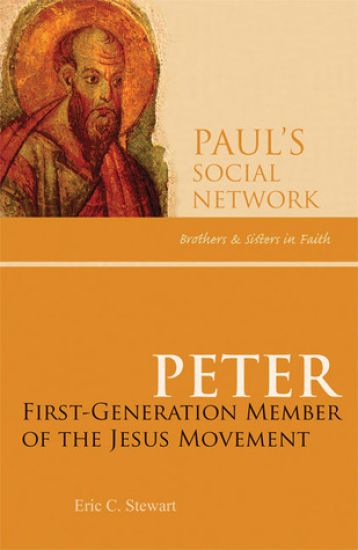
Unlike other New Testament persons described in the Paul's Social Network Series, Peter was a member of Jesus' inner circle during his life and ministry in Galilee. In Peter, Eric Stewart explores the depictions of Peter that appear throughout the New Testament for insights into who he was. Readers will learn what it means that Peter was a villager and a fisherman, a holy person, an authorized change agent, a moral entrepreneur, a healer, a speaker, and a writer. In the end, they will understand Peter's message, and the message of his Master, far more deeply.
Simon Peter was a follower like us--he wanted to be like Jesus, but he struggled with doubts and fears. At times he failed miserably. At other times he was used powerfully by God. This twelve-session LifeGuide(R) Bible Study on the great apostle's life challenges and motivates us to continue to grow in Christlikeness.For over three decades LifeGuide Bible Studies have provided solid biblical content and raised thought-provoking questions--making for a one-of-a-kind Bible study experience for individuals and groups. This series has more than 130 titles on Old and New Testament books, character studies, and topical studies.
"Peter, By F. Hopkinson Smith: A Novel Of Which He Is Not The Hero" offers a captivating character study set in the early 20th century. Though centered on a bank teller, this is no ordinary tale of finance. Smith's novel explores the nuances of social interactions with a generous dose of humor. This meticulously prepared edition brings a classic work of fiction to a new audience. Delve into a world where everyday lives are rendered with warmth and wit. Smith's storytelling provides a timeless glimpse into human nature, showcasing the enduring appeal of observant and humorous literary fiction. A delightful read for those who appreciate classic stories and finely drawn characters.This work has been selected by scholars as being culturally important, and is part of the knowledge base of civilization as we know it.This work is in the public domain in the United States of America, and possibly other nations. Within the United States, you may freely copy and distribute this work, as no entity (individual or corporate) has a copyright on the body of the work.Scholars believe, and we concur, that this work is important enough to be preserved, reproduced, and made generally available to the public. We appreciate your support of the preservation process, and thank you for being an important part of keeping this knowledge alive and relevant.