Kirjojen hintavertailu. Mukana 11 627 616 kirjaa ja 12 kauppaa.

Kirjahaku

Etsi kirjoja tekijän nimen, kirjan nimen tai ISBN:n perusteella.

1000 tulosta hakusanalla Philip E. Auerswald

Intelligence and Cultural Environment (Psychology Revivals)
Originally published in 1969, Intelligence and Cultural Environment looks at the concept of intelligence and the factors influencing the mental development of children, including health and nutrition, as well as child-rearing practices. It goes on to discuss the application of intelligence tests in non-Western countries and includes both British and cross-cultural studies to illustrate this. Inevitably a product of the time in which it was written, this book nonetheless makes a valuable contribution to intelligence theory as we know it today.
Personality Assessment (Psychology Revivals)
Originally published in 1964, the aim of this book was to analyse the psychological processes involved in understanding personality, and to consider how the psychologist could help in making more accurate assessments.Professor Vernon discusses in detail the scientific status of psychoanalytic and other ‘depth’ theories of motivation, the value of different types of psychotherapeutic treatment and counselling, the influence of upbringing on the development of personality, and the effectiveness of projective techniques. He also examines the reasons for the highly variable results obtained with personality tests and questionnaires.As well as providing a balanced review of theories of personality and of various types of test, this work made a fresh contribution to developing improved techniques of assessment.
Personality Assessment (Psychology Revivals)
Originally published in 1964, the aim of this book was to analyse the psychological processes involved in understanding personality, and to consider how the psychologist could help in making more accurate assessments.Professor Vernon discusses in detail the scientific status of psychoanalytic and other ‘depth’ theories of motivation, the value of different types of psychotherapeutic treatment and counselling, the influence of upbringing on the development of personality, and the effectiveness of projective techniques. He also examines the reasons for the highly variable results obtained with personality tests and questionnaires.As well as providing a balanced review of theories of personality and of various types of test, this work made a fresh contribution to developing improved techniques of assessment.
Personality Tests and Assessments (Psychology Revivals)
Originally published in 1953 this book provided the first comprehensive account of methods of personality assessment by a British author. It starts with a short survey of personality theory, pointing out the difficulties in any method of testing or assessment. Next it describes the weaknesses of the common interview method. (Throughout the emphasis is on methods which are usable in educational or vocational guidance and selection, not on methods which are mainly of scientific interest.) Thereafter it takes up each main type of technique – tests based on physique or psychological measures, on expressive movement such as gestures and handwriting, tests of behaviour (including War Office Selection Board ‘house party’ methods), ratings and rating scales, questionnaires, and so-called projective techniques. The evidence for or against each test or method is surveyed and numerous references provided for relevant literature. Illustrative excerpts are given of many of the more promising tests, and some pictorial illustrations. British work in this field at the time is covered completely, and an attempt is made to provide a fair summary of the main contributions of American and other psychologists of the day.
Personality Tests and Assessments (Psychology Revivals)
Originally published in 1953 this book provided the first comprehensive account of methods of personality assessment by a British author. It starts with a short survey of personality theory, pointing out the difficulties in any method of testing or assessment. Next it describes the weaknesses of the common interview method. (Throughout the emphasis is on methods which are usable in educational or vocational guidance and selection, not on methods which are mainly of scientific interest.) Thereafter it takes up each main type of technique – tests based on physique or psychological measures, on expressive movement such as gestures and handwriting, tests of behaviour (including War Office Selection Board ‘house party’ methods), ratings and rating scales, questionnaires, and so-called projective techniques. The evidence for or against each test or method is surveyed and numerous references provided for relevant literature. Illustrative excerpts are given of many of the more promising tests, and some pictorial illustrations. British work in this field at the time is covered completely, and an attempt is made to provide a fair summary of the main contributions of American and other psychologists of the day.
The Structure of Human Abilities (Psychology Revivals)
First published in 1950, this revised edition of The Structure of Human Abilities was published in 1961, but remained largely unchanged from the original save for an additional supplement on the developments in factorial work on human abilities from 1950-1959.Much research had been carried out during the years leading up to publication, in England and America, into mental abilities; and modern methods of statistical treatment, especially factor analysis, had been increasingly used.It was felt that the mass of diverse material was apt to confuse the student of psychology of the time, especially as the results of such research were often apparently conflicting. Professor Vernon, one of the leading experts in this branch of psychology, sifted the material and attempted to provide a consistent picture of our mental structure.
The Structure of Human Abilities (Psychology Revivals)
First published in 1950, this revised edition of The Structure of Human Abilities was published in 1961, but remained largely unchanged from the original save for an additional supplement on the developments in factorial work on human abilities from 1950-1959.Much research had been carried out during the years leading up to publication, in England and America, into mental abilities; and modern methods of statistical treatment, especially factor analysis, had been increasingly used.It was felt that the mass of diverse material was apt to confuse the student of psychology of the time, especially as the results of such research were often apparently conflicting. Professor Vernon, one of the leading experts in this branch of psychology, sifted the material and attempted to provide a consistent picture of our mental structure.
The Psychology and Education of Gifted Children (Psychology Revivals)

The Psychology and Education of Gifted Children (Psychology Revivals)

Philip E. Vernon; Georgina Adamson; Dorothy F. Vernon

Routledge
2013
sidottu
Originally published in 1977, this book looks at the problem of educating highly intelligent and gifted children, which it felt was of paramount importance to modern society. In the 1970s education increasingly focused on average pupils, and often made excellent provision for handicapped children, the authors felt it all the more important for teachers, parents and educationalists generally to be made aware of the special needs of the bright and talented, and how they could best be catered for. In this book Professor Vernon and his two co-authors discuss the provision of special facilities for the education of these children at the time, particularly with reference to the UK and Canada. The serious losses to society when the gifted and specially talented are ignored or repressed are pointed out and the merits and difficulties of alternative schemes are underlined. Detailed consideration is given to the psychological origins and nature of intelligence (both genetic and environmental) and of creativity and special talents (artistic and scientific), and also to available tests and other techniques for identifying exceptionally able children. The book was particularly intended to help teachers and educational administrators of the time, together with the parents of very bright children.
The Psychology and Education of Gifted Children (Psychology Revivals)

The Psychology and Education of Gifted Children (Psychology Revivals)

Philip E. Vernon; Georgina Adamson; Dorothy F. Vernon

Routledge
2015
nidottu
Originally published in 1977, this book looks at the problem of educating highly intelligent and gifted children, which it felt was of paramount importance to modern society. In the 1970s education increasingly focused on average pupils, and often made excellent provision for handicapped children, the authors felt it all the more important for teachers, parents and educationalists generally to be made aware of the special needs of the bright and talented, and how they could best be catered for. In this book Professor Vernon and his two co-authors discuss the provision of special facilities for the education of these children at the time, particularly with reference to the UK and Canada. The serious losses to society when the gifted and specially talented are ignored or repressed are pointed out and the merits and difficulties of alternative schemes are underlined. Detailed consideration is given to the psychological origins and nature of intelligence (both genetic and environmental) and of creativity and special talents (artistic and scientific), and also to available tests and other techniques for identifying exceptionally able children. The book was particularly intended to help teachers and educational administrators of the time, together with the parents of very bright children.
The Social Construction of the Ocean

The Social Construction of the Ocean

Philip E. Steinberg

Cambridge University Press
2001
pokkari
Steinberg presents a history of the uses, regulations and representation of the world-ocean, from approximately 1450 through the present. This history is told through a ‘territorial political economy’ lens, borrowing from world-systems theory, economic-geographic studies of the spatiality of capitalism, political-geographic work on the history of territoriality, and post-structural work on social conflict in the production of space. Just as the modern era has been characterized by a conflicting set of dynamic and contested spatiality on land, so has it been characterized by a conflicting set of spatial functions at sea. Evidence is marshaled from legal texts, literary and artistic creations, cartographic representations, advertisements, commercial and military history, and policy debates. The book concludes by considering how lessons learned from the history of the ocean may be applied to emerging spaces, such as cyberspace, where there is a similarly problematic ‘fit’ between social processes and the institutions of state governance.
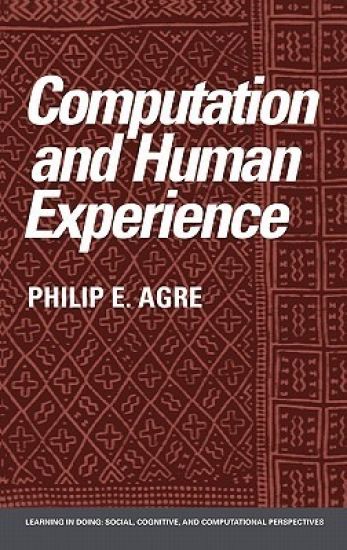
Computation and Human Experience

Computation and Human Experience

Philip E. Agre

Cambridge University Press
1997
sidottu
This book offers a critical reconstruction of the fundamental ideas and methods of artificial intelligence research. Through close attention to the metaphors of artificial intelligence and their consequences for the field’s patterns of success and failure, it argues for a reorientation of the field away from thought in the head and towards activity in the world. By considering computational ideas in a large, philosophical framework, the author eases critical dialogue between technology and the social sciences. AI can benefit from an understanding of the field in relation to human nature, and in return, it offers a powerful mode of investigation into the practicalities of physical realization.
Principles of Linear Systems

Principles of Linear Systems

Philip E. Sarachik

Cambridge University Press
1997
sidottu
State-space methods form the basis of modern control theory. This graduate text is devoted to a description of these methods in the analysis of linear multi-input, multi-output dynamic systems. Following a chapter which sets out the basic concepts and definitions, state equations of finite dimensional systems, and their solution, are discussed in detail. The principles of time-domain and frequency-domain analysis are then presented, as are the properties and applications of the Z-transformation. Separate chapters deal with the controllability, observability, and stability of linear systems. A useful tutorial review of the key results from matrix theory and linear algebra is given in the appendix. The book includes several worked examples, and there are problems at the end of each chapter. It will be of great use to advanced undergraduate and graduate students of electrical or mechanical engineering taking courses in linear systems or control systems.
Principles of Linear Systems

Principles of Linear Systems

Philip E. Sarachik

Cambridge University Press
1997
pokkari
State-space methods form the basis of modern control theory. This graduate text is devoted to a description of these methods in the analysis of linear multi-input, multi-output dynamic systems. Following a chapter which sets out the basic concepts and definitions, state equations of finite dimensional systems, and their solution, are discussed in detail. The principles of time-domain and frequency-domain analysis are then presented, as are the properties and applications of the Z-transformation. Separate chapters deal with the controllability, observability, and stability of linear systems. A useful tutorial review of the key results from matrix theory and linear algebra is given in the appendix. The book includes several worked examples, and there are problems at the end of each chapter. It will be of great use to advanced undergraduate and graduate students of electrical or mechanical engineering taking courses in linear systems or control systems.
The Social Construction of the Ocean

The Social Construction of the Ocean

Philip E. Steinberg

Cambridge University Press
2001
sidottu
This 2001 book presents a history of the uses, regulations and representation of the world-ocean, from approximately 1450 through the present. This history is told through a 'territorial political economy' lens, borrowing from world-systems theory, economic-geographic studies of the spatiality of capitalism, political-geographic work on the history of territoriality, and post-structural work on social conflict in the production of space. Just as the modern era has been characterized by a conflicting set of dynamic and contested spatiality on land, so has it been characterized by a conflicting set of spatial functions at sea. Evidence is marshaled from legal texts, literary and artistic creations, cartographic representations, advertisements, commercial and military history, and policy debates. The book concludes by considering how lessons learned from the history of the ocean may be applied to emerging spaces, such as cyberspace, where there is a similarly problematic 'fit' between social processes and the institutions of state governance.
Political Representation in France

Political Representation in France

Philip E Converse; Roy Pierce

Harvard University Press
1986
sidottu
There can scarcely be a greater tribute to the vitality of the Fifth Republic's democracy than this monumental work. A searching analysis of how the will of the voters is translated into authoritative political decision making, this book not only uncovers political truths about contemporary France but also provides a model for the study of other popular forms of government. The authors set out to find an answer to the perplexing question of how representative government operates in France in the seemingly unstable context of multiparties. By interviewing voters as well as legislators in 1967 and in 1968 after the great upheaval, and by monitoring policies of the National Assembly from 1967 to 1973, the authors test relationships between public opinion and decision making. They are able to sort out the abiding political cues that orient the French voter, to establish the normal electoral processes, to gauge the nature of mass perceptions of the political options available to voters, and to interpret the strikes, riots, and demonstrations of 1968 as a channel of communication parallel to the electoral process itself. Lucid in style, methodologically sophisticated, and often comparative in approach, "Political Representation in France" is a seminal work for political scientists, sociologists, and historians.
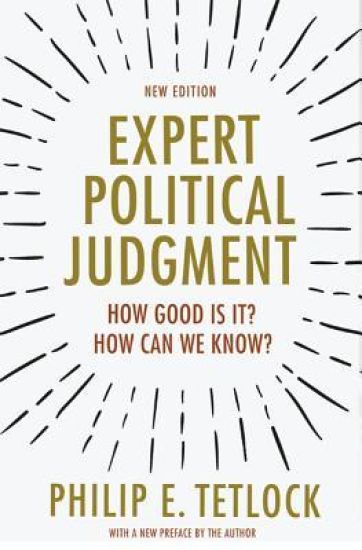
Expert Political Judgment

Expert Political Judgment

Philip E. Tetlock

Princeton University Press
2017
pokkari
Since its original publication, Expert Political Judgment by New York Times bestselling author Philip Tetlock has established itself as a contemporary classic in the literature on evaluating expert opinion. Tetlock first discusses arguments about whether the world is too complex for people to find the tools to understand political phenomena, let alone predict the future. He evaluates predictions from experts in different fields, comparing them to predictions by well-informed laity or those based on simple extrapolation from current trends. He goes on to analyze which styles of thinking are more successful in forecasting. Classifying thinking styles using Isaiah Berlin's prototypes of the fox and the hedgehog, Tetlock contends that the fox--the thinker who knows many little things, draws from an eclectic array of traditions, and is better able to improvise in response to changing events--is more successful in predicting the future than the hedgehog, who knows one big thing, toils devotedly within one tradition, and imposes formulaic solutions on ill-defined problems. He notes a perversely inverse relationship between the best scientific indicators of good judgement and the qualities that the media most prizes in pundits--the single-minded determination required to prevail in ideological combat. Clearly written and impeccably researched, the book fills a huge void in the literature on evaluating expert opinion. It will appeal across many academic disciplines as well as to corporations seeking to develop standards for judging expert decision-making. Now with a new preface in which Tetlock discusses the latest research in the field, the book explores what constitutes good judgment in predicting future events and looks at why experts are often wrong in their forecasts.