Kirjojen hintavertailu. Mukana 12 390 323 kirjaa ja 12 kauppaa.

Kirjahaku

Etsi kirjoja tekijän nimen, kirjan nimen tai ISBN:n perusteella.

1000 tulosta hakusanalla Pieper Josef

Leisure: The Basis of Culture

Leisure: The Basis of Culture

Josef Pieper

Ignatius Press
2009
pokkari
One of the most important philosophy titles published in the twentieth century, Josef Pieper's Leisure, the Basis of Culture is more significant, even more crucial, today than it was when it first appeared more than fifty years ago. This edition also includes his work The Philosophical Act. Leisure is an attitude of the mind and a condition of the soul that fosters a capacity to perceive the reality of the world. Pieper shows that the Greeks and medieval Europeans, understood the great value and importance of leisure. He also points out that religion can be born only in leisure -- a leisure that allows time for the contemplation of the nature of God. Leisure has been, and always will be, the first foundation of any culture. Pieper maintains that our bourgeois world of total labor has vanquished leisure, and issues a startling warning: Unless we regain the art of silence and insight, the ability for non-activity, unless we substitute true leisure for our hectic amusements, we will destroy our culture -- and ourselves.
The Christian Idea of Man

The Christian Idea of Man

Josef Pieper; Dan Farrelly; John Haldane

ST AUGUSTINE'S PRESS
2011
sidottu
In The Christian Idea of Man Josef Pieper brings off an extraordinary feat. He acknowledges that whoever introduces the theme of “virtue” and “the virtues” can expect to be met with a smile – of various shades of condescension. He then proceeds to single out “prudence” as the fundamental virtue on which the other cardinal virtues are based. In defining it, he does away with the shallow connotations which have debased it in modern times. Similarly, he manages to divest it of all traces of “moralism,” which, to a large extent has become identified with the Christian idea of virtue and has made it fall into general disrepute. For Pieper, prudence is fundamentally based on a clear perception of reality – of things as they are – and the prudent person is the one who acts in accordance with this perception. It has nothing to do with knowing how to avoid decisions which might be to one’s disadvantage. Similarly, justice, which is based on prudence, involves acting toward other persons according to one’s perception of the truth of the circumstances – again, a perception of things “as they are.” This is not a reference to any “status quo,” but to the reality as constituted by the Creator. In referring to courage [fortitude], Pieper discusses the overcoming of fear. This does not imply having no fear but, precisely, overcoming it. With regard to the fundamental fear of death, Pieper rejects the approaches which contend that there is nothing to fear in death. On the contrary, there is everything to fear in death: it concerns the question of possible absolute annihilation! Here Pieper introduces the consideration of the “theological” virtues of faith, hope, and love [charity]. When confronted with the question of possible annihilation, the Christian’s faith is paramount. Belief in God lets him confront danger and overcome even the most radical fear – through hope in God. His love of God does not wipe out fear but gives him courage. Moderation is seen as the last in the hierarchy of the cardinal virtues. Through its manifestation, in recent Christian thinking, with chastity and abstinence, it became in the Christian mind the most prominent characteristic of the Christian idea of man and one that dominated everything else. It has been reduced to the status of the most private of the virtues and is combined with a moralistic conception of the good. Pieper’s analysis of moderation shows how this virtue needs to be rethought, although, even then, it will remain the last in the hierarchy of virtues.
The Christian Idea of Man

The Christian Idea of Man

Josef Pieper; Dan Farrelly; John Haldane

ST AUGUSTINE'S PRESS
2011
nidottu
In The Christian Idea of Man Josef Pieper brings off an extraordinary feat. He acknowledges that whoever introduces the theme of “virtue” and “the virtues” can expect to be met with a smile – of various shades of condescension. He then proceeds to single out “prudence” as the fundamental virtue on which the other cardinal virtues are based. In defining it, he does away with the shallow connotations which have debased it in modern times. Similarly, he manages to divest it of all traces of “moralism,” which, to a large extent has become identified with the Christian idea of virtue and has made it fall into general disrepute. For Pieper, prudence is fundamentally based on a clear perception of reality – of things as they are – and the prudent person is the one who acts in accordance with this perception. It has nothing to do with knowing how to avoid decisions which might be to one’s disadvantage. Similarly, justice, which is based on prudence, involves acting toward other persons according to one’s perception of the truth of the circumstances – again, a perception of things “as they are.” This is not a reference to any “status quo,” but to the reality as constituted by the Creator. In referring to courage [fortitude], Pieper discusses the overcoming of fear. This does not imply having no fear but, precisely, overcoming it. With regard to the fundamental fear of death, Pieper rejects the approaches which contend that there is nothing to fear in death. On the contrary, there is everything to fear in death: it concerns the question of possible absolute annihilation! Here Pieper introduces the consideration of the “theological” virtues of faith, hope, and love [charity]. When confronted with the question of possible annihilation, the Christian’s faith is paramount. Belief in God lets him confront danger and overcome even the most radical fear – through hope in God. His love of God does not wipe out fear but gives him courage. Moderation is seen as the last in the hierarchy of the cardinal virtues. Through its manifestation, in recent Christian thinking, with chastity and abstinence, it became in the Christian mind the most prominent characteristic of the Christian idea of man and one that dominated everything else. It has been reduced to the status of the most private of the virtues and is combined with a moralistic conception of the good. Pieper’s analysis of moderation shows how this virtue needs to be rethought, although, even then, it will remain the last in the hierarchy of virtues.
Exercises in the Elements – Essays, Speeches, Notes
This title, which at first sight seems curious, shows Pieper’s philosophical work as rooted in the basics. He takes his inspiration from Plato – and his Socrates – and Thomas Aquinas. With them, he is interested in philosophy as pure theory, the theoretical being precisely the non-practical. The philosophizer wants to know what all existence is fundamentally about, what “reality” “really” means. With Plato, Pieper eschews the use of language to convince an audience of anything which is not the truth. If Plato was opposed to the sophists – amongst them the politicians –, Pieper is likewise opposed to discourse that leads to the “use” of philosophy to bolster a totalitarian regime or any political or economic system. A fundamental issue for Pieper is “createdness.” He sees this as the fundamental truth of our being – all being – and the fundamental virtue we can practise is the striving to live according to our perception of real truth in any given situation. The strength and attraction of Pieper’s writing is its direct and intuitive character which is independent of abstract systematization. He advocates staying in touch with the “real” as we experience it deep within ourselves. Openness to the totality of being – in no matter what context being reveals itself – and the affirmation of all that is founded in this totality are central pillars of all his thinking. Given the “simplicity” of this stance, it is no surprise that much of it is communicated – and successfully – through his gift for illustration by anecdote. Like Plato, this philosopher is a story-teller and, like him, very readable.
Exercises in the Elements – Essays, Speeches, Notes
This title, which at first sight seems curious, shows Pieper’s philosophical work as rooted in the basics. He takes his inspiration from Plato – and his Socrates – and Thomas Aquinas. With them, he is interested in philosophy as pure theory, the theoretical being precisely the non-practical. The philosophizer wants to know what all existence is fundamentally about, what “reality” “really” means. With Plato, Pieper eschews the use of language to convince an audience of anything which is not the truth. If Plato was opposed to the sophists – amongst them the politicians –, Pieper is likewise opposed to discourse that leads to the “use” of philosophy to bolster a totalitarian regime or any political or economic system. A fundamental issue for Pieper is “createdness.” He sees this as the fundamental truth of our being – all being – and the fundamental virtue we can practise is the striving to live according to our perception of real truth in any given situation. The strength and attraction of Pieper’s writing is its direct and intuitive character which is independent of abstract systematization. He advocates staying in touch with the “real” as we experience it deep within ourselves. Openness to the totality of being – in no matter what context being reveals itself – and the affirmation of all that is founded in this totality are central pillars of all his thinking. Given the “simplicity” of this stance, it is no surprise that much of it is communicated – and successfully – through his gift for illustration by anecdote. Like Plato, this philosopher is a story-teller and, like him, very readable.
A Journey to Point Omega – Autobiography from 1964

A Journey to Point Omega – Autobiography from 1964

Josef Pieper; Dan Farrelly

ST AUGUSTINE'S PRESS
2020
sidottu
This volume, the original version of which was published in 1988, brings to a close the autobiographical writings of a modern Christian philosopher who lived through the two World Wars and the ecclesiastical upheaval in the Catholic Church in the context of the Second Vatican Council. What stamps this philosopher throughout the course of his life – with all its social and political uncertainties – is his constant dedication to truth and his manifest unswerving integrity. Themes with which the reader of his previous works would be well acquainted recur in this volume. The dedicated Catholic philosopher, who preferred his independence as a trainer of teachers to the less independent role of a professor in a Catholic university, was quite prepared to criticize developments in the Church which resulted from Vatican II. In his defense of the sacred, which he deemed threatened by popularizing trends in the Church, he criticized what he saw as the watered down language in modern German translations of Church liturgical texts; the growing preference for secular garb; and the compromising developments which saw the sacramental signs – surrounding baptism, for instance – being reduced to such an extent that they no longer had the power to signify their sacred meaning even to a well-intentioned congregation. A great lover of the philosophy of Plato, Augustine, and Aquinas – among many others –, Pieper highlighted the need for living a life of truth. He did not consider truth to be merely something abstract but as something to be lived existentially. While he could explain his philosophy in clear rational terms, something which especially stood to him in his post-war lectures to eager students who were hungry for intellectual guidance and leadership, the great interest of his philosophy was, possibly, his preoccupation with mystery – that which impinges on our inner lives but frustrates all our attempts to account for it in purely rational terms. As a philosopher – one might say a Christian philosopher – Pieper seems to have observed the traditional boundaries drawn between philosophy and theology. His generation was exposed to the modernist debates in the Church. It would have been deemed heretical to say that the Divine could be grasped by our purely human thought processes – access to the Divine being only possible through faith and grace. Pieper was no heretic. But he was also not altogether conservative. In fact, his philosophy, closely allied to existentialism – despite his care, for instance, to distance himself from the negative existentialism of Sartre – focused on the individual’s inner existential grasp of the most profound reality. Truth is to be found within us, even if it remains a mystery. What lies beyond death is, for the individual, the ultimate mystery.
A Journey to Point Omega – Autobiography from 1964

A Journey to Point Omega – Autobiography from 1964

Josef Pieper; Dan Farrelly

ST AUGUSTINE'S PRESS
2020
nidottu
This volume, the original version of which was published in 1988, brings to a close the autobiographical writings of a modern Christian philosopher who lived through the two World Wars and the ecclesiastical upheaval in the Catholic Church in the context of the Second Vatican Council. What stamps this philosopher throughout the course of his life – with all its social and political uncertainties – is his constant dedication to truth and his manifest unswerving integrity. Themes with which the reader of his previous works would be well acquainted recur in this volume. The dedicated Catholic philosopher, who preferred his independence as a trainer of teachers to the less independent role of a professor in a Catholic university, was quite prepared to criticize developments in the Church which resulted from Vatican II. In his defense of the sacred, which he deemed threatened by popularizing trends in the Church, he criticized what he saw as the watered down language in modern German translations of Church liturgical texts; the growing preference for secular garb; and the compromising developments which saw the sacramental signs – surrounding baptism, for instance – being reduced to such an extent that they no longer had the power to signify their sacred meaning even to a well-intentioned congregation. A great lover of the philosophy of Plato, Augustine, and Aquinas – among many others –, Pieper highlighted the need for living a life of truth. He did not consider truth to be merely something abstract but as something to be lived existentially. While he could explain his philosophy in clear rational terms, something which especially stood to him in his post-war lectures to eager students who were hungry for intellectual guidance and leadership, the great interest of his philosophy was, possibly, his preoccupation with mystery – that which impinges on our inner lives but frustrates all our attempts to account for it in purely rational terms. As a philosopher – one might say a Christian philosopher – Pieper seems to have observed the traditional boundaries drawn between philosophy and theology. His generation was exposed to the modernist debates in the Church. It would have been deemed heretical to say that the Divine could be grasped by our purely human thought processes – access to the Divine being only possible through faith and grace. Pieper was no heretic. But he was also not altogether conservative. In fact, his philosophy, closely allied to existentialism – despite his care, for instance, to distance himself from the negative existentialism of Sartre – focused on the individual’s inner existential grasp of the most profound reality. Truth is to be found within us, even if it remains a mystery. What lies beyond death is, for the individual, the ultimate mystery.
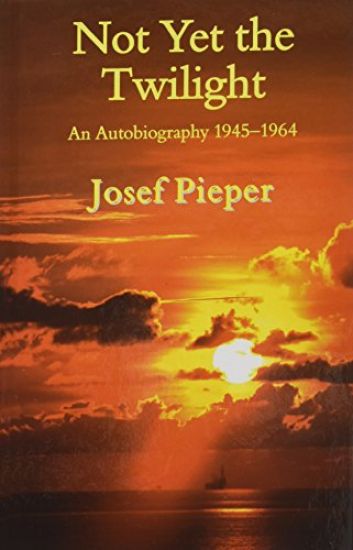
Not Yet the Twilight – An Autobiography 1945–1964

Not Yet the Twilight – An Autobiography 1945–1964

Josef Pieper; Dan Farrelly; Una Farrelly

ST AUGUSTINE'S PRESS
2017
sidottu
Volume 2 of Josef Pieper’s three-part autobiography is here presented for the first time in English translation. The volume represents not just a simple continuation of a seamless story. The first volume dealt with Pieper’s life from his birth in 1904 to the time of World War 2. The current volume deals with the post-war years, 1945–1964, offering a personal documentation of the institutional rubble through which an emerging academic and philosopher had to find his way. This included finding work, re-establishing himself in the family home, completing his academic education, and beginning to teach philosophy in a climate of despair and disillusionment. In this context, the quintessential Pieper emerges. His positive philosophy of being, firmly based on Plato and Thomas Aquinas, finds extraordinary resonance with students, who flock to his lectures in surprising numbers — seeking and finding a positive way forward. His dedication to training teachers sees him declining higher academic posts in Germany in favor of work which, though less lucrative and more obscure, he considered more fruitful. These years are also marked by his fiercely independent stance over against the Catholic hierarchy — despite his staunch adherence to the tradition values of Christianity. His popularity as a philosopher and teacher quickly spread to America, where he was invited to teach at famous universities. His fame led to further travels — to Switzerland, England, France, Spain, India, China, Saigon, and Thailand. Such travels enriched his thinking and nourished the open-mindedness of the Western philosopher.
Not Yet the Twilight – An Autobiography 1945–1964

Not Yet the Twilight – An Autobiography 1945–1964

Josef Pieper; Dan Farrelly; Una Farrelly

ST AUGUSTINE'S PRESS
2017
nidottu
Volume 2 of Josef Pieper’s three-part autobiography is here presented for the first time in English translation. The volume represents not just a simple continuation of a seamless story. The first volume dealt with Pieper’s life from his birth in 1904 to the time of World War 2. The current volume deals with the post-war years, 1945–1964, offering a personal documentation of the institutional rubble through which an emerging academic and philosopher had to find his way. This included finding work, re-establishing himself in the family home, completing his academic education, and beginning to teach philosophy in a climate of despair and disillusionment. In this context, the quintessential Pieper emerges. His positive philosophy of being, firmly based on Plato and Thomas Aquinas, finds extraordinary resonance with students, who flock to his lectures in surprising numbers — seeking and finding a positive way forward. His dedication to training teachers sees him declining higher academic posts in Germany in favor of work which, though less lucrative and more obscure, he considered more fruitful. These years are also marked by his fiercely independent stance over against the Catholic hierarchy — despite his staunch adherence to the tradition values of Christianity. His popularity as a philosopher and teacher quickly spread to America, where he was invited to teach at famous universities. His fame led to further travels — to Switzerland, England, France, Spain, India, China, Saigon, and Thailand. Such travels enriched his thinking and nourished the open-mindedness of the Western philosopher.
Scholasticism

Scholasticism

Josef Pieper

St Augustine's Press
2001
pokkari
No better guide over the thousand-year period called the Middle Ages could be found than Josef Pieper. In this amazing tour de monde medievale, he moves easily back and forth between the figures and the doctrines that made medieval philosophy unique in Western thought. After reflecting on the invidious implications of the phrase "Middle Ages," Pieper turns to the fascinating personality of Boethius whose contribution to prison literature, The Consolation of Philosophy, is second only to the Bible in the number of manuscript copies. The Neo-Platonic figures - Dionysius and Eriugena - are the occasion for a discussion of negative theology. The treatment of Anselm of Canterbury's proof of God's existence involves later voices, e.g., Kant. Like other historians, Pieper is enamored of the twelfth century, which is regularly eclipsed by accounts of the thirteenth century. Pieper does justice to both. His account of the rivalry between Peter Abelard and Bernard of Clairvaux is masterful, nor does he fail to give John of Salisbury the space he deserves. The account is broken by the gradual replacement of the synthesis of faith and reason that had been achieved in the early Middle Ages by a new one that made use of Aristotle. Pieper gives a thorough and lively account of the struggle between Aristotelians and anti-Aristotelians, and the famous condemnations that put the effort of Saint Thomas Aquinas at risk. But the Summa theologiae is regarded by Pieper as the unique achievement of the period. If the early centuries, the medieval period, can be seen as moving toward the thirteenth and Thomas's unique achievement, subsequent centuries saw the decline of scholasticism and theappearance of harbingers of modern philosophy. The book closes with Pieper's thoughts on the permanent philosophical and theological significance of scholasticism and the Middle Ages. Once again, wearing his learning lightly, writing with a clarity that delights, Josef Pieper has taken the field from stuffier and more extended accounts.
The Silence of Goethe

The Silence of Goethe

Josef Pieper

ST AUGUSTINE'S PRESS
2009
sidottu
During the last months of the war, Josef Pieper saw the realization of a long-cherished plan to escape from the “lethal chaos” that was the Germany of that time, “plucked,” he writes, “as was Habakkuk, by the hair of his head . . . to be planted into a realm of the most peaceful seclusion, whose borders and exists were, of course, controlled by armed sentries.” There he made contact with a friend close-by, who possessed an amazing library, and Pieper hit upon the idea of reading the letters of Goethe from that library. Soon, however, he decided to read the entire Weimar edition of fifty volumes, which were brought to him in sequence, two or three at a time.The richness of this life revealing itself over a period of more than sixty years appeared before my gaze in its truly overpowering magnificence, which almost shattered my powers of comprehension – confined, as they had been, to the most immediate and pressing concerns. What a passionate focus on reality in all its forms, what an undying quest to chase down all that is in the world, what strength to affirm life, what ability to take part in it, what vehemence in the way he showed his dedication to it! Of course, too, what ability to limit himself to what was appropriate; what firm control in inhibiting what was purely aimless; what religious respect for the truth of being! I could not overcome my astonishment; and the prisoner entered a world without borders, a world in which the fact of being in prison was of absolutely no significance. But no matter how many astonishing things I saw in these unforgettable weeks of undisturbed inner focus, nothing was more surprising or unexpected than this: to realize how much of what was peculiar to this life occurred in carefully preserved seclusion; how much the seemingly communicative man who carried on a world-wide correspondence still never wanted to expose in words the core of his existence. It was precisely in the seclusion, the limitation, the silence of Goethe that made the strongest impact on Pieper. Here was modern Germany’s quintessential conversationalist intellectual, but the strength of his words came from the restraint behind them, even to the point of purposeful forgetting:The culmination is when the eighty-year-old sees forgetting not as a convulsive refusal to think of things, but as what could almost be termed a physiological process of simple forgetting as a function of life. He praises as “a great gift of the gods” . . . “the ethereal stream of forgetfulness” which he “was always able to value, to use, and to heighten.” However manifold the forms of this silence and of their unconscious roots and conscious motives may have been, is it not always the possibility of hearing, the possibility of a purer perception of reality that is aimed at? And so, is not Goethe’s type of silence above all the silence of one who listens? . . . This listening silence is much deeper than the mere refraining from words and speech in human intercourse. It means a stillness, which, like a breath, has penetrated into the inmost chamber of one’s own soul. It is meant, in the Goethean “maxim,” to “deny myself as much as possible and to take up the object into myself as purely as it is possible to do.” . . . The meaning of being silent is hearing – a hearing in which the simplicity of the receptive gaze at things is like the naturalness, simplicity, and purity of one receiving a confidence, the reality of which is creatura, God’s creation. And insofar as Goethe’s silence is in this sense a hearing silence, to that extent it has the status of the model and paradigm – however much, in individual instances, reservations and criticism are justified. One could remain circumspectly silent about this exemplariness after the heroic nihilism of our age has proclaimed the attitude of the knower to be by no means that of a silent listener but rather as that of self-affirmation over against being: insight and knowledge are naked defiance, the severest endangering of existence in the midst of the superior strength of concrete being. The resistance of knowledge opposes the oppressive superior power. However, that the knower is not a defiant rebel against concrete being, but above all else a listener who stays silent and, on the basis of his silence, a hearer – it is here that Goethe represents what, since Pythagoras, may be considered the silence tradition of the West.Pieper concludes his remarkable find with this summation:When such talk, which one encounters absolutely everywhere in workshops and in the marketplace – and as a constant temptation – , when such deafening talk, literally out to thwart listening, is linked to hopelessness, we have to ask is there not in silence – listening silence – necessarily a shred of hope? For who could listen in silence to the language of things if he did not expect something to come of such awareness of the truth? And, in a newly founded discipline of silence, is there not a chance not merely to overcome the sterility of everyday talk but also to overcome its brother, hopelessness – possibly if only to the extent that we know the true face of this relationship? I know that here quite different forces come into play which are beyond human control, and perhaps the circulus has to be broken through in a different place. However, one may ask: could not the “quick, strict resolution” to remain silent at the same time serve as a kind of training in hope?
The Silence of Goethe

The Silence of Goethe

Josef Pieper

ST AUGUSTINE'S PRESS
2009
nidottu
During the last months of the war, Josef Pieper saw the realization of a long-cherished plan to escape from the “lethal chaos” that was the Germany of that time, “plucked,” he writes, “as was Habakkuk, by the hair of his head . . . to be planted into a realm of the most peaceful seclusion, whose borders and exists were, of course, controlled by armed sentries.” There he made contact with a friend close-by, who possessed an amazing library, and Pieper hit upon the idea of reading the letters of Goethe from that library. Soon, however, he decided to read the entire Weimar edition of fifty volumes, which were brought to him in sequence, two or three at a time.The richness of this life revealing itself over a period of more than sixty years appeared before my gaze in its truly overpowering magnificence, which almost shattered my powers of comprehension – confined, as they had been, to the most immediate and pressing concerns. What a passionate focus on reality in all its forms, what an undying quest to chase down all that is in the world, what strength to affirm life, what ability to take part in it, what vehemence in the way he showed his dedication to it! Of course, too, what ability to limit himself to what was appropriate; what firm control in inhibiting what was purely aimless; what religious respect for the truth of being! I could not overcome my astonishment; and the prisoner entered a world without borders, a world in which the fact of being in prison was of absolutely no significance. But no matter how many astonishing things I saw in these unforgettable weeks of undisturbed inner focus, nothing was more surprising or unexpected than this: to realize how much of what was peculiar to this life occurred in carefully preserved seclusion; how much the seemingly communicative man who carried on a world-wide correspondence still never wanted to expose in words the core of his existence. It was precisely in the seclusion, the limitation, the silence of Goethe that made the strongest impact on Pieper. Here was modern Germany’s quintessential conversationalist intellectual, but the strength of his words came from the restraint behind them, even to the point of purposeful forgetting:The culmination is when the eighty-year-old sees forgetting not as a convulsive refusal to think of things, but as what could almost be termed a physiological process of simple forgetting as a function of life. He praises as “a great gift of the gods” . . . “the ethereal stream of forgetfulness” which he “was always able to value, to use, and to heighten.” However manifold the forms of this silence and of their unconscious roots and conscious motives may have been, is it not always the possibility of hearing, the possibility of a purer perception of reality that is aimed at? And so, is not Goethe’s type of silence above all the silence of one who listens? . . . This listening silence is much deeper than the mere refraining from words and speech in human intercourse. It means a stillness, which, like a breath, has penetrated into the inmost chamber of one’s own soul. It is meant, in the Goethean “maxim,” to “deny myself as much as possible and to take up the object into myself as purely as it is possible to do.” . . . The meaning of being silent is hearing – a hearing in which the simplicity of the receptive gaze at things is like the naturalness, simplicity, and purity of one receiving a confidence, the reality of which is creatura, God’s creation. And insofar as Goethe’s silence is in this sense a hearing silence, to that extent it has the status of the model and paradigm – however much, in individual instances, reservations and criticism are justified. One could remain circumspectly silent about this exemplariness after the heroic nihilism of our age has proclaimed the attitude of the knower to be by no means that of a silent listener but rather as that of self-affirmation over against being: insight and knowledge are naked defiance, the severest endangering of existence in the midst of the superior strength of concrete being. The resistance of knowledge opposes the oppressive superior power. However, that the knower is not a defiant rebel against concrete being, but above all else a listener who stays silent and, on the basis of his silence, a hearer – it is here that Goethe represents what, since Pythagoras, may be considered the silence tradition of the West.Pieper concludes his remarkable find with this summation:When such talk, which one encounters absolutely everywhere in workshops and in the marketplace – and as a constant temptation – , when such deafening talk, literally out to thwart listening, is linked to hopelessness, we have to ask is there not in silence – listening silence – necessarily a shred of hope? For who could listen in silence to the language of things if he did not expect something to come of such awareness of the truth? And, in a newly founded discipline of silence, is there not a chance not merely to overcome the sterility of everyday talk but also to overcome its brother, hopelessness – possibly if only to the extent that we know the true face of this relationship? I know that here quite different forces come into play which are beyond human control, and perhaps the circulus has to be broken through in a different place. However, one may ask: could not the “quick, strict resolution” to remain silent at the same time serve as a kind of training in hope?
Tradition – Concept and Claim

Tradition – Concept and Claim

Josef Pieper; E. Christian Kopff

ST AUGUSTINE'S PRESS
2010
nidottu
“This is a profound reflection on contemporary understandings and misunderstandings of what tradition is. Pieper argues powerfully that the modern scientific situation, and the zeal for the new, do not and cannot supersede the human need of tradition if we are to orient ourselves in the world and find meaning. Pieper’s quest for the reconciliation of reason/science with tradition/revelation suggests Thomas Aquinas speaking in the language and context of our time.” – Timothy Fuller, Lloyd E. Worner Distinguished Service Professor, Colorado College“Josef Pieper, in this lucid translation, shows that tradition is not the same as ‘traditionalism’; nor is it the mindless repetition of a past no longer understood. Rather, tradition is the handing down and the reception, generation after generation, of unchanging truths that originate vin a primal revelation. Pieper shows in a brilliant, paradigm-shifting way, how philosophy, theology, science, and the arts interact with tradition, and how a sense of unchanging sacred tradition is necessary for human community.” – Gene Edward Veith, Patrick Henry College