Kirjojen hintavertailu. Mukana 11 342 296 kirjaa ja 12 kauppaa.

Kirjahaku

Etsi kirjoja tekijän nimen, kirjan nimen tai ISBN:n perusteella.

1000 tulosta hakusanalla R F

R for Political Data Science

R for Political Data Science

Francisco Urdinez; Andres Cruz

TAYLOR FRANCIS LTD
2022
nidottu
R for Political Data Science: A Practical Guide is a handbook for political scientists new to R who want to learn the most useful and common ways to interpret and analyze political data. It was written by political scientists, thinking about the many real-world problems faced in their work. The book has 16 chapters and is organized in three sections. The first, on the use of R, is for those users who are learning R or are migrating from another software. The second section, on econometric models, covers OLS, binary and survival models, panel data, and causal inference. The third section is a data science toolbox of some the most useful tools in the discipline: data imputation, fuzzy merge of large datasets, web mining, quantitative text analysis, network analysis, mapping, spatial cluster analysis, and principal component analysis.Key features: Each chapter has the most up-to-date and simple option available for each task, assuming minimal prerequisites and no previous experience in R Makes extensive use of the Tidyverse, the group of packages that has revolutionized the use of R Provides a step-by-step guide that you can replicate using your own data Includes exercises in every chapter for course use or self-study Focuses on practical-based approaches to statistical inference rather than mathematical formulae Supplemented by an R package, including all dataAs the title suggests, this book is highly applied in nature, and is designed as a toolbox for the reader. It can be used in methods and data science courses, at both the undergraduate and graduate levels. It will be equally useful for a university student pursuing a PhD, political consultants, or a public official, all of whom need to transform their datasets into substantive and easily interpretable conclusions.
R for Political Data Science

R for Political Data Science

Francisco Urdinez; Andres Cruz

CRC Press
2020
sidottu
R for Political Data Science: A Practical Guide is a handbook for political scientists new to R who want to learn the most useful and common ways to interpret and analyze political data. It was written by political scientists, thinking about the many real-world problems faced in their work. The book has 16 chapters and is organized in three sections. The first, on the use of R, is for those users who are learning R or are migrating from another software. The second section, on econometric models, covers OLS, binary and survival models, panel data, and causal inference. The third section is a data science toolbox of some the most useful tools in the discipline: data imputation, fuzzy merge of large datasets, web mining, quantitative text analysis, network analysis, mapping, spatial cluster analysis, and principal component analysis.Key features: Each chapter has the most up-to-date and simple option available for each task, assuming minimal prerequisites and no previous experience in R Makes extensive use of the Tidyverse, the group of packages that has revolutionized the use of R Provides a step-by-step guide that you can replicate using your own data Includes exercises in every chapter for course use or self-study Focuses on practical-based approaches to statistical inference rather than mathematical formulae Supplemented by an R package, including all dataAs the title suggests, this book is highly applied in nature, and is designed as a toolbox for the reader. It can be used in methods and data science courses, at both the undergraduate and graduate levels. It will be equally useful for a university student pursuing a PhD, political consultants, or a public official, all of whom need to transform their datasets into substantive and easily interpretable conclusions.
R For Medicine And Biology

R For Medicine And Biology

Paul D. Lewis

Jones and Bartlett Publishers, Inc
2009
nidottu
R is quickly becoming the number one choice for users in the fields of biology, medicine, and bioinformatics as their main means of storing, processing, sharing, and analyzing biomedical data. R for Medicine and Biology is a step-by-step guide through the use of the statistical environment R, as used in a biomedical domain. Ideal for healthcare professionals, scientists, informaticists, and statistical experts, this resource will provide even the novice programmer with the tools necessary to process and analyze their data using the R environment. Introductory chapters guide readers in how to obtain, install, and become familiar with R and provide a clear introduction to the programming language using numerous worked examples. Later chapters outline how R can be used, not just for biomedical data analysis, but also as an environment for the processing, storing, reporting, and sharing of data and results. The remainder of the book explores areas of R application to common domains of biomedical informatics, including imaging, statistical analysis, data mining/modeling, pathology informatics, epidemiology, clinical trials, and metadata usage. R for Medicine and Biology will provide you with a single desk reference for the R environment and its many capabilities.
R for Quantitative Chemistry

R for Quantitative Chemistry

David K. Gosser

TAYLOR FRANCIS LTD
2023
sidottu
R for Quantitative Chemistry is an exploration of how the R language can be applied to a wide variety of problems in what is typically termed "Quantitative Chemistry" or sometimes "Analytical Chemistry". Topics include: basic statistics, spectroscopic data, acid base equilibria and titrations, binding curves (of great current interest for biomedical applications), Fourier Transforms, and chemical kinetics and enzyme kinetics. An innovative feature is the discussion (as an alternative to the less stable nls packages) of the simplex adaptation subplex (R package) coupled with Monte Carlo analysis to determine confidence intervals for estimated parameters resulting from least squares optimization. Chemists who are interested in learning R as a research tool as well as Chemists who are teaching Quantitative Chemistry, as well as their students will be interested. This book is useful as most R books approach data analysis from an economic, social, medical, or biological context. Analysis of chemical data draws upon specific numerical models and a different set R programming and packages than is typically discussed in other disciplines. This book will be based upon, in large part, actual experimental data and will include end of chapter questions and projects. Readers are encouraged to email the author at [email protected] and to follow the accompanying blog on Medium "R Programming for Quantitative Chemistry". Key Features: Elements of R programming for Chemists Literature Based Examples Includes Binding Assay Analysis Integrates theory, experiment, and R programming
R for Quantitative Chemistry

R for Quantitative Chemistry

David K. Gosser

TAYLOR FRANCIS LTD
2023
nidottu
R for Quantitative Chemistry is an exploration of how the R language can be applied to a wide variety of problems in what is typically termed "Quantitative Chemistry" or sometimes "Analytical Chemistry". Topics include: basic statistics, spectroscopic data, acid base equilibria and titrations, binding curves (of great current interest for biomedical applications), Fourier Transforms, and chemical kinetics and enzyme kinetics. An innovative feature is the discussion (as an alternative to the less stable nls packages) of the simplex adaptation subplex (R package) coupled with Monte Carlo analysis to determine confidence intervals for estimated parameters resulting from least squares optimization. Chemists who are interested in learning R as a research tool as well as Chemists who are teaching Quantitative Chemistry, as well as their students will be interested. This book is useful as most R books approach data analysis from an economic, social, medical, or biological context. Analysis of chemical data draws upon specific numerical models and a different set R programming and packages than is typically discussed in other disciplines. This book will be based upon, in large part, actual experimental data and will include end of chapter questions and projects. Readers are encouraged to email the author at [email protected] and to follow the accompanying blog on Medium "R Programming for Quantitative Chemistry". Key Features: Elements of R programming for Chemists Literature Based Examples Includes Binding Assay Analysis Integrates theory, experiment, and R programming
R For College Mathematics and Statistics

R For College Mathematics and Statistics

Thomas Pfaff

TAYLOR FRANCIS LTD
2023
nidottu
R for College Mathematics and Statistics encourages the use of R in mathematics and statistics courses. Instructors are no longer limited to ``nice'' functions in calculus classes. They can require reports and homework with graphs. They can do simulations and experiments. R can be useful for student projects, for creating graphics for teaching, as well as for scholarly work. This book presents ways R, which is freely available, can enhance the teaching of mathematics and statistics.R has the potential to help students learn mathematics due to the need for precision, understanding of symbols and functions, and the logical nature of code. Moreover, the text provides students the opportunity for experimenting with concepts in any mathematics course. Features: Does not require previous experience with R Promotes the use of R in typical mathematics and statistics course work Organized by mathematics topics Utilizes an example-based approach Chapters are largely independent of each other
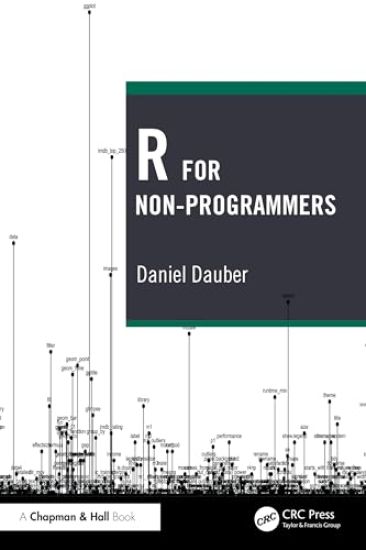
R for Non-Programmers

R for Non-Programmers

Daniel Dauber

TAYLOR FRANCIS LTD
2025
nidottu
Unlock the Power of Data Analysis with RWhether you are a researcher, student, or professional new to programming, this book provides a step-by-step guide to mastering R for quantitative and mixed-methods analysis. Designed for those who still need to gain program- ming experience or wish to learn a new one, it demystifies data analysis, helping you tackle challenges from data wrangling to statistical modelling. Packed with practical examples, engaging explanations, and real-world applications, this book equips you with the tools to analyse data confidently, identify trends, and uncover meaningful insights.Transform Your Approach to ResearchThrough clear instructions and hands-on exercises, you will learn to prepare datasets, explore patterns with descriptive statistics, and create impactful visualisations. You will also gain confidence in performing statistical tests such as comparing groups and building predictive models using regression techniques. This book provides strategies and tools to streamline your workflow, whether handling large datasets, managing missing data, or conducting mixed-methods research.Each chapter builds your expertise incrementally, supported by accessible examples and interactive online training. The accompanying training modules, available through the book’s companion package, offer engaging exercises and extended examples to reinforce learning. These features enable you to practise skills and retain knowledge more effectively.This book, which strongly focuses on reproducible research, is an indispensable guide for anyone looking to enhance their analytical toolkit and unlock R’s full potential for data analysis and statistical modelling.
R for Non-Programmers

R for Non-Programmers

Daniel Dauber

TAYLOR FRANCIS LTD
2025
sidottu
Unlock the Power of Data Analysis with RWhether you are a researcher, student, or professional new to programming, this book provides a step-by-step guide to mastering R for quantitative and mixed-methods analysis. Designed for those who still need to gain program- ming experience or wish to learn a new one, it demystifies data analysis, helping you tackle challenges from data wrangling to statistical modelling. Packed with practical examples, engaging explanations, and real-world applications, this book equips you with the tools to analyse data confidently, identify trends, and uncover meaningful insights.Transform Your Approach to ResearchThrough clear instructions and hands-on exercises, you will learn to prepare datasets, explore patterns with descriptive statistics, and create impactful visualisations. You will also gain confidence in performing statistical tests such as comparing groups and building predictive models using regression techniques. This book provides strategies and tools to streamline your workflow, whether handling large datasets, managing missing data, or conducting mixed-methods research.Each chapter builds your expertise incrementally, supported by accessible examples and interactive online training. The accompanying training modules, available through the book’s companion package, offer engaging exercises and extended examples to reinforce learning. These features enable you to practise skills and retain knowledge more effectively.This book, which strongly focuses on reproducible research, is an indispensable guide for anyone looking to enhance their analytical toolkit and unlock R’s full potential for data analysis and statistical modelling.
R for Statistics

R for Statistics

Pierre-Andre Cornillon; Arnaud Guyader; Francois Husson; Nicolas Jegou; Julie Josse; Maela Kloareg; Eric Matzner-Lober; Laurent Rouvière

CRC Press
2017
sidottu
Although there are currently a wide variety of software packages suitable for the modern statistician, R has the triple advantage of being comprehensive, widespread, and free. Published in 2008, the second edition of Statistiques avec R enjoyed great success as an R guidebook in the French-speaking world. Translated and updated, R for Statistics includes a number of expanded and additional worked examples. Organized into two sections, the book focuses first on the R software, then on the implementation of traditional statistical methods with R. Focusing on the R software, the first section covers: Basic elements of the R software and data processing Clear, concise visualization of results, using simple and complex graphs Programming basics: pre-defined and user-created functions The second section of the book presents R methods for a wide range of traditional statistical data processing techniques, including: Regression methods Analyses of variance and covariance Classification methods Exploratory multivariate analysis Clustering methods Hypothesis tests After a short presentation of the method, the book explicitly details the R command lines and gives commented results. Accessible to novices and experts alike, R for Statistics is a clear and enjoyable resource for any scientist. Datasets and all the results described in this book are available on the book‘s webpage at http://www.agrocampus-ouest.fr/math/RforStat
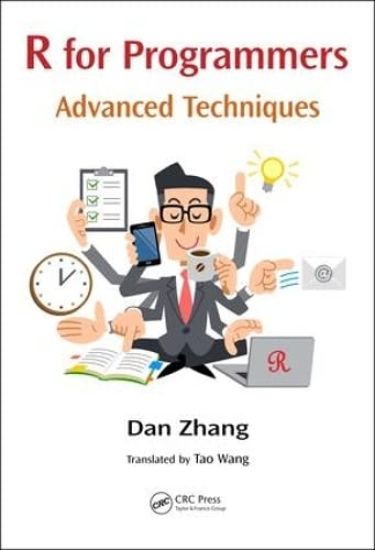
R for Programmers

R for Programmers

Dan Zhang

CRC Press
2017
sidottu
This book discusses advanced topics such as R core programing, object oriented R programing, parallel computing with R, and spatial data types. The author leads readers to merge mature and effective methdologies in traditional programing to R programing. It shows how to interface R with C, Java, and other popular programing laguages and platforms.
R for Statistics

R for Statistics

Pierre-Andre Cornillon

Chapman Hall/CRC
2012
nidottu
Although there are currently a wide variety of software packages suitable for the modern statistician, R has the triple advantage of being comprehensive, widespread, and free. Published in 2008, the second edition of Statistiques avec R enjoyed great success as an R guidebook in the French-speaking world. Translated and updated, R for Statistics includes a number of expanded and additional worked examples.Organized into two sections, the book focuses first on the R software, then on the implementation of traditional statistical methods with R. Focusing on the R software, the first section covers: Basic elements of the R software and data processingClear, concise visualization of results, using simple and complex graphs Programming basics: pre-defined and user-created functions The second section of the book presents R methods for a wide range of traditional statistical data processing techniques, including: Regression methodsAnalyses of variance and covariance Classification methodsExploratory multivariate analysis Clustering methodsHypothesis tests After a short presentation of the method, the book explicitly details the R command lines and gives commented results. Accessible to novices and experts alike, R for Statistics is a clear and enjoyable resource for any scientist. Datasets and all the results described in this book are available on the book’s webpage at http://www.agrocampus-ouest.fr/math/RforStat
R for Stata Users

R for Stata Users

Robert A. Muenchen; Joseph M. Hilbe

Springer-Verlag New York Inc.
2010
sidottu
Stata is the most flexible and extensible data analysis package available from a commercial vendor. R is a similarly flexible free and open source package for data analysis, with over 3,000 add-on packages available. This book shows you how to extend the power of Stata through the use of R. It introduces R using Stata terminology with which you are already familiar. It steps through more than 30 programs written in both languages, comparing and contrasting the two packages' different approaches. When finished, you will be able to use R in conjunction with Stata, or separately, to import data, manage and transform it, create publication quality graphics, and perform basic statistical analyses. A glossary defines over 50 R terms using Stata jargon and again using more formal R terminology. The table of contents and index allow you to find equivalent R functions by looking up Stata commands and vice versa. The example programs and practice datasets for both R and Stata are available for download.
R for SAS and SPSS Users

R for SAS and SPSS Users

Robert A. Muenchen

Springer-Verlag New York Inc.
2011
sidottu
R is a powerful and free software system for data analysis and graphics, with over 5,000 add-on packages available. This book introduces R using SAS and SPSS terms with which you are already familiar. It demonstrates which of the add-on packages are most like SAS and SPSS and compares them to R's built-in functions. It steps through over 30 programs written in all three packages, comparing and contrasting the packages' differing approaches. The programs and practice datasets are available for download.The glossary defines over 50 R terms using SAS/SPSS jargon and again using R jargon. The table of contents and the index allow you to find equivalent R functions by looking up both SAS statements and SPSS commands. When finished, you will be able to import data, manage and transform it, create publication quality graphics, and perform basic statistical analyses. This new edition has updated programming, an expanded index, and even more statistical methods covered in over 25 new sections.
R for Stata Users

R for Stata Users

Robert A. Muenchen; Joseph M. Hilbe

Springer-Verlag New York Inc.
2012
nidottu
Stata is the most flexible and extensible data analysis package available from a commercial vendor. R is a similarly flexible free and open source package for data analysis, with over 3,000 add-on packages available. This book shows you how to extend the power of Stata through the use of R. It introduces R using Stata terminology with which you are already familiar. It steps through more than 30 programs written in both languages, comparing and contrasting the two packages' different approaches. When finished, you will be able to use R in conjunction with Stata, or separately, to import data, manage and transform it, create publication quality graphics, and perform basic statistical analyses. A glossary defines over 50 R terms using Stata jargon and again using more formal R terminology. The table of contents and index allow you to find equivalent R functions by looking up Stata commands and vice versa. The example programs and practice datasets for both R and Stata are available for download.
R for Business Analytics

R for Business Analytics

A Ohri

Springer-Verlag New York Inc.
2012
sidottu
R for Business Analytics looks at some of the most common tasks performed by business analysts and helps the user navigate the wealth of information in R and its 4000 packages. With this information the reader can select the packages that can help process the analytical tasks with minimum effort and maximum usefulness. The use of Graphical User Interfaces (GUI) is emphasized in this book to further cut down and bend the famous learning curve in learning R. This book is aimed to help you kick-start with analytics including chapters on data visualization, code examples on web analytics and social media analytics, clustering, regression models, text mining, data mining models and forecasting. The book tries to expose the reader to a breadth of business analytics topics without burying the user in needless depth. The included references and links allow the reader to pursue business analytics topics. This book is aimed at business analysts with basic programming skills for using R for Business Analytics. Note the scope of the book is neither statistical theory nor graduate level research for statistics, but rather it is for business analytics practitioners. Business analytics (BA) refers to the field of exploration and investigation of data generated by businesses. Business Intelligence (BI) is the seamless dissemination of information through the organization, which primarily involves business metrics both past and current for the use of decision support in businesses. Data Mining (DM) is the process of discovering new patterns from large data using algorithms and statistical methods. To differentiate between the three, BI is mostly current reports, BA is models to predict and strategize and DM matches patterns in big data. The R statistical software is the fastest growing analytics platform in the world, and is established in both academia and corporations for robustness, reliability and accuracy. The book utilizes Albert Einstein’s famous remarks on making things as simple as possible, but no simpler. This book will blow the last remaining doubts in your mind about using R in your business environment. Even non-technical users will enjoy the easy-to-use examples. The interviews with creators and corporate users of R make the book very readable. The author firmly believes Isaac Asimov was a better writer in spreading science than any textbook or journal author.
R for Business Analysis

R for Business Analysis

O'Reilly Media, Inc, USA
2020
nidottu
Build quantitative models that will leverage data to improve the performance of your organization's marketing and operations campaigns. In this practical book, author Pierre DeBois shows business analysts how to develop quantitative models using a more business-friendly framework for selecting the right data and analysis models to support business intelligence.Data-driven strategies are at the heart of competitive advantage today. Yet discerning which method of quantitative analysis can be a challenge with so many data types and models available. This guide covers the key frameworks that blend well with business data for advanced analysis. You'll be better informed on choosing models and preliminary machine learning strategies that will help improve products, services, and operations.Explore statistical techniques to establish data relationshipsReview business intelligence research that can be incorporated into machine learning initiativesUnderstand which models are applicable for marketing and operations analysisGain immediate data management steps that can aid marketing and operations strategiesPlan data visualizations to fit each business need being examined
R for Data Science

R for Data Science

Hadley Wickham; Mine Cetinkaya-Rundel; Garrett Grolemund

O'Reilly Media
2023
nidottu
Learn how to use R to turn data into insight, knowledge, and understanding. Ideal for current and aspiring data scientists, this book introduces you to doing data science with R and RStudio, as well as the tidyverse-a collection of R packages designed to work together to make data science fast, fluent, and fun. Even if you have no programming experience, this updated edition will have you doing data science quickly. You'll learn how to import, transform, and visualize your data and communicate the results. And you'll get a complete, big-picture understanding of the data science cycle and the basic tools you need to manage the details. Each section in this edition includes exercises to help you practice what you've learned along the way. Updated for the latest tidyverse best practices, new chapters dive deeper into visualization and data wrangling, show you how to get data from spreadsheets, databases, and websites, and help you make the most of new programming tools. You'll learn how to: Visualize-create plots for data exploration and communication of results Transform-discover types of variables and the tools you can use to work with them Import-get data into R and in a form convenient for analysis Program-learn R tools for solving data problems with greater clarity and ease Communicate-integrate prose, code, and results with Quarto