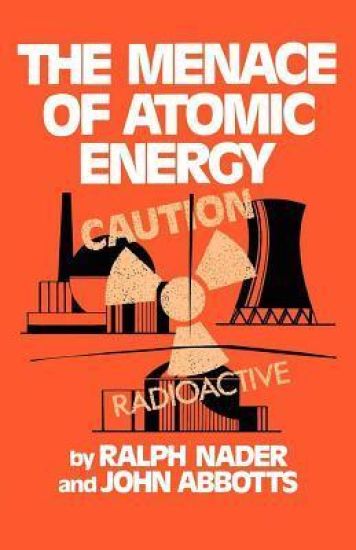
In this book, Ralph Nader and John Abbotts replace the myth of nuclear energy with a clear description of the technology and its attendant perils. They analyze the performance of the atomic energy industry as it affects workers, consumers, taxpayers, and future generations. They take the reader step by step through the political thicket of atomic energy from the local community level to international relations. Decisions now being made about nuclear power will have far-reaching effects upon our economy, our institutions, and our freedom. Above all, this book emphasizes that such choices must not be left only to experts and politicians. This is both a chilling and a hopeful book, one for readers who want to be informed as well as for those who want to get involved. It is a book of solutions. Alternative energy sources—safer, cheaper—are discussed, as are the efforts of citizens’ groups around the country to explore these possibilities. For the paperback edition, the authors have revised and expanded the chapter “Challenging Electric Utilities,” the list of information sources, and the notes, and have added a chapter detailing new developments.
Something has changed in the culture and values of academic science over the last quarter-century. University science is now entangled with entrepreneurship, and researchers with a commercial interest are caught in an ethical quandary. How can an academic scientist honor knowledge for its own sake, while also using knowledge as a means to generate wealth? Science in the Private Interest investigates the trends and effects of modern, commercialized academic science. This book dives unhesitatingly into some of modern science's messiest and most urgent questions. How did scientists begin choosing proprietary gain over the pursuit of knowledge? What effects have academic-corporate partnerships had on the quality and integrity of science? And, most importantly, how does this affect the public?
Something has changed in the culture and values of academic science over the last quarter-century. University science is now entangled with entrepreneurship, and researchers with a commercial interest are caught in an ethical quandary. How can an academic scientist honor knowledge for its own sake, while also using knowledge as a means to generate wealth? Science in the Private Interest investigates the trends and effects of modern, commercialized academic science. This book dives unhesitatingly into some of modern science's messiest and most urgent questions. How did scientists begin choosing proprietary gain over the pursuit of knowledge? What effects have academic-corporate partnerships had on the quality and integrity of science? And, most importantly, how does this affect the public?
Many sports fans are conflicted—they may love the games, the players, and their communities, but may be alarmed by issues including academic corruption, athlete health, and the overarching emphasis on winning and profit at all costs. From disturbing new research about the long-term impact of sports concussions to publicly financed stadiums that drive profits to team owners but not communities, author Ken Reed argues that much of our sports culture is broken, driven by ego and greed. How We Can Save Sports is written to inform and empower sports stakeholders who care deeply about the impact of sports today on individuals and society as a whole. Reed, sports policy director for the League of Fans, introduces readers to ten of the most pressing problems in sports today and shows how they largely derive from the mentalities of profit-at-all-costs and win-at-all-costs. Chapters dig into issues such as concussions, overzealous adults in youth sports, the disappearance of PE from many school curriculums, the focus on profit objectives in college sports, discrimination in sports, and more. Each chapter outlines key challenges and provides concrete steps that readers can take to work for change. The book includes lists of helpful resources for readers interested in change at various levels—from youth and high school sports, to AAU and college athletics, to professional sports.
A powerful memoir of a molecular biologist’s courageous fight against corporate retaliation after revealing dangerous biosafety failures in biotech labs.When molecular biologist Becky McClain raised urgent alarms about biosafety lapses at her biotech lab at Pfizer, she expected concern--not retaliation. Instead, her warnings about dangerous, genetically engineered viruses that were handled without following standard safety protocols were met with hostility, intimidation, and ultimately, devastating illness after a workplace exposure changed her life forever.Exposed is McClain’s riveting memoir of her transformation from dedicated scientist to the nation’s first successful biotech whistleblower. Chronicling her battle against a powerful industry and its culture of secrecy, McClain reveals the high personal cost of speaking out, the legal showdown that rocked Pfizer, and the alarming gaps in biosafety and regulatory oversight that put workers--and the public--at risk.In a post-pandemic world, McClain’s story is more urgent than ever: a wake-up call to the dangers lurking behind laboratory doors, a testament to the power of truth, and a courageous demand for accountability in science. Exposed is not just a personal journey--it’s a public reckoning with the ethical failures and hidden hazards of 21st-century biotechnology.
Many sports fans are conflicted—they may love the games, the players, and their communities, but they are often alarmed by issues such as academic corruption, athlete health, and the overarching emphasis on winning and profit. In How We Can Save Sports: A Game Plan, with a New Introduction, Ken Reed argues that much of our sports culture is broken, driven by ego and greed. Written to inform and empower those who care deeply about the impact of sports on individuals and society as a whole, Reed introduces readers to the most pressing problems in sports and shows how they largely derive from the mentalities of profit-at-all-costs and win-at-all-costs. Chapters dig into issues such as concussions, overzealous adults in youth sports, the disappearance of PE from many school curriculums, the focus on profit in college athletics, discrimination in sports, and more. With a new introduction to bring this perennial topic up to the present, and featuring helpful resources and practical solutions for readers interested in change at all levels, How We Can Save Sports is an invaluable tool for addressing the many challenges in sports today.
A powerful critique of how manipulation of media gives rise to disinformation, intolerance, and divisiveness, and what can be done to change direction."Mickey Huff and Nolan Higdon emphasize what we can do today to restore the power of facts, truth, and fair, inclusive journalism as tools for people to keep political and corporate power subordinate to the engaged citizenry and the common good."—Ralph NaderThe role of news media in a free society is to investigate, inform, and provide a crucial check on political power. But does it?It's no secret that the goal of corporate-owned media is to increase the profits of the few, not to empower the many. As a result, people are increasingly immersed in an information system structured to reinforce their social biases and market to their buying preferences. Journalism’s essential role has been drastically compromised, and Donald Trump’s repeated claims of "fake news" and framing of the media as “an enemy of the people” have made a bad scenario worse.Written in the spirit of resistance and hope, United States of Distraction offers a clear, concise appraisal of our current situation, and presents readers with action items for how to improve it. Praise for United States of Distraction:"A war of distraction is underway, media is the weapon, and our minds are the battlefield. Higdon and Huff have written a brilliant book of how we’ve gotten to this point, and how to educate ourselves to fight back and win."—Henry A. Giroux, author of American Nightmare: Facing the Challenge of Fascism"A timely and urgent demand re-asserting the central importance of civic pursuits—not commercialism—in U.S. media and society."—Ralph Nader"Higdon and Huff have produced the best short introduction to the nature of Trump-era journalism and how the 'Post-Truth' media world is inimical to a democratic society that I have seen. The book is provocative and an entertaining read. Best of all, the analysis in United States of Distraction leads to concrete and do-able recommendations for how we can rectify this deplorable situation."—Robert W. McChesney, author of Rich Media, Poor Democracy: Communication Politics in Dubious Times"The U.S. wouldn't be able to hide its empire in plain sight were it not for the subservient 'free' press. United States of Distraction shows, in chilling detail, America's major media dysfunction—how the gutting of the fourth estate paved the road for fascism and what tools are critical to salvage our democracy."—Abby Martin, The Empire Files"Nolan Higdon and Mickey Huff provides us with a fearless and dangerous text that refuses the post-truth proliferation of fake news, disinformation, and media that serve the interests of the few. This is a vital wake-up call for how the public can protect itself against manipulation and authoritarianism through education and public interest media.”—George Yancy, author of Backlash: What Happens When We Talk Honestly about Racism in America and Professor of Philosophy at Emory University"United States of Distraction challenges our hegemon-media’s ideological mind control and the occupation of human thought. … Huff and Higdon correctly call for mass critical resistance through truth telling by free minds. Power to the people!"—Peter Phillips, author of Giants: The Global Power Elite
Investigating the essential role that the postal system plays in American democracy and how the corporate sector has attempted to destroy it."With First Class: The U.S. Postal Service, Democracy, and the Corporate Threat, Christopher Shaw makes a brilliant case for polishing the USPS up and letting it shine in the 21st century."—John Nichols, national affairs correspondent for The Nation and author of Coronavirus Criminals and Pandemic Profiteers: Accountability for Those Who Caused the Crisis"First Class is essential reading for all postal workers and for our allies who seek to defend and strengthen our public Postal Service."—Mark Dimondstein, President, American Postal Workers Union, AFL-CIOThe fight over the future of the U.S. Postal Service is on. For years, corporate interests and political ideologues have pushed to remake the USPS, turning it from a public institution into a private business—and now, with mail-in voting playing a key role in local, state, and federal elections, the attacks have escalated. Leadership at the USPS has been handed over to special interests whose plan for the future includes higher postage costs, slower delivery times, and fewer post offices, policies that will inevitably weaken this invaluable public service and source of employment.Despite the general shift to digital communication, the vast majority of the American people—and small businesses—still rely heavily on the U.S. postal system, and many are rallying to defend it. First Class brings readers to the front lines of the struggle, explaining the various forces at work for and against a strong postal system, and presenting reasonable ideas for strengthening and expanding its capacity, services, and workforce. Emphasizing the essential role the USPS has played ever since Benjamin Franklin served as our first Postmaster General, author Christopher Shaw warns of the consequences for the country—and for our democracy—if we don’t win this fight.Praise for First Class:"Piece by piece, an essential national infrastructure is being dismantled without our consent. Shaw makes an eloquent case for why the post office is worth saving and why, for the sake of American democracy, it must be saved."—Steve Hutkins, founder/editor of Save the Post Office and Professor of English at New York University"The USPS is essential for a democratic American society; thank goodness we have this new book from Christopher W. Shaw explaining why."—Danny Caine, author of Save the USPS and owner of the Raven Book Store, Lawrence, KS"Shaw's excellent analysis of the Postal Service and its vital role in American Democracy couldn't be more timely. … First Class should serve as a clarion call for Americans to halt the dismantling and to, instead, preserve and enhance the institution that can bind the nation together."—Ruth Y. Goldway, Retired Chair and Commissioner, U.S. Postal Regulatory Commission, responsible for the Forever Stamps"In a time of community fracture and corporate predation, Shaw argues, a first-class post office of the future can bring communities together and offer exploitation-free banking and other services."—Robert Weissman, president of Public Citizen
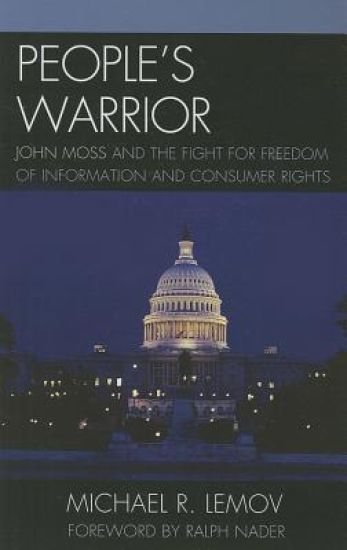
It is hard to believe that there was a time, not long ago, when there was no right to obtain government information, no protection against hazards in children's toys and other consumer products, no federal safety standards for motor vehicles, and no insurance to protect an investors' money and securities in brokerage accounts. These and other consumer rights were created only after fierce political battles in the decade between 1966 and 1976. People's Warrior is the untold story of that era and one of its towering leaders, Congressman John Moss. Based on previously undisclosed materials and interviews with key players of the time People's Warrior tells the story of a stormy decade in America, one in which key laws, such as the Freedom of Information Act and the Consumer Product Safety Act were enacted by Congress, despite overwhelming political opposition. It is also the improbable story of one man's life and determination. Moss fought for twelve years, against three presidents and at times his own party, for a freedom of information law that has stood the test of time and been copied around the world. Although at first stymied by special interests, he won sweeping consumer protection reforms. He went on to challenge Wall Street in an intense battle to enact major new investor protection laws. What happened to Moss and his progressive agenda in later decades, and what the future may bring for that agenda, make up the final part of this compelling story of a man and an era.
It is hard to believe that there was a time, not long ago, when there was no right to obtain government information, no protection against hazards in children's toys and other consumer products, no federal safety standards for motor vehicles, and no insurance to protect an investors' money and securities in brokerage accounts. These and other consumer rights were created only after fierce political battles in the decade between 1966 and 1976. People's Warrior is the untold story of that era and one of its towering leaders, Congressman John Moss. Based on previously undisclosed materials and interviews with key players of the time People's Warrior tells the story of a stormy decade in America, one in which key laws, such as the Freedom of Information Act and the Consumer Product Safety Act were enacted by Congress, despite overwhelming political opposition. It is also the improbable story of one man's life and determination. Moss fought for twelve years, against three presidents and at times his own party, for a freedom of information law that has stood the test of time and been copied around the world. Although at first stymied by special interests, he won sweeping consumer protection reforms. He went on to challenge Wall Street in an intense battle to enact major new investor protection laws. What happened to Moss and his progressive agenda in later decades, and what the future may bring for that agenda, make up the final part of this compelling story of a man and an era.
Ralph is a picture book featuring truthful events in the lives of Ralph (dog), George (cat), Elaine Morrison, and friend Shadow (black dog) in Toronto, Jerusalem, and British Columbia - although Ralph does disclaim any incidence of himself parachuting. Ralph is volume 1 in the "Time, space, all you need is 8" series depicting philosophy on the meaning of life and is suitable for all ages.