Kirjojen hintavertailu. Mukana 11 342 296 kirjaa ja 12 kauppaa.

Kirjahaku

Etsi kirjoja tekijän nimen, kirjan nimen tai ISBN:n perusteella.

1000 tulosta hakusanalla Raymond B. Vickers

From Rights to Needs

From Rights to Needs

Raymond B. Blake

University of British Columbia Press
2008
sidottu
This book explores the family allowance phenomenon from the idea's debut in the House of Commons in 1929 to the program's demise as a universal program under the Mulroney government in 1992. Although successive federal governments remained committed to its underlying principle of universality, party politics, bureaucracy, federal-provincial wrangling, and the shifting priorities of citizens eroded the rights-based approach to social security and replaced it with one based on need. In tracing the evolution of one social security program within a national perspective, From Rights to Needs sheds new light on how Canada's welfare state and social policy has been transformed over the past half century.
From Rights to Needs

From Rights to Needs

Raymond B. Blake

University of British Columbia Press
2009
pokkari
This book explores the family allowance phenomenon from the idea's debut in the House of Commons in 1929 to the program's demise as a universal program under the Mulroney government in 1992. Although successive federal governments remained committed to its underlying principle of universality, party politics, bureaucracy, federal-provincial wrangling, and the shifting priorities of citizens eroded the rights-based approach to social security and replaced it with one based on need. In tracing the evolution of one social security program within a national perspective, From Rights to Needs sheds new light on how Canada's welfare state and social policy has been transformed over the past half century.
Canada's Prime Ministers and the Shaping of a National Identity

Canada's Prime Ministers and the Shaping of a National Identity

Raymond B. Blake

University of British Columbia Press
2024
sidottu
Since Confederation, Canadian prime ministers have consciously constructed the national story. Each created shared narratives, formulating and reformulating a series of unifying national ideas that served to keep this geographically large, ethnically diverse, and regionalized nation together. This book is about those narratives and stories.Focusing on the post–Second World War period, Raymond B. Blake shows how, regardless of political stripe, prime ministers worked to build national unity, forged a citizenship based on inclusion, and defined a place for Canada in the world. They created for citizens an ideal image of what the nation stood for and the path it should follow. They told a national story of Canada as a modern, progressive, liberal state with a strong commitment to inclusion, a deep respect for diversity and difference, and a fundamental belief in universal rights and freedoms. Ultimately, this innovative history provides readers with a new way to see and understand what Canada is, and what holds us together as a nation.
Canada's Prime Ministers and the Shaping of a National Identity

Canada's Prime Ministers and the Shaping of a National Identity

Raymond B. Blake

University of British Columbia Press
2025
pokkari
Since Confederation, Canadian prime ministers have consciously constructed the national story. Each created shared narratives, formulating and reformulating a series of unifying national ideas that served to keep this geographically large, ethnically diverse, and regionalized nation together. This book is about those narratives and stories. Focusing on the post–Second World War period, Raymond B. Blake shows how, regardless of political stripe, prime ministers worked to build national unity, forged a citizenship based on inclusion, and defined a place for Canada in the world. They created for citizens an ideal image of what the nation stood for and the path it should follow. They told a national story of Canada as a modern, progressive, liberal state with a strong commitment to inclusion, a deep respect for diversity and difference, and a fundamental belief in universal rights and freedoms. Ultimately, this innovative history provides readers with a new way to see and understand what Canada is, and what holds us together as a nation.
Tortured into Fake Confession

Tortured into Fake Confession

Raymond B. Lech

McFarland Co Inc
2011
pokkari
In 1952, during the Korean War, Colonel Frank H. Schwable became the second-highest-ranking officer held as a prisoner of war by the Communists. His captivity was marked by months of physical and psychological torture that resulted in a signed confession asserting that the United States had used germ warfare on Korean civilians. This serious allegation reverberated throughout the American media with devastating consequences to Col. Schwable's reputation. Once he was released, an official Marine Corps inquiry was made into his false confession and uncovered the effect psychological torture had on a distinguished and decorated officer's actions.
Canadians at Last

Canadians at Last

Raymond B. Blake

University of Toronto Press
1994
pokkari
History provides some interesting case studies of what happens when trade barriers come down. Among them is the story told in this book of Newfoundland's integration into Canada in the aftermath of the province's 1948 referendum. Raymond B. Blake takes a refreshing approach to this episode in Canadian history, avoiding the old shibboleths of conspiracy and local nationalism, and instead making a down-to-earth study of economic and political events. Canadians at Last explores the efforts of the many Canadians and Newfoundlanders who tried to make Confederation work. Blake argues that Canada wanted union, to remove any uncertainty in its dealings with Newfoundland over civil aviation, defence, and trade. Newfoundland opted for union largely because Canada's burgeoning social welfare system promised a more secure existence. Investigating the complex problems they encountered, Blake details changes in trade, fishing, and manufacturing and in the political process in Newfoundland. He also looks at the introduction and impact of social programs, and the terms of the US military presence there. Finally, he demonstrates that by 1957 Newfoundland's integration into Canada was essentially complete; it was being treated the same as the other provinces, subject to the terms of union. By beginning with the 1949 Confederation rather than the activities leading up to it, and by thoroughly documenting areas of agreement, contention, and neglect, Blake writes a solid, contemporary history of Newfoundland's integration into Canada. Virtually the only complete academic treatment of this subject, Canadians at Last offers much basic information that so far has not been made available.
In Search of Schopenhauer's Cat

In Search of Schopenhauer's Cat

Raymond B. Marcin

The Catholic University of America Press
2015
nidottu
Arthur Schopenhauer’s theory of justice is radical. Justice, in Schopenhauer’s system of thought, is not an epistemological construct. It is neither rights based nor process based. It rejects the concept of individual moral duty as vehemently as it embraces the concept of collective moral guilt. For Schopenhauer, justice is not a way of assessing reality. It is a facet of reality itself. Schopenhauer’s theory of justice is ontology—a study of being itself.In this book Raymond B. Marcin offers several reasons why a review and a reevaluation of Schopenhauer’s theory of justice are worthwhile now, almost two hundred years after it was first formulated. One is that his theory of justice, based squarely on his philosophy of being (or ontology), seems remarkably consistent with the view of reality that is taking shape in the minds of contemporary quantum physicists. Albert Einstein called Schopenhauer’s writings “wonderful,” and Erwin Schrödinger called them “beautiful.” Another reason is that the metaphysical basis of Schopenhauer’s theory of justice bridges a gap that has long existed between Western and Eastern approaches to philosophy and may well have had an influence on the thought of Mohandas K. Gandhi. Yet another reason is that some contemporary jurisprudential movements with a strong social orientation have of late taken an interest in the concept of “community.” The idea of “community” in its most basic and most literal sense is at the heart of Schopenhauer’s deep ontology of justice. Finally, the concept of justice has almost always beenexamined from an epistemological vantage point. Seldom have we seen, outside the natural law tradition, a metaphysical or ontological examination of justice, and that is exactly what Schopenhauer gives.
The Tragic Fate of the U.S.S. Indianapolis

The Tragic Fate of the U.S.S. Indianapolis

Raymond B. Lech

Cooper Square Publishers Inc.,U.S.
2000
pokkari
On July 29, 1945, four days after delivering the atomic bomb destined for Hiroshima, the U.S.S. Indianapolis was torpedoed and sunk. of the 1,199 men on board, 883 perished. Culled from previously unavailable files, this is the chilling story of how the U. S. Navy left the crew in shark-infested waters for four days, and why only a fraction of the 800 men who safely abandoned the ship survived the ordeal. This is the true story of the massive thirty-year cover-up that followed.
Cartographic Mexico

Cartographic Mexico

Raymond B Craib

Duke University Press
2004
sidottu
In Cartographic Mexico, Raymond B. Craib analyzes the powerful role cartographic routines such as exploration, surveying, and mapmaking played in the creation of the modern Mexican state in the nineteenth and early twentieth centuries. Such routines were part of a federal obsession-or “state fixation”-with determining and “fixing” geographic points, lines, and names in order to facilitate economic development and political administration. As well as analyzing the maps that resulted from such routines, Craib examines in close detail the processes that eventually generated them. Taking central Veracruz as a case in point, he shows how in the field, agrarian officials, military surveyors, and metropolitan geographers traversed a “fugitive landscape” of overlapping jurisdictions and use rights, ambiguous borders, shifting place names, and villagers with their own conceptions of history and territory. Drawing on an array of sources-including maps, letters from peasants, official reports, and surveyors’ journals and correspondence-Craib follows the everyday, contested processes through which officials attempted to redefine and codify such fugitive landscapes in struggle with the villagers they encountered in the field. In the process, he vividly demonstrates how surveying and mapmaking were never mere technical procedures: they were, and remain to this day, profoundly social and political practices in which surveyors, landowners, agrarian bureaucrats, and peasants all played powerful and complex roles.
Cartographic Mexico

Cartographic Mexico

Raymond B Craib

Duke University Press
2004
pokkari
In Cartographic Mexico, Raymond B. Craib analyzes the powerful role cartographic routines such as exploration, surveying, and mapmaking played in the creation of the modern Mexican state in the nineteenth and early twentieth centuries. Such routines were part of a federal obsession-or “state fixation”-with determining and “fixing” geographic points, lines, and names in order to facilitate economic development and political administration. As well as analyzing the maps that resulted from such routines, Craib examines in close detail the processes that eventually generated them. Taking central Veracruz as a case in point, he shows how in the field, agrarian officials, military surveyors, and metropolitan geographers traversed a “fugitive landscape” of overlapping jurisdictions and use rights, ambiguous borders, shifting place names, and villagers with their own conceptions of history and territory. Drawing on an array of sources-including maps, letters from peasants, official reports, and surveyors’ journals and correspondence-Craib follows the everyday, contested processes through which officials attempted to redefine and codify such fugitive landscapes in struggle with the villagers they encountered in the field. In the process, he vividly demonstrates how surveying and mapmaking were never mere technical procedures: they were, and remain to this day, profoundly social and political practices in which surveyors, landowners, agrarian bureaucrats, and peasants all played powerful and complex roles.
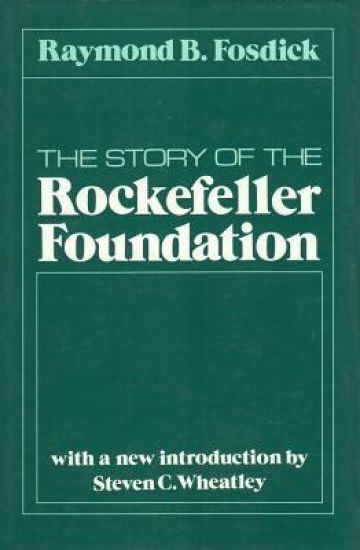
The Story of the Rockefeller Foundation

The Story of the Rockefeller Foundation

Raymond B. Fosdick

Transaction Publishers
1988
sidottu
Since its original publication in 1952, Fosdick's book has been the single most reliable treatment of one of the most important philanthropies in the United States and indeed the world. Fosdick served as president of the foundation for twelve years, from 1936 to 1948, when it was the largest grant-making endow-ment in the world. As Steven Wheatley notes in his valuable new introduction, in part The Story of the Rockefeller Foundation was intended as an instrument of institutional self-defense. When it was written, the foundation community was under mounting political attack from the right, and the book was meant to help balance the Scales by cataloging the foundation's good works. As a deliberate self-portrait, the book conceals as much as it reveals, while in the process it reveals a good deal about the author. Fosdick sees politics, like bureaucracy, as perhaps an avoidable problem and not an inevitable consequence of foundation activity. He sees foundations as engaging in the application of scientific, tech-nical, and organizational solutions to public problems through a "venture cap-ital" approach to discovering how to resolve them. Fosdick's "higher ground" approach became established philanthropic practice far beyond the Rockefeller Foundation. Consequently, this volume is significant as an institutional history as well as a charter for American foundations.
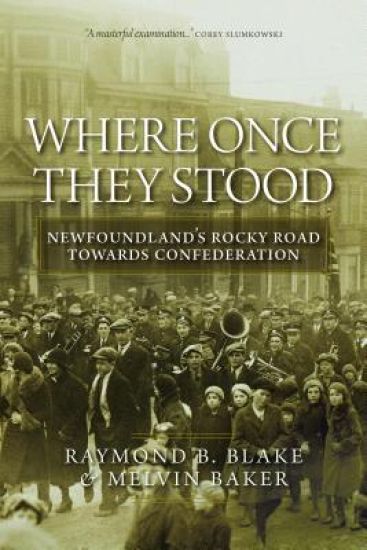
Where Once They Stood

Where Once They Stood

Raymond B. Blake; Melvin Baker

University of Regina Press
2019
nidottu
Where Once They Stood challenges popular notions that those who voted against Confederation in 1869 and for union in 1948 were uninformed and gullible. Raymond Blake and Melvin Baker demonstrate that voters fully understood the issues at stake in both cases, and women became instrumental in determining the final outcome, voting for Canada in 1948, believing it provided the best opportunities for their children. "[Blake and Baker] challenge popular and persistent notions that Newfoundlanders were duped into joining Confederation and instead characterize their decisions as complex, nuanced, and informed." — Canada's History "A lively history of Newfoundland politics from the 1860s to the 1940s, with vigorous and persuasive arguments as to why Newfoundlanders were right to reject Confederation in 1869, and right to embrace it in 1949." — Christopher Moore, author of 1867: How the Fathers Made a Deal "Blake and Baker vigorously bring the exciting fight of ideas in Newfoundland to life. We forget how great the stakes were--nothing less than the survival, security, belonging and recognition of a people. Readers will discover how Newfoundlanders debated for four generations whether Canada was a beau risque." — Patrice Dutil, author of Prime Ministerial Power in Canada
Where Once They Stood

Where Once They Stood

Raymond B. Blake; Melvin Baker

University of Regina Press
2019
sidottu
Where Once They Stood challenges popular notions that those who voted against Confederation in 1869 and for union in 1948 were uninformed and gullible. Raymond Blake and Melvin Baker demonstrate that voters fully understood the issues at stake in both cases, and women became instrumental in determining the final outcome, voting for Canada in 1948, believing it provided the best opportunities for their children.
Knowing Your Faith: All Basic Catholic Beliefs

Knowing Your Faith: All Basic Catholic Beliefs

Raymond B. Fullam

Catholic Book Publishing
1985
nidottu
Knowing Your Faith 978-0-89942-259-6 Knowing Your Faith from Catholic Book Publishing is a short catechism of Catholic teachings, practices, and worship, arranged in a well-organized question-and-answer format. This illustrated catechism also includes brief instructions to enhance the presentation of the basics of the Catholic Faith. This book is intended for both adults and high school students and thus is ideal for adult religious education as well as youth courses and RCIA. Written by Rev. Raymond B. Fullam, S.J., this short catechism of Catholic teachings, practices, and worship is intended for both adults and high school age reader. It makes use of questions and answers as well as brief instructions to present the basics of the Catholic Faith. Who can benefit from this? RCIA candidates, non-practicing Catholics, and daily communicants all have something to learn from the brief but orthodox responses to questions about the Catholic Faith. This short catechism is a most useful resource in the accurate transmission of the Catholic Faith. The plethora of Catholic prayers will foster greater reverence and devotion to the Blessed Sacrament and for the wisdom of the Church. Be an evangelizer by passing on copies. Check out more Catholic resources in our catalogue at www.catholicbookpublishing.com Among the features of Knowing Your Faith are: Illustrations Durably sewn hardcover binding East to read text and explanations of what the Church teaches Prayers at the conclusion High-quality paper Conveniently sized to accommodate pocket or purse Nihil Obstat Imprimatur Advantages of a 'pocket' book: Portable and Convenient - A 'pocket' book is easy to carry, allowing you to access important information, prayers, or inspiration anytime, anywhere. Encourages Frequent Reading - Having a small book on hand makes it more likely that you'll read regularly, whether for spiritual growth, learning, or reflection. Quick Reference Guide - Whether it's a prayer book, inspirational quotes, or key teachings, a pocket book serves as a handy resource for moments of need. Promotes Mindfulness - Carrying a pocket book encourages moments of quiet reflection, helping you stay grounded and connected to your faith or personal growth. Distraction-Free Learning - Unlike digital devices, a pocket book allows you to focus without the distractions of notifications, social media, or screens. Great for Sharing - A pocket book can be easily shared with others, offering wisdom, encouragement, or comfort to those in need. A Personal Companion - Whether for prayer, journaling, or inspiration, a pocket book becomes a trusted source of guidance and reassurance throughout daily life. A pocket sized book on the essentials of the Catholic Faith is an invaluable resource for deepening faith, reinforcing Church teachings, and providing guidance in daily life. This compact yet comprehensive tool allows Catholics to quickly access essential teachings on faith, sacraments, morality, and prayer wherever they go. One of its greatest benefits is accessibility. In a world filled with distractions and challenges to faith, having a small catechism readily available ensures that believers can always turn to the Church's wisdom for clarity and strength. It serves as a quick reference for answering questions, deepening understanding, and defending Catholic beliefs with confidence. For those involved in evangelization or catechesis, a mini catechism is a powerful aid in teaching and sharing faith with others. Whether used in conversations, prayer groups, or personal study, it helps individuals grow spiritually and remain rooted in Church doctrine. Additionally, a pocket-sized catechism encourages frequent reflection on key aspects of the faith, making it easier to integrate Catholic teachings into daily decisions and actions. It fosters a habit of learning and prayer, helping Catholics stay connected to the truths that guide their spiritual journey. Ultimately, a mini catechism is a portable treasure, equipping the faithful with knowledge and inspiration to live their Catholic faith with conviction and devotion. A few of the topics covered are: What Religion is God Reveals Saving truths to Us One God in Three Divine Persons, The Most Blessed Trinity God the Creator of Angels, All Human Beings, and Everything Else Of Sin, Original and Personal Jesus Christ, True Gd, True Man, Our Lord and Redeemer The Holy Spirit and God's Graces and Virtues for us Our Aim is for Holiness of Life Our Catholic Church Our Blessed Mother and the Saints Christ's Resurrection and Ours in the Happiness of Heaven Love in Our Lives and God's Ten Commandments to Help Us Precepts pr Guiding Laws of the Catholic Church to Assist Us God's Graces for Us from Christ's Seven Sacraments and the Holy Mass The Sacraments-Many Little Blessings Valuable Appendices
Hot Organic Coatings

Hot Organic Coatings

Raymond B. (Raymond Benedict) Seymour

Hassell Street Press
2021
sidottu
This work has been selected by scholars as being culturally important and is part of the knowledge base of civilization as we know it.This work is in the public domain in the United States of America, and possibly other nations. Within the United States, you may freely copy and distribute this work, as no entity (individual or corporate) has a copyright on the body of the work.Scholars believe, and we concur, that this work is important enough to be preserved, reproduced, and made generally available to the public. To ensure a quality reading experience, this work has been proofread and republished using a format that seamlessly blends the original graphical elements with text in an easy-to-read typeface.We appreciate your support of the preservation process, and thank you for being an important part of keeping this knowledge alive and relevant.
Hot Organic Coatings

Hot Organic Coatings

Raymond B. (Raymond Benedict) Seymour

Hassell Street Press
2021
nidottu
This work has been selected by scholars as being culturally important and is part of the knowledge base of civilization as we know it.This work is in the public domain in the United States of America, and possibly other nations. Within the United States, you may freely copy and distribute this work, as no entity (individual or corporate) has a copyright on the body of the work.Scholars believe, and we concur, that this work is important enough to be preserved, reproduced, and made generally available to the public. To ensure a quality reading experience, this work has been proofread and republished using a format that seamlessly blends the original graphical elements with text in an easy-to-read typeface.We appreciate your support of the preservation process, and thank you for being an important part of keeping this knowledge alive and relevant.
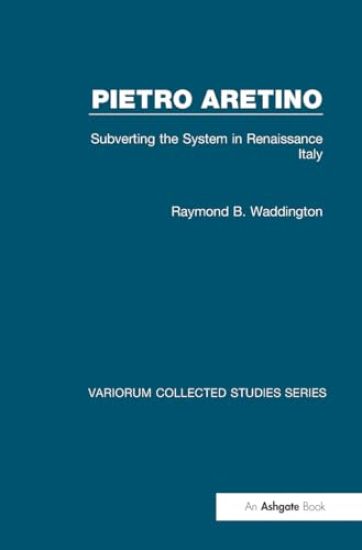
Pietro Aretino: Subverting the System in Renaissance Italy

Pietro Aretino: Subverting the System in Renaissance Italy

Raymond B. Waddington

TAYLOR FRANCIS LTD
2024
nidottu
The essays gathered together in this volume follow the career of the sixteenth-century courtier-poet Pietro Aretino. Part One introduces the author during the 1520s in Rome with his remarkable first comedy, La Cortigiana. With Aretino’s move to Venice (1527), he found a congenial life-long home in which he could flourish. Yet the transition from courtier poet to poligrafo, vernacular writer for the popular press, was slow and difficult before he adopted a new career model derived from Erasmus; even then, he contemplated abandoning Italy for the Ottoman Empire. Part Two examines his work as a satirist in the mid-thirties with the Ragionamenti, the dialogues that branded him a pornographer when the satiric targets lost their immediacy. He augmented the satiric writings by creating the visual persona of a satirist in various media - woodcut author portraits in books, engravings, and particularly portrait medals. The complementary, verbal-visual relationship is the subject of this pairing. Aretino’s religious writings have not been taken seriously until quite recently. The two essays presented here trace Aretino’s associations with Erasmians, spirituali, heretics, and apostates, arguing that his own convictions were sincere, suggesting that he became a Nicodemite during the gathering Counter-Reformation repression of the 1540s. The concluding essays consider two examples of Aretino’s continuing influence in different media, visual arts and literature: on the brilliant, eccentric artist, Giuseppe Arcimboldo, and on a great English comedy, Ben Jonson’s Volpone.
The Story of the Rockefeller Foundation

The Story of the Rockefeller Foundation

Raymond B. Fosdick

Routledge
2017
nidottu
Since its original publication in 1952, Fosdick's book has been the single most reliable treatment of one of the most important philanthropies in the United States and indeed the world. Fosdick served as president of the foundation for twelve years, from 1936 to 1948, when it was the largest grant-making endow-ment in the world. As Steven Wheatley notes in his valuable new introduction, in part The Story of the Rockefeller Foundation was intended as an instrument of institutional self-defense. When it was written, the foundation community was under mounting political attack from the right, and the book was meant to help balance the Scales by cataloging the foundation's good works. As a deliberate self-portrait, the book conceals as much as it reveals, while in the process it reveals a good deal about the author. Fosdick sees politics, like bureaucracy, as perhaps an avoidable problem and not an inevitable consequence of foundation activity. He sees foundations as engaging in the application of scientific, tech-nical, and organizational solutions to public problems through a "venture cap-ital" approach to discovering how to resolve them. Fosdick's "higher ground" approach became established philanthropic practice far beyond the Rockefeller Foundation. Consequently, this volume is significant as an institutional history as well as a charter for American foundations.