Kirjojen hintavertailu. Mukana 12 390 323 kirjaa ja 12 kauppaa.

Kirjahaku

Etsi kirjoja tekijän nimen, kirjan nimen tai ISBN:n perusteella.

1000 tulosta hakusanalla Reagan Miranda Talley

Reagan and the World

Reagan and the World

Praeger Publishers Inc
1990
nidottu
Essays by seven historians. John Lewis Gaddis argues that Reagan's record of dealing with the Soviets is equal or superior to that of Nixon and Kissinger; Akira Iriye praises the administration for improving relations with Japan; but the essays on Western Europe, the Middle East, Africa and Central America range from tempered to slashing criticism. A consensus on the foreign policy of the Reagan years will be a long time in coming. Foreign AffairsThe final curtain having fallen on the administration of the first actor president, historians are now faced with the formidable task of assessing the foreign relations of the Reagan presidency and placing them into a larger historical context. The task of appraising Ronald Reagan as foreign policymaker is difficult because it involves making sense of his apparent inconsistencies. This collection of essays represents the attempts at such an assessment by six distinguished historians of international stature.The contributors address U.S. relations with the Soviet Union, East Asia, Latin America, the Middle East, Western Europe, and Africa. They differ markedly in their appraisals. John Lewis Gaddis asserts that Reagan's Soviet policy was not only successful, but was rationally determined and pursued from the outset of his administration. Akira Iriye finds much to admire in the Reagan administration's relations with East Asia, particularly with respect to economic diplomacy. In contrast, Geir Lundestad is far less complimentary about Reagan's relations with Western Europe, and the three scholars who deal with the less-developed areas of the globe offer generally negative appraisals of Reagan's record. Philip S. Khoury argues that the administration further inflamed the volatile Middle East; Susanne Jonas finds Reagan's Central America policy ultimately destructive of U.S. interests in the region; and Robert Rotberg concludes that Reagan's administrators allowed Africa's fundamental racial conflicts and economic difficulties to fester. Together these six scholars draw an overall picture of the U.S. government more consistent in its regional preoccupations than in its ideology. Many aspects of Reagan's foreign relations will require further investigation before they are clear. For the moment, however, this volume offers a sound first historical evaluation of the Reagan administration's foreign relations. It will appeal to historians, political scientists, specialists in international relations, and general readers interested in the United States and the world in the 1980s.
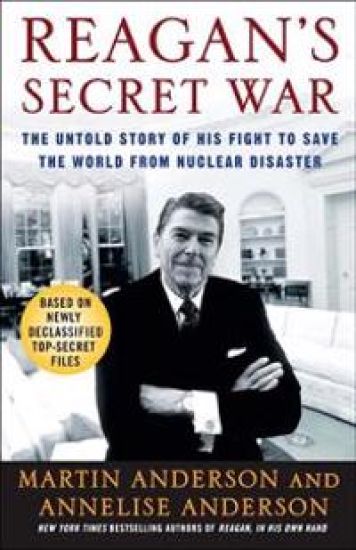
Reagan's Secret War

Reagan's Secret War

Martin Anderson; Annelise Anderson

Three Rivers Press
2010
pokkari
On February 6, 1981, at his first National Security Council meeting, Ronald Reagan told his advisers: "I will make the decisions." As Reagan's Secret War reveals, these words provide the touchstone for understanding the extraordinary accomplishments of the Reagan administration, including the decisive events that led to the end of the Cold War. In penning this book, New York Times bestselling authors Martin Anderson and Annelise Anderson drew upon their unprecedented access to more than eight million highly classified documents housed within the Ronald Reagan Presidential Library in Simi Valley, California--unseen by the public until now. Using his top secret clearances, Martin Anderson was able to access Ronald Reagan's most privileged exchanges with subordinates and world leaders as well as the tactical record of how Reagan fought to win the Cold War and control nuclear weapons. The most revelatory of these documents are the minutes of Reagan-chaired National Security Council meetings, the dozens of secret letters sent by Reagan to world leaders, and the eyewitness notes from Reagan-Gorbachev summits. Along with these findings, the authors use Reagan's speeches, radio addresses, personal diaries, and other correspondence to develop a striking picture of a man whose incisive intelligence, uncanny instincts, and quiet self-confidence changed the course of history. What emerges from this treasure trove of material is irrefutable evidence that Reagan intended from his first days in office to bring down the Soviet Union, that he considered eliminating nuclear weapons his paramount objective, and that he--not his subordinates--was the principal architect of the policies that ultimately brought the Soviets to the nuclear-arms negotiating table. The authors also affirm that many of Reagan's ideas, including his controversial "Star Wars" missile-defense initiative, proved essential in dissolving the Soviet Union and keeping America safe. Riveting and eye-opening, Reagan's Secret War provides a front-row seat to history, a journey into the political mind of a remarkable leader, and proof that one man can, through the force of his deep convictions, bring about sweeping global change.
Reagan and the World

Reagan and the World

Praeger Publishers Inc
1990
sidottu
Essays by seven historians. John Lewis Gaddis argues that Reagan's record of dealing with the Soviets is equal or superior to that of Nixon and Kissinger; Akira Iriye praises the administration for improving relations with Japan; but the essays on Western Europe, the Middle East, Africa and Central America range from tempered to slashing criticism. A consensus on the foreign policy of the Reagan years will be a long time in coming. Foreign AffairsThe final curtain having fallen on the administration of the first actor president, historians are now faced with the formidable task of assessing the foreign relations of the Reagan presidency and placing them into a larger historical context. The task of appraising Ronald Reagan as foreign policymaker is difficult because it involves making sense of his apparent inconsistencies. This collection of essays represents the attempts at such an assessment by six distinguished historians of international stature.The contributors address U.S. relations with the Soviet Union, East Asia, Latin America, the Middle East, Western Europe, and Africa. They differ markedly in their appraisals. John Lewis Gaddis asserts that Reagan's Soviet policy was not only successful, but was rationally determined and pursued from the outset of his administration. Akira Iriye finds much to admire in the Reagan administration's relations with East Asia, particularly with respect to economic diplomacy. In contrast, Geir Lundestad is far less complimentary about Reagan's relations with Western Europe, and the three scholars who deal with the less-developed areas of the globe offer generally negative appraisals of Reagan's record. Philip S. Khoury argues that the administration further inflamed the volatile Middle East; Susanne Jonas finds Reagan's Central America policy ultimately destructive of U.S. interests in the region; and Robert Rotberg concludes that Reagan's administrators allowed Africa's fundamental racial conflicts and economic difficulties to fester. Together these six scholars draw an overall picture of the U.S. government more consistent in its regional preoccupations than in its ideology. Many aspects of Reagan's foreign relations will require further investigation before they are clear. For the moment, however, this volume offers a sound first historical evaluation of the Reagan administration's foreign relations. It will appeal to historians, political scientists, specialists in international relations, and general readers interested in the United States and the world in the 1980s.
Reagan, Bush, Gorbachev

Reagan, Bush, Gorbachev

Norman A. Graebner; Richard Dean Burns; Joseph M. Siracusa

Praeger Publishers Inc
2008
sidottu
This work is a contemporary chronicle of the Cold War and offers an analysis of policy and rhetoric of the United States and Soviet Union during the 1980s. The authors examine the assumptions that drove political decisions and the rhetoric that defined the relationship as the Soviet Union began to implode. This work demonstrates that while the subsequent unraveling of the Soviet empire was an unintended side effect of Mikhail Gorbachev's reforms, termination of the Cold War was not. Ronald Reagan deserves full credit for recognizing Gorbachev's sincerity and his determination to change the direction of Soviet policies. For this, Reagan felt the full wrath of anticommunist hawks for doing business with a communist leader. But it was Gorbachev who concluded the superpowers had become mesmerized by ideological myths which ruled out any meaningful discussions of a possible accommodation of political issues for more than four decades. The evidence is compelling that Gorbachev himself broke the Cold War's ideological straight jacket that had paralyzed Moscow and Washington's ability to resolve their differences. Though politically weakened, Gorbachev conceded nothing to U.S. military superiority. Never did he negotiate from a position of weakness. In doing so, the last Soviet leader faced even greater political and physical risk. Without Gorbachev the end of the Cold War could have played out very differently and perhaps with great danger.
Reagan Versus The Sandinistas

Reagan Versus The Sandinistas

Thomas W Walker; Harvey Williams; Peter Kornbluh; Eva Gold

Routledge
2020
sidottu
The product of research and investigation by a team of sixteen authors, Reagan versus the Sandinistas is the most comprehensive and current study to date of the Reagan administration's mounting campaign to reverse the Sandinista revolution. The authors thoroughly examine all major aspects of Reagan's "low-intensity war," from the U.S. government's attempts at economic destabilization to direct CIA sabotage and the sponsorship of the contras or freedom fighters. They also explore less-public tactics such as electronic penetration, behind-the-scenes manipulation of religious and ethnic tensions, and harassment of U.S. Nicaraguan specialists and "fellow travelers." The book concludes with a consideration of the impact of these activities and their implications for international law, U.S. interests, U.S. polity, and Nicaragua itself. Reagan versus the Sandinistas is designed not only for courses on Latin America, U.S. foreign policy, and international relations, but also for students, scholars, and others interested in understanding one of the most massive, complex efforts—short of direct intervention—organized by the United States to overthrow the government of another country.
Reagan Versus The Sandinistas

Reagan Versus The Sandinistas

Thomas W Walker; Harvey Williams; Peter Kornbluh; Eva Gold

TAYLOR FRANCIS LTD
2024
nidottu
The product of research and investigation by a team of sixteen authors, Reagan versus the Sandinistas is the most comprehensive and current study to date of the Reagan administration's mounting campaign to reverse the Sandinista revolution. The authors thoroughly examine all major aspects of Reagan's "low-intensity war," from the U.S. government's attempts at economic destabilization to direct CIA sabotage and the sponsorship of the contras or freedom fighters. They also explore less-public tactics such as electronic penetration, behind-the-scenes manipulation of religious and ethnic tensions, and harassment of U.S. Nicaraguan specialists and "fellow travelers." The book concludes with a consideration of the impact of these activities and their implications for international law, U.S. interests, U.S. polity, and Nicaragua itself. Reagan versus the Sandinistas is designed not only for courses on Latin America, U.S. foreign policy, and international relations, but also for students, scholars, and others interested in understanding one of the most massive, complex efforts—short of direct intervention—organized by the United States to overthrow the government of another country.
Reagan’s “Boys” and the Children of the Greatest Generation
During the 1980s and 1990s, aging Baby Boomer parents constructed a particular type of memory as they attempted to laud their own parents’ wartime accomplishments with the label "The Greatest Generation." This book is the first to tell the entire story of this particular type of U.S. World War II memory begun by U.S. President Ronald Reagan in 1984, and promoted the same year by newscaster Tom Brokaw. The story continues in 1994, when it was given academic credence by historian Stephen E. Ambrose, a sensory realism and ideal American character by director Steven Spielberg and actor Tom Hanks, sloganized by Tom Brokaw in 1998, and later interpreted in light of 9/11 and new wars.
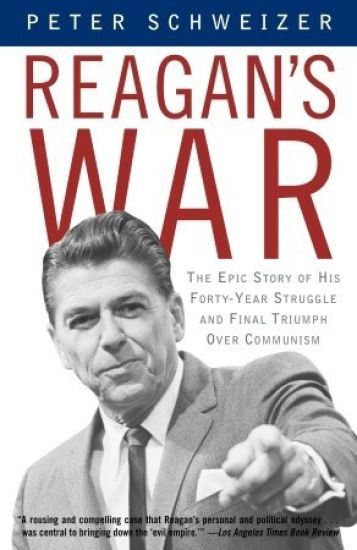
Reagan's War

Reagan's War

Peter Schweizer

Bantam USA
2003
pokkari
A leading historian of the Cold War takes a close-up look at Ronald Reagan and his fierce commitment to battling communism, from his role as a secret informer for the FBI and criticism of 1960s détente to his political and economic war against Moscow as president and his ultimate triumph over communism. Reprint. 50,000 first printing.
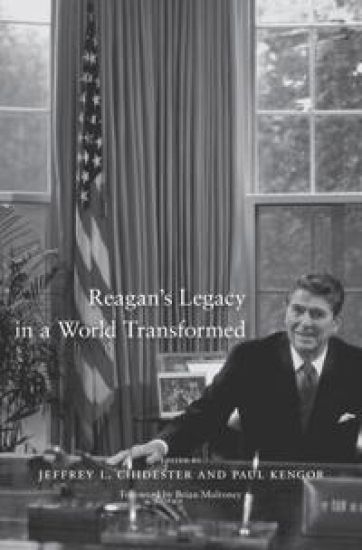
Reagan's Legacy in a World Transformed

Reagan's Legacy in a World Transformed

Brian Mulroney

Harvard University Press
2015
sidottu
Since Ronald Reagan left office in 1989, the global community has witnessed the collapse of the Soviet Union and the integration of Europe, the War on Terror and the Arab Spring, a hot Chinese economy and a major international recession. Reagan’s Legacy in a World Transformed brings together scholars from diverse disciplines and persuasions to assess the fortieth president’s policies and their ongoing impact today, and to offer a timely retrospective on his complex legacy.The authors consider the influence of Reagan’s free-market ideas on economic globalization, showing how deregulation succeeded in spurring economic expansion. In foreign policy, Reagan favored significant increases in military spending (“peace through strength”) and an assertive agenda abroad. His break with détente in dealing with the Soviet Union, notably expressed in his 1982 March of Freedom speech, effectively restored the early Cold War strategy of rolling back communism. More than twenty years later, President George W. Bush invoked this speech in describing his goals in the Middle East—a striking example of how Reagan’s ideas affected the post-9/11 world.In contrast with his hawkish stance on defense, Reagan’s efforts to reduce nuclear arsenals, negotiated with Mikhail Gorbachev, constitute one of his enduring contributions to stability. Although Reagan’s policies soared on rhetoric rooted in ideological conviction, the president engaged in pragmatic internationalism when a multilateral approach served America’s interests. He believed that America had a special mission as a moral leader and beacon of freedom, a view that continues to inform U.S. foreign policy.
Reagan and the States

Reagan and the States

Richard P. Nathan; Fred C. Doolittle

Princeton University Press
2014
pokkari
Here is the most thorough study to date on the impact of Ronald Reagan's policies on the states, especially the outcomes of his well-known budget cuts. A treasure trove of information that will be essential for interpretations of the Reagan presidency. Originally published in 1987. The Princeton Legacy Library uses the latest print-on-demand technology to again make available previously out-of-print books from the distinguished backlist of Princeton University Press. These editions preserve the original texts of these important books while presenting them in durable paperback and hardcover editions. The goal of the Princeton Legacy Library is to vastly increase access to the rich scholarly heritage found in the thousands of books published by Princeton University Press since its founding in 1905.
Reagan and the States

Reagan and the States

Richard P. Nathan; Fred C. Doolittle

Princeton University Press
2016
sidottu
Here is the most thorough study to date on the impact of Ronald Reagan's policies on the states, especially the outcomes of his well-known budget cuts. A treasure trove of information that will be essential for interpretations of the Reagan presidency. Originally published in 1987. The Princeton Legacy Library uses the latest print-on-demand technology to again make available previously out-of-print books from the distinguished backlist of Princeton University Press. These editions preserve the original texts of these important books while presenting them in durable paperback and hardcover editions. The goal of the Princeton Legacy Library is to vastly increase access to the rich scholarly heritage found in the thousands of books published by Princeton University Press since its founding in 1905.
Reagan's Reward

Reagan's Reward

Susan G Mathis

Smwordworks, LLC
2020
pokkari
Summer 1912Reagan Kennedy assumes the position of governess to the Bernheim family's twin nephews, and her life at Cherry Island's Casa Blanca becomes frustratingly complicated. Service to a Jewish family and tending to eight-year-old mischievous boys brings trouble galore.Daniel Lovitz serves as the island's caretaker and boatman. When he tries to help the alluring Reagan make sense of her new world, her insecurities mount as her confidence is shaken―especially when she crosses the faith divide and when Etta Damsky makes her life miserable. As trouble brews, Daniel sees another side of the woman he's come to love.Finalist in the 2020 Selah Awards, Reagan's Reward will touch your heart.
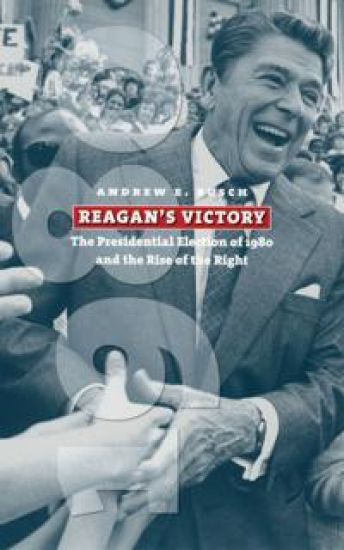
Reagan's Victory

Reagan's Victory

Andrew E. Busch

University Press of Kansas
2005
sidottu
Many have pointed to the Iran hostage crisis, others to galloping inflation. In reality, as Andrew Busch makes clear, Ronald Reagan's defeat of President Jimmy Carter in 1980 was attributable to more than any one issue, no matter how galvanizing. It marked the growing ascendancy of conservative attitudes that had been brewing for two decades - and marked the clear end of the era of New Deal liberalism. Busch offers the first comprehensive study of this contest, going beyond journalistic accounts to show why it remains one of the truly landmark elections of the past century. Through a compelling story full of colorful characters, unexpected plot twists, and dramatic finales, he reveals how it both reflected the politics of its time and foreshadowed our nation's political future. Beginning with Carter's ""crisis of confidence"" speech on July 15, 1979, Busch introduces the field of candidates, follows their campaigns through the primaries and general election, identifies the key turning points and winning strategies, and assesses the results, including the GOP's first Senate majority in twenty-six years. He shows how the Democrats were weakened by the demise of the New Deal coalition and a decline in public confidence, while Republicans were bolstered by the growth of the conservative movement and by all that had gone wrong during the Carter presidency. He also examines the creation of a Sunbelt coalition, the growing influence of religious conservatives, and the independent candidacy of John Anderson, which held Reagan's majority to 51 per cent and foreshadowed Ross Perot's 1992 run. Reagan's victory marked a major turning point in American presidential history, realigned the demographics of party affiliation throughout the nation (especially in the nation's Sunbelt), and gave conservatives their first real victory in their fight against Big Government. Busch's book recaptures the people and events of that historic campaign and greatly enlarges our understanding of American politics from the 1960s to the present.
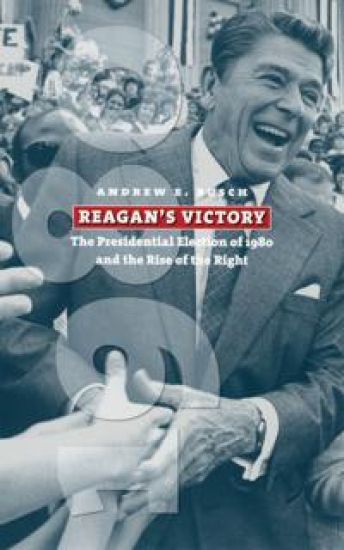
Reagan's Victory

Reagan's Victory

Andrew E. Busch

University Press of Kansas
2005
nidottu
Ronald Reagan's defeat of President Jimmy Carter in 1980 and how the campaign both reflected the politics of its time and foreshadowed the nation's political future are examined in the first comprehensive study of this contest. Simultaneous.
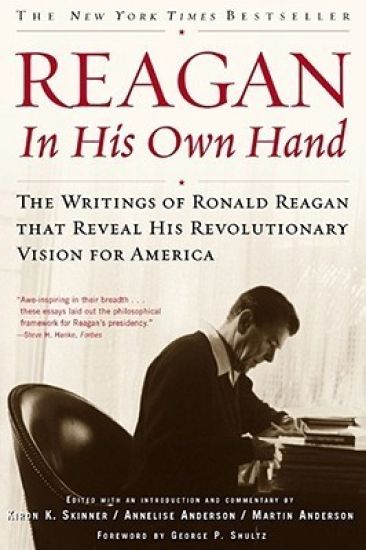
Reagan, In His Own Hand

Reagan, In His Own Hand

George P. Shultz

The Free Press
2002
pokkari
During the eight years that Ronald Reagan served as president of the United States, a period of sustained economic prosperity and increased American power on the world stage, many of his advisers claimed authorship of the ideas that comprised 'the Reagan revolution.' The press, in turn, lent credence to the idea that President Reagan was merely a skilled communicator of those ideas, the consummate actor, not the director or producer. Few people realised that Reagan had left a paper trail of original writings that make clear he was the intellectual powerhouse behind his administration's landmark policies. Hidden in archives for more than twenty years, Reagan's pre-presidential writings reveal an active mind wrestling with the problems of a sluggish economy, social pathologies, welfare, reform and the Cold War struggle with the Soviet Union. Selected and annotated by three leading scholars, two of whom were among Reagan's principal domestic-policy advisers, these writings unlock the puzzle of the man so many historians have tried to comprehend, with so little success. A publishing landmark, REAGAN, IN HIS OWN HAND will redefine the way we think about American history of the past quarter-century, and about the fortieth American president.
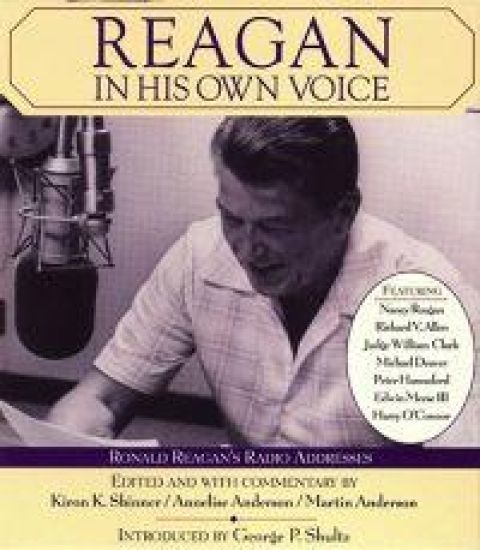
Reagan in His Own Voice

Reagan in His Own Voice

Kiron K. Skinner; Annelise Anderson; Martin Anderson

Simon Schuster Audio
2001
cd
Reagan In His Own Voice features Ronald Reagan's radio addresses from the late 1970s. Edited by Kiron K. Skinner, Annelise Anderson, and Martin Anderson, they are introduced by George Shultz and feature additional introductions by Nancy Reagan, Richard V. Allen, Judge William Clark, Michael Deaver, Peter Hannaford, Edwin Meese III and Harry O'Connor. From 1975 to 1979 Ronald Reagan gave more than 1,000 daily radio broadcasts, the great majority of which he wrote himself. This program represents the opening of a major archive of pre-presidential material from the Reagan Library and the Hoover Institution Archives. These addresses transform our image of Ronald Reagan, and enhance and revise our understanding of the late 1970s -- a time when Reagan held no political office, but was nonetheless mapping out a strategy to transform the economy, end the cold war, and create a vision of America that would propel him to the presidency. These radio programs demonstrate that Reagan had carefully considered nearly every issue he would face as president. Reagan's radio broadcasts will change his reputation even among his closest allies and friends. Here, in his own voice, Reagan the thinker is finally fully revealed.
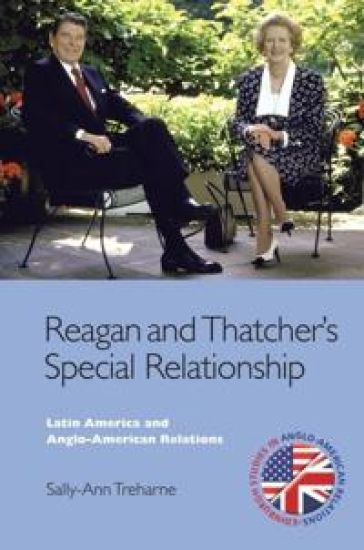
Reagan and Thatcher's Special Relationship

Reagan and Thatcher's Special Relationship

Sally-Ann Treharne

Edinburgh University Press
2015
sidottu
The Falklands War, the US invasion of Grenada, the Anglo-Guatemalan dispute over Belize and the US involvement in Nicaragua - in the 1980s, these crises threatened to overwhelm a renewal in US-UK relations. Sally-Ann Treharne vividly portrays the role of personal diplomacy between US President Ronald Reagan and UK Prime Minister Margaret Thatcher in overcoming obstacles to Anglo-American relations emanating from the turbulent Latin American region in the final years of the Cold WarDrawing onrecently declassified documents and candid interviews with key protagonists, she highlights the pivotal moments in Reagan and Thatcher's shared history from a new vantage point. Interviewees include: Lord Geoffrey Howe, Lord Michael Heseltine, Lord Cecil Parkinson, Sir John Nott, Sir Bernard Ingham, Lord Charles Powell, Baroness Gloria Hooper, Sir Adrian Beamish, Lord Peter Carrington, Lord Neil Kinnock and Lord Timothy Bell.
Reagan, Bush and Right-wing Politics
In this two-volume work the author, a Rutgers University professor, argues that recently organized right-wing interests, sometimes called the counter-establishment, rose to power during the Reagan and Bush years, and exerted great influence in these two administrations, particularly the former. In the first major volume, entitled 'The American right-wing takes command - key executive appointments', Burch takes a close look at the economic background and think tank ties of many of the people appointed to high posts in these rightist regimes-officials such as the CIA's William Casey, Reagan's first Secretary of the Interior, James Watt, his second-term Attorney General, (and first-term high White House aided) Edwin Meese, and Defense Secretary Caspar Weinberger.All of these new men were connected to some part of America's new counter-establishment, a complex headed by such groups as the American Enterprise Institute, Committee on the Present Danger, Heritage Foundation, Hoover Institution, Institute for Contemporary Studies, and the (Joseph Coorsbacked) Mountain States Legal Foundation. This skewed recruitment pattern also held true for many of the second-and third tier posts in the administration of Ronald Reagan and, to a lesser extend, that of George Bush. Along with this study of the appointment process under Reagan a brief analysis of such issues as antitrust and civil rights es also provided in the course of this work.Following the same line of analysis, in the second part of this work, entitled 'The American Right-Wing at Court and in Action - Supreme Court Nominations and Major Policy-making', the author found that four of the six people appointed to the Supreme Court (or elevated to the top post of Chief Justice) during this period were closely associated, at one time or another, with right-wing think tanks - namely William Rehnquist, Anthony Kennedy, Antonin Scalia, and Clarence Thomas. Thus, since people making policy (an old axiom), it is not surprising that the public policy in the Reagan and Bush years took a sharp turn to the right. This was particularly true in such important fields as foreign policy, military spending, and economics and taxation. In the last three chapters , Burch presents case studies of the political and economic forces at work in the Iran-Contra affair, the SDI (Star Wars) program, 'voodoo economics' (George Bush's term), and the Tax Reform Act of 1986.
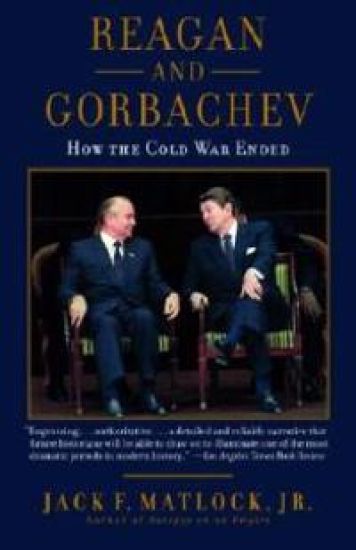
Reagan and Gorbachev

Reagan and Gorbachev

Matlock Jack

St Martin's Press
2005
pokkari
In Reagan and Gorbachev, Jack F. Matlock, Jr., gives an eyewitness account of how the Cold War ended, with humankind declared the winner. As Reagan’s principal adviser on Soviet and European affairs, and later as the U.S. ambassador to the U.S.S.R., Matlock lived history: He was the point person for Reagan’s evolving policy of conciliation toward the Soviet Union. Working from his own papers, recent interviews with major figures, and archival sources both here and abroad, Matlock offers an insider’s perspective on a diplomatic campaign far more sophisticated than previously thought, led by two men of surpassing vision. Matlock details how, from the start of his term, Reagan privately pursued improved U.S.—U.S.S.R. relations, while rebuilding America’s military and fighting will in order to confront the Soviet Union while providing bargaining chips. When Gorbachev assumed leadership, however, Reagan and his advisers found a potential partner in the enterprise of peace. At first the two leaders sparred, agreeing on little. Gradually a form of trust emerged, with Gorbachev taking politically risky steps that bore long-term benefits, like the agreement to abolish intermediate-range nuclear missiles and the agreement to abolish intermediate-range nuclear missiles and the U.S.S.R.’s significant unilateral troop reductions in 1988.Through his recollections and unparalleled access to the best and latest sources, Matlock describes Reagan’s and Gorbachev’s initial views of each other. We learn how the two prepared for their meetings; we discover that Reagan occasionally wrote to Gorbachev in his own hand, both to personalize the correspondence and to prevent nit-picking by hard-liners in his administration. We also see how the two men were pushed closer together by the unlikeliest characters (Senator Ted Kennedy and François Mitterrand among them) and by the two leaders’ remarkable foreign ministers, George Shultz and Eduard Shevardnadze.The end of the Cold War is a key event in modern history, one that demanded bold individuals and decisive action. Both epic and intimate, Reagan and Gorbachev will be the standard reference, a work that is critical to our understanding of the present and the past.