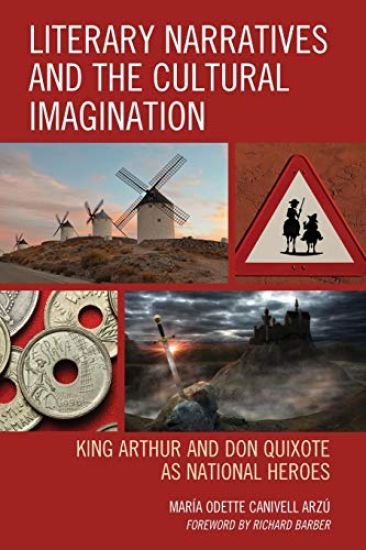
In Literary Narratives and the Cultural Imagination: King Arthur and Don Quixote as National Heroes the author examines traditional Arthurian and Cervantine literary narratives to discuss how the two literary figures became paladins of their respective nations. Whereas the former bestows upon the homeland a positive image of Britain, based on military might, a glorious past and a promise of return, the latter contributes to a negative image of Spain based on a narrative of defeat and faded glory. In the analysis of the political intentions behind the literature that gave wings to the rise as paragons of these very famous literary characters, a semblance of the national imaginaries of the countries of their birth appears. Indeed, the tradition of Waterloo and the tradition of La Mancha are polar opposites in their Weltanschauung, and they only have in common that both heroes, Arthur and Quijote, are depicted as paladins of justice, benefactors, and redeemers of their land of birth. It is this idealized view of what is possibly the figment of a writer’s (or many different writers) pen that astonishes the reader, for behind it lies an intention to market (for internal and external consumption) both literary creations, exceeding the boundaries of the creative fiction that invented them to transform them into myths and political symbols of their respective nations.
Full edition in modern spelling of Aubrey's racy portraits of greatfigures of 16-17c England, from Sir Walter Raleigh to John Milton. John Aubrey's racy portraits of the great figures of 17th-centuryEngland stand alongside Pepys's diary as a vivid evocation of the period. Aubrey was born in 1626, the son of a Wiltshire squire; at the age of 26 he inherited a family estate encumbered with debt, and finally went bankrupt in the 1670s. From then on he led a sociable, rootless existence at the houses of friends - from Oxford and the Middle Temple -pursuing the antiquarian studies which had always obsessed him. At his death in 1697 he left a mass of notes and manuscripts, among them the material for Brief Lives. He never managed to put even a single life into logical order; all we have are the raw materials, scribbled down -`tumultuously as they occurred to my thoughts'. With this full, modern English edition, which reproduces Aubrey's words as closely as possible, Richard Barber introduces us to Aubrey and his world, tells how the Lives came into being and enables many new readers to enjoy this eccentric masterpiece.
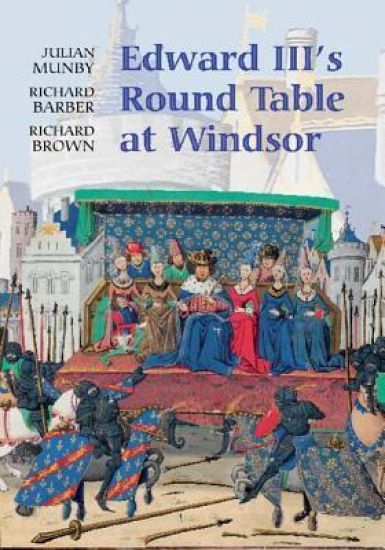
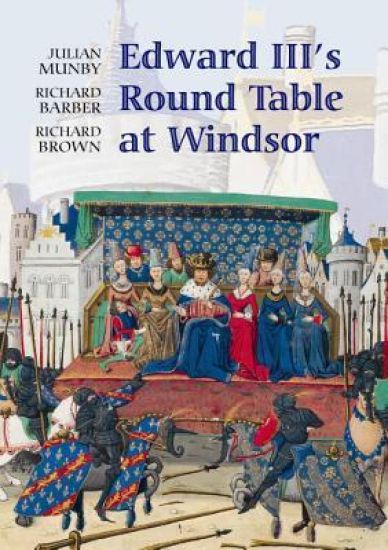
A dramatic archaeological find at Windsor Castle reveals Edward III's 'House of the Round Table', designed to show off Edward's power and prestige at a crucial moment in his attempts to lay claim to the throne of France. NEW LOWER PRICE The image of King Arthur's Round Table is well-known, both as Thomas Malory's portrayal of a fellowship of knights dedicated to the highest ideals of chivalry, and as the great wooden table at Winchester castle. Now a dramatic archaeological find at Windsor castle sheds new light on the idea of a round table as a gathering: the 'House of the Round Table' which Edward III ordered to be constructed at the conclusion of his Windsor festival of 1344. The discovery of the foundation trench of a great building two hundred feet in diameter in the Upper Ward of Windsor castle, allows the reconstruction of that building's appearance and raises the question of itspurpose. Chronicles, building materials inventories from the royal accounts, medieval romances, and earlier descriptions of round table festivals all confirm the archaeological evidence: at a time when secular orders of knighthood were almost unknown, Edward declared his intention to found an Order of the Round Table with three hundred knights. This grand building, and the Arthurian entertainments he planned for it, would bind his nobles to his cause ata crucial point in his progress to claiming the throne of France. His ambitious scheme, however, was overtaken by events. Victory at Crécy in 1346 confirmed Edward's reputation, and the order which he founded in 1348 was themuch more exclusive Order of the Garter, rewarding those commanders who had helped him to win the Crécy campaign. His reputation was assured, the omens for his reign were auspicious; he had the loyalty of his knights and magnates.The Round Table building was abandoned, and eventually pulled down in the 1360s. Thus a major plank in the strategic thinking of one of England's greatest kings almost became a footnote in history. Time Team discovered .there [are] indeed foundations of a massive round building in Windsor Castle's upper ward. A splendidly produced volume, which gives full credit both to the history and to the archaeology: analysis of the chivalric background, archaeological analysis, discussion of the probable form of the building [and] the early history of Windsor Castle as well as the types of stone used by Edward III's masons. The book is attractively illustrated, and its appendicesprovide a full text in Latin, with translation, of the building accounts, as well as translations of many of the relevant chronicle extracts. MICHAEL PRESTWICH, THE TIMES LITERARY SUPPLEMENT
Terror doesn't stumble and moan-it walks silently among us, cloaked in the guise of the overlooked. Nick, burdened with the rare ability to see these dead predators for what they truly are, faces a nightmare when his girlfriend, Abby, becomes ensnared by their sinister intent.These are not your typical undead. They blend in, their appearances mirroring the forgotten faces of society, making their predatory nature all the more chilling. A touch is all it takes for them to latch onto their prey, draining life in a way that leaves the body walking but the spirit doomed.As Abby becomes the focus of such a being's obsession, Nick is drawn into a desperate struggle not just for her life, but for her very soul. Their fight for survival takes them from the deceptive safety of city streets to the foreboding quiet of a cemetery, where the boundary between the living and those claimed by the shadowy grasp of the dead becomes perilously thin.One of The Dead weaves a tale not of a zombie apocalypse, but of a quiet invasion, a creeping horror that targets the heart. It's a story of love tested by unfathomable forces, of a battle against an enemy that never rests, never forgives, and never ceases its pursuit until you become one of its own.One of the Dead is a novella of quiet horror for fans of Paul Tremblay and Thomas Olde Heuvelt, which explores the horror in society. Proudly represented by Crystal Lake Publishing-Tales from the Darkest Depths.
Henry II is the most imposing figure among the medieval kings of England. His fiefs and domains extended from the Atlantic to the Mediterranean, and his court was frequented by the greatest thinkers and men of letters of his time, besides ambassadors from all over Europe. This readable and accessible biography offers both a study of his character, and an estimate of his work as a ruler, work which is in a sense the history of his life, since it occupied his entire energies from his accession at the age of twenty-one to his death thirty-five years later. Nor is this the mere routine of government; from the desolate and lawless anarchy of Stephen's reign, and against the opposition of the great magnates and the Church, he built in England a stable and prosperous realm, and welded his diverse inheritance overseas into a single, and by the standards of the time, peaceful, unit. Only the folly of John dispersed his empire, and his work in England left an enduring mark on the institutions by which we are governed today.RICHARD BARBER's other books include Tournaments, with Juliet Barker, Edward Prince of Wales and Aquitaine, The Life and Campaigns of the Black Prince, The Knight and Chivalry and books on King Arthur; he is currently working on a study of the legend of the Holy Grail. 1154-1189
Collected together for the first time, the best weird fiction from Morpheus Tales, the UK's most controversial weird fiction magazine! Only the very best weird fiction has been hand-picked from the Morpheus Tales archives to create the seventh collected volume of the magazine Christopher Fowler calls "edgy and dark." Featuring fiction by Philip Roberts, Brent Pilkey, C. E. Zacherl, Todd Outcalt, Jessica Lilien, Clay Waters, Tyler Bowler, Jude-Marie Green, Paul Michael Moreau, Tim Foley, Charles Austin Muir, Benjamin Blake, Morgan Duchesney, Nate Jacobs, Richard Farren Barber, Jason Sturner, Jared Bernard, Edward A. Taylor, Paul L. Howard, Steven Lee Climer, Meredith Doench. Established horror best-sellers rub shoulders with rising stars and newcomers in this diverse collection of short weird fiction.
The image of King Arthur's Round Table is well-known, both as Thomas Malory's portrayal of a fellowship of knights dedicated to the highest ideals of chivalry, and as the great wooden table at Winchester castle. Now a dramatic archaeological find at Windsor castle sheds new light on the idea of a round table as a gathering: the 'House of the Round Table' which Edward III ordered to be constructed at the conclusion of his Windsor festival of 1344. The discovery of the foundation trench of a great building two hundred feet in diameter in the Upper Ward of Windsor castle, allows the reconstruction of that building's appearance and raises the question of its purpose. Chronicles, building materials inventories from the royal accounts, medieval romances, and earlier descriptions of round table festivals all confirm the archaeological evidence: at a time when secular orders of knighthood were almost unknown, Edward declared his intention to found an Order of the Round Table with three hundred knights. This grand building, and the Arthurian entertainments he planned for it, would bind his nobles to his cause at a crucial point in his progress to claiming the throne of France. His ambitious scheme, however, was overtaken by events. Victory at Crécy in 1346 confirmed Edward's reputation, and the order which he founded in 1348 was the much more exclusive Order of the Garter, rewarding those commanders who had helped him to win the Crécy campaign. His reputation was assured, the omens for his reign were auspicious; he had the loyalty of his knights and magnates. The Round Table building was abandoned, and eventually pulled down in the 1360s. Thus a major plank in the strategic thinking of one of England's greatest kings almost became a footnote in history. Time Team discovered ... there [are] indeed foundations of a massive round building in Windsor Castle's upper ward. A splendidly produced volume, which gives full credit both to the history and to the archaeology: analysis of the chivalric background, archaeological analysis, discussion of the probable form of the building [and] the early history of Windsor Castle as well as the types of stone used by Edward III's masons. The book is attractively illustrated, and its appendices provide a full text in Latin, with translation, of the building accounts, as well as translations of many of the relevant chronicle extracts. MICHAEL PRESTWICH, THE TIMES LITERARY SUPPLEMENT
The Story of Scotch, is a classical book and has been considered important throughout the human history. So that this book is never forgotten we at Alpha Editions have made efforts in its preservation by republishing this again in a modern format book for present and future generations. This whole book has been reformatted, retyped and designed. These books are not made of scanned copies of their original work and hence the text is clear and readable.
A wide-ranging retrospective that reveals a master printer’s own photographs to be technically brilliant work of remarkable breadth and complexity This book presents the first in-depth survey of photographs by Richard Benson (1943–2017), who approached photography as a thrilling set of technical challenges and used the medium to craft profound depictions of people, the spaces of their lives and work, and the products of their labor. An essay by curator Peter Barberie interweaves examination of Benson’s photographic practices with the story of his ideas, writing, and reproductive printing, while photographer An-My Lê, Benson’s former student, offers her perspective on his teaching, family life, and art. The book begins with his stunning darkroom prints in silver and platinum and follows his trajectory toward extraordinary digital photography, culminating in later color prints that are at once elegant and garish, representing the contemporary world in vivid detail. Benson’s democratic eye also extended to human subjects: he photographed loved ones and strangers with extraordinary attention, and directed the same gaze to the buildings and landscapes entwined with individual lives.Published in association with the Philadelphia Museum of ArtExhibition Schedule:Philadelphia Museum of Art (October 3, 2021–January 23, 2022)
Big Cat for Little Wandle Fluency has been developed in collaboration with Wandle Learning Trust and Little Sutton Primary School. It consists of a range of chapter books with increasing word counts across 10 fluency levels aimed at children in Year 2 and 3. Each book builds reading confidence, stamina and speed and nurtures a love for reading. Fluency 4 books have a word count of 4080 words with an expected reading rate of 85 words per minute. Brodie loves visiting his Traveller grandparents on their Brilliant Barber Bus every summer holiday. Their home is always full of fascinating stories and friendly faces. But this year, not everything goes to plan!
Secularism, the Church, and the Way Forward is a succinct yet descriptive dialogue between a nonagenarian church leader and a young pastor who are struggling with the reality of the rapidly morphing Western Protestant church. At times debatable, at others provocative, and with insights that induce conviction, the authors challenge, confuse, and enlighten the reader. Combining proven, multidisciplinary models with innovative approaches, the authors inspire a deeper understanding of the complexities surrounding the church's relationship to society. In so doing, they point the church's leaders toward the perilous yet necessary path of rediscovering its identity.
This book explores presidential power through an analysis of the ways that U.S. presidents attempt to manage scandals. While presidents routinely stonewall to block or limit investigations into their alleged transgressions or, in some cases, cooperate with investigators, this book proposes the existence of a third way of responding to scandals—a “backfire” or the creation of a counter-scandal to try to extinguish the original scandal. The existence of possible backfires is surveyed through case studies of the major scandals that impacted the Nixon, Reagan, Clinton, and Trump administrations. The development of this form of scandal response has meaningful implications concerning the growth of presidential power and its impacts on the functioning of the U.S. political system and the quality of American democracy. Changes in partisanship, the media environment, and the public’s view of the presidency and government are topics covered in the book’s explanation of the trends in scandal responses.