Kirjahaku
Etsi kirjoja tekijän nimen, kirjan nimen tai ISBN:n perusteella.
1000 tulosta hakusanalla Richard Cook
At the helm of X, bankrolling far-right lawsuits, and parroting white nationalist conspiracy theories to millions, Elon Musk is no longer a tech eccentric with odd politics - he's the public face of the MAGA counter-revolution. Alongside Trump and the digital culture warriors of the new right, Musk is acting as both financier and foot soldier, reshaping the online public sphere in the image of a paranoid, hyper-capitalist backlash. He's not just posting through it - he's helping lead it. In this urgent and razor-sharp essay, award-winning journalist Richard Cooke dissects the political descent of Elon Musk: from self-described moderate to reactionary provocateur, from self-mythologised innovator to conspiracy peddler and chaos agent. With forensic clarity, Cooke exposes the roots of Musk's transformation - the mythology of genius, the libertarian cult of disruption, and the tech elite's growing comfort with authoritarianism. Dark Star Rising investigates how the richest man alive came to dominate what was once the digital town square - and what it means when that square is turned into a plaything of the paranoid elite. As Cooke reveals, Musk's trajectory is not an anomaly but a warning: when billionaires cosplay as rebels and monopolise the means of communication, democracy itself hangs in the balance. Dark Star Rising is searing account of the political devolution of Elon Musk - and what it reveals about the tech elite's descent into far-right reaction.

Essay on the Life and Character of John Lord Somers, Baron of Evesham
Richard Cooksey
Gale Ecco, Print Editions
2010
pokkari
Essay on the Life and Character of John Lord Somers, Baron of Evesham
Richard Cooksey
Gale Ecco, Print Editions
2018
sidottu
The 18th century was a wealth of knowledge, exploration and rapidly growing technology and expanding record-keeping made possible by advances in the printing press. In its determination to preserve the century of revolution, Gale initiated a revolution of its own: digitization of epic proportions to preserve these invaluable works in the largest archive of its kind. Now for the first time these high-quality digital copies of original 18th century manuscripts are available in print, making them highly accessible to libraries, undergraduate students, and independent scholars.Delve into what it was like to live during the eighteenth century by reading the first-hand accounts of everyday people, including city dwellers and farmers, businessmen and bankers, artisans and merchants, artists and their patrons, politicians and their constituents. Original texts make the American, French, and Industrial revolutions vividly contemporary.++++The below data was compiled from various identification fields in the bibliographic record of this title. This data is provided as an additional tool in helping to insure edition identification: ++++British LibraryT057526With a final errata leaf. In this edition a treble rule separates the title from the imprint. Text and register continuous.Worcester: printed by J. Holl; (for the author.) And sold by J. Bew; J. Richardson; J. Walter; H. Gardner, and W. Brown, London, 1791. 8],135,134-167, 3]p., table; 4
Polarised, enraged and spiritually bereft, America under Donald Trump seems to be on the brink of failure.In this dazzling debut, award-winning Australian writer Richard Cooke takes a close-up look at the state of the United States. From the theology of opioids to the aftermath of a mass shooting, from #MeToo to the paintings of George W. Bush, Cooke's reporting takes him from an East Coast ravaged by climate change to the dangerous world of the US-Mexico border.This is not another diner-hopping week in Trump country- it's a radical effort to capture dissonant and varied Americas, across more than twenty states. In brilliantly rendered accounts of poets, politicians and poisoned cities, Cooke finds a nation splintering under the weight of alienation - but showing resilience and hope in the most unexpected ways.Entertaining and terrifying in equal measure, Tired of Winning reveals the schisms and the clamour of contemporary America.
Elon Musk - head of Tesla and SpaceX and owner of Twitter - has become a neo-reactionary online troll. What has caused his troubling political transformation?"Though he is already preparing to send astronauts to the moon, Musk has been consistently under estimated, and now the danger he presents is being underestimated as well." -Richard CookeAt first it was so unexpected: why was this humanity-loving unorthodox liberal visionary flirting with white nationalists and Holocaust deniers onTwitter? But over time, a sinister pattern emerged, making it impossible to ignore.Dark Star explores the troubling political devolution of Elon Musk.Award-winning writer Richard Cooke looks at the transformation of the world's richest person from self-described social moderate to trolling neo-reactionary and staunch advocate for hardline US conservatives. He unearths the roots of this turning in Musk's rise to power as well as in the politics of the new "tech right" and its adoring fanbase.The essay also investigates an urgent question: what are the consequences for free speech - and hate speech - as Musk controls and reshapes the online town square?
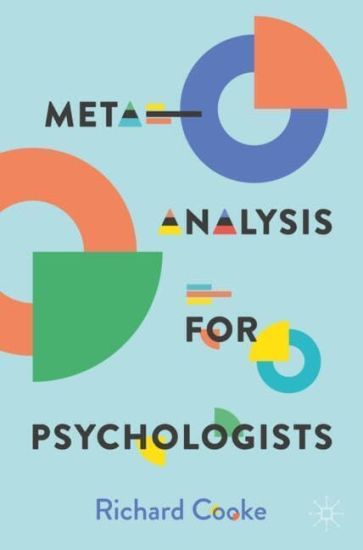
This textbook provides a comprehensive, user-friendly guide to meta-analysis and how to conduct it, using open source software and based on examples commonly found in the field of psychology. Meta-analysis is a key tool used in systematic literature reviews to synthesize research findings across studies, but despite being relatively straightforward to perform, it remains underused by psychologists. In the first section the reader is introduced to key ideas that underlie meta-analysis and how it might be best employed. Following this the reader is guided through how to run a meta-analysis of correlational studies and experimental studies using the free and open statistical software JAMOVI. In the concluding section Professor Cooke considers common issues, key debates and examines the relative merits of different analyses and different software packages.Covers theory, key issues and step-by-step demonstrationsIncludes examples worked examples familiar to psychologists and datasetsCompanion videos demonstrate the methods outlinedIt will provide a valuable new resource for postgraduate students and researchers in the behavioural and social sciences looking to enhance their methodological skills.
The Lost Passenger: A Collection of Poetry
Christopher Richard Cook
Independently Published
2019
nidottu
The Lost Passenger: A Collection of Poetry is a personal journey told through a hundred poems for the broken, the fallen, and the lost. Exploring themes such as loneliness, love, loss, trauma, and recovery, it encourages readers to consider the possibilities that there can be light at the end of the tunnel and that holding on to hope can keep us strong.
In late 2012 I moved back to Hawaii from Portland, OR. After a few months of bouncing around Honolulu and spending my weekends sleeping up country in my van I decided to just go with it go full time vanlife. I drove a 1989 Toyota van, a spacepod from the 80s complete with spray paint palm leaf camo and gold tint. I kept my clothes and cameras and books under my futon (a door propped the length of the car with a thin mattress and sleeping bag) and a cooler filled with ice and film.These are some of the 35mm photos that survived the ride.
Parking: The Hidden World of a Billion Pound Industry
Clive Richard Cook
Independently Published
2018
nidottu
The Golden Keyboard: second book of love in a different world series
Clive Richard Cook
Independently Published
2019
nidottu
Richard Cook and Brian Morton's Penguin Jazz Guide: The History of the Music in 1001 Best Albums is an indispensible guide to the recordings that every fan should know. Richard Cook and Brian Morton's Penguin Guide to Jazz Recordings is firmly established as the world's leading guide to the music. In this book, Brian Morton has picked out 1001 essential recordings from their acclaimed guide, adding new information, revising and reassessing each entry, and showing how these key pieces tell the history of the music - and with it the history of the twentieth century. These are the essential albums that that all true jazz fans should own, or - at the very least - have listened to, from Kind of Blue to lesser-known classics and more surprising choices. Full of fascinating updated biographical information, new quotes and interviews and, of course, highly opinionated and wittily trenchant critical reviews, the result is an endlessly browsable companion that will prove required reading for aficionados and jazz novices alike. 'One of the great books of recorded jazz; the other guides don't come close' Irish Times 'It's the kind of book that you'll yank off the shelf to look up a quick fact and still be reading two hours later' Fortune 'The leader in its field ... If you own only one book on jazz, it really should be this one' International Record Review 'Indispensable and incomparable' NME Brian Morton is a freelance writer and broadcaster who for many years presented Radio 3's jazz magazine Impressions and In Tune. Richard Cook (1957-2007) was formerly editor of The Wire and edited Jazz Review. He contributed to many other publications, including the New Statesman and his books included Richard Cook's Jazz Encyclopaedia and It's About That Time: Miles Davis on Record.
Narrative Therapy is an approach to counseling and community work that is having increasing influence in the helping field internationally. As well, the concept of narrative has become increasingly utilized in therapy, spirituality, organizational psychology and theology.This text is written for counseling practitioners, psychologists, pastors, social workers and chaplains who desire to integrate spirituality in their professional practice. The book presents a conversation between Christian spirituality and Narrative ideas demonstrating the effectiveness of Narrative Therapy in transformational work. The book is edited by two lecturer/practitioners who both lead counselor education faculties. Other contributors to the book are lecturers and therapists who are integrating these ideas in their practice in the counseling room and the classroom. Philosophical difficulties are discussed and practical applications are offered for using Narrative Therapy in a range of contexts.
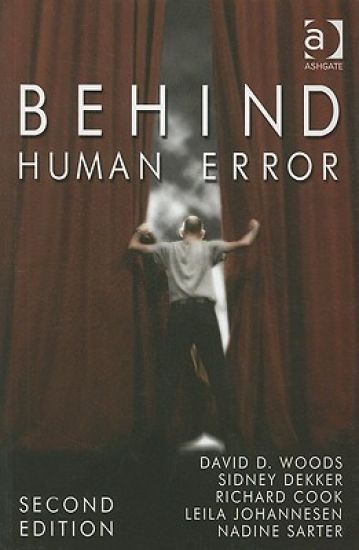
Behind Human Error
David Woods; Sidney Dekker; Richard Cook; Leila Johannesen; Nadine Sarter
Ashgate Publishing Limited
2010
sidottu
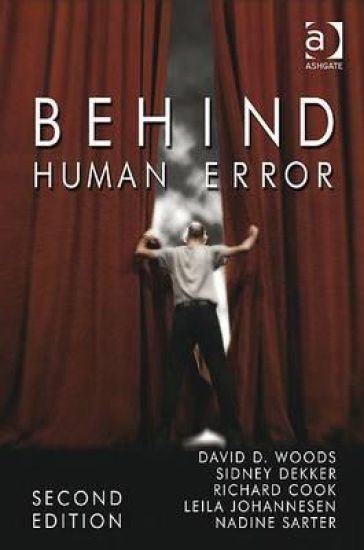
Human error is cited over and over as a cause of incidents and accidents. The result is a widespread perception of a 'human error problem', and solutions are thought to lie in changing the people or their role in the system. For example, we should reduce the human role with more automation, or regiment human behavior by stricter monitoring, rules or procedures. But in practice, things have proved not to be this simple. The label 'human error' is prejudicial and hides much more than it reveals about how a system functions or malfunctions. This book takes you behind the human error label. Divided into five parts, it begins by summarising the most significant research results. Part 2 explores how systems thinking has radically changed our understanding of how accidents occur. Part 3 explains the role of cognitive system factors - bringing knowledge to bear, changing mindset as situations and priorities change, and managing goal conflicts - in operating safely at the sharp end of systems. Part 4 studies how the clumsy use of computer technology can increase the potential for erroneous actions and assessments in many different fields of practice. And Part 5 tells how the hindsight bias always enters into attributions of error, so that what we label human error actually is the result of a social and psychological judgment process by stakeholders in the system in question to focus on only a facet of a set of interacting contributors. If you think you have a human error problem, recognize that the label itself is no explanation and no guide to countermeasures. The potential for constructive change, for progress on safety, lies behind the human error label.
Behind Human Error
David Woods; Sidney Dekker; Richard Cook; Leila Johannesen; Nadine Sarter
Ashgate Publishing Limited
2010
nidottu
Human error is cited over and over as a cause of incidents and accidents. The result is a widespread perception of a 'human error problem', and solutions are thought to lie in changing the people or their role in the system. For example, we should reduce the human role with more automation, or regiment human behavior by stricter monitoring, rules or procedures. But in practice, things have proved not to be this simple. The label 'human error' is prejudicial and hides much more than it reveals about how a system functions or malfunctions. This book takes you behind the human error label. Divided into five parts, it begins by summarising the most significant research results. Part 2 explores how systems thinking has radically changed our understanding of how accidents occur. Part 3 explains the role of cognitive system factors - bringing knowledge to bear, changing mindset as situations and priorities change, and managing goal conflicts - in operating safely at the sharp end of systems. Part 4 studies how the clumsy use of computer technology can increase the potential for erroneous actions and assessments in many different fields of practice. And Part 5 tells how the hindsight bias always enters into attributions of error, so that what we label human error actually is the result of a social and psychological judgment process by stakeholders in the system in question to focus on only a facet of a set of interacting contributors. If you think you have a human error problem, recognize that the label itself is no explanation and no guide to countermeasures. The potential for constructive change, for progress on safety, lies behind the human error label.
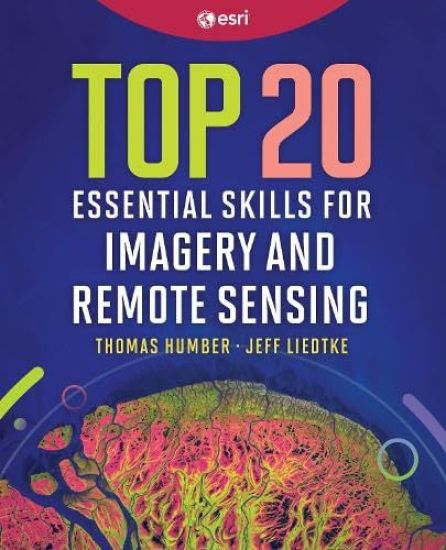
Top 20 Essential Skills for Imagery and Remote Sensing
Thomas Humber; Jeff Liedtke; Richard Cooke
ESRI Press
2026
sidottu
Gain the essential imagery skills you need for data preparation, data exploration, and advanced imagery analysis workflows. Top 20 Essential Skills for Imagery and Remote Sensing guides readers step-by-step through the essential techniques needed to visualize, process, analyze, and manage imagery and raster products. In just a few clicks, you’ll learn the skills necessary to interpret imagery, create imagery products, and perform various imagery analysis workflows. These concise chapters are designed for quick learning, with each chapter taking about 45 minutes to complete. Clear, easy-to-follow tutorials with practical examples consisting of instructions and screenshots make Top 20 Essential Skills for Imagery and Remote Sensing an approachable resource for users of all skill levels. By the end of this book, you’ll be proficient in: Enhancing imagery, managing image collections, and performing advanced analyses Using the ArcGIS Image Analyst extension for advanced image processing Applying real-world skills to support decision-making and solve complex problems Top 20 Essential Skills for Imagery and Remote Sensing is ideal for GIS professionals who want to deepen their understanding of imagery, as well as students eager to learn about remote sensing. Empower yourself to use imagery and raster data effectively in your GIS projects with this comprehensive resource.
The World Color Survey
Paul Kay; Brent Berlin; Luisa Maffi; William R. Merrifield; Richard Cook
Centre for the Study of Language Information
2011
nidottu
The 1969 publication of Brent Berlin and Paul Kay's "Basic Color Terms" proved explosive. Contrary to the then-popular doctrine of random language variation, Berlin and Kay's multilingual study of color nomenclature indicated a cross-cultural and almost universal pattern in the selection of colors that received abstract names in each language. After four decades in print, "Basic Color Terms" now has a sequel: in this book, the authors authoritatively extend the original survey, studying 110 additional unwritten languages in detail and in situ. The results are presented with charts showing the overall palette of color terms within each language, as well as the levels of agreement among speakers.
Multistate Models for the Analysis of Life History Data
Richard J Cook; Jerald F. Lawless
CRC Press
2020
nidottu
Multistate Models for the Analysis of Life History Data provides the first comprehensive treatment of multistate modeling and analysis, including parametric, nonparametric and semiparametric methods applicable to many types of life history data. Special models such as illness-death, competing risks and progressive processes are considered, as well as more complex models. The book provides both theoretical development and illustrations of analysis based on data from randomized trials and observational cohort studies in health research. It features: Discusses a wide range of applications of multistate models, Presents methods for both continuously and intermittently observed life history processes, Gives a thorough discussion of conditionally independent censoring and observation processes, Discusses models with random effects and joint models for two or more multistate processes, Discusses and illustrates software for multistate analysis that is available in R, Target audience includes those engaged in research and applications involving multistate models.