Kirjojen hintavertailu. Mukana 11 627 461 kirjaa ja 12 kauppaa.

Kirjahaku

Etsi kirjoja tekijän nimen, kirjan nimen tai ISBN:n perusteella.

1000 tulosta hakusanalla Richard K. Nelson

Enemies of Intelligence

Enemies of Intelligence

Richard K. Betts

Columbia University Press
2007
sidottu
The tragic events of September 11, 2001, and the false assessment of Saddam Hussein's weapons arsenal were terrible reminders that good information is essential to national security. These failures convinced the American public that their intelligence system was broken and prompted a radical reorganization of agencies and personnel, but as Richard K. Betts argues in this book, critics and politicians have severely underestimated the obstacles to true reform. One of the nation's foremost political scientists, Betts draws on three decades of work within the U.S. intelligence community to illuminate the paradoxes and problems that frustrate the intelligence process. Unlike America's efforts to improve its defenses against natural disasters, strengthening its strategic assessment capabilities means outwitting crafty enemies who operate beyond U.S. borders. It also requires looking within to the organizational and political dynamics of collecting information and determining its implications for policy. Combining academic research with personal experience, Betts outlines strategies for better intelligence gathering and assessment. He describes how fixing one malfunction can create another; in what ways expertise can be both a vital tool and a source of error and misjudgment; the pitfalls of always striving for accuracy in intelligence, which in some cases can render it worthless; the danger, though unavoidable, of "politicizing" intelligence; and the issue of secrecy--when it is excessive, when it is insufficient, and how limiting privacy can in fact protect civil liberties. Betts argues that when it comes to intelligence, citizens and politicians should focus less on consistent solutions and more on achieving a delicate balance between conflicting requirements. He also emphasizes the substantial success of the intelligence community, despite its well-publicized blunders, and highlights elements of the intelligence process that need preservation and protection. Many reformers are quick to respond to scandals and failures without detailed, historical knowledge of how the system works. Grounding his arguments in extensive theory and policy analysis, Betts takes a comprehensive and realistic look at how knowledge and power can work together to face the intelligence challenges of the twenty-first century.

Enemies of Intelligence

Enemies of Intelligence

Richard K. Betts

Columbia University Press
2009
pokkari
The tragic events of September 11, 2001, and the false assessment of Saddam Hussein's weapons arsenal were terrible reminders that good information is essential to national security. These failures convinced the American public that their intelligence system was broken and prompted a radical reorganization of agencies and personnel, but as Richard K. Betts argues in this book, critics and politicians have severely underestimated the obstacles to true reform. One of the nation's foremost political scientists, Betts draws on three decades of work within the U.S. intelligence community to illuminate the paradoxes and problems that frustrate the intelligence process. Unlike America's efforts to improve its defenses against natural disasters, strengthening its strategic assessment capabilities means outwitting crafty enemies who operate beyond U.S. borders. It also requires looking within to the organizational and political dynamics of collecting information and determining its implications for policy. Combining academic research with personal experience, Betts outlines strategies for better intelligence gathering and assessment. He describes how fixing one malfunction can create another; in what ways expertise can be both a vital tool and a source of error and misjudgment; the pitfalls of always striving for accuracy in intelligence, which in some cases can render it worthless; the danger, though unavoidable, of "politicizing" intelligence; and the issue of secrecy--when it is excessive, when it is insufficient, and how limiting privacy can in fact protect civil liberties. Betts argues that when it comes to intelligence, citizens and politicians should focus less on consistent solutions and more on achieving a delicate balance between conflicting requirements. He also emphasizes the substantial success of the intelligence community, despite its well-publicized blunders, and highlights elements of the intelligence process that need preservation and protection. Many reformers are quick to respond to scandals and failures without detailed, historical knowledge of how the system works. Grounding his arguments in extensive theory and policy analysis, Betts takes a comprehensive and realistic look at how knowledge and power can work together to face the intelligence challenges of the twenty-first century.

Ethnic Music on Records

Ethnic Music on Records

Richard K. Spottswood

University of Illinois Press
1991
sidottu
This impressive compilation offers a nearly complete listing of sound recordings made by American minority artists prior to mid-1942. Organized by national group or language, the seven-volume set cites primary and secondary titles, composers, participating artists, instrumentation, date and place of recording, master and release numbers, and reissues in all formats. Because of its clear arrangements and indexes, it will be a unique and valuable tool for music and ethnic historians, folklorists, and others.
Ethnic Music on Records

Ethnic Music on Records

Richard K. Spottswood

University of Illinois Press
1990
sidottu
This impressive compilation offers a nearly complete listing of sound recordings made by American minority artists prior to mid-1942. Organized by national group or language, the seven-volume set cites primary and secondary titles, composers, participating artists, instrumentation, date and place of recording, master and release numbers, and reissues in all formats. Because of its clear arrangements and indexes, it will be a unique and valuable tool for music and ethnic historians, folklorists, and others.
Ethnic Music on Records

Ethnic Music on Records

Richard K. Spottswood

University of Illinois Press
1990
sidottu
This impressive compilation offers a nearly complete listing of sound recordings made by American minority artists prior to mid-1942. Organized by national group or language, the seven-volume set cites primary and secondary titles, composers, participating artists, instrumentation, date and place of recording, master and release numbers, and reissues in all formats. Because of its clear arrangements and indexes, it will be a unique and valuable tool for music and ethnic historians, folklorists, and others. Winner of the ARSC Award for Excellence in the Field of Recorded Country, Folk, or Ethnic Music, 1991.
Ethnic Music on Records

Ethnic Music on Records

Richard K. Spottswood

University of Illinois Press
1990
sidottu
This impressive compilation offers a nearly complete listing of sound recordings made by American minority artists prior to mid-1942. Organized by national group or language, the seven-volume set cites primary and secondary titles, composers, participating artists, instrumentation, date and place of recording, master and release numbers, and reissues in all formats. Because of its clear arrangements and indexes, it will be a unique and valuable tool for music and ethnic historians, folklorists, and others.
Ethnic Music on Records

Ethnic Music on Records

Richard K. Spottswood

University of Illinois Press
1990
sidottu
This impressive compilation offers a nearly complete listing of sound recordings made by American minority artists prior to mid-1942. Organized by national group or language, the seven-volume set cites primary and secondary titles, composers, participating artists, instrumentation, date and place of recording, master and release numbers, and reissues in all formats. Because of its clear arrangements and indexes, it will be a unique and valuable tool for music and ethnic historians, folklorists, and others.
Ethnic Music on Records

Ethnic Music on Records

Richard K. Spottswood

University of Illinois Press
1990
sidottu
This impressive compilation offers a nearly complete listing of sound recordings made by American minority artists prior to mid-1942. Organized by national group or language, the seven-volume set cites primary and secondary titles, composers, participating artists, instrumentation, date and place of recording, master and release numbers, and reissues in all formats. Because of its clear arrangements and indexes, it will be a unique and valuable tool for music and ethnic historians, folklorists, and others.
Ethnic Music on Records

Ethnic Music on Records

Richard K. Spottswood

University of Illinois Press
1990
sidottu
This impressive compilation offers a nearly complete listing of sound recordings made by American minority artists prior to mid-1942. Organized by national group or language, the seven-volume set cites primary and secondary titles, composers, participating artists, instrumentation, date and place of recording, master and release numbers, and reissues in all formats. Because of its clear arrangements and indexes, it will be a unique and valuable tool for music and ethnic historians, folklorists, and others.
The Black Cow's Footprint

The Black Cow's Footprint

Richard K. Wolf

University of Illinois Press
2006
sidottu
A black cow leads the members of a South Indian hill tribe, the Kotas, to the Nilgiri Hills and, with its hoof, indicates where to found each village. This footprint acts as a moral center of gravity, an important place for music-making, dancing, and other rituals. Places such as this, and moments in time, serve as physical and moral "anchors" for the Kota community. In this book, Richard K. Wolf explores how the Kotas "anchor" their musical and other activities around places and significant moments in time and, in the process, constitute themselves as individuals and as a group. This volume also includes a CD of Richard Wolf's Kota field recordings.
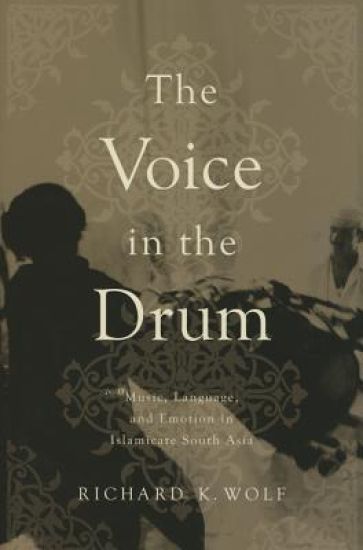
The Voice in the Drum

The Voice in the Drum

Richard K. Wolf

University of Illinois Press
2014
sidottu
Based on extensive field research in India and Pakistan, this new study examines the ways drumming and voices interconnect over vast areas of South Asia and considers what it means for instruments to be voice-like and carry textual messages in particular contexts. Richard K. Wolf employs a hybrid, novelistic form of presentation, in which a fictional protagonist interacts with Wolf's field consultants, to communicate ethnographic and historical realities that transcend the local details of any one person's life. The narrative explores how the themes of South Asian Muslims and their neighbors coming together, moving apart, and relating to God and spiritual intermediaries resonate across ritual and expressive forms such as drumming and dancing. Wolf weaves in the story of a family led by Ahmed Ali Khan, a North Indian ruler who revels in the glories of 19th century life, when many religious communities joined together harmoniously in grand processions. His journalist son Muharram Ali obsessively scours the subcontinent in pursuit of a music he naively hopes will dissolve religious and political barriers. The story charts the breakdown of this naiveté. A daring narrative of music, religion and politics in late twentieth century South Asia, The Voice in the Drum delves into the social and religious principles around which Muslims, Hindus, and others bond, create distinctions, reflect upon one another, or decline to acknowledge differences.
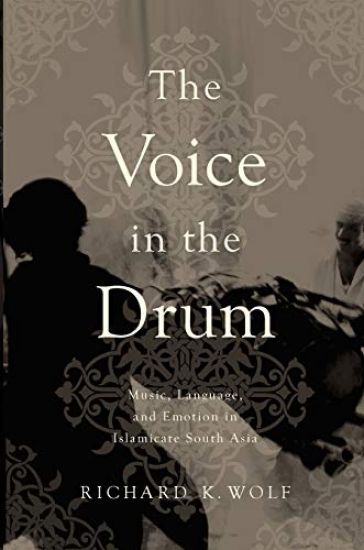
The Voice in the Drum

The Voice in the Drum

Richard K. Wolf

University of Illinois Press
2017
nidottu
Based on extensive field research in India and Pakistan, this new study examines the ways drumming and voices interconnect over vast areas of South Asia and considers what it means for instruments to be voice-like and carry textual messages in particular contexts. Richard K. Wolf employs a hybrid, novelistic form of presentation, in which a fictional protagonist interacts with Wolf's field consultants, to communicate ethnographic and historical realities that transcend the local details of any one person's life. The narrative explores how the themes of South Asian Muslims and their neighbors coming together, moving apart, and relating to God and spiritual intermediaries resonate across ritual and expressive forms such as drumming and dancing. Wolf weaves in the story of a family led by Ahmed Ali Khan, a North Indian ruler who revels in the glories of 19th century life, when many religious communities joined together harmoniously in grand processions. His journalist son Muharram Ali obsessively scours the subcontinent in pursuit of a music he naively hopes will dissolve religious and political barriers. The story charts the breakdown of this naiveté. A daring narrative of music, religion and politics in late twentieth century South Asia, The Voice in the Drum delves into the social and religious principles around which Muslims, Hindus, and others bond, create distinctions, reflect upon one another, or decline to acknowledge differences.
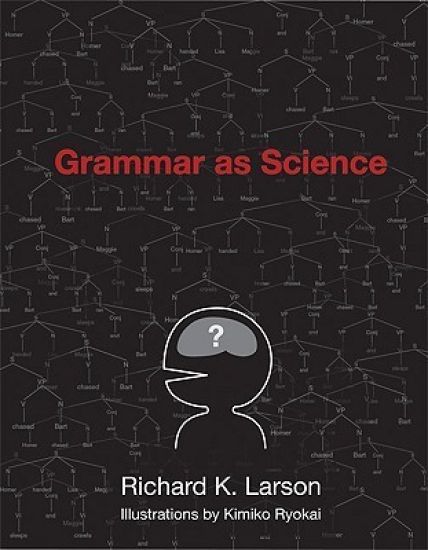
Grammar as Science

Grammar as Science

Richard K. Larson

MIT Press
2009
pokkari
An introduction to the study of syntax that also introduces students to the principles of scientific theorizing.This introductory text takes a novel approach to the study of syntax. Grammar as Science offers an introduction to syntax as an exercise in scientific theory construction. Syntax provides an excellent instrument for introducing students from a wide variety of backgrounds to the principles of scientific theorizing and scientific thought; it engages general intellectual themes present in all scientific theorizing as well as those arising specifically within the modern cognitive sciences. The book is intended for students majoring in linguistics as well as non-linguistics majors who are taking the course to fulfill undergraduate requirements. Grammar as Science covers such core topics in syntax as phrase structure, constituency, the lexicon, inaudible elements, movement rules, and transformational constraints, while emphasizing scientific reasoning skills. The individual units are organized thematically into sections that highlight important components of this enterprise, including choosing between theories, constructing explicit arguments for hypotheses, and the conflicting demands that push us toward expanding our technical toolkit on the one hand and constraining it on the other. Grammar as Science is constructed as a "laboratory science" course in which students actively experiment with linguistic data. Syntactica, a software application tool that allows students to create and explore simple grammars in a graphical, interactive way, is available online in conjunction with the book. Students are encouraged to "try the rules out," and build grammars rule-by-rule, checking the consequences at each stage.
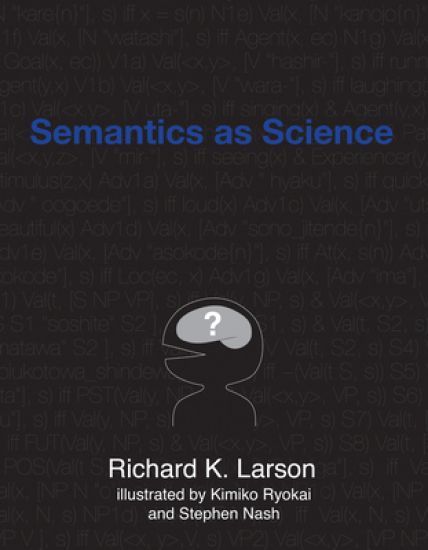
Semantics as Science

Semantics as Science

Richard K. Larson; Kimiko Ryokai

MIT PRESS LTD
2022
nidottu
An introductory linguistics textbook that takes a novel approach: studying linguistic semantics as an exercise in scientific theory construction. This introductory linguistics text takes a novel approach, one that offers educational value to both linguistics majors and nonmajors. Aiming to help students not only grasp the fundamentals of the subject but also engage with broad intellectual issues and develop general intellectual skills, Semantics as Science studies linguistic semantics as an exercise in scientific theory construction. Semantics offers an excellent medium through which to acquaint students with the notion of a formal, axiomatic system--that is, a system that derives results from a precisely articulated set of assumptions according to a precisely articulated set of rules. The book develops semantic theory through the device of axiomatic T-theories, first proposed by Alfred Tarski more than eighty years ago, introducing technical elaboration only when required. It adopts Japanese as its core object of study, allowing students to explore and investigate the real empirical issues arising in the context of non-English structures, a non-English lexicon and non-English meanings. The book is structured as a laboratory science text that poses specific empirical questions, with 25 short units, each of which can be covered in one class session. The layout is engagingly visual, designed to help students understand and retain the material, with lively illustrations, examples, and quotations from famous scholars.
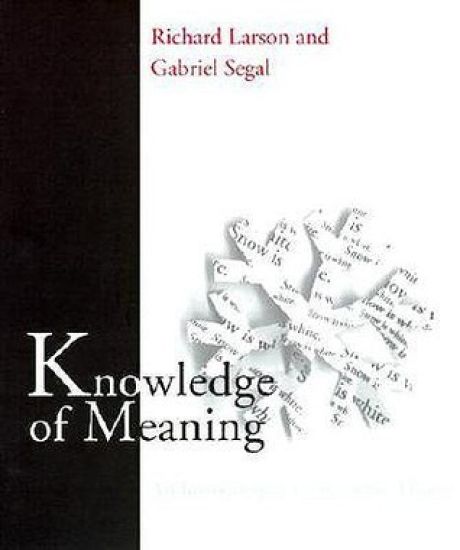
Knowledge of Meaning

Knowledge of Meaning

Richard K. Larson; Gabriel M.A. Segal

Bradford Books
1995
pokkari
Current textbooks in formal semantics are all versions of, or introductions to, the same paradigm in semantic theory: Montague Grammar. Knowledge of Meaning is based on different assumptions and a different history. It provides the only introduction to truth- theoretic semantics for natural languages, fully integrating semantic theory into the modern Chomskyan program in linguistic theory and connecting linguistic semantics to research elsewhere in cognitive psychology and philosophy. As such, it better fits into a modern graduate or undergraduate program in linguistics, cognitive science, or philosophy. Furthermore, since the technical tools it employs are much simpler to teach and to master, Knowledge of Meaning can be taught by someone who is not primarily a semanticist.Linguistic semantics cannot be studied as a stand-alone subject but only as part of cognitive psychology, the authors assert. It is the study of a particular human cognitive competence governing the meanings of words and phrases. Larson and Segal argue that speakers have unconscious knowledge of the semantic rules of their language, and they present concrete, empirically motivated proposals about a formal theory of this competence based on the work of Alfred Tarski and Donald Davidson. The theory is extended to a wide range of constructions occurring in natural language, including predicates, proper nouns, pronouns and demonstratives, quantifiers, definite descriptions, anaphoric expressions, clausal complements, and adverbs.Knowledge of Meaning gives equal weight to philosophical, empirical, and formal discussions. It addresses not only the empirical issues of linguistic semantics but also its fundamental conceptual questions, including the relation of truth to meaning and the methodology of semantic theorizing. Numerous exercises are included in the book.
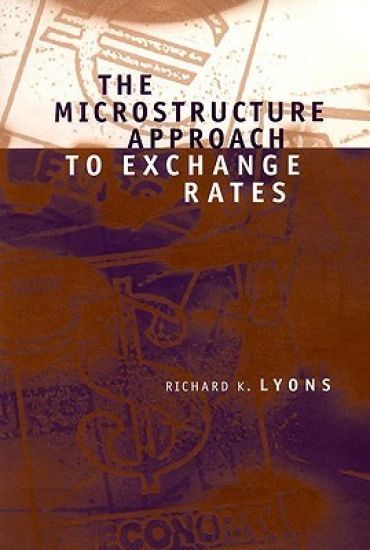
The Microstructure Approach to Exchange Rates
Historically, the fields of exchange-rate economics and microstructure finance have progressed independently of each other. Recent interaction, however, has given rise to a microstructure approach to exchange rates. This book focuses on the economics of financial information and how microstructure tools help to clarify the types of information most relevant to exchange rates.The microstructure approach views exchange rates from the perspective of the trading room, the place where exchange rates are actually determined. Emphasizing information economics over institutional issues, the approach departs from three unrealistic assumptions common to previous approaches: that all information relevant to exchange rates is publicly available, that all market participants are alike in their goals or in how they view information, and that how trading is organized is inconsequential for exchange rates. The book shows how exchange-rate behavior previously thought to be particularly puzzling can be explained using the microstructure approach. It contains a combination of theoretical and empirical work.
Apocalypse Illuminated

Apocalypse Illuminated

Richard K. Emmerson

Pennsylvania State University Press
2018
sidottu
With its rich symbolism, complex narrative, and stunning imagery, the Apocalypse, or Revelation of John, is arguably the most memorable book in the Christian Bible. In Apocalypse Illuminated, Richard Emmerson explores how this striking visionary text is represented across seven centuries of medieval illustrations.Focusing on twenty-five of the most renowned illustrated Apocalypse manuscripts, from the earliest extant Carolingian ones produced in the ninth century to the deluxe Apocalypse made for the dukes of Savoy and completed in 1490, Emmerson examines not only how they illustrate the biblical text, but also how they interpret it for specific and increasingly diverse audiences. He discusses what this imagery shows us about expectations for the Apocalypse as the year 1000 approached, its relationship to Spanish monasticism on the Christian-Muslim frontier and to thirteenth-century Joachimist prophetic beliefs, and the polemical reinterpretations of Revelation that arose at the end of the Middle Ages. The resulting study includes historical and stylistic comparisons, highlights innovative features, and traces iconographic continuities over time, including the recurring apocalyptic patterns, events, figures, and motifs that characterize Apocalypse illustrations throughout the Middle Ages.Gorgeously illustrated and written in lively and accessible prose, this is a masterful analysis of over seven hundred years of Apocalypse manuscripts by one of the most preeminent scholars of medieval apocalypticism.
Prophets of Agroforestry

Prophets of Agroforestry

Richard K. Reed

University of Texas Press
2012
pokkari
For almost four centuries, the indigenous Chiripá (Guaraní) people of eastern Paraguay have maintained themselves as a distinct society and culture, despite continual and often intense relations with Paraguayan society and the international economy. In this study, Richard K. Reed explores the economic and social basis for this ethnic autonomy.Reed finds that Chiripá economic power derives from their practice of commercial agroforestry. Unlike Latin American indigenous societies that have been forced to clear land for commercial agriculture, the Chiripá continue to harvest and sell forest products, such as caffeinated yerba mate, without destroying the forests. Reed also explores the relation of this complex economy to Chiripá social organization and shows how flexible kin ties allowed the Chiripá to adapt to the pressure and opportunities of the commercial economy without adopting the authoritarian nature of rural Paraguayan society.These findings offer important insights into the relations among indigenous groups, nation-states, and the international economy. They also provide a timely alternative model for sustainable management of subtropical forests that will be of interest in the fields of development and environmental studies.
Steinway and Sons

Steinway and Sons

Richard K. Lieberman

Yale University Press
1997
pokkari
The Steinway—once called the "instrument of the immortals"—is more than the preeminent American piano. It is also a symbol of Old World craftsmanship combined with American capitalism, of technological innovation, and of remarkable family management. This authoritative and entertaining book tells the story of the Steinway piano company and the people behind it. The first book based on the rich archive of Steinway business and family papers at LaGuardia Community College in New York, as well as on interviews with family members and company employees in the United States, Germany, and England, Steinway & Sons describes the making and marketing of an American cultural icon. Founded in New York in 1853 by a German immigrant, the Steinway company quickly rose to prominence on the strength of the distinctive "Steinway sound." For five generations Steinways steered their company in the face of vigorous domestic and foreign competition, bitter labor disputes, temperamental musicians, a fluctuating economy, and wars. Members of the Gilded Age elite, the family also contended with adultery, alcoholism, emotional depression, and long court battles over money. Lieberman discusses the company town the Steinways built in Queens in the 1870s to "escape the machinations of the anarchists and socialists" in the city; the decision to manufacture in both New York and Hamburg, which led to Steinway factories supplying both sides in World War II; the improvements in piano technology that made the Steinway the envy of other piano makers; the company's creative marketing techniques, such as booking celebrated European pianists into American concert halls; the competition from the Japanese-owned Yamaha company; and the sale of the financially troubled company to CBS in 1972. Weaving together themes from social, music, business, labor, and immigrant history, and lavishly illustrated with pictures from the Steinway archive, Steinway & Sons is a rich narrative that casts new light on American cultural history and on a unique family enterprise.
Society and Health

Society and Health

Richard K. Thomas

Kluwer Academic/Plenum Publishers
2003
sidottu
For the first time, a guide to the sociology of health and healthcare that addresses the needs of both sociologists and health professionals. Written by a career health professional with a medical sociology background, Thomas applies sociological concepts to current healthcare issues, incorporates the latest findings from health services research, and provides clear examples of the uses of sociology in understanding the U.S. healthcare system. Each chapter contains illustrative boxed material, exhibits highlighting key information, suggested readings, and useful websites for more information. With over 30 years of experience, the author provides valuable insights into the social aspects of health behavior and reveals an in-depth understanding of the social dimensions of the health delivery system. The book is a textbook for students of sociology and health, as well as a reference book for instructors and practitioners in the healthcare and sociology fields.