Kirjojen hintavertailu. Mukana 12 390 323 kirjaa ja 12 kauppaa.

Kirjahaku

Etsi kirjoja tekijän nimen, kirjan nimen tai ISBN:n perusteella.

1000 tulosta hakusanalla Richard Nelson

Left

Left

Richard Nelson

Broadway Play Publishing
2006
nidottu
The Left is personified in Richard Nelson's idealistic and intellectual characters, whose fascinating friendships are as fraught as the political history through which they've lived. "You can't watch LEFT] without thinking about Lillian Hellman, Mary McCarthy, and Diana Trilling. Richard Nelson ... hasn't brought the famous, undignified Hellman/McCarthy/Trilling feud directly onstage, but he invokes their noisy ghosts. They resonate. It's uncanny. Imagine I'M NOT RAPPAPORT with Simon Gray's wit and Doris Lessing's brains. We first meet Marianne, a retired college president, and Eddie, who writes essays on pornography for The New York Review of Books, in the Adirondacks. They are waiting for Elinor, an editor at a Manhattan publishing house, to arrive by motorboat and explain her memoir. In her memoir, Elinor savages her oldest friend, Marianne, as typical of a whole class of I'm-all-right-Jack Upper West side intellectuals who betrayed their youthful idealism in the dreary Cold War years. Eddie, an ex-husband as well as an ex-radical, has been deleted, even from Elinor's index. From the beginning of their m nage trois, Eddie has always been the odd man out. LEFT] is as much consumed by female friendship as it is by left history. Almost immediately, we flash back fifty years to their first visit to the Adirondacks, fresh from college politics in the middle of the Spanish Civil War, looking for money to start a magazine a lot like Partisan Review. We'll go back and forth the rest of the play, until all six of them, the pure of heart and their revised editions, are in the same room, at the same time, a crowd of regrets. These people talk about Joseph Stalin and the Sierra Club, Amnesty International and Saran Wrap, South Africa and skinny-dipping. What they're really talking about is friendship in history. If the person is political, how much so, at what cost and is there any forgiveness? I felt like a spy, switching sides so often in my sympathies." -John Leonard, New York Magazine
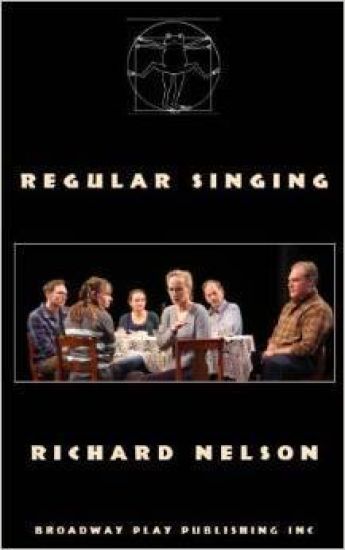
Regular Singing

Regular Singing

Richard Nelson

Broadway Play Publishing
2014
nidottu
Unfolding on the 50th anniversary of John F. Kennedy's assassination, REGULAR SINGING is the final play in Richard Nelson's series chronicling the lives and times of the Apple family in upstate New York. "To my knowledge, no previous works of theater have been topical in the resonant and specific ways as the Apple Family plays. REGULAR SINGING, the fourth and final installment of Richard Nelson's wonderful, sui generis Apple Family plays, this deeply intimate drama is about how we remember our living and our dead ... A rare and radiant mirror of the way we live - and fail to live - now." -Ben Brantley, New York Times "After a holiday weekend, it is natural to miss the family. But the family I'm missing now is named Apple and lives up the Hudson in Rhinebeck. These are the six people with whom I spent intimate, deeply moving and satisfying evenings. The Apple Family: Scenes from Life in the Country is] an extraordinary four-play cycle ... one of the major American plays of our time." -Linda Winer, Newsday "Smart and funny, moving and touching, honest and thoughtful ... The fantastic fourth and final installment in Mr Nelson's Apple Family plays." -Jesse Oxfeld, New York Observer "An extraordinary achievement ... A quietly devastating look at final things, and the last word in the unmatched power of stage naturalism." -Jesse Green, New York Magazine "... bids farewell to the clan we have come to know with almost unbearable intimacy throughout four plays ... These plays approach the question of how we live now with an immediate, nearly pointillist specificity." -Alexis Soloski, The Village Voice "This intensely naturalistic drama consists of hushed, emotionally resonant conversations about matter personal and political, amid laughter, tears, food and drink ... These plays] are civilized ways for an audience (leaning in, listening close) to form a temporary clan with some lovingly rendered fictional creations. It's good to be home." -David Cote, Time Out New York
Hungry

Hungry

Richard Nelson

Broadway Play Publishing
2016
nidottu
"Wonderful...HUNGRY, a work in which nothing much happens beyond some contemplative pre-dinner chatter, may well be the most resonantly topical and emotionally engaging play of this election year." Ben Brantley, New York Times " HUNGRY's] thousand acts of extreme daily realism, from chopping vegetables to the constant dance of interpersonal negotiation, amount to a kind of human politics, dramatizing, as many more 'dramatic' plays cannot, the historic conflict and consolations of living in our country right now." Jesse Green, New York Magazine " Nelson] may just be quietly building a masterwork." Linda Winer, Newsday "If you want to understand the forces driving the current presidential election, pay close attention to this play." The Daily Beast "Richard Nelson's quietly incandescent play HUNGRY, a play that feels as fresh as if it was written this morning..." Jeremy Gerard, Deadline/Hollywood "...delivers the sort of intimacy rarely encountered on the stage." Frank Scheck, The Hollywood Reporter
An American Comedy

An American Comedy

Richard Nelson

Broadway Play Publishing
2016
nidottu
A mock 1930s farce in which hilarity reigns supreme. "...if you can believe that a play can be part ROOM SERVICE, part Das Capital and part His Girl Friday, you've got the premise of the wildly funny AN AMERICAN COMEDY. The play is such an accurate pastiche of the time, that some audiences have taken it for a genuine comedy written in the thirties. There's so many doors slammed, fires put out, trunks shut, typewriters ruined, disrobings, and darts thrown that at times you think you've wandered into a lost Marx Brothers comedy..." Diane Wright, The Herald
Rip Van Winkle, Or "The Works"

Rip Van Winkle, Or "The Works"

Richard Nelson

Broadway Play Publishing
2016
nidottu
Richard Nelson uses the familiar tale of Rip Van Winkle as the basis for his epic study of American agrarian reform, the Industrial Revolution, and the labor movement. "...The play has a smart, engaging premise. Rip Van Winkle's sleep and waking are used to frame a variety of themes: men and women, parents and children, alcoholism, superstition, and, above all, the battle between industry and agriculture in the social history of the Hudson Valley. The style is also interesting: a kind of terse Bondian dialogue in short Brechtian scenes which allow the audience to find its own path between two ends of an imaginative leap..." Erika Munk, The Village Voice
Farewell to the Theatre

Farewell to the Theatre

Richard Nelson

Broadway Play Publishing
2017
nidottu
"I am normally wary of any new play that could be called Chekhovian' it implies something fragile and wispily atmospheric. But Richard Nelson's extraordinary play about the pioneering playwright-director Harley Granville Barker combines a command of realistic detail with a sense of suffering and loss that genuinely evokes the Russian master. As in many of his previous plays, such as Some Americans Abroad, Nelson deals with cultural collision. In this instance, Granville Barker finds himself in Williamstown, Massachusetts, in 1916, surrounded by a group of English refugees. Disillusioned with English theatre, and with his marriage to Lillah McCarthy on the rocks, the great man is making a living by lecturing on the college circuit. This brings him into contact not only with fellow exiles, including a Dickensian recitalist and a love-struck female actor, but also with the deeply poisonous politics of American campus life. At one point, Granville Barker dreams of writing a non-Aristotelian play in which there wouldn't be any doing', only being'. And, in many respects, that is just what Nelson himself has created. There is not a lot of plot: simply a mesmerising record of a group of people all in flight from their own unhappiness. Granville Barker, you feel, is not just escaping London theatre, but also his traumatic memories of a European war to which he was sent to write about the Red Cross. Beatrice, the ex-pat actor, is likewise trying to get away from a doomed marriage by having a passionate affair with an undergraduate. As the twinkling Dickensian points out, they all treat America as if it were a Shakespearean forest that could transform their lives. It may not quite do that but, as Nelson artfully suggests, it does temporarily restore Granville Barker's faith in his chosen medium." Michael Billington, The Guardian
The Return of Pinocchio

The Return of Pinocchio

Richard Nelson

Broadway Play Publishing
2017
nidottu
"Nelson's brief play takes place in a tiny Italian village after the Allied victory in World War II. This village is the birthplace of Pinocchio, the puppet who became a real boy--a fact advertised on a huge billboard decorated with the toy boy's famous smiling face. But the billboard is dilapidated and defaced now; and the pretty town we remember from the opening frames of Walt Disney's movie has become a cesspool of corruption and poverty. Geppetto has been knocked off by black marketeers; Jiminy Cricket is squashed by a bored townsperson before our eyes; theft, abortion, and murder are common occurrences. Pinocchio, now an all-too-human grown-up U S O entertainer (like so many one-time movie stars), arrives at his birthplace with pockets full of U S dollars and cigarettes and dreams about America, where anyone can become a millionaire. Once easy prey for wicked foxes and donkey-boys, Pinocchio is still a gullible na f, and he is soon easily victimized by various villagers. But underneath his easygoing exterior, he's also a dark and frightening figure capable, it is implied, of cruel violence. The script's peak is a long monologue in which Pinocchio tells a village girl about the American dream: becoming a millionaire. All you need is to be ruthless, dishonest, and hardworking. Pinocchio's lecture includes tips on working the night shift (so you can sleep when no one's looking), loan-sharking, cutthroat business practices, secret takeovers, and insurance fraud. This information is delivered with good-natured casualness as Pinocchio sweeps a barroom floor to pay off his debt--except, we notice, he doesn't really do any work, but spends all his time spinning his vision of success American-style...a study in ironic contrast between the surface brightness of Pinocchio's image and the underlying darkness of his reality." Albert Williams, Chicago Reader
The Vienna Notes

The Vienna Notes

Richard Nelson

Broadway Play Publishing
2017
nidottu
Stubbs, a United States senator, writes his memoirs and in so doing exposes to us the discrepancies between the actual events that took place and his recounting of them, which he freely reshapes to his own benefit. When armed terrorists arrive to kidnap the senator, at which point surely the real Stubbs must appear, he shows himself incapable of an honest response even under these circumstances and concerns himself instead with how his reactions might most favorably enhance his public persona. "The political plays of those years mark Nelson's intense response to America's evolution from its left-leaning Post-Watergate era to the 1980 election of Ronald Reagan and the country's turn to the right. Outrage is the tone of voice that unifies much of his work from this period. Taken together, these three plays present a downward moral trajectory. THE VIENNA NOTES shows a politician who literally lives by acting, almost in opposition to reality." from the Introduction to Plays By Richard Nelson, Early Plays Volume Two by Robert Marx
Bal

Bal

Richard Nelson

Broadway Play Publishing
2017
nidottu
Inspired by the Bertolt Brecht play BAAL, Richard Nelson's BAL concerns a thoroughly amoral man who destroys the lives of those around him. "The political plays of those years mark Nelson's intense response to America's evolution from its left-leaning Post-Watergate era to the 1980 election of Ronald Reagan and the country's turn to the right. Outrage is the tone of voice that unifies much of his work from this period." from the Introduction by Robert Marx
Conversations in Tusculum

Conversations in Tusculum

Richard Nelson

Broadway Play Publishing
2018
nidottu
"Set in country villas outside of Rome in the months before Caesar's assassination, Conversations in Tusculum imagines the frustrations of fiery senators and warriors reduced to brooding in self-imposed isolation about the endangered civil freedoms of their republic... A portrait of the guilt of being merely intellectual when the world demands something more." Ben Brantley, The New York Times "Mr Nelson has charted how the chaos of the world enters in the first place: slight by slight, betrayal by betrayal, injustice by injustice, conversation by conversation." Eric Grode, The New York Sun " CONVERSATIONS IN TUSCULUM] feels a little like Chekhov, and means to remind us of the power-hungry men currently in charge in Washington. Nelson's script, basically faithful to history, is written in a 21st-century vernacular that casts these men as Wall Street or Movie moguls on their days off. TUSCULUM is a taste well worth acquiring." Elizabeth Zimmer, Metro