Kirjojen hintavertailu. Mukana 11 699 587 kirjaa ja 12 kauppaa.

Kirjahaku

Etsi kirjoja tekijän nimen, kirjan nimen tai ISBN:n perusteella.

1000 tulosta hakusanalla Richard P. Cobb

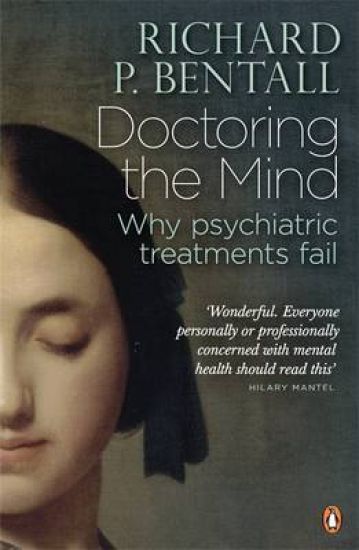
Doctoring the Mind

Doctoring the Mind

Richard P Bentall

Penguin Books Ltd
2010
pokkari
Why is the Western world's treatment of mental illness so flawed? Who really benefits from psychiatry? And why would a patient in Nigeria have a much greater chance of recovery than one in the UK? In Doctoring the Mind, leading clinical psychologist Richard Bentall reveals the shocking truths behind the system of mental health care in the West. With a heavy dependence on pills and the profit they bring, psychiatry has been relying on myths and misunderstandings of madness for too long, and builds on methods which can often hinder rather than help the patient. Bentall argues passionately for a new future of mental health, one that considers the patient as an individual and redefines our understanding and treatment of madness for the twenty-first century.
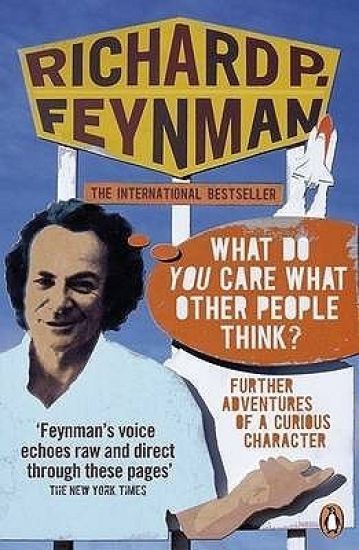
'What Do You Care What Other People Think?'

'What Do You Care What Other People Think?'

Richard P Feynman

Penguin Books Ltd
2007
pokkari
What Do You Care What Other People Think? Further Adventures of a Curious Character is a captivating collection of reminiscences from freewheeling scientific genius Richard P. Feynman. Richard Feynman - Nobel Laureate, teacher and iconic intellect - possessed an unquenchable thirst for an adventure and an unparalleled gift for telling the extraordinary stories of his life. In this collection of short pieces Feynman describes everything from his love of beauty to college pranks to how his father taught him to think. He takes us behind the scenes of the space shuttle Challenger investigation, where he dramatically revealed the cause of the disaster with a simple experiment. And he tells us of how he met his beloved first wife Arlene, and their brief time together before her death. Sometimes intensely moving, sometimes funny, these writings are infused with Feynman's curiosity and passion for life. 'Feynman's voice echoes raw and direct through these pages' The New York Times 'Outrageously gifted, iconoclastic, irrepressible ... Richard Feynman still has the capacity to suprise' Observer 'One of the greatest minds of the twentieth century ... he was also stubborn, irreverent, playful, intensely curious and highly original in practically everything he did' New York Review of Books 'If more scientists were like Feynman, the world really would be a better, and better understood, place' Independent on Sunday Richard P. Feynman (1918-1988) was one of this century's most brilliant theoretical physicists and original thinkers. Feynman's other books, also available in Penguin, include QED, Six Easy Pieces, Six Not-so-Easy Pieces, Don't You Have Time to Think, The Pleasure of Finding Things Out, What Do You Care What Other People Think? and The Meaning of it All.
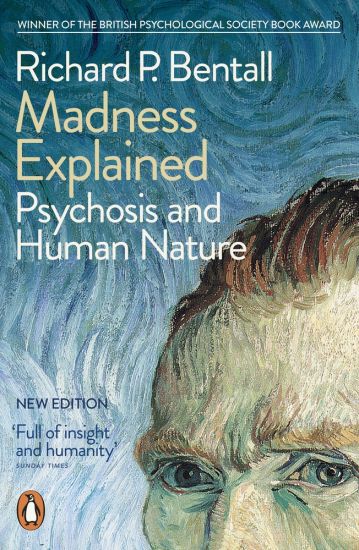
Madness Explained

Madness Explained

Richard P Bentall

PENGUIN BOOKS LTD
2026
pokkari
A revised edition of Madness Explained, Richard Bentall's groundbreaking classic on mental illness In Madness Explained, leading clinical psychologist Richard Bentall shatters the modern myths that surround psychosis. Is madness purely a medical condition that can be treated with drugs? Is there a clear dividing line between who is sane and who is insane? For this revised edition, he adds new material drawing on the recent advances in molecular genetics, new studies of the role of environment in psychosis, and important discoveries on early symptoms preceding illness, among other important developments in our understanding.'Madness Explained is a substantial, yet highly accessible work. Full of insight and humanity, it deserves a wide readership.' Sunday Times 'Will give readers a glimpse both of answers to their own problems, and to questions about how the mind works' Independent Magazine Richard P. Bentall holds a Chair in Experimental Clinical Psychology at the University of Manchester. In 1989 he received the British Psychological Society's May Davidson Award for his contribution to the field of Clinical Psychology.
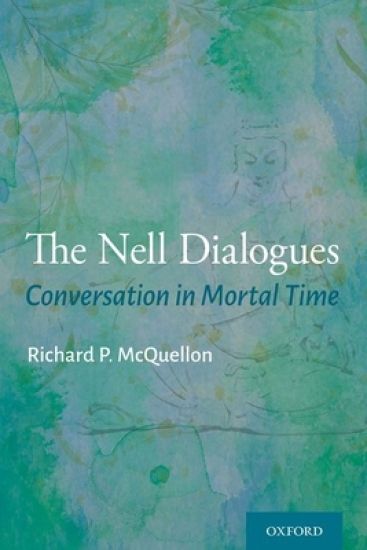
The Nell Dialogues

The Nell Dialogues

Richard P. McQuellon

OXFORD UNIVERSITY PRESS INC
2022
nidottu
Nell M. came to her therapist with an unusual problem. She was disappointed that her metastatic breast cancer was not progressing as predicted. She had hoped breast cancer would lead to death, preventing her from witnessing her spouse's mental deterioration from Alzheimer's disease. This is how Nell's story began. As Nell became increasingly aware of her death on the near horizon, the therapy sessions with the author were recorded and transcribed. The Nell Dialogues: Conversation in Mortal Time consists of twelve of Nell's illness narratives that explore the challenges of managing the physical and emotional demands of cancer, relationship issues with family and health care professionals, and disturbing, anxiety provoking thoughts as well as the mourning that accompanies the end of life. These dialogues trace Nell's acceptance of, and struggle with, the practical obstacles to achieving a good death. They also offer a window on the world of patients and their caregivers facing a life-threatening illness together. A commentary by the author accompanies each dialogue, giving the reader insights on the therapist's thinking during the counselling sessions and offering context and lessons learned from them. Nell's vibrant voice is a beacon throughout the narratives, sometimes sad, yet always hopeful for a good death. Her ability to navigate the difficult territory of mortal time and dying informs the reader about how death might be approached with grace and dignity.
The Society of the Muslim Brothers

The Society of the Muslim Brothers

Richard P. Mitchell; John O. Voll

Oxford University Press Inc
1993
nidottu
Since its first publication in 1969, this book continues to be routinely cited as the standard source for the history of the revivalist Egyptian movement, the Muslim Brethren, up to the time of Nasser. This classic work is now accessible to a new generation of scholars and students interested in the Muslim revival. Professor John Voll of the University of New Hampshire, a leading scholar of Islam in the English speaking world, contributes a Foreword to the paperback edition.
Democracy, Risk, and Community

Democracy, Risk, and Community

Richard P. Hiskes

Oxford University Press Inc
1998
sidottu
This controversial book explores the connection between technological risk and basic concepts of liberal political theory and practice. Arguing that modern risks are emergent and therefore not reducible to individual actors or events, Hiskes demonstrates how risks challenge the most basic concepts of liberal political theory and democratic politics, including the ideas of consent, authority, rights, and moral responsibility. He argues forcefully that successful policy for risk depends on understanding the dynamic between risk and liberal concepts.
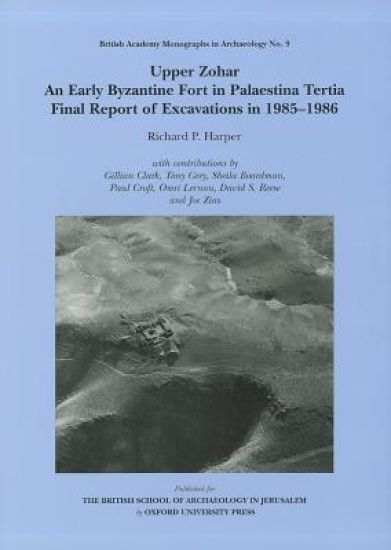
Upper Zohar

Upper Zohar

Richard P. Harper

Oxford University Press
1995
sidottu
The final report of excavations undertaken by the British School of Archaeology in Jerusalem. The fort dates from the late fifth to early seventh centuries and was the first such fort to have been fully investigated. It was a small but strategically placed military installation which provided evidence for the late antique military system and the daily life of traders and travellers. The preservation conditions in the dry sand resulted in some remarkable finds and interesting zooarchaeological records.
Belmont Castle: The Excavation of a Crusader Stronghold in the Kingdom of Jerusalem
This is the final definitive publication of the excavations that were conducted by the British School of Archaeology in Jerusalem on the site of the Crusader castle of Belmont (Suba), in the Judaean hills west of Jerusalem, between 1986 and 1989. The excavations and associated documentary research indicate that Belmont began its existence as a manor house or maison-forte in the first half of the twelfth century; at that time it probably represented the country seat of a fief-holding knight on the royal domain. By the 1140s, however, the area in which Belmont lay had been acquired by the Hospital of St John, which subsequently developed nearby Abu Ghosh (identified as biblical Emmaus) as the centre for an extensive estate. Following the Hospitallers takeover, while another former maison-forte, Aqua Bella, was converted into a priory or infirmary building, Belmont was extended and developed as a concentric castle, dominating the landscape round about. A polygonal outer ward was added to the original rectangular maison-forte on the top of the hill, and ranges of vaulted buildings were constructed within it. This castle fell to Saladin in 1187, and was slighted by the Ayyubids in 1191. After this, the site was occupied by a village until 1948. The account of the excavation is preceded by a historical introduction and a discussion of the castles archaeological setting. It is followed by specialist reports on the coins and tokens, pottery, ceramic lamps, Persian seal impressions, glass, metalwork, clay tobacco pipes, and objects of stone, bone and terracotta. A detailed analysis and discussion is provided of the faunal remains; and a concluding chapter discusses the castles architecture and planning, its military functions, and its economic role within an agricultural estate that developed in the later twelfth century to produce food and revenue for the Hospital in Jerusalem.
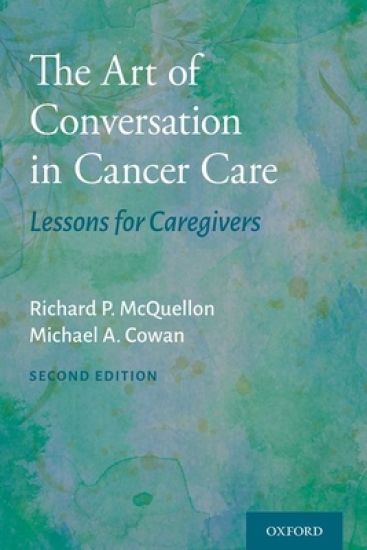
The Art of Conversation in Cancer Care

The Art of Conversation in Cancer Care

Richard P. McQuellon; Michael A. Cowan

OXFORD UNIVERSITY PRESS INC
2021
nidottu
Every day, thousands of people are diagnosed with cancer or other life-threatening illnesses. Despite the best of intentions, it is not always easy to communicate well under these circumstances or find deep empathy for something one has never experienced. When is it best to speak, and when to be silent? How can someone provide real comfort, and how can relationships with loved ones facing serious illness be enhanced in this most difficult time? Written by a psychosocial oncologist and psychologist-theologian, The Art of Conversation in Cancer Care: Lessons for Caregivers offers practical suggestions for health professionals, families, and friends about talking to one who has cancer. This revised and updated second edition is organized around the themes of mortal time and healing conversation with cancer patients and their caregivers. Mortal time is not so much a specific period, but rather, the psychological experience encountering mortality that often accompanies the diagnosis of cancer. The first section of the book articulates the many ways people experience mortal time, including a range of adaptive and less adaptive methods. Next, the basic elements of healing conversation are delineated, with an emphasis on the hope that can spring from talking with a trusted companion. Empathy, listening carefully, and responding thoughtfully and compassionately are discussed. In the final section, the authors offer guidance for caregivers. This section includes material on the risks and costs of companionship as well as personal virtues that help a person navigate the demands of mortal time with their loved one. The authors discuss resilience and the consequences of absorbing suffering including empathy shift where the cancer caregiver becomes less empathic with minor illnesses in others. They conclude with the power of healing conversation in mortal time as a source of hope. Throughout, numerous patient vignettes illustrate the art of conversation in cancer medicine.
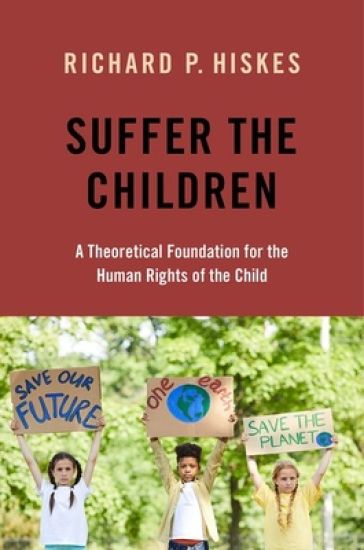
Suffer the Children

Suffer the Children

Richard P. Hiskes

Oxford University Press Inc
2021
sidottu
In 1973, Hillary Rodham Clinton famously stated that "children's rights" is a slogan in search of a definition, used to bolster various arguments for peace and for specific rights, but without any coherent conception of children as political beings. In 1989, the United Nations established the basis for this definition in the Convention on the Rights of the Child (CRC), a document every nation in the world, save the United States, has ratified. Still, human rights theorists, scholars, and jurists continue to disagree as to the theoretical justification for children's human rights. In Suffer the Children, Richard P. Hiskes establishes the first substantive theoretical foundation for the human rights of children. As Hiskes argues, recognizing the rights of children fundamentally alters the meaning and usefulness of human rights in a global context. Ironically, the case for children's rights, as Hiskes argues, should be seen as the evolution, distillation, or "maturing" of human rights in general. Children's human rights will end the debate about whether groups can have rights because, globally, many rights claims today are precisely group claims, including those from children. Moreover, Hiskes provides a new critical assessment of the United Nations CRC and explores child activism for human rights worldwide--in courts, on social networks, and in public demonstrations--to show how children are already claiming their rights in ways that will fundamentally change the meaning both of rights themselves and of democratic processes. Giving children rights in a way that avoids privileging any single cultural experience of children would make rights no longer a "Western," individualistic idea, but a truly global one.
Suffer the Children

Suffer the Children

Richard P. Hiskes

Oxford University Press Inc
2021
nidottu
In 1973, Hillary Rodham Clinton famously stated that "children's rights" is a slogan in search of a definition, used to bolster various arguments for peace and for specific rights, but without any coherent conception of children as political beings. In 1989, the United Nations established the basis for this definition in the Convention on the Rights of the Child (CRC), a document every nation in the world, save the United States, has ratified. Still, human rights theorists, scholars, and jurists continue to disagree as to the theoretical justification for children's human rights. In Suffer the Children, Richard P. Hiskes establishes the first substantive theoretical foundation for the human rights of children. As Hiskes argues, recognizing the rights of children fundamentally alters the meaning and usefulness of human rights in a global context. Ironically, the case for children's rights, as Hiskes argues, should be seen as the evolution, distillation, or "maturing" of human rights in general. Children's human rights will end the debate about whether groups can have rights because, globally, many rights claims today are precisely group claims, including those from children. Moreover, Hiskes provides a new critical assessment of the United Nations CRC and explores child activism for human rights worldwide--in courts, on social networks, and in public demonstrations--to show how children are already claiming their rights in ways that will fundamentally change the meaning both of rights themselves and of democratic processes. Giving children rights in a way that avoids privileging any single cultural experience of children would make rights no longer a "Western," individualistic idea, but a truly global one.
Chemistry of Atmospheres

Chemistry of Atmospheres

Richard P. Wayne

Oxford University Press
2000
nidottu
Atmospheric chemistry has been the focus of much research activity in recent years, and there is now heightened public awareness of the environmental issues in which it plays a part. In a clear, readable style, this important book looks at the insights and interpretations afforded by the research, and places in context the exciting, dramatic, and sometimes disturbing findings. Like its highly successful predecessor, this new edition lays down the principles of atmospheric chemistry and provides the necessary background for more detailed study. The text has been thoroughly revised and expanded throughout to take into account recent advances in atmospheric science that include a host of new atmospheric measurements, extended laboratory experiments, ever more sophisticated models, and ingenious interpretations of the phenomena. Heterogeneous processes are now known to be of great significance in the chemistry of the Earth's atmosphere, and new sections of the book discuss the influence of such processes on both the stratosphere and the troposphere. A major eruption, that of Mount Pinatubo, has highlighted how volcanoes can influence 'natural' atmospheric chemistry, and the opportunity is taken to examine the effects of the gases and particles produced in such eruptions. The startling discovery of the 'Antarctic ozone hole' has now been matched by observations of similar ozone losses in the Arctic; both phenomena are explored in more depth than before, and the whole question of trends in stratospheric ozone concentrations is updated. New topics in tropospheric chemistry that are discussed in this edition for the first time include the atmospheric chemistry of biogenic hydrocarbons, of aromatic compounds, and of halogens and halogen-containing species. Several aspects have been added to the examination of air pollution, including the effects of biomass burning. Rapid changes in the composition of the Earth's atmosphere, apparently a result of man's activities, are apparently even having an effect on global climate, and recent assessments of the Intergovernmental Panel on Climate Change are presented in this context. Air transport continues to expand, and the influence of aircraft on atmospheric chemistry and, indeed, on climate has excited interest that is explained here. Moving away from Earth, information gathered by the Voyager, Galileo, and other space missions, which have provided a new understanding of the atmosphere of the planets other than our own, is also discussed and brought up to date. This book does not attempt to suggest answers to the environmental problems facing us, but it lays the foundations for the study of atmospheric chemistry on which rational decisions will need to be based. A multidisciplinary approach is taken throughout in order to highlight the interplay between the atmosphere of a planet and other parts of the environment. This feature makes the book full of interest for chemists, physicists, biologists, and other scientists alike, and accessible to all of them. Readers will find the book an excellent introduction to an exciting topic, and a fascinating source of information about a part of science that is proving to be of key importance.
Chemical Instrumentation

Chemical Instrumentation

Richard P. Wayne

Oxford University Press
1994
nidottu
Instrumentation, often of a highly sophisticated kind, lies behind many of the most interesting aspects of contemporary chemistry. Some techniques - such as NMR - owe their existance to electronic instrumentation; others have been made simpler, more reliable, and more precise. Yet undergraduates reading chemistry often have only the most rudimentary understanding to be performed. This book aims to introduce chemists to some of the building blocks and devices that make up the most important instruments used in industry and research. It is not a book about electronics or about detailed circuit design, though the first chapter reviews the principles. Simple measuring devices are discussed before the introduction of the constituent elements of more complex devices, and emphasis is given to the enhancement of signal-to-noise ratios, which often lies at the heart of some of the most demanding measurements in the chemical sciences. This clearly written text will provide a basic understanding of how instrumentation works and thus help chemists use what is available both correctly and effectively.
Photon-hadron Interactions

Photon-hadron Interactions

Richard P. Feynman

Westview Press Inc
1972
nidottu
In these classic lectures, Feynman analyses the theoretical questions related to electron and photon interactions at high energies. These lectures are based on a special topics course taught by Feynman at Caltech in 1971 and 1972. The material is dealt with on an advanced level and includes discussions of vector meson dominance and deep inelastic scattering. The possible consequences of the parton model are also analyzed.
Statistical Mechanics

Statistical Mechanics

Richard P. Feynman

Westview Press Inc
1998
nidottu
This classic graduate lecture note volume on statistical mechanics focuses on Physics, rather than mathematics. It provides a concise introduction to basic concepts and a clear presentation of difficult topics, while challenging the student to reflect upon as yet unanswered questions.
From Child Abuse to Foster Care

From Child Abuse to Foster Care

Richard P. Barth; Mark E. Courtney; Jill Duerr Berrick; Vicky N. Albert

AldineTransaction
2010
nidottu
More than two million child abuse reports are filed annually on behalf of children in the United States. Each of the reported children becomes a concern, at least temporarily, of the professional who files the report, and each family is assessed by additional professionals. A substantial number of children in these families will subsequently enter foster care. Until now, the relationships between the performance of our child welfare system and the growth and outcomes of foster care have not been understood. In an effort to clarify them, Barth and his colleagues have synthesized the results of their longitudinal study in California of the paths taken by children after the initial abuse report: foster care, a return to their homes, or placement for adoption. Because of the outcomes of child welfare services in California have national significance, this is far more than a regional study. It provides a comprehensive picture of children's experiences in the child welfare system and a gauge of the effectiveness of that system. The policy implications of the California study have bearing on major federal and state initiatives to prevent child abuse and reduce unnecessary foster and group home care.
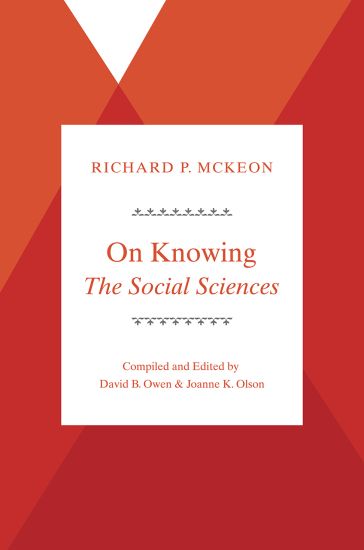
On Knowing--The Social Sciences

On Knowing--The Social Sciences

Richard P. McKeon

University of Chicago Press
2017
sidottu
As a philosopher, Richard McKeon spent his career developing Pragmatism in a new key, specifically by tracing the ways in which philosophic problems arise in fields other than philosophy—across the natural and social sciences and aesthetics—and showed the ways in which any problem, pushed back to its beginning or taken to its end, is a philosophic problem. The roots of this book, On Knowing—The Social Sciences, are traced to McKeon’s classes where he blended philosophy with physics, ethics, politics, history, and aesthetics. This volume—the second in a series—leaves behind natural science themes to embrace freedom, power, and history, which, McKeon argues, lay out the whole field of human action. The authors McKeon considers—Hobbes, Machiavelli, Spinoza, Kant, and J. S. Mill—show brilliantly how philosophic methods work in action, via analyses that do not merely reduce or deconstruct meaning, but enhance those texts by reconnecting them to the active history of philosophy and to problems of ethics, politics, and history. The waves of modernism and post-modernism are receding. Philosophic pluralism is now available, fully formulated, in McKeon’s work, spreading from the humanities to the social sciences.
On Knowing--The Social Sciences

On Knowing--The Social Sciences

Richard P. McKeon

University of Chicago Press
2017
nidottu
As a philosopher, Richard McKeon spent his career developing Pragmatism in a new key, specifically by tracing the ways in which philosophic problems arise in fields other than philosophy—across the natural and social sciences and aesthetics—and showed the ways in which any problem, pushed back to its beginning or taken to its end, is a philosophic problem. The roots of this book, On Knowing—The Social Sciences, are traced to McKeon’s classes where he blended philosophy with physics, ethics, politics, history, and aesthetics. This volume—the second in a series—leaves behind natural science themes to embrace freedom, power, and history, which, McKeon argues, lay out the whole field of human action. The authors McKeon considers—Hobbes, Machiavelli, Spinoza, Kant, and J. S. Mill—show brilliantly how philosophic methods work in action, via analyses that do not merely reduce or deconstruct meaning, but enhance those texts by reconnecting them to the active history of philosophy and to problems of ethics, politics, and history. The waves of modernism and post-modernism are receding. Philosophic pluralism is now available, fully formulated, in McKeon’s work, spreading from the humanities to the social sciences.
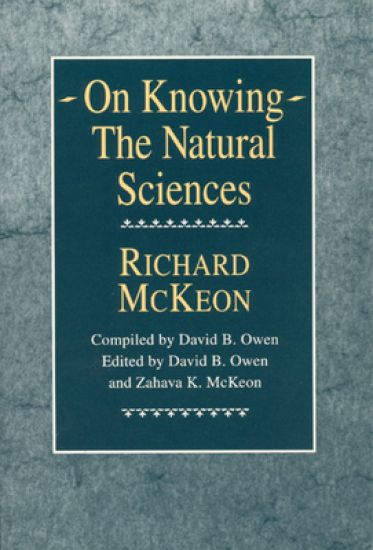
On Knowing--The Natural Sciences

On Knowing--The Natural Sciences

Richard P. McKeon

University of Chicago Press
1994
sidottu
This text is a transcription of a full course, including both lectures and student discussions, taught by McKeon. As such, it provides an introduction to McKeon's conception of pluralism, a central aspect of neo-Pragmatism, while demonstrating how pluralism works in a classroom setting. In his lectures, McKeon outlines the history of Western thinking on the sciences. Treating the central concepts of motion, space, time and cause, he traces modern intellectual debates back to the ancient Greeks, notably Plato, Aristotle, Democritus and the Sophists. As he brings the story of Western science up to the 20th century, he uses his fabled semantic schema to uncover ideas and observations about cosmology, mechanics, dynamics and other aspects of physical science. Illustrating the broad historical sweep of the lectures are a series of discussions which give detail to the course's intellectual framework.