Kirjojen hintavertailu. Mukana 12 458 022 kirjaa ja 12 kauppaa.

Kirjahaku

Etsi kirjoja tekijän nimen, kirjan nimen tai ISBN:n perusteella.

1000 tulosta hakusanalla Richard Price

Observations on the Nature of Civil Liberty, the Principles of Government, and the Justice and Policy of the war With America To Which is Added, an Appendix, Containing, a State of the National Debt, By Richard Price, [fifth ed]
The 18th century was a wealth of knowledge, exploration and rapidly growing technology and expanding record-keeping made possible by advances in the printing press. In its determination to preserve the century of revolution, Gale initiated a revolution of its own: digitization of epic proportions to preserve these invaluable works in the largest archive of its kind. Now for the first time these high-quality digital copies of original 18th century manuscripts are available in print, making them highly accessible to libraries, undergraduate students, and independent scholars.Delve into what it was like to live during the eighteenth century by reading the first-hand accounts of everyday people, including city dwellers and farmers, businessmen and bankers, artisans and merchants, artists and their patrons, politicians and their constituents. Original texts make the American, French, and Industrial revolutions vividly contemporary.++++The below data was compiled from various identification fields in the bibliographic record of this title. This data is provided as an additional tool in helping to insure edition identification: ++++Huntington LibraryN041501Edition statement from preface - Tables included in pagination.London: printed for T. Cadell] in the year, 1776. 48p.: tables; 8
Observations on the Importance of the American Revolution, and the Means of Making it a Benefit to the World. By Richard Price, D.D. L.L.D. and Fellow of the Royal Society of London
The 18th century was a wealth of knowledge, exploration and rapidly growing technology and expanding record-keeping made possible by advances in the printing press. In its determination to preserve the century of revolution, Gale initiated a revolution of its own: digitization of epic proportions to preserve these invaluable works in the largest archive of its kind. Now for the first time these high-quality digital copies of original 18th century manuscripts are available in print, making them highly accessible to libraries, undergraduate students, and independent scholars.Delve into what it was like to live during the eighteenth century by reading the first-hand accounts of everyday people, including city dwellers and farmers, businessmen and bankers, artisans and merchants, artists and their patrons, politicians and their constituents. Original texts make the American, French, and Industrial revolutions vividly contemporary.++++The below data was compiled from various identification fields in the bibliographic record of this title. This data is provided as an additional tool in helping to insure edition identification: ++++Library of CongressW002326The Massachusetts Historical Society copy does not include the statement of price in the imprint. Publishers' prospectus, p. 62]. Philadelphia]: London, printed, and Philadelphia: re-printed by M. Carey and Co. for W. Spotswood, J. Rice, and T. Seddon, booksellers, in Market Street, M, DCC, LXXXV. 1785] Price one-shilling. 2],60, 2]p.; 22 cm
Richard Price

Richard Price

VDM Publishing House
2010
nidottu
Observera att förlaget som ger ut denna produkt baserar innehållet i sina produkter på fria källor som Wikipedia. Boken är med stor sannolikhet endast ett utdrag ur dessa informationskällor, alltså inte en vanlig bok i den bemärkelsen.
Richard Price and the Ethical Foundations of the American Revolution
Richard Price was a loyal, although dissenting, subject of Great Britain who thought the British treatment of their colonies as wrong, not only prudentially, financially, economically, militarily, and politically, but, above all, morally wrong. He expressed these views in his first pamphlet early in 1776. It concluded with a plea for the cessation of hostilities by Great Britain and reconciliation. Its analyses, arguments, and conclusions, however, along with its admiration for the colonists, their moral position and qualities, could hardly fail to contribute to their reluctant recognition that there was no real alternative to independence. Price found some of his views not only misunderstood but vilified by negative critics in the ensuing controversy. So he wrote a second pamphlet which was published in early 1777. He expanded his analysis of liberty, extended its application to the war with America, and greatly expanded his discussion of the economic impact upon Great Britain. After the war, in 1784, he published a third pamphlet on the importance of the American Revolution and the means of making it a benefit to the world, appending an extensive letter from the Frenchman, Turgot. Implicitly the letter regards Price as a perceptive theorist of the revolution; explicitly it identifies the problems facing the prospective new nation and expresses a wish that it will fulfill its role s the hope of the world. Selections in the appendices present a part of the pamphlet controversy and the selection of correspondence shows how seriously Price was regarded by Revolutionary leaders.
Richard Price and the Foundation of Virtue

Richard Price and the Foundation of Virtue

Francesco Allegri

Mimesis International
2022
nidottu
Although little known, Richard Price’s A Review of the Principal Questions in Morals (1758) is one of the most important texts of eighteenth-century moral philosophy. Hastings Rasdhall described it “as the best work published on Ethics till quite recent times” because it “contains the gist of the kantian doctrine without Kant’s confusions”; C. D. Broad pointed out in this regard that “until Ross published his book The Right and the Good in 1930” there existed “no statement and defence of what may be called the ‘rationalistic type’ of ethical theory comparable in merit to Price’s”; and W. D. Hudson considered A Review to be “probably the best statement of the case for rational intuitionism which has ever been written”. The current volume aims to demonstrate, through a rigorous analysis of the text itself, the full validity of these previous evaluations, highlighting in particular that in the Review it is possible to find many of the traits that characterize the ethical reflection of our own times, such as the need to focus attention on the meaning of terms in order to clarify and resolve disputes; the identification of different levels and types of investigation and the need to keep them separate; the thesis that moral judgments are not definable in non-moral terms; the criticism of all forms of normative monism; the non-absolute nature of ethical principles; the need to distinguish the moral properties of the agent from those of action. Focusing on details, we owe to Price the distinction between meta-ethics and normative ethics, as well as the first systematic application of the open question argument, (the argument by which in the twentieth century all attempts to reduce moral concepts to non-moral concepts have been accused of failing into the “naturalistic fallacy”). But it also provides a model for critiquing utilitarianism that has found great fortune in contemporary moral philosophy; an early intuition of the status of prima facie or pro tanto duties of basic ethical principles; the distinction between what is subjectively right and what is objectively right. Despite being much less famous, Price’s Review can stand up to comparison with the greatest classics of eighteenthth-century Anglo-Saxon ethics, such as Hume’s Enquiry Concerning the Principles of Morals or Adam Smith’s Theory of Moral Sentiments.
The Correspondence of Richard Price: July 1748-March 1778 v. 1
This third volume in the series completes the known extant correspondence of Richard Price (1732-1791). Perhaps best known as a political philosopher, Price made significant contributions to Anglo-American intellectual life in the late 18th century in a variety of fields. This collection of letters covers a range of topics including religion, theology, politics, education, liberty, finance, demography and insurance. Price's correspondence with Adams, Franklin, Jefferson, Rush and other Americans concern issues of slavery, the rebellion in Massachusetts, use of paper money, opposition to the establishment of religion, and the status of the federal government. Letters to Priestly, Lansdowne and others in Britain are about science and technology, the crisis in the United Provinces, armed neutrality, the national debt, revolution, religious sects and foreign relations. In his correspondence with French leaders following the fall of the Bastille, particularly with le Duc de la Rochefoucauld, Price expresses his high hopes for the growth of civil and religious freedom in France.
The Correspondence of Richard Price, Volume II
Perhaps best known as a political philosopher, Richard Price (1723–1791) made important contributions to British and American intellectual life in a variety of fields-philosophy, theology, mathematics, demography, probability and public finance, and private and social insurance. The second in a three-volume series edited by W. Bernard Peach and D. O. Thomas, The Correspondence of Richard Price makes available the extant copies of the correspondence to and from Price, including many published for the first time. These letters reveal Price's absorption with financial problems, his influence on the policies adopted by the British government, his defense of Newtonianism against Lord Monboddo, as well as important insights into the political and cultural life in Britain and America. Correspondents include John Adams, William Adams, J. D. van der Capellen, Benjamin Franklin, Thomas Jefferson, Henry Laurens, Lord Monboddo, William Pitt, Joseph Priestly, the Earl of Shelburne, Ezra Stiles, P. W. Wargentin, and Joseph Willard.
The Correspondence of Richard Price, Volume III
This third and final volume in the series completes the known extant correspondence of Richard Price (1723-1791). Perhaps best known as a political philosopher, Price made significant contributions to Anglo-American intellectual life in the late eighteenth century in a variety of fields. This remarkable collection of letters, most previously unpublished, is impressive for the breadth of topics covered--religion, theology, politics, education, liberty, finance, demography, and insurance. Price's correspondence with Adams, Franklin, Jefferson, Rush, and other Americans concern the issues of slavery, the rebellion in Massachusetts, use of paper money, opposition to the establishment of religion, and the status of the federal government. Letters to Priestly, Lansdowne, and others in Britain are about science and technology, the crisis in the United Provinces, armed neutrality, the national debt, revolution, religious sects, and foreign relations. In his correspondence with French leaders following the fall of the Bastille, particularly with le Duc del la Rochefoucauld, Price expresses his high hopes for the growth of civil and religious freedom in France. Indispensable for an understanding of the work of one of the best known and most distinguished Welshmen of the eighteenth century, this book-and the series-will also be of interest to those who study the history of ideas.
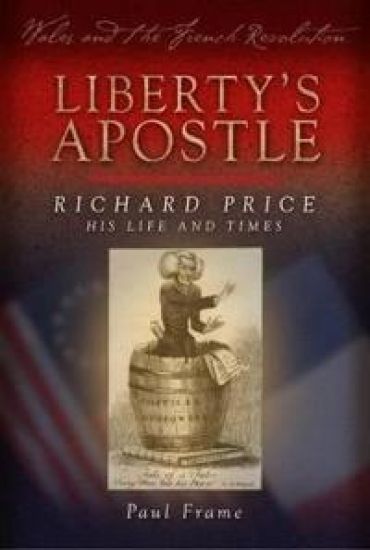
Liberty's Apostle - Richard Price, His Life and Times

Liberty's Apostle - Richard Price, His Life and Times

Paul Frame

University of Wales Press
2015
nidottu
Born in the village of Llangeinor, near Bridgend in south Wales, Richard Price (1723–91) was, to his contemporaries, an apostle of liberty, an enemy to tyranny and a great benefactor of the human race. His friend Benjamin Franklin described aspects of his work as ‘the foremost production of human understanding that this century has afforded us’. A supporter of the American and French Revolutions, Price corresponded with the likes of Jefferson, Adams, Washington, Mirabeau and Condorcet. In November 1789 he publicly welcomed the start of the French Revolution and thus inspired not only Edmund Burke to write his rebuttal in Reflections on the Revolution in France, but also the Revolution Controversy, ‘the most crucial ideological debate ever carried on in English’. Price also brought to world attention the Bayes-Price Theorem on probability, which is the invisible background to so much in modern life, and wrote a fundamental text on moral philosophy. Yet, despite all this and more, he remains little-known beyond academia, a situation that this biography helps to rectify. Liberty’s Apostle tells his life story through his published works and, fully for the first time, his now published correspondence with a host of eighteenth century celebrities. The life revealed is of a truly remarkable Welshman and, as Condorcet remarked, of ‘one of the formative minds’ of the eighteenth century Enlightenment.
Torchbearer of Freedom: The Influence of Richard Price on Eighteenth Century Thought
Torchbearer of Freedom: The Influence of Richard Price on Eighteenth Century Thought is a book written by Carl B. Cone. The book explores the life and work of Richard Price, a prominent figure in the intellectual and political landscape of the eighteenth century. Price was a philosopher, theologian, and political activist who played a significant role in the American and French Revolutions. The book provides a comprehensive overview of Price's life and ideas, tracing his intellectual development from his early years as a dissenting minister to his later work as a political theorist. Cone examines Price's contributions to a wide range of fields, including theology, philosophy, economics, and politics. One of Price's most significant contributions was his defense of individual liberty and human rights, which he articulated in his influential work, A Discourse on the Love of Our Country. Cone explores how Price's ideas influenced the thinking of other prominent figures of the time, such as Thomas Paine, Thomas Jefferson, and Mary Wollstonecraft. The book also delves into Price's role in the abolitionist movement, his advocacy for religious toleration, and his support for the American and French Revolutions. Cone argues that Price's ideas were instrumental in shaping the political and intellectual landscape of the eighteenth century and had a lasting impact on the development of modern liberalism. Overall, Torchbearer of Freedom provides a fascinating insight into the life and ideas of Richard Price and their influence on the intellectual and political history of the eighteenth century.This scarce antiquarian book is a facsimile reprint of the old original and may contain some imperfections such as library marks and notations. Because we believe this work is culturally important, we have made it available as part of our commitment for protecting, preserving, and promoting the world's literature in affordable, high quality, modern editions, that are true to their original work.
Revolutionary Road, the Easter Parade, Eleven Kinds of Loneliness: Introduction by Richard Price
Three classic works--including the virtuosic Revolutionary Road--that exemplify the remarkable gifts of this great American master "It is Yates's relentless, unflinching investigation of our secret hearts, and his speaking to us in language as clear and honest and unadorned and unsentimental and uncompromising as his vision, that makes him such a great writer." --Richard Russo, Pulitzer Prize-winning author of Empire Falls Richard Yates's first novel, National Book Award finalist Revolutionary Road, is the unforgettable portrait of a marriage built on dreams that tragically never come to fruition. In The Easter Parade, he tells the story of two sisters whose parents' divorce overshadows their entire lives. And in the stories in Eleven Kinds of Loneliness, we witness men and women striving for better lives amid discouragement and disillusion.