Kirjahaku
Etsi kirjoja tekijän nimen, kirjan nimen tai ISBN:n perusteella.
1000 tulosta hakusanalla Robin Wilson
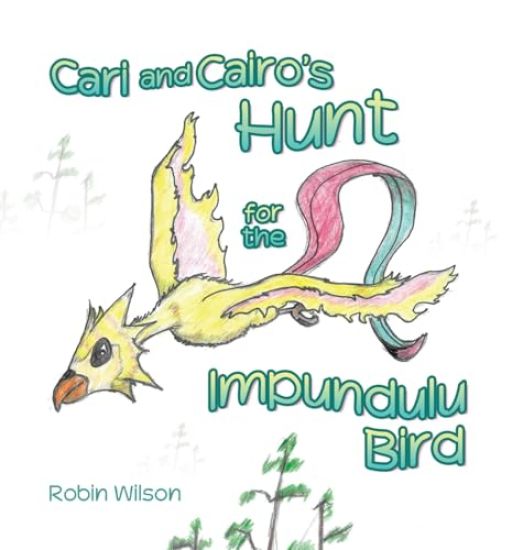
Fraternal twins, Cari, and Cairo, join their father Calvin on a birdwatching adventure to Snake Mountain. They enjoy being in the wild outdoors as Cari wonders if she will get to see the bird of her dreams.
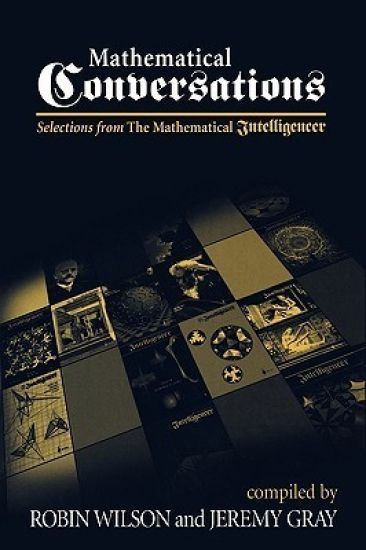
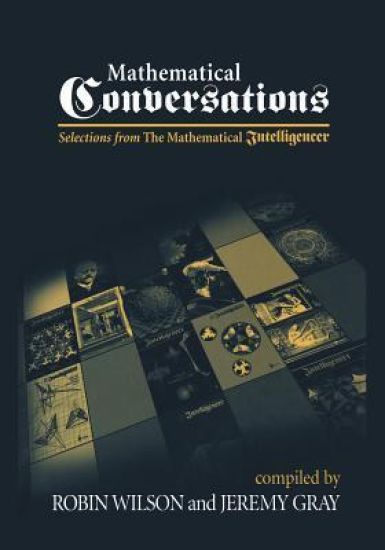
Approximately fifty articles that were published in The Mathematical Intelligencer during its first eighteen years. The selection demonstrates the wide variety of attractive articles that have appeared over the years, ranging from general interest articles of a historical nature to lucid expositions of important current discoveries. Each article is introduced by the editors. "...The Mathematical Intelligencer publishes stylish, well-illustrated articles, rich in ideas and usually short on proofs...Many, but not all articles fall within the reach of the advanced undergraduate mathematics major...This book makes a nice addition to any undergraduate mathematics collection that does not already sport back issues of The Mathematical Intelligencer." D.V. Feldman, University of New Hamphire, CHOICE Reviews, June 2001.
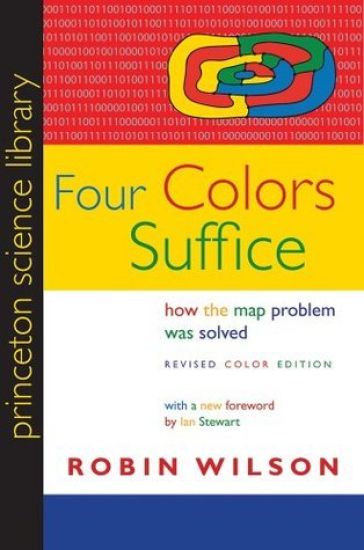
On October 23, 1852, Professor Augustus De Morgan wrote a letter to a colleague, unaware that he was launching one of the most famous mathematical conundrums in history--one that would confound thousands of puzzlers for more than a century. This is the amazing story of how the "map problem" was solved. The problem posed in the letter came from a former student: What is the least possible number of colors needed to fill in any map (real or invented) so that neighboring counties are always colored differently? This deceptively simple question was of minimal interest to cartographers, who saw little need to limit how many colors they used. But the problem set off a frenzy among professional mathematicians and amateur problem solvers, among them Lewis Carroll, an astronomer, a botanist, an obsessive golfer, the Bishop of London, a man who set his watch only once a year, a California traffic cop, and a bridegroom who spent his honeymoon coloring maps. In their pursuit of the solution, mathematicians painted maps on doughnuts and horseshoes and played with patterned soccer balls and the great rhombicuboctahedron. It would be more than one hundred years (and countless colored maps) later before the result was finally established. Even then, difficult questions remained, and the intricate solution--which involved no fewer than 1,200 hours of computer time--was greeted with as much dismay as enthusiasm. Providing a clear and elegant explanation of the problem and the proof, Robin Wilson tells how a seemingly innocuous question baffled great minds and stimulated exciting mathematics with far-flung applications. This is the entertaining story of those who failed to prove, and those who ultimately did prove, that four colors do indeed suffice to color any map. This new edition features many color illustrations. It also includes a new foreword by Ian Stewart on the importance of the map problem and how it was solved.
Graph Theory in America
Robin Wilson; John J. Watkins; David J. Parks
PRINCETON UNIVERSITY PRESS
2023
sidottu
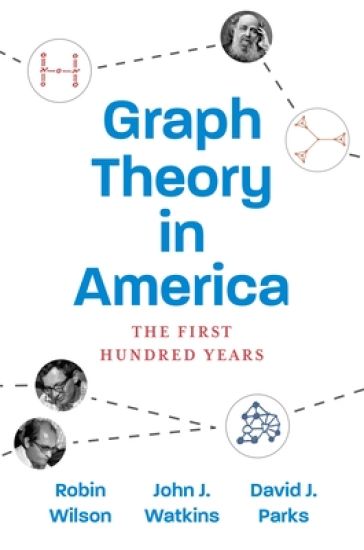
How a new mathematical field grew and matured in America Graph Theory in America focuses on the development of graph theory in North America from 1876 to 1976. At the beginning of this period, James Joseph Sylvester, perhaps the finest mathematician in the English-speaking world, took up his appointment as the first professor of mathematics at the Johns Hopkins University, where his inaugural lecture outlined connections between graph theory, algebra, and chemistry—shortly after, he introduced the word graph in our modern sense. A hundred years later, in 1976, graph theory witnessed the solution of the long-standing four color problem by Kenneth Appel and Wolfgang Haken of the University of Illinois.Tracing graph theory’s trajectory across its first century, this book looks at influential figures in the field, both familiar and less known. Whereas many of the featured mathematicians spent their entire careers working on problems in graph theory, a few such as Hassler Whitney started there and then moved to work in other areas. Others, such as C. S. Peirce, Oswald Veblen, and George Birkhoff, made excursions into graph theory while continuing their focus elsewhere. Between the main chapters, the book provides short contextual interludes, describing how the American university system developed and how graph theory was progressing in Europe. Brief summaries of specific publications that influenced the subject’s development are also included.Graph Theory in America tells how a remarkable area of mathematics landed on American soil, took root, and flourished.
Approximately fifty articles that were published in The Mathematical Intelligencer during its first eighteen years. The selection demonstrates the wide variety of attractive articles that have appeared over the years, ranging from general interest articles of a historical nature to lucid expositions of important current discoveries. Each article is introduced by the editors. "...The Mathematical Intelligencer publishes stylish, well-illustrated articles, rich in ideas and usually short on proofs...Many, but not all articles fall within the reach of the advanced undergraduate mathematics major...This book makes a nice addition to any undergraduate mathematics collection that does not already sport back issues of The Mathematical Intelligencer." D.V. Feldman, University of New Hamphire, CHOICE Reviews, June 2001.
Who is God Now? Hope in God after Betrayal is for the woman whose heart has been shattered by her husband's unfaithfulness, infidelity, pornography use, emotional affairs, addictions, or any other cause of marital betrayal, and who seeks a Biblical context for both suffering and hope. God's attributes come into sharp focus in a practical and Biblically accurate manner, drawn from the author's own experiences of healing from the unthinkable. The author meditates on who God is, shares examples from Scripture, and offers realistic ways the reader can apply this knowledge to her own life. Who is God Now? Hope in God after Betrayal describes truths and characteristics of God, offering to be a springboard to a new, flourishing relationship with Jesus Christ that will help to carry the reader through and beyond her own devastating journey and recovery.Endorsement: When Robin Wilson experienced her own personal "D-Day" due to her husband's infidelity, she armed herself with God's Word to fight courageously to save her marriage. Her book chronicles her journey through the highs and lows of remaining faithful to God's calling. A must-read providing hope for those who have endured betrayal.-Josh D. McDowell, authorAbout the Authors: Robin Wilson has been there, and has asked, "Why?" "How?" and "Who are You, Lord?" Robin began to understand God's character in new ways as He walked her through the trauma of marital betrayal, and began healing her heart. On that journey, Robin experienced and learned to understand Our Lord's love, trustworthiness, and healing firsthand. Now, her heart's desire is to share the truth of God's character with women who also are on the journey of recovery from betrayal and searching for their own answers.A middle school English teacher for 20+ years, Christy Bottom not only is skilled at encouraging others to excel in their writing, but she also is an accomplished author of works published in several literary magazines and newspapers. Christy's most important work, however, is sharing the hopeful and heartening news of the Gospel with others. Christy is a wife, mother, teacher, and avid reader, who enjoys regular Bible study, travel, and time with her family.
Who is God Now? Hope in God after Betrayal is for the woman whose heart has been shattered by her husband's unfaithfulness, infidelity, pornography use, emotional affairs, addictions, or any other cause of marital betrayal, and who seeks a Biblical context for both suffering and hope. God's attributes come into sharp focus in a practical and biblically accurate manner, drawn from the author's own experiences of healing from the unthinkable. The author meditates on who God is, shares examples from Scripture, and offers realistic ways the reader can apply this knowledge to her own life. Who is God Now? Hope in God after Betrayal describes truths and characteristics of God, offering to be a springboard to a new, flourishing relationship with Jesus Christ that will help to carry the reader through and beyond her own devastating journey and recovery.Endorsement: When Robin Wilson experienced her own personal "D-Day" due to herhusband's infidelity, she armed herself with God's Word to fight courageously to save her marriage. Her book chronicles her journey through the highs and lows of remaining faithful to God's calling. A must read providing hope for those who have endured betrayal.-Josh D. McDowell, authorAbout the Authors: Robin WilsonRobin Wilson has been there, and has asked, "Why?" "How?" and "Who are You, Lord?" Robin began to understand God's character in new ways as He walked her through the trauma of marital betrayal, and began healing her heart. On that journey, Robin experienced and learned to understand our Lord's love, trustworthiness, and healing firsthand. Now, her heart's desire is to share the truth of God's character with women who also are on the journey of recovery from betrayal and searching for their own answers.Christy BottomA middle school English teacher for 20+ years, Christy Bottom not only is skilled at encouraging others to excel in their writing, but she also is an accomplished author of works published in several literary magazines and newspapers. Christy's most important work, however, is sharing the hopeful and heartening news of the Gospel with others. Christy is a wife, mother, teacher, and avid reader, who enjoys regular Bible study, travel, and time with her family.
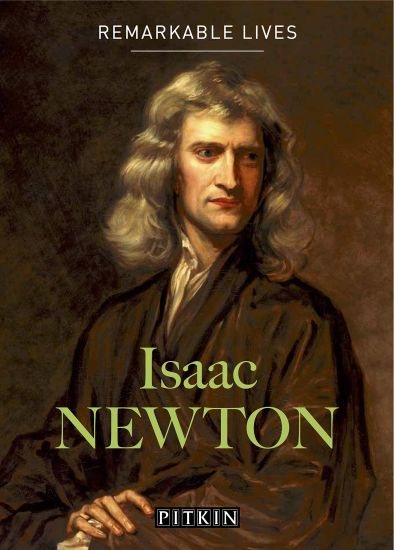
Sir Isaac Newton (1642-1727), mathematician and physicist, is one of the foremost scientific intellects of all time. This fully illustrated, accessible guide to the life and work of Isaac Newton is the perfect introduction to his groundbreaking work on gravity, motion, optics, light, colour and calculus. It also considers his lesser known research into chemistry, theology and alchemy while assessing his continuing legacy.Organised chronologically, this book covers his childhood in rural Lincolnshire, school days in Grantham and undergraduate life at Trinity College, Cambridge. All of his major discoveries, breakthroughs and publications are lucidly described. Entries include: the story of the falling apple, Gravity and the Principia, Newton’s laws of motion, Optics, Alchemy and Divinity, as well as his time as Warden of the Royal Mint in London.This is the essential guide to the life, work and legacy of one of the greatest geniuses of all time. Organised chronologically, this book covers his childhood in rural Lincolnshire, school days in Grantham and undergraduate life at Trinity College, Cambridge. All of his major discoveries, breakthroughs and publications are lucidly described. Entries include: the story of the falling apple, Gravity and the Principia, Newtons laws of motion, Optics, Alchemy and Divinity, as well as his time as Warden of the Royal Mint in London. This is the essential guide to the life, work and legacy of one of the greatest geniuses of all time.
A middle class, Midwestern family in search of meaning uproot themselves and move to their ancestral village in Croatia "We can look at this in two ways," Jim wrote, always the pragmatist. "We can panic and scrap the whole idea. Or we can take this as a sign. They're saying the economy is going to get worse before it gets better. Maybe this is the kick in the pants we needed to do something completely different. There will always be an excuse not to go..." And that, friends, is how a typically sane middle-aged mother decided to drag her family back to a forlorn mountain village in the backwoods of Croatia. So begins the author Jennifer Wilson's journey in Running Away to Home. Jen, her architect husband, Jim, and their two children had been living the typical soccer- and ballet-practice life in the most Middle American of places: Des Moines, Iowa. They overindulged themselves and their kids, and as a family they were losing one another in the rush of work, school, and activities. One day, Jen and her husband looked at each other-both holding their Starbucks coffee as they headed out to their SUV in the mall parking lot, while the kids complained about the inferiority of the toys they just got-and asked themselves: "Is this the American dream? Because if it is, it sort of sucks." Jim and Jen had always dreamed of taking a family sabbatical in another country, so when they lost half their savings in the stock-market crash, it seemed like just a crazy enough time to do it. High on wanderlust, they left the troubled landscape of contemporary America for the Croatian mountain village of Mrkopalj, the land of Jennifer's ancestors. It was a village that seemed hermetically sealed for the last one hundred years, with a population of eight hundred (mostly drunken) residents and a herd of sheep milling around the post office. For several months they lived like locals, from milking the neighbor's cows to eating roasted pig on a spit to desperately seeking the village recipe for bootleg liquor. As the Wilson-Hoff family struggled to stay sane (and warm), what they found was much deeper and bigger than themselves.
Every year, thousands of students from around the world come to Canada, Australia and the U.S. for an immersive, educational experience. Helping them to get the most of their overseas adventure are the homestay families who open their hearts and homes to these students. But what does it take to have success as a homestay family? Is it safe? Is it worth it? If you have questions, this collection of stories and guidance has your answers. In The Heart of Homestay, Jennifer Wilson draws on her two decades of experience working in the homestay industry to provide an honest and comprehensive portrayal of the homestay experience. By sharing real stories from a vast network of homestay families, Wilson shows the benefits of bringing an international student into your home while also being real about the challenges that can arise. From first impressions and settling in to navigating cultural differences with compassion, communicating through language barriers, and what to do when it's time to say goodbye, Wilson guides you through countless scenarios to bring you closer to the experience. No matter what stage of the homestay journey you are in, this book is a resource you will return to again and again. And you’ll learn that while there is a lot to consider when choosing to open your home to a stranger, once you do, your family will grow further abroad than you ever imagined.
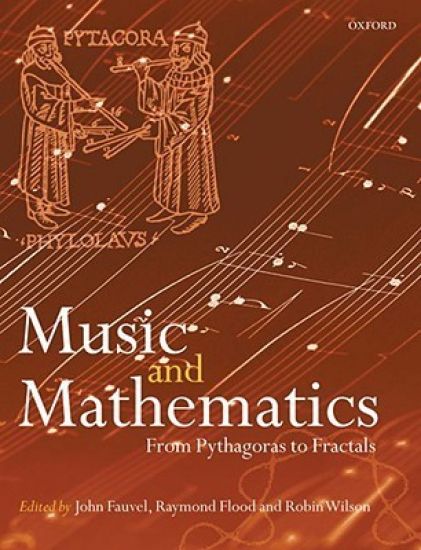
From Ancient Greek times, music has been seen as a mathematical art, and the relationship between mathematics and music has fascinated generations. This collection of wide ranging, comprehensive and fully-illustrated papers, authored by leading scholars, presents the link between these two subjects in a lucid manner that is suitable for students of both subjects, as well as the general reader with an interest in music. Physical, theoretical, physiological, acoustic, compositional, and analytical relationships between mathematics and music are unfolded and explored with focus on tuning and temperament, the mathematics of sound, bell-ringing and modern compositional techniques.
Who Gave you the Epsilon?
Anderson Marlow; Victor Katz; Robin Wilson
Mathematical Association of America
2009
sidottu
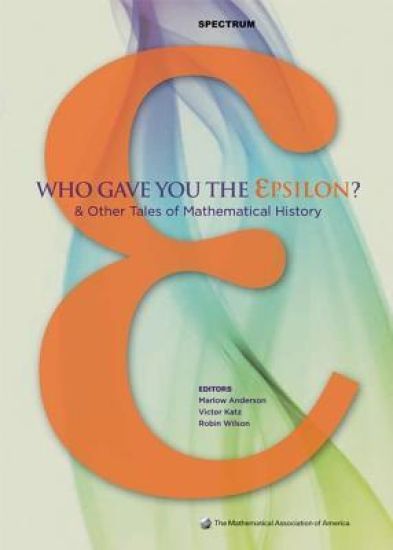
This book picks up the history of mathematics from where Sherlock Holmes in Babylon left it. The 40 articles of Who Gave You the Epsilon? continue the story of the development of mathematics into the nineteenth and twentieth centuries. The articles have all been published in the Mathematical Association of America journals and are in many cases written by distinguished mathematicians such as G. H. Hardy and B. van der Waerden. The articles are arranged thematically to show the development of analysis, geometry, algebra and number theory through this period of time. Each chapter is preceded by a foreword, giving the historical background and setting and the scene, and is followed by an afterword, reporting on advances in our historical knowledge and understanding since the articles first appeared. This book is ideal for anyone wanting to explore the history of mathematics.
The History of Mathematics
June Barrow-Green; Jeremy Gray; Robin Wilson

AMERICAN MATHEMATICAL SOCIETY
2019
nidottu
The History of Mathematics: A Source-Based Approach is a comprehensive history of the development of mathematics. This, the first volume of the two-volume set, takes readers from the beginning of counting in prehistory to 1600 and the threshold of the discovery of calculus. It is notable for the extensive engagement with original—primary and secondary—source material. The coverage is worldwide, and embraces developments, including education, in Egypt, Mesopotamia, Greece, China, India, the Islamic world and Europe. The emphasis on astronomy and its historical relationship to mathematics is new, and the presentation of every topic is informed by the most recent scholarship in the field.The two-volume set was designed as a textbook for the authors' acclaimed year-long course at the Open University. It is, in addition to being an innovative and insightful textbook, an invaluable resource for students and scholars of the history of mathematics. The authors, each among the most distinguished mathematical historians in the world, have produced over fifty books and earned scholarly and expository prizes from the major mathematical societies of the English-speaking world.
The History of Mathematics
June Barrow-Green; Jeremy Gray; Robin Wilson

AMERICAN MATHEMATICAL SOCIETY
2022
nidottu
The History of Mathematics: A Source-Based Approach is a comprehensive history of the development of mathematics. The first volume of the two-volume set takes readers from the beginning of counting in prehistory to 1600 and the threshold of the discovery of calculus. It is notable for the extensive engagement with original-primary and secondary-source material. The coverage is worldwide, and embraces developments, including education, in Egypt, Mesopotamia, Greece, China, India, the Islamic world and Europe. The emphasis on astronomy and its historical relationship to mathematics is new, and the presentation of every topic is informed by the most recent scholarship in the field.The second volume takes the reader from the invention of the calculus to the beginning of the twentieth century. The initial discoverers of calculus are given thorough investigation, and special attention is also paid to Newton's Principia. The eighteenth century is presented as primarily a period of the development of calculus, particularly in differential equations and applications of mathematics. Mathematics blossomed in the nineteenth century and the book explores progress in geometry, analysis, foundations, algebra, and applied mathematics, especially celestial mechanics. The approach throughout is markedly historiographic: How do we know what we know? How do we read the original documents? What are the institutions supporting mathematics? Who are the people of mathematics? The reader learns not only the history of mathematics, but also how to think like a historian.The two-volume set was designed as a textbook for the authors' acclaimed year-long course at the Open University. It is, in addition to being an innovative and insightful textbook, an invaluable resource for students and scholars of the history of mathematics. The authors, each among the most distinguished mathematical historians in the world, have produced over fifty books and earned scholarly and expository prizes from the major mathematical societies of the English-speaking world.
The History of Mathematics: A Source-Based Approach, Volume 2
June Barrow-Green; Jeremy Gray; Robin Wilson
AMERICAN MATHEMATICAL SOCIETY
2022
nidottu
The History of Mathematics: A Source-Based Approach is a comprehensive history of the development of mathematics. This, the second volume of a two-volume set, takes the reader from the invention of the calculus to the beginning of the twentieth century. The initial discoverers of calculus are given thorough investigation, and special attention is also paid to Newton's Principia. The eighteenth century is presented as primarily a period of the development of calculus, particularly in differential equations and applications of mathematics. Mathematics blossomed in the nineteenth century and the book explores progress in geometry, analysis, foundations, algebra, and applied mathematics, especially celestial mechanics. The approach throughout is markedly historiographic: How do we know what we know? How do we read the original documents? What are the institutions supporting mathematics? Who are the people of mathematics? The reader learns not only the history of mathematics, but also how to think like a historian. The two-volume set was designed as a textbook for the authors' acclaimed year-long course at the Open University. It is, in addition to being an innovative and insightful textbook, an invaluable resource for students and scholars of the history of mathematics. The authors, each among the most distinguished mathematical historians in the world, have produced over fifty books and earned scholarly and expository prizes from the major mathematical societies of the English-speaking world.
The Turing Guide
Jack Copeland; Jonathan Bowen; Mark Sprevak; Robin Wilson
Oxford University Press
2017
sidottu
Alan Turing has long proved a subject of fascination, but following the centenary of his birth in 2012, the code-breaker, computer pioneer, mathematician (and much more) has become even more celebrated with much media coverage, and several meetings, conferences and books raising public awareness of Turing's life and work. This volume will bring together contributions from some of the leading experts on Alan Turing to create a comprehensive guide to Turing that will serve as a useful resource for researchers in the area as well as the increasingly interested general reader. The book will cover aspects of Turing's life and the wide range of his intellectual activities, including mathematics, code-breaking, computer science, logic, artificial intelligence and mathematical biology, as well as his subsequent influence.
The Turing Guide
Jack Copeland; Jonathan Bowen; Mark Sprevak; Robin Wilson
Oxford University Press
2017
nidottu
Alan Turing has long proved a subject of fascination, but following the centenary of his birth in 2012, the code-breaker, computer pioneer, mathematician (and much more) has become even more celebrated with much media coverage, and several meetings, conferences and books raising public awareness of Turing's life and work. This volume will bring together contributions from some of the leading experts on Alan Turing to create a comprehensive guide to Turing that will serve as a useful resource for researchers in the area as well as the increasingly interested general reader. The book will cover aspects of Turing's life and the wide range of his intellectual activities, including mathematics, code-breaking, computer science, logic, artificial intelligence and mathematical biology, as well as his subsequent influence.
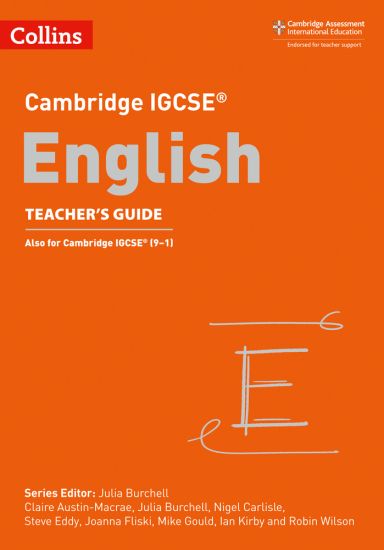
Cambridge IGCSE™ English Teacher’s Guide
Claire Austin-Macrae; Julia Burchell; Nigel Carlisle; Steve Eddy; Joanna Fliski; Mike Gould; Ian Kirby; Robin Wilson
Collins
2018
nidottu
The third edition of the Collins Cambridge IGCSE® English Teacher’s Guide supports the Student’s Book, giving teachers everything they need to teach the Cambridge IGCSE® and IGCSE® (9–1) First Language English syllabuses 0500 and 0990. This Teacher’s Guide supports the new syllabuses for first examination in 2020. Exam Board: Cambridge Assessment International Education Level & Subject: IGCSE First Language English (0500), IGCSE (9–1) First Language English (0990) First teaching: September 2018 First examination: June 2020 This title has been endorsed by Cambridge Assessment International Education. Revised and updated to support the 2020 syllabuses and examination formats. Support student progress with teaching sequences that follow the structure of the Student Book, moving from building the key reading and writing skills to applying these skills to specific exam questions and coursework tasks. Save time on planning and preparation with expert support from Julia Burchell, an experienced examiner and trainer. The Teacher Guide includes a two-year scheme of work, differentiated lesson plans, worksheets and PowerPoints for every two- or four-page section of the Student Book, plus extension activities for students aiming for the highest grades. Adapt the resources to the needs of your classes with printable PDFs and editable Word and PowerPoint files. Detailed guidance and annotated sample answers in the Teacher Guide help you and your classes to make the most of the practice examination papers in the Student Book.