Kirjojen hintavertailu. Mukana 11 244 527 kirjaa ja 12 kauppaa.

Kirjahaku

Etsi kirjoja tekijän nimen, kirjan nimen tai ISBN:n perusteella.

1000 tulosta hakusanalla Roger H Small

Let No Guilty Man Escape

Let No Guilty Man Escape

Roger H. Tuller

University of Oklahoma Press
2001
sidottu
Presiding from 1875 to 1896 over the United States Court for the Western Judicial District of Arkansas, Isaac Charles Parker attained notoriety as the ""Hanging Judge"" responsible for law and order in Indian Territory. Popular accounts have portrayed him as a jurist driven relentlessly by a Biblical sense of justice to administer absolute authority over a lawless jurisdiction inhabited by bold outlaws.Let No Guilty Man Escape, the first new Parker biography in four decades, corrects this simplistic image by presenting Parker's unique brand of frontier justice within the legal and political context of his time. Using primary documents from the National Archives, Missouri court records, and other sources not included by previous biographers, Roger H. Tuller demonstrates that Parker was an ambitious attorney who used the law to advance his own career. Parker rose from a frontier Missouri lawyer to become a congressional representative, and when Reconstructionist-era politics denied him continued progress, he sought the judicial appointment for which he is most remembered.Although he sent seventy-nine felons to the gallows, Parker's public hangings were actually restricted by federal officials, commutations, and pardons, as well as Supreme Court rulings. In an ironic twist, during his final public interview, the ""Hanging Judge"" claimed he supported the abolition of the death penalty.
Let No Guilty Man Escape

Let No Guilty Man Escape

Roger H. Tuller

UNIVERSITY OF OKLAHOMA PRESS
2023
nidottu
Presiding from 1875 to 1896 over the United States Court for the Western Judicial District of Arkansas, Isaac Charles Parker attained notoriety as the "Hanging Judge" responsible for law and order in Indian Territory. Popular accounts have portrayed him as a jurist driven relentlessly by a Biblical sense of justice to administer absolute authority over a lawless jurisdiction inhabited by bold outlaws.Let No Guilty Man Escape, the first new Parker biography in four decades, corrects this simplistic image by presenting Parker's unique brand of frontier justice within the legal and political context of his time. Using primary documents from the National Archives, Missouri court records, and other sources not included by previous biographers, Roger H. Tuller demonstrates that Parker was an ambitious attorney who used the law to advance his own career. Parker rose from a frontier Missouri lawyer to become a congressional representative, and when Reconstructionist-era politics denied him continued progress, he sought the judicial appointment for which he is most remembered.Although he sent seventy-nine felons to the gallows, Parker's public hangings were actually restricted by federal officials, commutations, and pardons, as well as Supreme Court rulings. In an ironic twist, during his final public interview, the "Hanging Judge" claimed he supported the abolition of the death penalty.
Cape Cod and Plymouth Colony in the Seventeenth Century

Cape Cod and Plymouth Colony in the Seventeenth Century

Roger H. King

University Press of America
1993
sidottu
This book examines the contribution of Cape Cod to the transformation of the Pilgrims' Plymouth into a mature colony. The author covers the exploration of the region as well as the early travels to the Cape before its settlement, explaining the eventual significance of individual towns like Sandwich, which became the colony's center of Quakerism. Politically, Cape towns forced the colony to adopt a representative legislature and economically, the Cape provided acreage for farming and sites for additional towns. King also examines why, despite the expansion and the growth, Plymouth still remained a poor and underpopulated colony.
Cape Cod and Plymouth Colony in the Seventeenth Century

Cape Cod and Plymouth Colony in the Seventeenth Century

Roger H. King

University Press of America
1993
nidottu
This book examines the contribution of Cape Cod to the transformation of the Pilgrims' Plymouth into a mature colony. The author covers the exploration of the region as well as the early travels to the Cape before its settlement, explaining the eventual significance of individual towns like Sandwich, which became the colony's center of Quakerism. Politically, Cape towns forced the colony to adopt a representative legislature and economically, the Cape provided acreage for farming and sites for additional towns. King also examines why, despite the expansion and the growth, Plymouth still remained a poor and underpopulated colony.
Baptists in Early North America-Wolfville, Nova Scotia

Baptists in Early North America-Wolfville, Nova Scotia

Roger H. Prentice

MERCER UNIVERSITY PRESS
2023
sidottu
Readers of the BENA Series will immediately recognize that this series does not follow the traditional ""Baptists in the United States"" or ""Baptists in America"" organizing pattern. Especially in the colonial period, the division between the Thirteen Colonies and the Canadas and Maritimes was secondary in light of a unified political culture under British colonial administration. As Morgan Edwards saw it, the Baptist religious community stretched from Nova Scotia to Georgia before the Revolution. Volume XI specifically illustrates the presence of Nova Scotia Baptists in the transatlantic community. In the late colonial period, the Maritime Provinces in British North America were a frontier to the emerging American colonies in the process of becoming a new nation. In addition to the administration of His Majesty's government there were significant influences from the New England colonies. From 1760 scores of families from the six New England colonies emigrated especially to New Brunswick and Nova Scotia, known as ""planters."" They were later joined by the United Empire Loyalists who fled the American Revolution to remain loyal to their King. Their settlements, villages, ports, and farms resettled the old Acadian lands and, happily for the British, they anglicized French Maritime Canada. In the historical introduction, Roger Prentice informatively demonstrates the theological and polity formation of a congregation made up of planters and the next generations. How the Baptist movement came to be in Canada is Wolfville's story: it is the oldest continuing Baptist congregation in Canada.
Boards of Directors and the Privately Owned Firm

Boards of Directors and the Privately Owned Firm

Roger H. Ford

Praeger Publishers Inc
1992
sidottu
This book is a comprehensive and authoritative guide on when and how to build a working board of directors to serve as a tool to assist small, family, and entrepreneurial businesses. Mr. Ford has combined years of research with his extensive personal board room experiences to discuss all the key issues concerning the use and role of the board by privately owned businesses. He describes thoroughly the functions and contributions of boards from all angles, including situations where boards can be detrimental to company health and should be avoided. The book also provides detailed strategies for developing an effective board, from goal setting and recruiting, to training, educating, and managing directors. Special chapters also include information specifically for directors and case studies.Following a brief introduction to the unique role and importance of privately owned businesses to the U.S. economy, the author reviews the literature and current theories on the advantages and disadvantages of boards of directors. He then offers guidelines for managers and business owners who are trying to decide if they would benefit from a working board. The following sections offer strategies for developing boards, choosing and recruiting directors, board management and organization, and control, cost, and overall board assessment. A chapter specifically for directors is also included. Finally, the author includes an executive summary of his study on the Inc. 500 boards, and three detailed case histories.
Congress and Its Members

Congress and Its Members

Roger H. Davidson; Walter J. Oleszek; Frances E. Lee; Eric Schickler; James M. Curry

Sage Publications Inc Ebooks
2026
nidottu
Now in its 20th Edition, Congress and Its Members offers comprehensive and current coverage of the U.S. Congress and the legislative process by examining the tension between Congress as a lawmaking institution and as a collection of politicians constantly seeking?re-election.
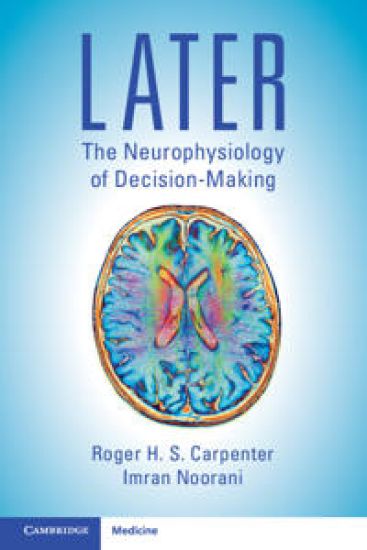
LATER

LATER

Roger H. S. Carpenter; Imran Noorani

Cambridge University Press
2023
pokkari
Why is deciding to do something sometimes so slow and difficult? How do we make decisions when lacking key information? When making decisions, the higher areas of the brain deliberately suppress lower areas capable of generating much faster but ill-considered responses while they develop ones that are more sophisticated, based on what can be gained in return. In this engaging book, the authors explore the increasingly popular neural model that may explain these mechanisms: the linear approach to threshold ergodic rate (LATER). Presenting a detailed description of the neurophysiological processes involved in decision-making and how these link to the LATER model, this is the first major resource covering the applications in describing human behaviour. With over 100 illustrations and a thorough discussion of the mathematics supporting the model, this is a rigorous yet accessible resource for psychologists, cognitive neuroscientists and neurophysiologists interested in decision-making.
An Introduction to Textile Coloration

An Introduction to Textile Coloration

Roger H. Wardman

Wiley-Blackwell
2017
nidottu
An Introduction to Textile Coloration: Principles and Practice The Publications Committee of the Society of Dyers and Colourists (SDC) has been aware for some time of the need to produce a book at an introductory level aimed at personnel working in textile dyeing or printing companies as well as those interested in entering into the field. The SDC runs a course for dyehouse technicians leading to the award of its Textile Coloration Certificate and this book is intended to be helpful for candidates following the course. Additionally, it will be helpful for professionals in textile companies who do not have a strong scientific background, so that they may attain a better understanding of the chemical principles of colour application. Starting with the basic science underlying dyeing and printing processes, this comprehensive book explains the fundamentals of dye and pigment chemistry and the various application techniques and processes. It offers chapter coverage of the general chemistry related to textiles, textile fibres, chemistry of dyes and pigments, industrial coloration methods, textile printing, theoretical aspects of dyeing, the measurement of colour and fastness testing. Reference is made to developments that have taken place in the coloration industry in recent years, not least of which have been the challenges imposed by the drive towards environmentally-friendly processes and restrictions on the use of certain chemicals. An Introduction to Textile Coloration: Principles and Practice Covers atomic structure, chemical reactions, and acids, bases, and saltsExplains the nature of fibre-forming polymers and the conversion of synthetic polymers into fibre filamentsEducates on the classification of colorants and the commercial naming of dyes and pigmentsIntroduces readers to the dye application processes and dyeing machineryInstructs on dye aggregation, factors affecting colour appearance, the principles of colour fastness testing, and more “…this is the sort of book any dyer, technician, student, academic will want to always have as an ready reference to everything pertaining to textile coloration.” Richard S. Blackburn, School of Design, University of Leeds, Leeds, LS2 9JT, UK
Value Management

Value Management

Roger H. Davies

Routledge
2016
nidottu
Change programmes in both private and public sectors have a poor record of delivering their intended value. The reasons given most often for their failure include lack of executive support or buy-in from key users, loose requirements definition, weak programme management, and plain wishful thinking. They rarely include technical limitations. Value Management puts forward the view that the true problem lies in failing to understand the causal links between the intended stakeholder outcomes and the actual programme outputs. Repeating the pattern of failure can be avoided by asking two questions: - Before implementation, what capabilities must a change programme deliver, when and in what order so as to cause intended value against a defined purpose with speed and certainty? - During and after implementation, what minor adjustments and/or major shifts are needed to be certain that the programme remains on purpose and on value? and two answers to be given: - Target, time and align change programmes to deliver maximum intended value to stakeholders - the baseline business case - track and respond to changes during and beyond implementation to ensure that the programme actually delivers or exceeds intended value - value realisation. The authors show how, by asking and answering these questions, direction and delivery of any programme can be clarified and greater economic value achieved.
Introduction to Christian Ethics

Introduction to Christian Ethics

Roger H Crook

Routledge
2017
sidottu
An Introduction to Christian Ethics uses a Christian approach while encouraging students to consider a variety of current ethical issues and apply relevant biblical and theological concepts to these issues. The main goal of the text is to acquaint students with both the field of ethics in general and varieties of Christian ethical systems in particular. Learning Goals Upon completing this book, readers will be able to use a Christian method of making moral decisions and view issues from a Christian perspective.