Kirjojen hintavertailu. Mukana 11 244 527 kirjaa ja 12 kauppaa.

Kirjahaku

Etsi kirjoja tekijän nimen, kirjan nimen tai ISBN:n perusteella.

1000 tulosta hakusanalla Roger Kaye Scopes
Roger Fry: A Biography

Roger Fry: A Biography

Virginia Woolf

HOUGHTON MIFFLIN
1976
nidottu
Virginia Woolf's only true biography, written to commemorate a devoted friend and one of the most renowned art critics of this century, who helped to bring the Postimpressionist movement from France to England and America. Index; illustrations.
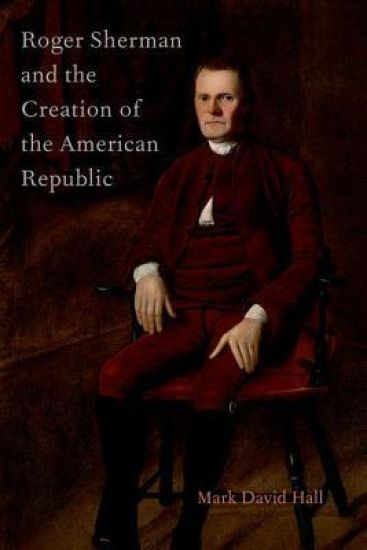
Roger Sherman and the Creation of the American Republic

Roger Sherman and the Creation of the American Republic

Mark David Hall

Oxford University Press Inc
2015
nidottu
One of leading figures of his day, Roger Sherman was a member of the five-man committee that drafted the Declaration of Independence and an influential delegate at the Constitutional Convention. As a Representative and Senator in the new republic, he had a hand in determining the proper scope of the national government's power as well as drafting the Bill of Rights. In Roger Sherman and the Creation of the American Republic, Mark David Hall explores Sherman's political theory and shows how it informed his many contributions to America's founding. A close examination of Sherman's religious beliefs provides insight into how those beliefs informed his political actions. Hall shows that Sherman, like many founders, was influenced by Calvinist political thought, a tradition that played a role in the founding generation's opposition to Great Britain, and led them to develop political institutions designed to prevent corruption, promote virtue, and protect rights. Contrary to oft-repeated assertions that the founders advocated a strictly secular policy, Hall argues persuasively that most founders believed Christianity should play an important role in the new American republic.
Roger Sessions

Roger Sessions

Prausnitz Frederik

Oxford University Press Inc
2002
sidottu
Composer Roger Sessions was a commanding figure on the American musical scene. He enjoyed the solid respect of his peers, and as a teacher of a generation of composers and author of compelling writings on his craft, his influence on musical thought remains profound. Yet, even in his lifetime, his music endured vastly disrespectful neglect. He was a "difficult" composer. Sessions was well aware of it. In a New York Times article, he wrote, "I have sometimes been told that my music is 'difficult' for the listener. There are those who consider this as praise, those who consider it a reproach. For my part I regard it as, in itself, neither one or the other...it is the way the music comes, the way it has to come." The way Sessions's music "had to come" is a recurrent focus of this biography. As the story is told, often in the composer's own words, the complex picture emerges of a remarkable man who, gradually and not very willingly, learned to accept his unexpected lot as a "difficult" composer. Frederik Prausnitz, an acquaintance of Sessions and conductor of his work, combines personal and musical insights to present this fascinating portrait of an influential, yet often overlooked, modernist composer.
Roger Williams

Roger Williams

Edwin S. Gaustad

Oxford University Press Inc
2006
sidottu
The founder of Rhode Island and of the first Baptist Church in America, an original and passionate advocate for religious freedom, a rare New England colonist who befriended Native Americans and took seriously their culture and their legal rights, Roger Williams is the forgotten giant among the first English colonists. Now, Edwin S. Gaustad, a leading expert on the life of Roger Williams, offers a vividly written and authoritative biography of the most far-seeing of the early settlers--the first such biography written for a general audience. Readers follow Roger and Mary Williams on their 1631 journey to Boston, where he soon became embroiled in many controversies, most notably, his claim that the colonists had unjustly taken Native American lands and his argument that civil authorities could not enforce religious duties. Soon banished for these troubling (if farsighted) views, Williams wandered for fourteen weeks in bitter snow until he bought land from the Narragansett Indians and founded Providence, which soon became a sanctuary for religious freedom and a refuge for dissenters of all stripes. The book discusses Williams' journey back to London, where he sought legal recognition of his colony, spread his enlightened views on Native Americans, and (alongside John Milton) fought passionately for religious freedom. Gaustad also describes how the royal charter of Rhode Island, obtained by Williams in 1663, would become the blueprint of religious freedom for many other colonies and a foundation stone for the First Amendment. Here then is a vibrant portrait of a great American who is truly worthy of remembrance.
Roger Bacon

Roger Bacon

Oxford University Press
2018
sidottu
Shortly after composing his Opus maius, Opus minus, and Opus tertium (1267) Bacon felt the need once again to call attention to obstacles to the achievement of wisdom placed by the Church, academia, and civil society in the early 1270s. This he did in Part I of his Compendium of the Study of Philosophy. But his explorations in 1267 of the need for the study of languages needed, he thought, further attention. So Part II of this follow-up work renews that call with greater fervour and detail and yields a presentation of the rudiments of Greek and Hebrew, indicating how knowledge of these is needed to interpret the scriptures accurately and how many errors result from failure to recognise this. This new edition of Bacon's Compendium of the Study of Philosophy, with facing English translation, enables today's readers to engage with Bacon's philosophy. It provides a window on academic life in Oxford and Paris of the 1270s at an important time in the development of the universities of both cities.
Roger Bacon and the Origins of Perspectiva in the Middle Ages
David Lindberg presents the first critical edition of the text of Roger Bacon's classic work Perspectiva, prepared from Latin manuscripts, accompanied by a facing-page English translation, critical notes, and a full study of the text. Also included is an analysis of Bacon's sources, influence, and role in the emergence of the discipline of perspectiva. About Roger Bacon: Roger Bacon (c.1220-c.1292) is one of the most renowned thinkers of the Middle Ages, a philosopher-scientist praised and mythologized for his attack on authority and his promotion of what he called experimental science. He was a leading figure in the intellectual life of the thirteenth century, a campaigner for educational reform, and a major disseminator of Greek and Arabic natural philosophy and mathematical science. About Perspectiva: The science that Roger Bacon most fully mastered was perspectiva, the study of light and vision (what would later become the science of optics). His great treatment of the subject, the Perspectiva, written in about 1260, was the first book by a European to display a full mastery of Greek and Arabic treatises on the subject, and through it Bacon was instrumental in defining this scientific discipline for the next 350 years.
Roger Penrose: Collected Works

Roger Penrose: Collected Works

Roger Penrose

Oxford University Press
2010
sidottu
Professor Sir Roger Penrose's work, spanning fifty years of science, with over five thousand pages and more than three hundred papers, has been collected together for the first time and arranged chronologically over six volumes, each with an introduction from the author. Where relevant, individual papers also come with specific introductions or notes. The first volume covers the beginnings of a career that is ground-breaking from the outset. Inspired by courses given by Dirac and Bondi, much of the early published work involves linking general relativity with tensor systems. Among his early works is the seminal 1955 paper, 'A Generalized Inverse for Matrices', his previously unpublished PhD and St John's College Fellowship theses, and from 1967, his Adam's Prize-winning essay on the structure of space-time. Add to this his 1965 paper, 'Gravitational collapse and space-time singularities', and the 1967 paper that introduced a remarkable new theory, 'Twistor algebra', and this becomes a truly stellar procession of works on mathematics and cosmology.
Roger Penrose: Collected Works

Roger Penrose: Collected Works

Roger Penrose

Oxford University Press
2010
sidottu
Professor Sir Roger Penrose's work, spanning fifty years of science, with over five thousand pages and more than three hundred papers, has been collected together for the first time and arranged chronologically over six volumes, each with an introduction from the author. Where relevant, individual papers also come with specific introductions or notes. Developing ideas sketched in the first volume, twistor theory is now applied to genuine issues of physics, and there are the beginnings of twistor diagram theory (an analogue of Feynman Diagrams). This collection includes joint papers with Stephen Hawking, and uncovers certain properties of black holes. The idea of cosmic censorship is also first proposed. Along completely different lines, the first methods of aperiodic tiling for the Euclidean plane that come to be known as Penrose tiles are described. This volume also contains Penrose's three prize-winning essays for the Gravity Foundation (two second places with both Ezra Newman and Steven Hawking, and a solo first place for 'The Non-linear graviton').
Roger Penrose: Collected Works

Roger Penrose: Collected Works

Roger Penrose

Oxford University Press
2010
sidottu
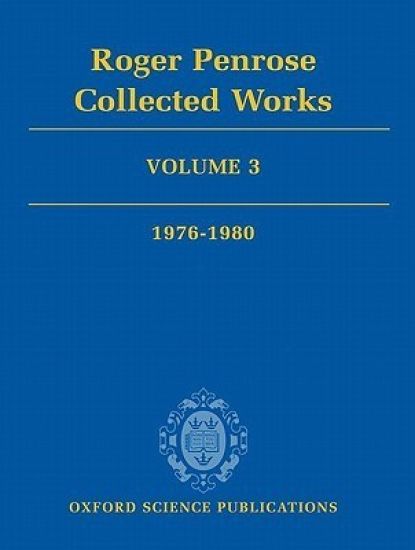
Professor Sir Roger Penrose's work, spanning fifty years of science, with over five thousand pages and more than three hundred papers, has been collected together for the first time and arranged chronologically over six volumes, each with an introduction from the author. Where relevant, individual papers also come with specific introductions or notes. Many important realizations concerning twistor theory occurred during the short period of this third volume, providing a new perspective on the way that mathematical features of the complex geometry of twistor theory relate to actual physical fields. Following on from the nonlinear graviton construction, a twistor construction was found for (anti-)self-dual electromagnetism allowing the general (anti-)self-dual Yang-Mills field to be obtained. It became clear that some features of twistor contour integrals could be understood in terms of holomorphic sheaf cohomology. During this period, the Oxford research group founded the informal publication, Twistor Newsletter. This volume also contains the influential Weyl curvature hypothesis and new forms of Penrose tiles.
Roger Penrose: Collected Works

Roger Penrose: Collected Works

Roger Penrose

Oxford University Press
2010
sidottu
Professor Sir Roger Penrose's work, spanning fifty years of science, with over five thousand pages and more than three hundred papers, has been collected together for the first time and arranged chronologically over six volumes, each with an introduction from the author. Where relevant, individual papers also come with specific introductions or notes. Among the new developments that occurred during this period was the introduction of a particular notion of 'quasi-local mass-momentum and angular momentum', the topic of Penrose's Royal Society paper. Many encouraging results were initially obtained but, later, difficulties began to emerge and remain today. Also, an extensive paper (with Eastwood and Wells) gives a thorough account of the relation between twistor cohomology and massless fields. This volume witnesses Penrose's increasing conviction that the puzzling issue of quantum measurement could only be resolved by the appropriate unification of quantum mechanics with general relativity, where that union must involve an actual change in the rules of quantum mechanics as well as in space-time structure. Penrose's first incursions into a possible relation between consciousness and quantum state reduction are also covered here.
Roger Penrose: Collected Works

Roger Penrose: Collected Works

Roger Penrose

Oxford University Press
2010
sidottu
Professor Sir Roger Penrose's work, spanning fifty years of science, with over five thousand pages and more than three hundred papers, has been collected together for the first time and arranged chronologically over six volumes, each with an introduction from the author. Where relevant, individual papers also come with specific introductions or notes. Publication of The Emperor's New Mind (OUP 1989) had caused considerable debate and Penrose's responses are included in this volume. Arising from this came the idea that large-scale quantum coherence might exist within the conscious brain, and actual conscious experience would be associated with a reduction of the quantum state. Within this collection, Penrose also proposes that a twistor might usefully be regarded as a source (or 'charge') for a massless field of spin 3/2, suggesting that the twistor space for a Ricci-flat space-time might actually be the space of such possible sources. Towards the end of the volume, Penrose begins to develop a quite different approach to incorporating full general relativity into twistor theory. This period also sees the origin of the Diósi-Penrose proposal.
Roger Penrose: Collected Works

Roger Penrose: Collected Works

Roger Penrose

Oxford University Press
2010
sidottu
Professor Sir Roger Penrose's work, spanning fifty years of science, with over five thousand pages and more than three hundred papers, has been collected together for the first time and arranged chronologically over six volumes, each with an introduction from the author. Where relevant, individual papers also come with specific introductions or notes. This sixth volume describes an actual experiment to measure the length of time that a quantum superposition might last (developing the Diósi-Penrose proposal). It also discusses the significant progress made in relation to incorporating the 'googly' information for a gravitational field into the structure of a curved twistor space. Penrose also covers such things as the geometry of light rays in relation to twistor-space structures, the utility of complex numbers in drawing three-dimensional shapes, and the geometrical representation of different types of musical scales. The turn of the millennium was also an opportunity to reflect on progress in many areas up until that point.
Roger Sherman and the Creation of the American Republic

Roger Sherman and the Creation of the American Republic

Mark David Hall

Oxford University Press Inc
2012
sidottu
Roger Sherman was the only founder to sign the Declaration and Resolves (1774), Articles of Association (1774), Declaration of Independence (1776), Articles of Confederation (1777, 1778), and Constitution (1787). He served on the five-man committee that drafted the Declaration of Independence, and he was among the most influential delegates at the Constitutional Convention. As a Representative and Senator in the new republic, he played important roles in determining the proper scope of the national government's power and in drafting the Bill of Rights. Even as he was helping to build a new nation, Sherman was a member of the Connecticut General Assembly and a Superior Court judge. In 1783, he and a colleague revised all of the state's laws. Roger Sherman and the Creation of the American Republic explores Sherman's political theory and shows how it informed his many contributions to America's founding. A central thesis of the work is that Sherman, like many founders, was heavily influenced by Calvinist political thought. This tradition had a significant impact on the founding generation's opposition to Great Britain, and it led them to develop political institutions designed to prevent corruption, promote virtue, and protect rights. Contrary to oft-repeated assertions by jurists and scholars that the founders advocated a strictly secular polity, Mark David Hall argues persuasively that most founders believed Christianity should play an important role in the new American republic.
A Roger Fry Reader

A Roger Fry Reader

Roger Fry

University of Chicago Press
1996
nidottu
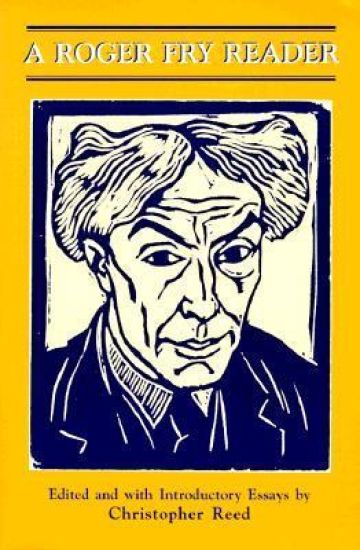
In the first decades of the 20th century, the art critic Roger Fry introduced English-speaking audiences to modern French art and formalist aesthetic theory. this text, edited by Christopher Reed, brings together for the first time a comprehensive selection of Fry's essays. Most appear here for the first time since their original publication in scholarly journals and art magazines, while some have never been published before. Representing 40 years of engagement with the arts, the essays cover a broad spectrum of topics, from Fry's influential promotion of Post-Impressionism to art education, museums, architecture, decorative art, and the implications of literature and dance for the visual arts. Reed also provides valuable historical background and considers Fry's legacy for the present.
A Roger Fry Reader

A Roger Fry Reader

Roger Fry

University of Chicago Press
1996
sidottu
In the first decades of the 20th century, the art critic Roger Fry introduced English-speaking audiences to modern French art and formalist aesthetic theory. this text, edited by Christopher Reed, brings together for the first time a comprehensive selection of Fry's essays. Most appear here for the first time since their original publication in scholarly journals and art magazines, while some have never been published before. Representing 40 years of engagement with the arts, the essays cover a broad spectrum of topics, from Fry's influential promotion of Post-Impressionism to art education, museums, architecture, decorative art, and the implications of literature and dance for the visual arts. "A Roger Fry Reader" affords an opportunity to examine both the foundations of modern art criticism from the point of view of one of its foremost practitioners and current debates about the nature ofart and aesthetic experience.
Roger Nash Baldwin and the American Civil Liberties Union

Roger Nash Baldwin and the American Civil Liberties Union

Robert Cottrell

Columbia University Press
2001
sidottu
Roger Nash Baldwin's thirty-year tenure as director of the ACLU marked the period when the modern understanding of the Bill of Rights came into being. Spearheaded by Baldwin, volunteer attorneys of the caliber of Clarence Darrow, Arthur Garfield Hays, Osmond Frankel, and Edward Ennis transformed the constitutional landscape. Company police forces were dismantled. Antievolutionists were discredited (thanks to the Scopes Trial). Censorship of such works as James Joyce's Ulysses was halted. The Scottsboro Boys and Sacco and Vanzetti were defended. The right of free speech for communists and Ku Klux Klansmen alike was upheld, and the foundations were laid for an end to school segregation. Robert Cottrell's magnificent book recaptures the accomplishments and contradictions of the complicated man at the center of these events. Driven, vain, frugal, and tempestuous, America's greatest civil libertarian was initially also a staunch defender of Communist Russia, deferred to the U.S. government over the internment of Japanese Americans, and openly admired J. Edgar Hoover and Douglas MacArthur. His personal relationships were equally complex. Spanning a hundred years from the late 1800s through Baldwin's death in 1981, this riveting biography is an eye-opening view of the development of the American left.
Roger Zelazny

Roger Zelazny

F. Brett Cox

University of Illinois Press
2021
sidottu
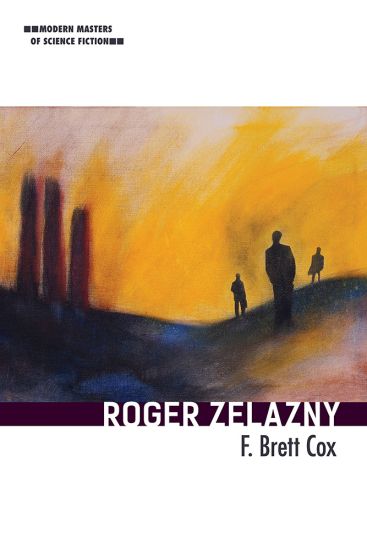
Challenging convention with the SF nonconformist Roger Zelazny combined poetic prose with fearless literary ambition to become one of the most influential science fiction writers of the 1960s. Yet many critics found his later novels underachieving and his turn to fantasy a disappointment. F. Brett Cox surveys the landscape of Zelazny's creative life and contradictions. Launched by the classic 1963 short story "A Rose for Ecclesiastes," Zelazny soon won the Hugo Award for Best Novel with …And Call Me Conrad and two years later won again for Lord of Light. Cox looks at the author's overnight success and follows Zelazny into a period of continued formal experimentation, the commercial triumph of the Amber sword and sorcery novels, and renewed acclaim for Hugo-winning novellas such as "Home Is the Hangman" and "24 Views of Mt. Fuji, by Hokusai." Throughout, Cox analyzes aspects of Zelazny's art, from his preference for poetically alienated protagonists to the ways his plots reflected his determined individualism. Clear-eyed and detailed, Roger Zelazny provides an up-to-date reconsideration of an often-misunderstood SF maverick.
Roger Zelazny

Roger Zelazny

F. Brett Cox

University of Illinois Press
2021
nidottu
Challenging convention with the SF nonconformist Roger Zelazny combined poetic prose with fearless literary ambition to become one of the most influential science fiction writers of the 1960s. Yet many critics found his later novels underachieving and his turn to fantasy a disappointment. F. Brett Cox surveys the landscape of Zelazny's creative life and contradictions. Launched by the classic 1963 short story "A Rose for Ecclesiastes," Zelazny soon won the Hugo Award for Best Novel with …And Call Me Conrad and two years later won again for Lord of Light. Cox looks at the author's overnight success and follows Zelazny into a period of continued formal experimentation, the commercial triumph of the Amber sword and sorcery novels, and renewed acclaim for Hugo-winning novellas such as "Home Is the Hangman" and "24 Views of Mt. Fuji, by Hokusai." Throughout, Cox analyzes aspects of Zelazny's art, from his preference for poetically alienated protagonists to the ways his plots reflected his determined individualism. Clear-eyed and detailed, Roger Zelazny provides an up-to-date reconsideration of an often-misunderstood SF maverick.
Roger Sandall's Films and Contemporary Anthropology

Roger Sandall's Films and Contemporary Anthropology

Lorraine Mortimer

Indiana University Press
2019
sidottu
In Roger Sandall's Films and Contemporary Anthropology, Lorraine Mortimer argues that while social anthropology and documentary film share historic roots and goals, particularly on the continent of Australia, their trajectories have tended to remain separate. This book reunites film and anthropology through the works of Roger Sandall, a New Zealand–born filmmaker and Columbia University graduate, who was part of the vibrant avant-garde and social documentary film culture in New York in the 1960s. Mentored by Margaret Mead in anthropology and Cecile Starr in fine arts, Sandall was eventually hired as the one-man film unit at the newly formed Australian Institute of Aboriginal Studies in 1965. In the 1970s, he became a lecturer in anthropology at the University of Sydney. Sandall won First Prize for Documentary at the Venice Film Festival in 1968, yet his films are scarcely known, even in Australia now. Mortimer demonstrates how Sandall's films continue to be relevant to contemporary discussions in the fields of anthropology and documentary studies. She ties exploration of the making and restriction of Sandall's aboriginal films and his nonrestricted films made in Mexico, Australia, and India to the radical history of anthropology and the resurgence today of an expanded, existential-phenomenological anthropology that encompasses the vital connections between humans, animals, things, and our environment.