Kirjojen hintavertailu. Mukana 12 481 266 kirjaa ja 12 kauppaa.

Kirjahaku

Etsi kirjoja tekijän nimen, kirjan nimen tai ISBN:n perusteella.

1000 tulosta hakusanalla Ronald J. Stephens

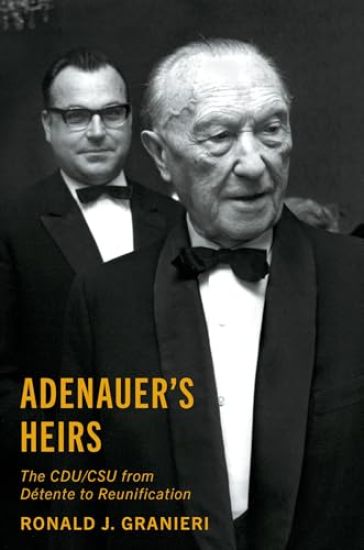
Adenauer's Heirs

Adenauer's Heirs

Ronald J. Granieri

OXFORD UNIVERSITY PRESS INC
2026
sidottu
The 1960s in Europe saw the emergence of social protest, newly confident center-left parties, Cold War détente, and frustrations with the pace and direction of European integration. The Federal Republic of Germany experienced these upheavals from a special position: on the front line of the Cold War, occupying a key position in both the European and Atlantic communities, and haunted by Nazi-era crimes. The parties that had governed West Germany since its founding in 1949-the Christian Democratic Union (CDU) and Christian Social Union (CSU)-underwent an especially intense identity crisis. European integration and the social market economy were essential to Christian Democratic political identity, but both faced challenges from right and left. The CDU/CSU was torn between market liberalism and social solidarity, and between nationalist conservatism and European enthusiasm. Konrad Adenauer, the first West German Chancellor, led the CDU and CSU to two decades of political dominance. As Adenauer retired from active politics, however, the parties gradually lost their grip on national power and had to reorient themselves in a rapidly changing domestic and international political environment. Aspiring to appeal to the broad political center, and to advocate both for German reunification and European cooperation, both parties and their leaders, including Franz Josef Strauß and Helmut Kohl, struggled to stabilize the provisional Federal Republic within a divided Germany and a divided Europe, then to react to the challenges of détente between East and West, and finally to develop a coherent response to the revolutions of 1989 in which those divisions were swept away. Among the first books to place the development of the CDU/CSU within the larger context of West German politics and international relations during the late Cold War, Adenauer's Heirs explores still potent questions of political identity from the age of détente to the present day.

The Biochemical Basis of Sports Performance

The Biochemical Basis of Sports Performance

Ronald J. Maughan; Michael Gleeson

Oxford University Press
2010
nidottu
Some understanding of the biochemistry of exercise is fundamental to any study of the factors that contribute to sports performance. It is the physical, chemical and biochemical properties of cells and tissues that determine the physiological responses to exercise, and yet the teaching of exercise biochemistry is poorly developed compared with exercise physiology. Where the subject is taught, the student often finds the approach somewhat daunting, with its focus on thermodynamics, chemical structures and metabolic pathways. Many students find the subject difficult, when it should not be so. This book introduces the student of sports science or exercise physiology to the biochemical processes that underpin exercise performance and the adaptations that occur with training. The focus is on skeletal muscle metabolism and the provision of energy for working muscles and the principles of exercise biochemistry are introduced in a context that is immediately relevant to the student of sports science. Instead of the traditional approach of working through the main classes of biomolecules and metabolic pathways, the subject is tackled by considering the biochemical processes involved in energy provision for different sports events and the way in which limitations in energy supply can cause fatigue, and thus limit performance. Recovery from exercise is important for athletes who train and compete with only a limited rest period, and the biochemical processes that influence recovery and restoration of performance capacity are also addressed. The processes fuelling the activities that contribute to sport form the core of this book, together with the changes that occur with training and the role of diet in providing the necessary fuels. But sporting talent is a rare gift, and a brief description of its hereditary basis is included. · A complete introduction to the biochemical basis of sports performance, appealing to undergraduate students, coaches, and athletes · Numerous links made between biochemistry and physiology for an integrated view of the subject · The student is directed to carefully chosen further reading articles, allowing them to readily explore key topics in more detail Online Resource Centre The Online Resource Centre to accompany The Biochemical Basis of Sports Performance features: For students: · 'In the News' updates · Multiple choice questions · Hyperlinked bibliography · Extended case study following an athlete through a season, with exercises For lecturers: · Figures from the book, available to download
Privacy Revisited

Privacy Revisited

Ronald J. Krotoszynski

Oxford University Press Inc
2016
sidottu
Rapid technological change, the advent of Big Data, and the creation of society-wide government surveillance programs have transformed the accessibility of highly personal information; these developments have highlighted the ambiguous treatment of privacy and personal intimacy. National legal systems vouchsafe and define "privacy," and its first cousin "dignity," in different ways that reflect local legal and cultural values. Yet, in an increasingly globalized world, purely local protection of privacy interests may prove insufficient to safeguard effectively fundamental autonomy interests - interests that lie at the core of self-definition, personal autonomy, and freedom. Privacy Revisited articulates the legal meanings of privacy and dignity through the lens of comparative law, and argues that the concept of privacy requires a more systematic approach if it is to be useful in framing and protecting certain fundamental autonomy interests. The book begins by providing relevant, and reasonably detailed, information about both the substantive and procedural protections of privacy/dignity in the U.S., Canada, South Africa, the United Kingdom, and among Council of Europe member states. Second, the book explores the inherent tension between affording significant legal protection to the right of privacy (or human dignity) and securing expressive freedoms, notably including the freedom of speech and of the press. The author then posits that the protection of privacy helps to illuminate some of the underlying social and political values that lead the U.S. to fail to protect privacy as reliably or as comprehensively as other liberal democracies. Finally, the book establishes that although privacy and speech come into conflict with some regularity, it is both useful and necessary to start thinking about the important ways in which both rights are integral to the maintenance of democratic self-government.
The First Amendment and the Business Corporation

The First Amendment and the Business Corporation

Ronald J. Colombo

Oxford University Press Inc
2014
sidottu
The role of the business corporation in modern society is a controversial one. Some fear and object to corporate power and influence over governments and culture. Others embrace the corporation as a counterweight to the State and as a vehicle to advance important private objectives. A flashpoint in this controversy has been the First Amendment to the U.S. Constitution, which enshrines the fundamental rights of freedom to speech, religion, and association. The extent to which a corporation can avail itself of these rights goes a long way in defining the corporation's role. Those who fear the corporation wish to see these rights restricted, while those who embrace it wish to see these rights recognized. The First Amendment and the Business Corporation explores the means by which the debate over the First Amendment rights of business corporations can be resolved. By recognizing that corporations possess constitutionally relevant differences, we discover a principled basis by which to afford some corporations the rights and protections of the First Amendment but not others. This is critically important, because a "one-size-fits-all" approach to corporate constitutional rights seriously threatens either democratic government or individual liberty. Recognizing rights where they should not be recognized unnecessarily augments the already considerable power and influence that corporations have in our society. However, denying rights where they are due undermines the liberty of human beings to create, patronize, work for, and invest in companies that share their most cherished values and beliefs.
Bizarre Labyrinth of Veiled Visions

Bizarre Labyrinth of Veiled Visions

Ronald J. Dayton

Lulu.com
2019
sidottu
With an avid curiousity of all things magical, Ronald J. Dayton has developed a reputation not only as a creator amongst magicians, but a special kinship within the bizarre and storytelling magick community across the years. Ron's abilities to conjure dark poetry too has been relished by many including the noted bizarrist, Gene Poinc, who accorded him the moniker `KOTAH' (an ellipsis, for `King Of The Ant Hill') which many in the know, still refer to him as today. Now you too can take a journey into the aphotic mind of Ronald J. Dayton. `Bizarre Labyrinth of Veiled Visions' is a select collection of 60 dark and curious short tales and poetry, of the likes many readers may have never experienced before ...
Machines like Us

Machines like Us

Ronald J. Brachman; Hector J. Levesque

MIT PRESS LTD
2023
pokkari
How we can create artificial intelligence with broad, robust common sense rather than narrow, specialized expertise.It’s sometime in the not-so-distant future, and you send your fully autonomous self-driving car to the store to pick up your grocery order. The car is endowed with as much capability as an artificial intelligence agent can have, programmed to drive better than you do. But when the car encounters a traffic light stuck on red, it just sits there—indefinitely. Its obstacle-avoidance, lane-following, and route-calculation capacities are all irrelevant; it fails to act because it lacks the common sense of a human driver, who would quickly figure out what’s happening and find a workaround. In Machines like Us, Ron Brachman and Hector Levesque—both leading experts in AI—consider what it would take to create machines with common sense rather than just the specialized expertise of today’s AI systems.Using the stuck traffic light and other relatable examples, Brachman and Levesque offer an accessible account of how common sense might be built into a machine. They analyze common sense in humans, explain how AI over the years has focused mainly on expertise, and suggest ways to endow an AI system with both common sense and effective reasoning. Finally, they consider the critical issue of how we can trust an autonomous machine to make decisions, identifying two fundamental requirements for trustworthy autonomous AI systems: having reasons for doing what they do, and being able to accept advice. Both in the end are dependent on having common sense.
Interest Group Politics in the Northeastern States

Interest Group Politics in the Northeastern States

Ronald J. Hrebenar; Clive S. Thomas

Pennsylvania State University Press
1993
pokkari
Interest Group Politics in the Northeastern States examines each of the twelve northeastern states in a separate chapter that seeks to convey the flavor and dynamics of politics in that state as a foundation for explaining the lobbying activities found within the state. The interest groups are placed within a historical context and within the current framework of the structure of state government and the party system. Additionally, the lobby registration laws, restrictions on lobbyists, PAC regulations, PAC patterns and political contribution patterns, and relative power of the various interest groups in each state are noted as they have changed over time.
Feminism and Pornography

Feminism and Pornography

Ronald J. Berger; Charles E. Cottle; Patricia Searles

Praeger Publishers Inc
1991
sidottu
Feminists do not present a united front on either the legal and political remedies they propose, or definitions of sexuality and appropriate standards representing it. This study is the first to treat pornography within the context of the debate among feminists, also examining nonfeminist views embodied in popular opinion and social policy. Presenting an in-depth review of feminist and nonfeminist literature, it explores influential feminist ideologies as well as those that are only beginning to be voiced.The authors first review the femininst movement in relation to the pornography debate among both feminists and nonfeminists. Divisions over questions of sexuality, censorship, and sexual roles and lifestyles are highlighted in an analysis of radical and libertarian feminist viewpoints. Liberal, Marxist, socialist, and black approaches to feminism are also evaluated. Feminism and Pornography also addresses the male perspective on pornography and men's responses to the feminists' debate. The final chapters assess this debate in terms of empirical research on pornography, and legal and nonlegal strategies for regulating pornography. Providing an understanding of a broad range of feminist viewpoints, this balanced, even-handed discussion may prove helpful in moving beyond the current impasse. Feminism and Pornography is an important new work for research or courses in women's studies, politics, sexuality, social problems, deviance, and law.
Envelopes of Sound

Envelopes of Sound

Ronald J. Grele

Praeger Publishers Inc
1991
nidottu
What is it that oral historians do? Prior to the publication of Envelopes of Sound oral history was regarded as an archival practice and interviews were considered the repositories of data. Envelopes shows that the interview is a series of dialectical relationships embedded in language, social practice, and historical imagination. It merges theory and method through the analysis of the basic structures of the interview. It incorporates new thinking on the nature of narrative and conversation, and it covers new ground in examining fieldwork in a number of disciplines. While strongly theoretical, it also has direct application in conducting oral history interviews. Ronald Grele is the dean of oral history in the United States, and Envelopes of Sound is the volume by which others will continue to be judged. Its contributions to methods and to meaning are still the place to start a serious discussion, whether with scholars or with high school students interviewing their grandparents. Paul M. Buhle Director, Oral History of the American Left New York University Grele's early, groundbreaking book on oral history remains a classic. It continues to challenge the practitioner to be more self-conscious of and attentive to the nuances of the oral history interview. Sherna Berger Gluck Director, Oral History California State University, Long Beach What is it that oral historians do? Prior to the publication of Envelopes of Sound oral history was regarded as an archival practice and interviews were considered the repositories of data. Envelopes shows that the interview is a series of dialectical relationships embedded in language, social practice, and historical imagination. It calls upon oral historians to begin to step back, to think seriously about what it is they do, and to ask what kind of documentation it is that they produce and how they can make it better. This volume merges theory and method through the analysis of the basic structures of the interview. It incorporates new thinking on the nature of narrative and conversation, and it covers new ground in examining fieldwork in a number of disciplines. While strongly theoretical, it also has direct application in conducting oral history interviews. It moves from relatively easy and simple considerations to increasingly complex issues. Envelopes of Sound can be used by a variety of students in discplines ranging from history and sociology to anthropology and contemporary literature, and it can be used in a variety of ways to raise issues on a number of theoretical levels.
Painful Inheritance

Painful Inheritance

Ronald J. Angel; Jacqueline Lowe Angel

University of Wisconsin Press
1993
nidottu
A comprehensive examination of the impact of single motherhood on the physical and mental health of women and their children in the USA. Based on scientific information, it predicts serious, long-term health consequences due to the poverty and social disorganisation in which many families live.
Reclaiming the Petition Clause

Reclaiming the Petition Clause

Ronald J. Krotoszynski

Yale University Press
2012
sidottu
Since the 2004 presidential campaign, when the Bush presidential advance team prevented anyone who seemed unsympathetic to their candidate from attending his ostensibly public appearances, it has become commonplace for law enforcement officers and political event sponsors to classify ordinary expressions of dissent as security threats and to try to keep officeholders as far removed from possible protest as they can. Thus without formally limiting free speech the government places arbitrary restrictions on how, when, and where such speech may occur.
Handbook of Emergency Management

Handbook of Emergency Management

Ronald J. Hy; William L. Waugh

Greenwood Press
1990
sidottu
During the 1980's, many Americans participated directly and indirectly in the drama and tragedy of major catastrophes, from volcanic eruptions to air crashes, closing the decade with the devastating Exxon Valdez oil spill, Hurricane Hugo, and the San Francisco earthquake. The objective of this volume is to examine how we have addressed some of the major hazards and, to the extent possible, assess the effectiveness of these efforts. This volume inventories and evaluates the major programs and policies designed to deal with the most common and destructive natural and man-made disasters, dividing them into four categories: mitigation, preparedness, response, and recovery. Disaster-types included in the handbook are earthquakes, volcanoes, hurricanes, floods, tornadoes, fires, droughts, hazardous materials accidents, nuclear facility accidents, structural failures, and transportation accidents. Following the analyses of specific disaster-types, the book considers the utility of all-hazard programs, such as the Federal Emergency Management Agency's Integrated Emergency Management System and documents the status of present emergency management efforts in the United States. A list of emergency management organizations is also included.Each disaster-type is evaluated in terms of the frequency of occurrence, potential for property loss and human casualties, predictability of events, and the history of such disasters in the United States. In addition to analyzing the disasters themselves, the book outlines the development of emergency management efforts by federal, state, and local governments; the major problems in designing policy to respond to the specific risks and hazards, as well as some of the major policy alternatives. The analyses address questions of issue salience, levels of program funding, and technical problems. Due to the wide variety of responses at the state and local levels, the primary focus is on federal emergency management program. This book will serve students, officials, and academic researchers by providing an overview of the major emergency management program areas. The addition of graphs, tables, and maps will assist nonspecialists in understanding the nature of the disasters and risks being discussed.
International Annual of Oral History, 1990

International Annual of Oral History, 1990

Ronald J. Grele

Greenwood Press
1992
sidottu
This volume marks the transformation of the International Journal of Oral History from a journal publication to an annual. The objective of the publication remains the same: providing a forum for articles on oral history methodologies and research perspectives.This year thirteen articles are presented. Following Ronald Grele's overview introduction, the world of the Japanese silk weaver is explored by Tamara Hareven. Selma Leydesdorff examines the making of a collective identity among workers in Amsterdam, while John Bodnar looks at the Polish immigrant experience. Issues of black South African working class and nationalist experience are the subject of pieces by Isabel Hofmeyr, Ari Sitas, and Glenn Adler. Florence Charpigny and Jenny Gregory raise issues of methodology and interdisciplinarity. Consciousness and political involvement are the concerns of essays by Lu Ann Jones, Alessandro Portelli, Michelle Palmer et al. Issues of political involvement and the ways in which oral history can document that involvement are the subject of articles by Pamela Grundy and Sherna Berger Gluck. As with the earlier issues of the Journal, this volume will be essential reading for scholars and researchers involved with oral history methodology and with working class and ethnic history.
State and Local Tax Policies

State and Local Tax Policies

Ronald J. Hy; William L. Waugh

Greenwood Press
1995
sidottu
Provides an overview of state and local taxation, the current and future outlook across the nation, the role of taxes in economic development, and tax administration. Analyzes and compares all types of state and local taxes—income (individual and corporate) sales (retail and wholesale taxes on food, medicine, gas, and electricity), excise and consumption (on motor fuel, tobacco, and alcoholic beverages and on food, lodging, amusements, parimutuels, and lotteries), property (on different types of property), and severance taxes (on timber and minerals). Examines the philosophy behind the different taxes, recent trends, and current and future policy options. Appendices describing policy analysis and evaluation and listing key sources of information about state and local taxes, many statistical exhibits, and selective bibliography further enhance this reference for undergraduate and graduate students, the general public, and for public administrators, economists, and political scientists.
Older Adult Education

Older Adult Education

Ronald J. Manheimer; Diane Moskow-McKenzie; Denise D. Snodgrass

Greenwood Press
1995
sidottu
This very first comprehensive book-length reference guide dealing with older adult education synthesizes current information about theoretical developments with specific practical details about the latest programs, policies, and research in the field. It is unique in placing the subject of lifelong learning into historical perspectives, discussing ways in which programs have been transformed over the last 15 to 20 years, and in considering the impact of institutional policies on older adult education.This guide points to demographic trends relating to aging and older learners; discusses older learner motives in relation to program missions and rationales; describes new opportunities for retirement-age people and the special role of education today; reviews the history of 12 different types of programs; compares five community-based model programs in college and universities, senior centers, shopping centers, and churches and synagogues; considers computer and electronic learning programs; reviews research and programs dealing with intergenerational education; and assesses future prospects in the field. Appendices describe important organizations, programs, sources of information, state tuition waiver policies, and other guidelines and data. Relevant statistics, research findings, numerous tables, original documents, and anecdotes about the experiences of older learners further enrich this state-of-the discipline reference guide for academic, professional, and public libraries and broad audiences of teachers, students, professionls, and general readers concerned with older Americans.
Financing Health Care in Sub-Saharan Africa

Financing Health Care in Sub-Saharan Africa

Ronald J. Vogel

Praeger Publishers Inc
1993
sidottu
Vogel views health care within the context of total Sub-Saharan economic systems, emphasizing the output of health-care programs (i.e., healthier people) and the most cost-effective ways to maximize that output. He recommends shifting public financing resources from the hospital sector to primary and preventive care, in order to reposition financial resources away from the colonial and post-colonial period of concentration upon cost-ineffective hospitals and toward the direction emphasized by the World Health Organization.