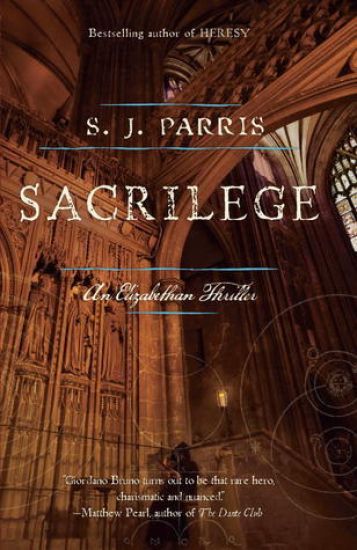
London, summer of 1584: Radical philosopher, ex-monk, and spy Giordano Bruno suspects he is being followed by an old enemy. Instead, he is shocked to discover that his pursuer is in fact Sophia Underhill, a young woman with whom he was once in love. When Bruno learns that Sophia has been accused of murdering her husband, a prominent magistrate of Canterbury, he agrees to do anything he can to help clear her name. But in the city that was once England's greatest center of pilgrimage, Bruno uncovers a more dangerous plot in the making, one that forces him to turn his detective's eye to the strange case of Saint Thomas Becket, a twelfth-century cardinal of Canterbury Cathedral whose mysterious murder is only matched by the legend surrounding the disappearance of his body.
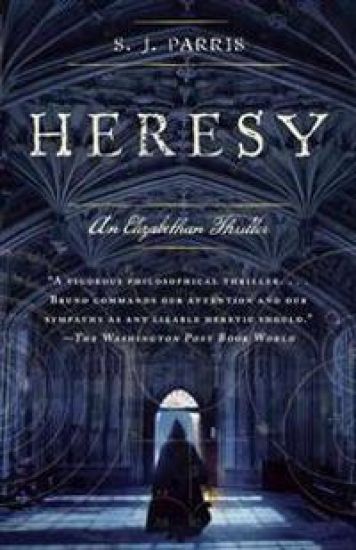
When fugitive Italian monk Giordano Bruno--philosopher, magician, and heretical scientist--arrives in London, he's only one step ahead of the Inquisition. An undercover mission for Queen Elizabeth I and her spymaster provides added protection. Officially, Bruno is to take part in a debate on the Copernican theory of the universe at Oxford University; unofficially, he is to find out whatever he can about a Catholic plot to overthrow the queen. But when his mission is dramatically thrown off course by a series of grisly deaths and the charms of a mysterious but beautiful young woman, he realizes that somewhere within Oxford's private chambers lurks a brutal killer. . .
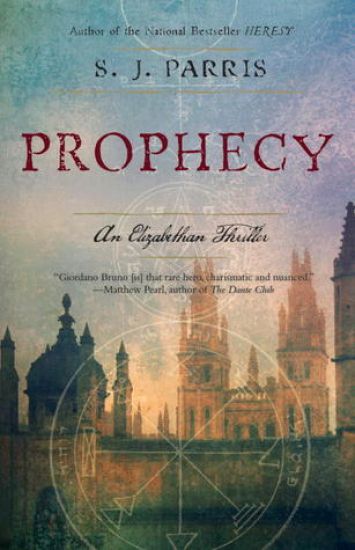
It is the year of the Great Conjunction, the year the powerful planets of Saturn and Jupiter align to herald the end of one age and the dawn of another, and the streets of London are abuzz with predictions of Queen Elizabeth's death. When one of the queen's ladies is found dead amidst rumors of black magic, Elizabeth calls upon Giordano Bruno to solve the crimes, along with the help of her personal astrologer, John Dee. But while Dee turns to a mysterious medium claiming knowledge of the murders, Bruno fears that something far more sinister is at work.
A gripping murder mystery set in 16th-century France, as Giordano Bruno fights against multiple factions manipulating the succession of King Henry III. December 1585: King Henry III of France is the last of his line. He has appointed a Protestant as his successor, which has caused a three-way war in his country. As a result, the king is in mortal fear of a coup being orchestrated by the ultra-conservative Catholic League. Radical philosopher, ex-monk and spy Giordano Bruno, forced to return to Paris, is called upon by King Henry to unearth the motivation behind several mysterious but linked deaths. Each victim is connected to a larger plot to manipulate the royal succession; what they knew and who killed them is a mystery to be solved. Meanwhile, Bruno makes an uneasy alliance with Charles Paget, a key figure in the community of English Catholics who tried to assassinate Queen Elizabeth. When Bruno is implicated in the death of Leonie, a member of the Queen Mother's "Flying Squadron," he is forced to call on Paget and his connections for help--and finds that it comes with a price, involving an old enemy.
Perfect for fans of C.J. Sansom. A short story featuring Giordano Bruno: heretic, philosopher and spy, from Parrisâ??s Sunday Times bestselling series.
The 18th century was a wealth of knowledge, exploration and rapidly growing technology and expanding record-keeping made possible by advances in the printing press. In its determination to preserve the century of revolution, Gale initiated a revolution of its own: digitization of epic proportions to preserve these invaluable works in the largest archive of its kind. Now for the first time these high-quality digital copies of original 18th century manuscripts are available in print, making them highly accessible to libraries, undergraduate students, and independent scholars.The Age of Enlightenment profoundly enriched religious and philosophical understanding and continues to influence present-day thinking. Works collected here include masterpieces by David Hume, Immanuel Kant, and Jean-Jacques Rousseau, as well as religious sermons and moral debates on the issues of the day, such as the slave trade. The Age of Reason saw conflict between Protestantism and Catholicism transformed into one between faith and logic -- a debate that continues in the twenty-first century.++++The below data was compiled from various identification fields in the bibliographic record of this title. This data is provided as an additional tool in helping to insure edition identification: ++++British LibraryT035284Half-title: 'A sermon on occasion of the present rebellion by J. S. Hill'. An advertisement leaf for other seasonable sermons printed for Hildyard immediately precedes the text.York: printed for John Hildyard; and sold by J. and P. Knapton; T. Longman and T. Shewell; and A. Dod; London, 1745. 2],30p.; 8
Title: History and Description of the Parish of Clerkenwell ... With numerous engravings, by J. & H. S. Storer. The historical department by T. Cromwell. Publisher: British Library, Historical Print Editions The British Library is the national library of the United Kingdom. It is one of the world's largest research libraries holding over 150 million items in all known languages and formats: books, journals, newspapers, sound recordings, patents, maps, stamps, prints and much more. Its collections include around 14 million books, along with substantial additional collections of manuscripts and historical items dating back as far as 300 BC. The HISTORY OF BRITAIN & IRELAND collection includes books from the British Library digitised by Microsoft. As well as historical works, this collection includes geographies, travelogues, and titles covering periods of competition and cooperation among the people of Great Britain and Ireland. Works also explore the countries' relations with France, Germany, the Low Countries, Denmark, and Scandinavia. ++++ The below data was compiled from various identification fields in the bibliographic record of this title. This data is provided as an additional tool in helping to insure edition identification: ++++ British Library Cromwell, Thomas; Storer, Henry Sargant.STORER James Sargant.; Storer, James Sargant 1828 viii. 448 p.; 8 . 10349.d.12. This work has been selected by scholars as being culturally important, and is part of the knowledge base of civilization as we know it. This work was reproduced from the original artifact, and remains as true to the original work as possible. Therefore, you will see the original copyright references, library stamps (as most of these works have been housed in our most important libraries around the world), and other notations in the work. This work is in the public domain in the United States of America, and possibly other nations. Within the United States, you may freely copy and distribute this work, as no entity (individual or corporate) has a copyright on the body of the work. As a reproduction of a historical artifact, this work may contain missing or blurred pages, poor pictures, errant marks, etc. Scholars believe, and we concur, that this work is important enough to be preserved, reproduced, and made generally available to the public. We appreciate your support of the preservation process, and thank you for being an important part of keeping this knowledge alive and relevant.
The 18th century was a wealth of knowledge, exploration and rapidly growing technology and expanding record-keeping made possible by advances in the printing press. In its determination to preserve the century of revolution, Gale initiated a revolution of its own: digitization of epic proportions to preserve these invaluable works in the largest archive of its kind. Now for the first time these high-quality digital copies of original 18th century manuscripts are available in print, making them highly accessible to libraries, undergraduate students, and independent scholars.The Age of Enlightenment profoundly enriched religious and philosophical understanding and continues to influence present-day thinking. Works collected here include masterpieces by David Hume, Immanuel Kant, and Jean-Jacques Rousseau, as well as religious sermons and moral debates on the issues of the day, such as the slave trade. The Age of Reason saw conflict between Protestantism and Catholicism transformed into one between faith and logic -- a debate that continues in the twenty-first century.++++The below data was compiled from various identification fields in the bibliographic record of this title. This data is provided as an additional tool in helping to insure edition identification: ++++British LibraryT104395J.S. = John Snell.London: printed in the year, 1793. 23, 1]p.; 12




![A Parish Doctor's Dream. a Poem. by the Author of Reminiscences of Old Smithfield, Etc. [j. W. Jackson.]](/covers/9781241043711.jpg)

![To the Parishioners of St. Paul, Covent Garden. [a Reply to J. Sant's Fact Against Assertion.]](/covers/9781240918515.jpg)


![Reply to an Appeal, Etc. by S. Yockney, Relative to a Late Canvass in the Parish of Saint Paul, Covent Garden, for the Office of Churchwarden. [by J. Sant, Etc.]](/covers/9781240918461.jpg)