Kirjojen hintavertailu. Mukana 12 423 132 kirjaa ja 12 kauppaa.

Kirjahaku

Etsi kirjoja tekijän nimen, kirjan nimen tai ISBN:n perusteella.

1000 tulosta hakusanalla S. M. J. Alt

Chambers's English Readers, Ed. by J.M.D. Meiklejohn

Chambers's English Readers, Ed. by J.M.D. Meiklejohn

John Miller D Meiklejohn

Palala Press
2018
pokkari
This work has been selected by scholars as being culturally important, and is part of the knowledge base of civilization as we know it. This work was reproduced from the original artifact, and remains as true to the original work as possible. Therefore, you will see the original copyright references, library stamps (as most of these works have been housed in our most important libraries around the world), and other notations in the work.This work is in the public domain in the United States of America, and possibly other nations. Within the United States, you may freely copy and distribute this work, as no entity (individual or corporate) has a copyright on the body of the work.As a reproduction of a historical artifact, this work may contain missing or blurred pages, poor pictures, errant marks, etc. Scholars believe, and we concur, that this work is important enough to be preserved, reproduced, and made generally available to the public. We appreciate your support of the preservation process, and thank you for being an important part of keeping this knowledge alive and relevant.
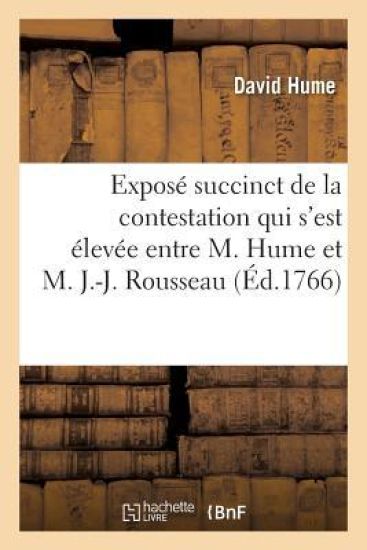
Exposé Succinct de la Contestation Qui s'Est Élevée Entre M. Hume Et M. J.-J. Rousseau
Expose succinct de la contestation qui s'est elevee entre M. Hume et M. J.-J. Rousseau: avec les pieces justificatives / par Hume; traduit par Suard]. Auquel on a joint le Docteur Pansophe, ou Lettres de M. VoltaireDate de l'edition originale: 1766"Comprend: Le docteur Pansophe ou Lettres de M. de Voltaire"Ce livre est la reproduction fidele d'une oeuvre publiee avant 1920 et fait partie d'une collection de livres reimprimes a la demande editee par Hachette Livre, dans le cadre d'un partenariat avec la Bibliotheque nationale de France, offrant l'opportunite d'acceder a des ouvrages anciens et souvent rares issus des fonds patrimoniaux de la BnF.Les oeuvres faisant partie de cette collection ont ete numerisees par la BnF et sont presentes sur Gallica, sa bibliotheque numerique.En entreprenant de redonner vie a ces ouvrages au travers d'une collection de livres reimprimes a la demande, nous leur donnons la possibilite de rencontrer un public elargi et participons a la transmission de connaissances et de savoirs parfois difficilement accessibles.Nous avons cherche a concilier la reproduction fidele d'un livre ancien a partir de sa version numerisee avec le souci d'un confort de lecture optimal. Nous esperons que les ouvrages de cette nouvelle collection vous apporteront entiere satisfaction.Pour plus d'informations, rendez-vous sur www.hachettebnf.fr
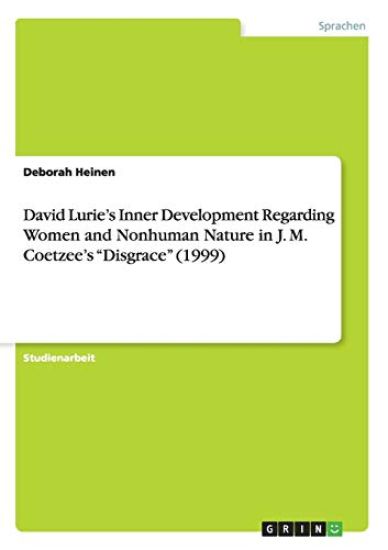
David Lurie's Inner Development Regarding Women and Nonhuman Nature in J. M. Coetzee's "Disgrace" (1999)
Studienarbeit aus dem Jahr 2015 im Fachbereich Englisch - Literatur, Werke, Note: 2,3, Rheinische Friedrich-Wilhelms-Universit t Bonn (Anglistik), Sprache: Deutsch, Abstract: The work at hand takes a closer look at J.M. Coetzee's novel "Disgrace" from 1999 from an ecocritical and ecofeminist perspective. It is paid special attention to the protagonist's attitude and relationship towards women, the countryside and what he considers as wilderness, and animals. The main question here is how the protagonist's attitudes change. So in other words, it is taken a look at how the protagonist's "new" unfamiliar environment influences his character. First of all, the reader gets a brief summary of the story itself and its narrative style. In the following chapter the protagonist's attitude towards women is elucidated. In relation to this, David Lurie's current crisis of identity is taken into consideration because it might influence his view on women. The next chapter deals with the difference between rural and urban areas and, in relation to this, the protagonist's perception of "otherness". After this it is taken a look at the protagonist's perception and relation to animals. Finally, the last chapter contains a conclusion and an answer to the question how the protagonist's attitudes towards women, nature, and animals changed. Beyond any doubt, read from an ecocritical perspective, "Disgrace" offers many more interesting issues that are worth being worked on.
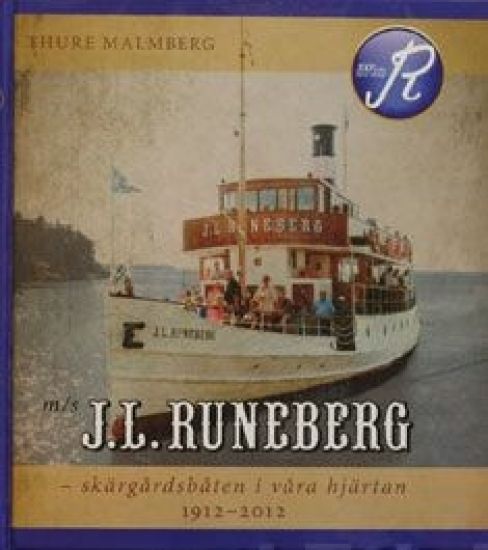
M/s J.L Runeberg

M/s J.L Runeberg

Thure Malmberg

Varustamo J.L. Runeberg
2012
sidottu
Satoja samanlaisia laivoja liikkui entisaikaan Suomen rannikoilla. Tänään m/s J.L. Runeberg on niistä viimeinen säännöllisessä liikenteessä oleva. Se on elävä museo, joka kertoo onnellisista kesämatkoista 100 vuoden ajalta. Ainutlaatuisella aluksella on mielenkiintoinen historia.Vuonna 1912 aluksen nimi oli s/s Helsingfors Skärgård ja se liikennöi Porkkalan ja Helsingin välillä. Sen jälkeen laiva on kokenut kaksi maailmansotaa ja maantiekuljetusten kilpailun. Se on Uudenmaan saariston ikioma alus, saaristolaiva sydämissämme.
M/s J.L. Runeberg

M/s J.L. Runeberg

Thure Malmberg

Varustamo J.L. Runeberg
2012
sidottu
En gång fanns det hundratals liknande båtar vid Finlands kuster. I dag är m/s J.L. Runeberg den sista i reguljär trafik. Ett levande museum med minnen av glada sommarresor under 100 år. Ett unikt fartyg med historia.1912 hette hon s/s Helsingfors Skärgård och gick i trafik mellan Porkala och Helsingfors. Sedan dess har hon överlevt både två världskrig och konkurrensen från landsvägarna. Hon är den nyländska skärgårdens egen båt, skärgårdsbåten i våra hjärtan.
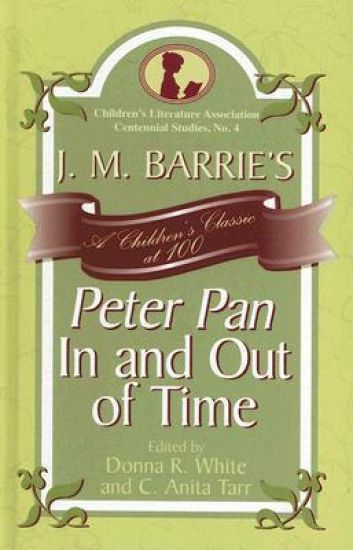
J. M. Barrie's Peter Pan In and Out of Time
Celebrating 100 years of Peter Pan, this fourth volume in the Centennial Studies series explores the cultural contents of Barrie's creation and the continuing impact of Peter Pan on children's literature and popular culture today, especially focusing on the fluctuations of time and narrative strategies. This collection of essays on Peter Pan is separated into four parts. The first section is comprised of essays placing Barrie's in its own time period, and tackles issues such as the relationship between Hook and Peter in terms of child hatred, the similarities between Peter and Oscar Wilde, Peter Pan's position as an exemplar of the Cult of the Boy Child is challenged, and the influence of pirate lore and fairy lore are also examined. Part two features an essay on Derrida's concept of the grapheme, and uses it to argue that Barrie is attempting to undermine racial stereotypes. The third section explores Peter Pan's timelessness and timeliness in essays that examine the binary of print literacy and orality; Peter Pan's modular structure and how it is ideally suited to video game narratives; the indeterminacy of gender that was common to Victorian audiences, but also threatening and progressive; Philip Pullman and J.K. Rowling, who publicly claim to dislike Peter Pan and the concept of never growing up, but who are nevertheless indebted to Barrie; and a Lacanian reading of Peter Pan arguing that Peter acts as "the maternal phallus" in his pre-Symbolic state. The final section looks at the various roles of the female in Peter Pan, whether against the backdrop of British colonialism or Victorian England. Students and enthusiasts of children's literature will find their understanding of Peter Pan immensely broadened after reading this volume.
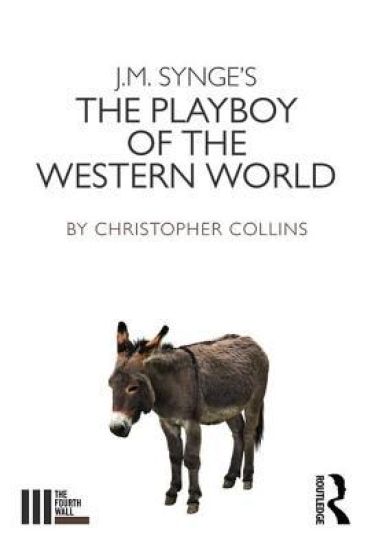
J. M. Synge's The Playboy of the Western World
‘I’m thinking this night wasn’t I a foolish fellow not to kill my father in years gone by.’ – Christy MahonOn the first night of J. M. Synge’s The Playboy of the Western World (1907) the audience began protesting in the theatre; by the third night the protests had spilled onto the streets of Dublin. How did one play provoke this? Christopher Collins addresses The Playboy ’s satirical treatment of illusion and realism in light of Ireland’s struggle for independence, as well as Synge’s struggle for artistic expression. By exploring Synge’s unpublished diaries, drafts and notebooks, he seeks to understand how and why the play came to be.This volume invites the reader behind the scenes of this inflammatory play and its first performances, to understand how and why Synge risked everything in the name of art.
J. M. Synge's The Playboy of the Western World
I'm thinking this night wasn't I a foolish fellow not to kill my father in years gone by.' – Christy MahonOn the first night of J. M. Synge's The Playboy of the Western World (1907) the audience began protesting in the theatre; by the third night the protests had spilled onto the streets of Dublin. How did one play provoke this? Christopher Collins addresses The Playboy 's satirical treatment of illusion and realism in light of Ireland's struggle for independence, as well as Synge's struggle for artistic expression. By exploring Synge's unpublished diaries, drafts and notebooks, he seeks to understand how and why the play came to be.This volume invites the reader behind the scenes of this inflammatory play and its first performances, to understand how and why Synge risked everything in the name of art.
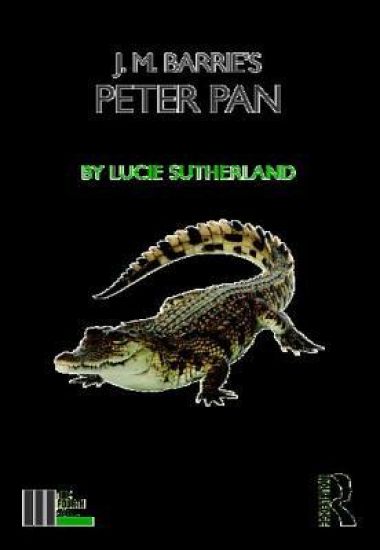
J. M. Barrie's Peter Pan

J. M. Barrie's Peter Pan

Lucie Sutherland

Routledge
2018
nidottu
‘Do you believe in fairies? Say quick that you believe!’ – Peter PanPeter Pan is a narrative many of us believe we know well, and yet the J.M. Barrie play that premiered on a West End stage in December 1904 is not the depiction of Peter, Wendy, Hook, and Never Land that most people have experienced. It was the critical and commercial success of this particular play which propelled the notoriety and appeal of the story, and without the success of that first production, Peter Pan would not be such a familiar part of our mainstream culture. Lucie Sutherland examines how, and why, this play became so popular, why the trans-Atlantic collaboration of Barrie and Charles Frohman was vital to the success of the 1904 production, and how key versions in England and America have created an iconic narrative that remains popular today. This book charts the ‘awfully big adventure’ of creating Peter Pan, as well as the many entertaining, enthralling, and often extraordinary ways the play has been adapted ever since.
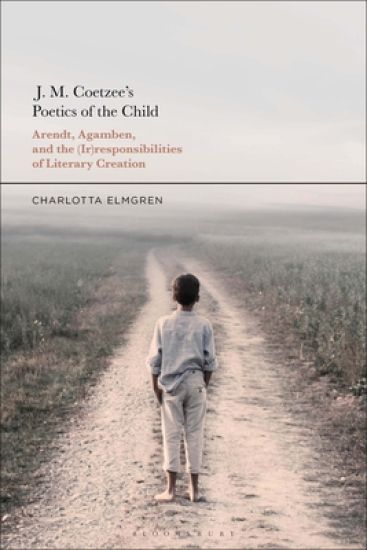
J. M. Coetzee's Poetics of the Child

J. M. Coetzee's Poetics of the Child

Charlotta Elmgren

Bloomsbury Academic
2020
sidottu
Tracing how central tensions in J.M. Coetzee’s fiction converge in and are made visible by the child figure, this book establishes the centrality of the child to Coetzee’s poetics. Through readings of novels from Dusklands to The Schooldays of Jesus, Charlotta Elmgren shows how Coetzee’s writing stages the constant interplay between irresponsibility and responsibility—to the self, the other, and the world. In articulating this poetics of (ir)responsibility, Elmgren offers the first sustained engagement with the intersections between Coetzee’s work and the philosophical thought of Giorgio Agamben. With reference also to Hannah Arendt’s thinking on natality, education, and amor mundi, Elmgren demonstrates the inextricable links in Coetzee’s writing between freedom, play, and serious attention to the world. The book identifies five central dynamics of Coetzee’s poetics: the child as a figure of truth-telling and authenticity; the ethics of the not-so-other child; the child, new beginnings and care for the world; childish behaviour as perpetual study; and the redemptive potential of infancy. Offering a fresh contribution to the field of literary childhood studies, Elmgren shows the critical possibilities in thinking about—and with—childlike openness and childish experimentation when approaching the writing and reading of the work of J.M. Coetzee and beyond.