Kirjojen hintavertailu. Mukana 12 390 323 kirjaa ja 12 kauppaa.

Kirjahaku

Etsi kirjoja tekijän nimen, kirjan nimen tai ISBN:n perusteella.

1000 tulosta hakusanalla Samuel Pufendorf

The Whole Duty of man According to the law of Nature. By That Famous Civilian Samuel Puffendorf, ... Now Made English. The Fourth Edition With the Notes of Mr. Barbeyrac, ... and an Index ... By Andrew Tooke,
The 18th century was a wealth of knowledge, exploration and rapidly growing technology and expanding record-keeping made possible by advances in the printing press. In its determination to preserve the century of revolution, Gale initiated a revolution of its own: digitization of epic proportions to preserve these invaluable works in the largest archive of its kind. Now for the first time these high-quality digital copies of original 18th century manuscripts are available in print, making them highly accessible to libraries, undergraduate students, and independent scholars.Rich in titles on English life and social history, this collection spans the world as it was known to eighteenth-century historians and explorers. Titles include a wealth of travel accounts and diaries, histories of nations from throughout the world, and maps and charts of a world that was still being discovered. Students of the War of American Independence will find fascinating accounts from the British side of conflict. ++++The below data was compiled from various identification fields in the bibliographic record of this title. This data is provided as an additional tool in helping to insure edition identification: ++++Bodleian Library (Oxford)N025724A translation of 'De officio hominis et civis juxta legem naturalem', which in turn is an abridgment of 'De jure natur et gentium'. With a preliminary advertisement leaf.London: printed for B. Tooke, and J. Hooke, 1716. 48],387, 17]p.; 8
The History of the Kingdoms and States of Asia, Africa and America. Both Ancient and Modern. The Sixth Edition With Additions. By Samuel Puffendorf,
The 18th century was a wealth of knowledge, exploration and rapidly growing technology and expanding record-keeping made possible by advances in the printing press. In its determination to preserve the century of revolution, Gale initiated a revolution of its own: digitization of epic proportions to preserve these invaluable works in the largest archive of its kind. Now for the first time these high-quality digital copies of original 18th century manuscripts are available in print, making them highly accessible to libraries, undergraduate students, and independent scholars.Rich in titles on English life and social history, this collection spans the world as it was known to eighteenth-century historians and explorers. Titles include a wealth of travel accounts and diaries, histories of nations from throughout the world, and maps and charts of a world that was still being discovered. Students of the War of American Independence will find fascinating accounts from the British side of conflict. ++++The below data was compiled from various identification fields in the bibliographic record of this title. This data is provided as an additional tool in helping to insure edition identification: ++++Cambridge University LibraryN008557With a half-title.London: printed for James, John and Paul Knapton, 1736. 24],621, 11]p.; 8
S. Pufendorfii de Officio Hominis & Civis Juxta Legem Naturalem Libri Duo. Selectis Variorum Notis, Maximeq; Propriis Illustravit, ... Indicemq; Rerum Subjunxit Tho. Johnson, ... Editio Secunda Longe Auctior & Emendatior.
The 18th century was a wealth of knowledge, exploration and rapidly growing technology and expanding record-keeping made possible by advances in the printing press. In its determination to preserve the century of revolution, Gale initiated a revolution of its own: digitization of epic proportions to preserve these invaluable works in the largest archive of its kind. Now for the first time these high-quality digital copies of original 18th century manuscripts are available in print, making them highly accessible to libraries, undergraduate students, and independent scholars.This collection reveals the history of English common law and Empire law in a vastly changing world of British expansion. Dominating the legal field is the Commentaries of the Law of England by Sir William Blackstone, which first appeared in 1765. Reference works such as almanacs and catalogues continue to educate us by revealing the day-to-day workings of society.++++The below data was compiled from various identification fields in the bibliographic record of this title. This data is provided as an additional tool in helping to insure edition identification: ++++Bodleian Library (Oxford)N021427An abridgment of Pufendorf's 'De jure natur et gentium'. Titlepage in red and black. Text is continuous despite pagination.Londini: impensis Gul. Thurlbourn, bibliopol Cantab. Prostant apud Knapton, Innys, Vaillant, Rivington & Birt, Londini; & Fletcher, & Clements, Oxonii, 1737. 2], xvi,176,179-482,479-509, 1]p., plate: port.; 8
An Introduction to the History of the Principal Kingdoms and States of Europe. By Samuel Puffendorf, ... Made English From the Original High Dutch. The Tenth Edition Corrected and Improved
The 18th century was a wealth of knowledge, exploration and rapidly growing technology and expanding record-keeping made possible by advances in the printing press. In its determination to preserve the century of revolution, Gale initiated a revolution of its own: digitization of epic proportions to preserve these invaluable works in the largest archive of its kind. Now for the first time these high-quality digital copies of original 18th century manuscripts are available in print, making them highly accessible to libraries, undergraduate students, and independent scholars.Rich in titles on English life and social history, this collection spans the world as it was known to eighteenth-century historians and explorers. Titles include a wealth of travel accounts and diaries, histories of nations from throughout the world, and maps and charts of a world that was still being discovered. Students of the War of American Independence will find fascinating accounts from the British side of conflict. ++++The below data was compiled from various identification fields in the bibliographic record of this title. This data is provided as an additional tool in helping to insure edition identification: ++++Cambridge University LibraryT166930With an index. Dublin]: London printed, and re-printed in Dublin, by and for Samuel Fairbrother, and are to be sold at his shop, 1729. 10],581, 15]p.; 8
Of the law of Nature and Nations. Eight Books. Written in Latin by the Baron Pufendorf The Second Edition Carefully Corrected, and Compared With Mr. Barbeyrac's French Translation; With the Addition of his Notes, and two Tables; ...
The 18th century was a wealth of knowledge, exploration and rapidly growing technology and expanding record-keeping made possible by advances in the printing press. In its determination to preserve the century of revolution, Gale initiated a revolution of its own: digitization of epic proportions to preserve these invaluable works in the largest archive of its kind. Now for the first time these high-quality digital copies of original 18th century manuscripts are available in print, making them highly accessible to libraries, undergraduate students, and independent scholars.The Age of Enlightenment profoundly enriched religious and philosophical understanding and continues to influence present-day thinking. Works collected here include masterpieces by David Hume, Immanuel Kant, and Jean-Jacques Rousseau, as well as religious sermons and moral debates on the issues of the day, such as the slave trade. The Age of Reason saw conflict between Protestantism and Catholicism transformed into one between faith and logic -- a debate that continues in the twenty-first century.++++The below data was compiled from various identification fields in the bibliographic record of this title. This data is provided as an additional tool in helping to insure edition identification: ++++British LibraryT141114Translator's dedication signed: Basil Kennett; publisher's preface names two other translators as Percivale and Rev. Itchiner.Oxford: printed by L. Lichfield, for A. and J. Churchil, R. Sare, R. Bonwicke, W. Freeman, T. Goodwyn and 7 others in London], 1710. 24],724, 22]p.; 2
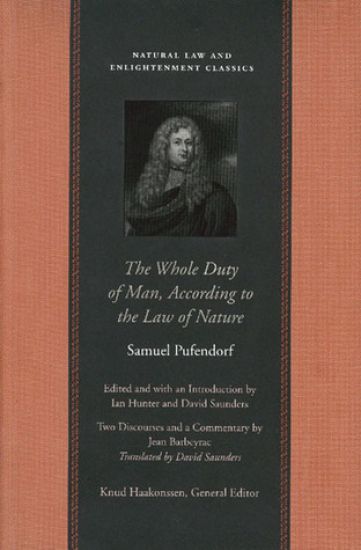
Whole Duty of Man According to the Law of Nature

Whole Duty of Man According to the Law of Nature

Samuel Pufendorf

Liberty Fund Inc
2002
sidottu
This new scholarly edition of Samuel Pufendorf's seminal The Whole Duty of Man According to the Law of Nature is among the first to suggest a purely conventional basis for natural law. Pufendorf wrote this work to make his insights accessible to a wide range of readers, especially university students, who were struggling with issues of church and state. Although indebted to Hobbes and Grotius, the work outlines a new understanding of ethics and politics, one suited to states that were emerging from the aftermath of religious civil war.
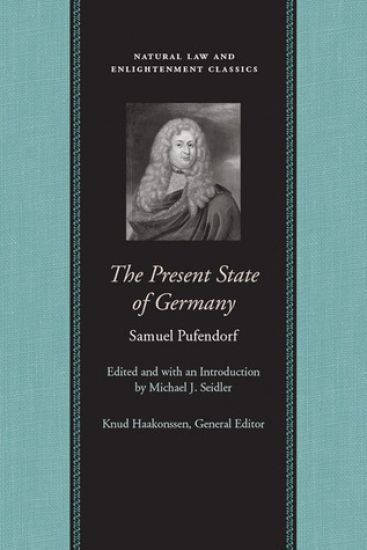
Present State of Germany

Present State of Germany

Samuel Pufendorf

Liberty Fund Inc
2007
nidottu
Although 'The Present State of Germany' was first made available in English over three centuries ago, it has been virtually unavailable in English since the period of the American Founding. By 1696, Pufendorf was well known in England as a staunch defender of the Protestant cause and as one of the renovators of natural law. His writings were familiar to such luminaries as Locke and figured prominently in James Tyrell's 'Patriarcha non Monarcha' (1681).
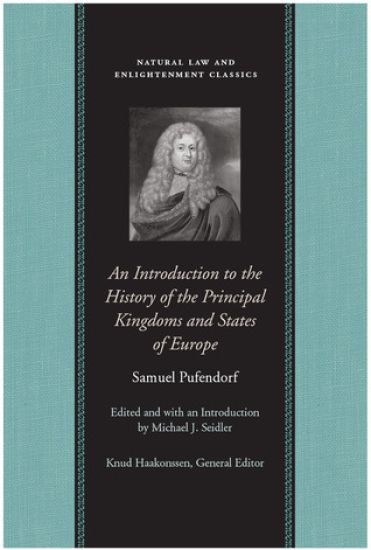
Introduction to the History of the Principal Kingdoms & States of Europe
Samuel Pufendorf was a pivotal figure in the early German Enlightenment and, along with Grotius, the great renewer of natural law theory. His version of voluntarist natural law theory had a major influence both on the European continent and in the English speaking world, particularly Scotland and America. "An Introduction to the History of the Principal Kingdoms & States of Europe" was first translated in 1695 but has been rare in English since the late eighteenth century. Pufendorf's histories exhibit the core notions of his natural law theory by recounting the development and current, reciprocal relations of individual states as collective social agents engaged in securing their own and, thus, their members' interests, including self-preservation. Hence, his histories essentially functioned as vehicles for philosophical demonstration or justification. Moreover, by emphasising empirical details and legitimating (in principle) the de facto politics of interest, these histories appealed strongly to the emerging nation-states of early modern Europe, which sought ratification of their external and internal actions, policies, and pedagogues. He based his account on the respective country's own historians and took care to describe its position from its own current and historical perspectives. It was a novel and appealing approach to political history, judging from the long and diverse publishing record of the work.
Introduction to the History of the Principal Kingdoms & States of Europe
Samuel Pufendorf was a pivotal figure in the early German Enlightenment and, along with Grotius, the great renewer of natural law theory. His version of voluntarist natural law theory had a major influence both on the European continent and in the English speaking world, particularly Scotland and America. "An Introduction to the History of the Principal Kingdoms & States of Europe" was first translated in 1695 but has been rare in English since the late eighteenth century. Pufendorf's histories exhibit the core notions of his natural law theory by recounting the development and current, reciprocal relations of individual states as collective social agents engaged in securing their own and, thus, their members' interests, including self-preservation. Hence, his histories essentially functioned as vehicles for philosophical demonstration or justification. Moreover, by emphasising empirical details and legitimating (in principle) the de facto politics of interest, these histories appealed strongly to the emerging nation-states of early modern Europe, which sought ratification of their external and internal actions, policies, and pedagogues. He based his account on the respective country's own historians and took care to describe its position from its own current and historical perspectives. It was a novel and appealing approach to political history, judging from the long and diverse publishing record of the work.
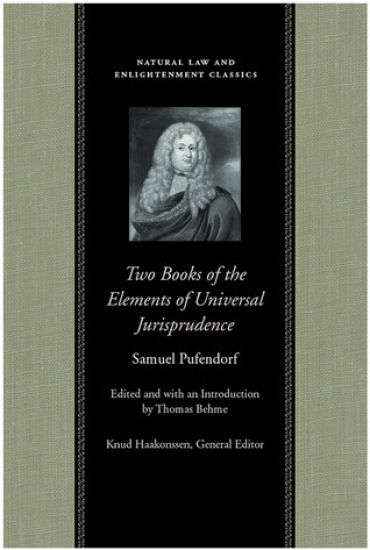
Two Books of the Elements of Universal Jurisprudence
"Two Books of the Elements of Universal Jurisprudence" was Pufendorf's first work, published in 1660. Its appearance effectively inaugurated the modern natural-law movement in the German-speaking world. The work also established Pufendorf as a key figure and laid the foundations for his major works, which were to sweep across Europe and North America. 'Elements of Universal Jurisprudence' established Pufendorf's political theory, which, when fully developed, became the most significant alternative to rights-based theories. Pufendorf rejected the concept of natural rights as liberties and the suggestion that political government is justified by its protection of such rights, arguing instead for a principled limit to the state's role in human life. The Liberty Fund edition is based on the translation by William Abbott Oldfather prepared for the Classics of International Law series published by the Carnegie Endowment for International Peace.
S. Puffendorfii De officio hominis et civis juxta legem naturalem libri duo. Editio octava, aucta lemmatibus, quibus argumenti sensus, & series illustratur.
The 18th century was a wealth of knowledge, exploration and rapidly growing technology and expanding record-keeping made possible by advances in the printing press. In its determination to preserve the century of revolution, Gale initiated a revolution of its own: digitization of epic proportions to preserve these invaluable works in the largest archive of its kind. Now for the first time these high-quality digital copies of original 18th century manuscripts are available in print, making them highly accessible to libraries, undergraduate students, and independent scholars.The Age of Enlightenment profoundly enriched religious and philosophical understanding and continues to influence present-day thinking. Works collected here include masterpieces by David Hume, Immanuel Kant, and Jean-Jacques Rousseau, as well as religious sermons and moral debates on the issues of the day, such as the slave trade. The Age of Reason saw conflict between Protestantism and Catholicism transformed into one between faith and logic -- a debate that continues in the twenty-first century.++++The below data was compiled from various identification fields in the bibliographic record of this title. This data is provided as an additional tool in helping to insure edition identification: ++++British LibraryT141121With two final advertisement leaves. An abridgment of Pufendorf's 'De jure natur et gentium'.Cantabrigi typis academicis. Impensis Jacobi Knapton Londini, 1715. 24],164, 4]p.; 12
The Divine Feudal Law

The Divine Feudal Law

Samuel Pufendorf

Gale Ecco, Print Editions
2018
sidottu
The 18th century was a wealth of knowledge, exploration and rapidly growing technology and expanding record-keeping made possible by advances in the printing press. In its determination to preserve the century of revolution, Gale initiated a revolution of its own: digitization of epic proportions to preserve these invaluable works in the largest archive of its kind. Now for the first time these high-quality digital copies of original 18th century manuscripts are available in print, making them highly accessible to libraries, undergraduate students, and independent scholars.The Age of Enlightenment profoundly enriched religious and philosophical understanding and continues to influence present-day thinking. Works collected here include masterpieces by David Hume, Immanuel Kant, and Jean-Jacques Rousseau, as well as religious sermons and moral debates on the issues of the day, such as the slave trade. The Age of Reason saw conflict between Protestantism and Catholicism transformed into one between faith and logic -- a debate that continues in the twenty-first century.++++The below data was compiled from various identification fields in the bibliographic record of this title. This data is provided as an additional tool in helping to insure edition identification: ++++British LibraryT141120With a half-title. Running title: 'An essay towards the uniting of Protestants.'.London: printed for John Wyat, 1703. 16],365, 3]p.; 8
Of the law of Nature and Nations. Eight Books. Written in Latin by the Baron Puffendorf, Done Into English by Basil Kennet, The Third Edition
The 18th century was a wealth of knowledge, exploration and rapidly growing technology and expanding record-keeping made possible by advances in the printing press. In its determination to preserve the century of revolution, Gale initiated a revolution of its own: digitization of epic proportions to preserve these invaluable works in the largest archive of its kind. Now for the first time these high-quality digital copies of original 18th century manuscripts are available in print, making them highly accessible to libraries, undergraduate students, and independent scholars.The Age of Enlightenment profoundly enriched religious and philosophical understanding and continues to influence present-day thinking. Works collected here include masterpieces by David Hume, Immanuel Kant, and Jean-Jacques Rousseau, as well as religious sermons and moral debates on the issues of the day, such as the slave trade. The Age of Reason saw conflict between Protestantism and Catholicism transformed into one between faith and logic -- a debate that continues in the twenty-first century.++++The below data was compiled from various identification fields in the bibliographic record of this title. This data is provided as an additional tool in helping to insure edition identification: ++++British LibraryT118565Duplicate pagination of pp.221-242 in 577 sequence. Pp.129-131 misnumbered 529-531 (sig.*R1,2).London: printed for R. Sare, R. Bonwicke, T. Goodwyn, J. Walthoe, M. Wotton, S. Manship, R. Wilkin, B. Tooke, R. Smith, T. Ward, and W. Churchill, 1717. 24],212,242,221-356,359-390,453-556,559-577, 1],531 i.e. 131], 23]p.; 2
S. Puffendorfii De officio hominis et civis juxta legem naturalem libri duo. Editio sexta, aucta lemmatibus, quibus argumenti sensus, & series illustratur.
The 18th century was a wealth of knowledge, exploration and rapidly growing technology and expanding record-keeping made possible by advances in the printing press. In its determination to preserve the century of revolution, Gale initiated a revolution of its own: digitization of epic proportions to preserve these invaluable works in the largest archive of its kind. Now for the first time these high-quality digital copies of original 18th century manuscripts are available in print, making them highly accessible to libraries, undergraduate students, and independent scholars.The Age of Enlightenment profoundly enriched religious and philosophical understanding and continues to influence present-day thinking. Works collected here include masterpieces by David Hume, Immanuel Kant, and Jean-Jacques Rousseau, as well as religious sermons and moral debates on the issues of the day, such as the slave trade. The Age of Reason saw conflict between Protestantism and Catholicism transformed into one between faith and logic -- a debate that continues in the twenty-first century.++++The below data was compiled from various identification fields in the bibliographic record of this title. This data is provided as an additional tool in helping to insure edition identification: ++++William Andrews Clark Memorial Library (UCLA)N021426An abridgment of Pufendorf's 'De jure natur et gentium'.Cantabrigi typis academicis. Impensis Edvardi Hall, 1701. 24],161, 5]p.; 8
Of the Law of Nature & Nations

Of the Law of Nature & Nations

Samuel Pufendorf

Liberty Fund Inc
2026
sidottu
Pufendorf provided a comprehensive system of society, law, and government based on a theory of human nature. Eschewing contemporary theological ideas of human perfection and other-worldly beatitude, he founded his natural law on the need for sociability in this world. While paying great respect to Grotius as the founder of a modern, enlightened natural law, Pufendorf criticised his remaining 'scholasticism'. Similarly, he learned from Hobbes but rejected the reduction of natural law to individual self-interest. Pufendorf wanted to transform natural law by getting rid of its metaphysical foundations, but he retained its function as a moral basis for civil law and the state. OF THE LAW OF NATURE AND NATIONS was Pufendorf's magnum opus. Despite its enormous size, the work was translated into nine languages. Together with the shorter textbook version, 'The Whole Duty of Man' -- published in thirteen languages -- Pufendorf's work influenced generations of students across Europe and America.