This is the first full-length monograph to examine the history of colonial medicine in India from the perspective of veterinary health. The history of human health in the subcontinent has received a fair amount of attention in the last few decades, but nearly all existing texts have completely ignored the question of animal health. This book will not only fill this gap, but also provide fresh perspectives and insights that might challenge existing arguments.At the same time, this volume is a social history of cattle in India. Keeping the question of livestock at the centre, it explores a range of themes such as famines, agrarian relations, urbanisation, middle-class attitudes, caste formations etc. The overall aim is to integrate medical history with social history in a way that has not often been attempted.
Destined to become a key work of subaltern studies and a crucial intervention in postcolonial scholarship, Stitches on Time probes the relationships between empire and modernity, nation and history, the colonial and the postcolonial, and power and difference. Saurabh Dube combines history and anthropology to provide critical understandings of the theory and practice of historical ethnography and contemporary historiography. Drawing on extensive archival research and innovative fieldwork as well as political economy and social theory-including considerations of gender-he unpacks the implications of specific Indian pasts from the middle of the nineteenth century through the end of the twentieth century.Dube provides incisive accounts of the interactions between North American evangelical missionaries and Christian converts of central India, and between colonial legal systems and Indian popular laws. He reflects on the difficulties of history writing by considering the production and reception of recent Hindu nationalist histories. Assessing the work of the South Asian Subaltern Studies Collective, he offers substantial critical readings of major writings by Ranajit Guha, Dipesh Chakrabarty, Partha Chatterjee, and others. Dube develops the concept and practice of a “history without warranty” as a means of rigorously rethinking categories such as modernity, colonialism, the West, the postcolonial, and the nation.
Destined to become a key work of subaltern studies and a crucial intervention in postcolonial scholarship, Stitches on Time probes the relationships between empire and modernity, nation and history, the colonial and the postcolonial, and power and difference. Saurabh Dube combines history and anthropology to provide critical understandings of the theory and practice of historical ethnography and contemporary historiography. Drawing on extensive archival research and innovative fieldwork as well as political economy and social theory-including considerations of gender-he unpacks the implications of specific Indian pasts from the middle of the nineteenth century through the end of the twentieth century.Dube provides incisive accounts of the interactions between North American evangelical missionaries and Christian converts of central India, and between colonial legal systems and Indian popular laws. He reflects on the difficulties of history writing by considering the production and reception of recent Hindu nationalist histories. Assessing the work of the South Asian Subaltern Studies Collective, he offers substantial critical readings of major writings by Ranajit Guha, Dipesh Chakrabarty, Partha Chatterjee, and others. Dube develops the concept and practice of a “history without warranty” as a means of rigorously rethinking categories such as modernity, colonialism, the West, the postcolonial, and the nation.
The world continues to lose more than a million lives each year to the HIV epidemic, and nearly two million individuals were infected with HIV in 2017 alone. The new Sustainable Development Goals, adopted by countries of the United Nations in September 2015, include a commitment to end the AIDS epidemic by 2030. Considerable emphasis on prevention of new infections and treatment of those living with HIV will be needed to make this goal achievable. With nearly 37 million people now living with HIV, it is a communicable disease that behaves like a noncommunicable disease.Nutritional management is integral to comprehensive HIV care and treatment. Improved nutritional status and weight gain can increase recovery and strength of individuals living with HIV/AIDS, improve dietary diversity and caloric intake, and improve quality of life. This book highlights evidence-based research linking nutrition and HIV and identifies research gaps to inform the development of guidelines and policies for the United Nations’ Sustainable Development Goals. A comprehensive approach that includes nutritional interventions is likely to maximize the benefit of antiretroviral therapy in preventing HIV disease progression and other adverse outcomes in HIV-infected men and women. Modification of nutritional status has been shown to enhance the quality of life of those suffering HIV/AIDS, both physically in terms of improved body mass index and immunological markers, and psychologically, by improving symptoms of depression. While the primary focus for those infected should remain on antiretroviral treatment and increasing its availability and coverage, improvement of nutritional status plays a complementary role in the management of HIV infection.
Scrupulously based in anthropology and history – and drawing on social theory and critical thought – this book revisits the disciplines, archives, and subjects of modernity. There are at least three interleaving emphases here. To begin with, the work rethinks institutionalized formations of anthropology and history – together with "archives" at large – as themselves intimating disciplines of modernity. Understood in the widest senses of the terms, these disciplines are constitutively contradictory. Moreover, the study interrupts familiar projections of modern subjects as molded a priori by a disenchanted calculus of interest and reason. It tracks instead the affective, embodied, and immanent attributes of our varied worlds as formative of subjects of modernity, sown into their substance and spirit. Finally, running through the book is a querying of entitlement and privilege that underlie social terrains and their scholarly apprehensions – articulating at once distinct elites, pervasive plutocracies, and modern "scholasticisms."
Scrupulously based in anthropology and history – and drawing on social theory and critical thought – this book revisits the disciplines, archives, and subjects of modernity. There are at least three interleaving emphases here. To begin with, the work rethinks institutionalized formations of anthropology and history – together with "archives" at large – as themselves intimating disciplines of modernity. Understood in the widest senses of the terms, these disciplines are constitutively contradictory. Moreover, the study interrupts familiar projections of modern subjects as molded a priori by a disenchanted calculus of interest and reason. It tracks instead the affective, embodied, and immanent attributes of our varied worlds as formative of subjects of modernity, sown into their substance and spirit. Finally, running through the book is a querying of entitlement and privilege that underlie social terrains and their scholarly apprehensions – articulating at once distinct elites, pervasive plutocracies, and modern "scholasticisms."
A comprehensive text that reviews the methods and technologies that explore emergent behavior in complex systems engineering in multidisciplinary fields In Emergent Behavior in Complex Systems Engineering, the authors present the theoretical considerations and the tools required to enable the study of emergent behaviors in manmade systems. Information Technology is key to today’s modern world. Scientific theories introduced in the last five decades can now be realized with the latest computational infrastructure. Modeling and simulation, along with Big Data technologies are at the forefront of such exploration and investigation. The text offers a number of simulation-based methods, technologies, and approaches that are designed to encourage the reader to incorporate simulation technologies to further their understanding of emergent behavior in complex systems. The authors present a resource for those designing, developing, managing, operating, and maintaining systems, including system of systems. The guide is designed to help better detect, analyse, understand, and manage the emergent behaviour inherent in complex systems engineering in order to reap the benefits of innovations and avoid the dangers of unforeseen consequences. This vital resource: Presents coverage of a wide range of simulation technologiesExplores the subject of emergence through the lens of Modeling and Simulation (M&S)Offers contributions from authors at the forefront of various related disciplines such as philosophy, science, engineering, sociology, and economicsContains information on the next generation of complex systems engineering Written for researchers, lecturers, and students, Emergent Behavior in Complex Systems Engineering provides an overview of the current discussions on complexity and emergence, and shows how systems engineering methods in general and simulation methods in particular can help in gaining new insights in complex systems engineering.
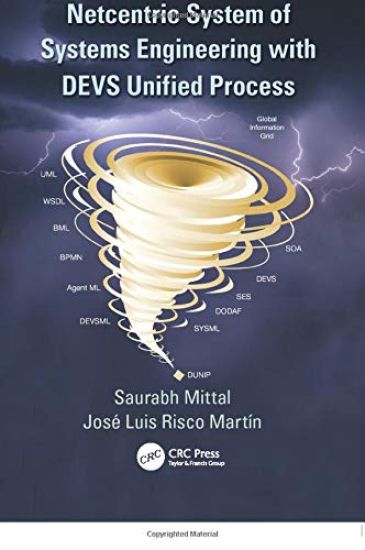
In areas such as military, security, aerospace, and disaster management, the need for performance optimization and interoperability among heterogeneous systems is increasingly important. Model-driven engineering, a paradigm in which the model becomes the actual software, offers a promising approach toward systems of systems (SoS) engineering. However, model-driven engineering has largely been unachieved in complex dynamical systems and netcentric SoS, partly because modeling and simulation (M&S) frameworks are stove-piped and not designed for SoS composability. Addressing this gap, Netcentric System of Systems Engineering with DEVS Unified Process presents a methodology for realizing the model-driven engineering vision and netcentric SoS using DEVS Unified Process (DUNIP).The authors draw on their experience with Discrete Event Systems Specification (DEVS) formalism, System Entity Structure (SES) theory, and applying model-driven engineering in the context of a netcentric SoS. They describe formal model-driven engineering methods for netcentric M&S using standards-based approaches to develop and test complex dynamic models with DUNIP. The book is organized into five sections: Section I introduces undergraduate students and novices to the world of DEVS. It covers systems and SoS M&S as well as DEVS formalism, software, modeling language, and DUNIP. It also assesses DUNIP with the requirements of the Department of Defense’s (DoD) Open Unified Technical Framework (OpenUTF) for netcentric Test and Evaluation (T&E). Section II delves into M&S-based systems engineering for graduate students, advanced practitioners, and industry professionals. It provides methodologies to apply M&S principles to SoS design and reviews the development of executable architectures based on a framework such as the Department of Defense Architecture Framework (DoDAF). It also describes an approach for building netcentric knowledge-based contingency-driven systems. Section III guides graduate students, advanced DEVS users, and industry professionals who are interested in building DEVS virtual machines and netcentric SoS. It discusses modeling standardization, the deployment of models and simulators in a netcentric environment, event-driven architectures, and more. Section IV explores real-world case studies that realize many of the concepts defined in the previous chapters. Section V outlines the next steps and looks at how the modeling of netcentric complex adaptive systems can be attempted using DEVS concepts. It touches on the boundaries of DEVS formalism and the future work needed to utilize advanced concepts like weak and strong emergence, self-organization, scale-free systems, run-time modularity, and event interoperability.This groundbreaking work details how DUNIP offers a well-structured, platform-independent methodology for the modeling and simulation of netcentric system of systems.
A powerful real world poetry collection about issues in Asia, from Afghanistan to India via Singapore. Asia is a huge area of the world and the problems and topics raised here are cutting edge and powerful. From the ongoing Philippine drug war to the Kashmir question, the work here is both memorable and soul searching. Everybody in Asia and further afield will find this book interesting and thought provoking. Priya Verma illustrates the book with simple but powerful cartoon images. Think of the man stood in front of the tank in Tienanmen Square, you get the idea. Everybody from President Putin to Premier Xi to the normal person in the street/field need to read this book. If only to bring awareness on the issues and broaden the solutions. A welcome book on Asian issues that are global by Visually Impaired author Saurabh Pant. Hard copy book version.
In areas such as military, security, aerospace, and disaster management, the need for performance optimization and interoperability among heterogeneous systems is increasingly important. Model-driven engineering, a paradigm in which the model becomes the actual software, offers a promising approach toward systems of systems (SoS) engineering. However, model-driven engineering has largely been unachieved in complex dynamical systems and netcentric SoS, partly because modeling and simulation (M&S) frameworks are stove-piped and not designed for SoS composability. Addressing this gap, Netcentric System of Systems Engineering with DEVS Unified Process presents a methodology for realizing the model-driven engineering vision and netcentric SoS using DEVS Unified Process (DUNIP).The authors draw on their experience with Discrete Event Systems Specification (DEVS) formalism, System Entity Structure (SES) theory, and applying model-driven engineering in the context of a netcentric SoS. They describe formal model-driven engineering methods for netcentric M&S using standards-based approaches to develop and test complex dynamic models with DUNIP. The book is organized into five sections: Section I introduces undergraduate students and novices to the world of DEVS. It covers systems and SoS M&S as well as DEVS formalism, software, modeling language, and DUNIP. It also assesses DUNIP with the requirements of the Department of Defense’s (DoD) Open Unified Technical Framework (OpenUTF) for netcentric Test and Evaluation (T&E). Section II delves into M&S-based systems engineering for graduate students, advanced practitioners, and industry professionals. It provides methodologies to apply M&S principles to SoS design and reviews the development of executable architectures based on a framework such as the Department of Defense Architecture Framework (DoDAF). It also describes an approach for building netcentric knowledge-based contingency-driven systems. Section III guides graduate students, advanced DEVS users, and industry professionals who are interested in building DEVS virtual machines and netcentric SoS. It discusses modeling standardization, the deployment of models and simulators in a netcentric environment, event-driven architectures, and more. Section IV explores real-world case studies that realize many of the concepts defined in the previous chapters. Section V outlines the next steps and looks at how the modeling of netcentric complex adaptive systems can be attempted using DEVS concepts. It touches on the boundaries of DEVS formalism and the future work needed to utilize advanced concepts like weak and strong emergence, self-organization, scale-free systems, run-time modularity, and event interoperability.This groundbreaking work details how DUNIP offers a well-structured, platform-independent methodology for the modeling and simulation of netcentric system of systems.
The world continues to lose more than a million lives each year to the HIV epidemic, and nearly two million individuals were infected with HIV in 2017 alone. The new Sustainable Development Goals, adopted by countries of the United Nations in September 2015, include a commitment to end the AIDS epidemic by 2030. Considerable emphasis on prevention of new infections and treatment of those living with HIV will be needed to make this goal achievable. With nearly 37 million people now living with HIV, it is a communicable disease that behaves like a noncommunicable disease.Nutritional management is integral to comprehensive HIV care and treatment. Improved nutritional status and weight gain can increase recovery and strength of individuals living with HIV/AIDS, improve dietary diversity and caloric intake, and improve quality of life. This book highlights evidence-based research linking nutrition and HIV and identifies research gaps to inform the development of guidelines and policies for the United Nations’ Sustainable Development Goals. A comprehensive approach that includes nutritional interventions is likely to maximize the benefit of antiretroviral therapy in preventing HIV disease progression and other adverse outcomes in HIV-infected men and women. Modification of nutritional status has been shown to enhance the quality of life of those suffering HIV/AIDS, both physically in terms of improved body mass index and immunological markers, and psychologically, by improving symptoms of depression. While the primary focus for those infected should remain on antiretroviral treatment and increasing its availability and coverage, improvement of nutritional status plays a complementary role in the management of HIV infection.