Kirjojen hintavertailu. Mukana 11 699 587 kirjaa ja 12 kauppaa.

Kirjahaku

Etsi kirjoja tekijän nimen, kirjan nimen tai ISBN:n perusteella.

1000 tulosta hakusanalla Selma Anttila

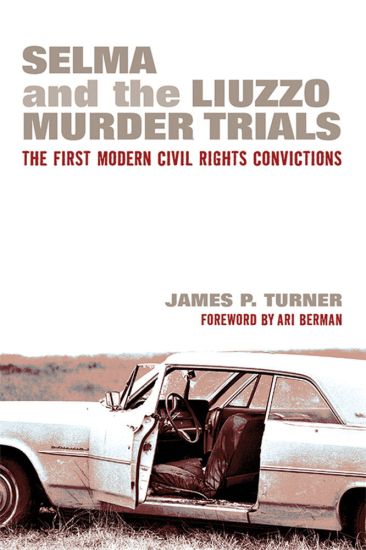
Selma and the Liuzzo Murder Trials

Selma and the Liuzzo Murder Trials

James P. Turner

The University of Michigan Press
2018
nidottu
In 1965 the drive for black voting rights in the south culminated in the epic Selma to Montgomery Freedom March. After brutal state police beatings stunned the nation on “Bloody Sunday,” troops under federal court order lined the route as the march finally made its way to the State Capitol and a triumphant address by Dr. Martin Luther King, Jr. But within hours klan terror struck, claiming the life of one of the marchers, Viola Liuzzo, a Detroit mother of five. Turner offers an insider’s view of the three trials that took place over the following nine months—which finally resulted in the conviction of the killers. Despite eyewitness testimony by an FBI informant who was riding in the car with the killers, two all-white state juries refused to convict. It took a team of Civil Rights Division lawyers, led by the legendary John Doar, to produce the landmark jury verdict that klansmen were no longer above the law. This is must reading today, as the voting rights won in Selma come under renewed attack.Explore several court documents, including court transcripts, exhibits, and memoranda on Fulcrum.org.
Selma and the Liuzzo Murder Trials

Selma and the Liuzzo Murder Trials

James P. Turner

The University of Michigan Press
2018
sidottu
In 1965 the drive for black voting rights in the south culminated in the epic Selma to Montgomery Freedom March. After brutal state police beatings stunned the nation on “Bloody Sunday,” troops under federal court order lined the route as the march finally made its way to the State Capitol and a triumphant address by Dr. Martin Luther King, Jr. But within hours klan terror struck, claiming the life of one of the marchers, Viola Liuzzo, a Detroit mother of five. Turner offers an insider’s view of the three trials that took place over the following nine months—which finally resulted in the conviction of the killers. Despite eyewitness testimony by an FBI informant who was riding in the car with the killers, two all-white state juries refused to convict. It took a team of Civil Rights Division lawyers, led by the legendary John Doar, to produce the landmark jury verdict that klansmen were no longer above the law. This is must reading today, as the voting rights won in Selma come under renewed attack.Explore several court documents, including court transcripts, exhibits, and memoranda on Fulcrum.org.
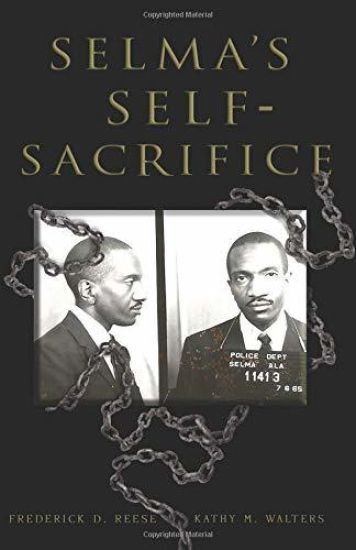
Selma's Self-Sacrifice

Selma's Self-Sacrifice

Kathy M. Walters; Frederick D. Reese

Reese Enterprise
2019
nidottu
Frederick D. Reese was born on November 28, 1929, in Selma, Alabama. Reese rose to national prominence as a civil rights leader after Selma's "Bloody Sunday." He later marched with Rev. Martin Luther King, Jr. from Selma to Montgomery as an advocate for African-American voter registration rights. On March 7, 1965, Reese and more than 600 other activists marched across the Edmund Pettus Bridge in Selma, Alabama. The day would live in infamy as "Bloody Sunday" after protestors were beaten and sprayed with tear gas on the orders of Alabama Governor George Wallace. Following the violence that day, the majority of the marchers congregated at Brown Chapel AME Church, where Reese spoke to the crowd. Rev. Martin Luther King, Jr. called Reese from Atlanta with news that he was organizing a march involving ministers from all over the country. On March 21, 1965, more than 3,000 people gathered at Selma's Brown Chapel AME Church in an attempt to march the 50-mile journey from Selma to Montgomery, but Judge Johnson would only grant clearance for 300 marchers to begin the two-lane trek along Hwy. 80 east, leaving Selma. Once the highway expanded from a two-lane to a four-lane road, people began joining the marchers. By the time they reached Alabama's state capital, Montgomery, the number of marchers had reached 50,000. Reese marched hand in hand with King, and his front row presence made him a symbol of and leader in the civil rights movement. Read how it all began...
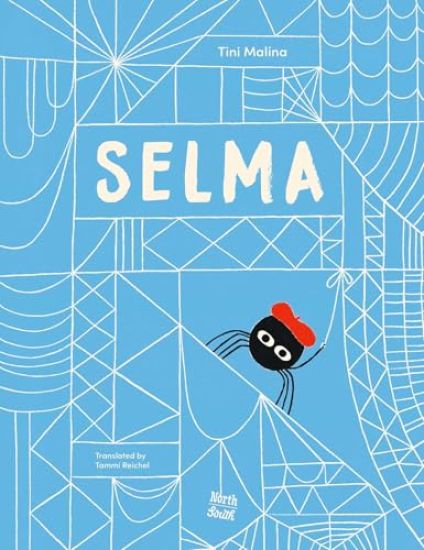
Selma-The Story of a Stellar Spider

Selma-The Story of a Stellar Spider

Tini Malina

Northsouth Books
2026
sidottu
A standout new picture book talent spins the story of a one-of-a-kind spider with an unstoppable artistic spirit. Also available in Spanish: Selma-la historia de una ara a estelar. Selma is no ordinary spider. Most spiders make webs to catch flies, but not Selma. She wants to capture the Splendor of the Universe. But it's hard to reach the stars from so close to the ground So Selma sets off to discover just how far a humble spider must spin to become out of this world . . .
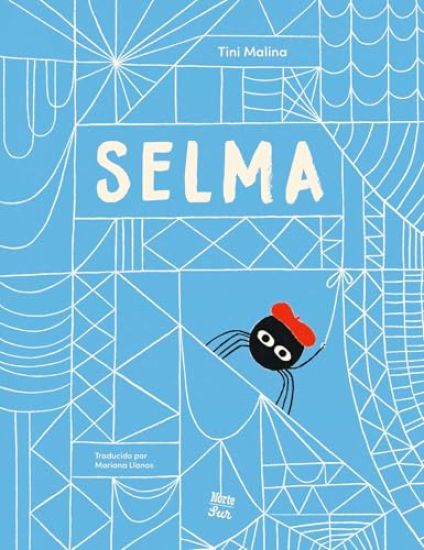
Selma-La Historia de Una Araña Estelar: (Spanish Edition)
A standout new picture book talent spins the story of a one-of-a-kind spider with an unstoppable artistic spirit. Una nueva y destacada talento de libros para ni os cuenta la historia de una ara a nica con un esp ritu art stico imparable. Also available in English/Tambi n disponsible en ingl s: Selma-The Story of a Stellar Spider. Selma is no ordinary spider. Most spiders make webs to catch flies, but not Selma. She wants to capture the Splendor of the Universe. But it's hard to reach the stars from so close to the ground So Selma sets off to discover just how far a humble spider must spin to become out of this world . . . Selma no es una ara a com n y corriente. La mayor a de las ara as tejen sus redes para atrapar moscas. Pero no Selma. Ella quiere capturar el esplendor del universo. Pero alcanzar las estrellas es dif cil cuando se vive tan cerca del suelo As que Selma se aventura para descubrir qu tan lejos debe ir una humilde ara a que quiere ser una superestrella.
Selma to Saigon

Selma to Saigon

Daniel S. Lucks

The University Press of Kentucky
2014
sidottu
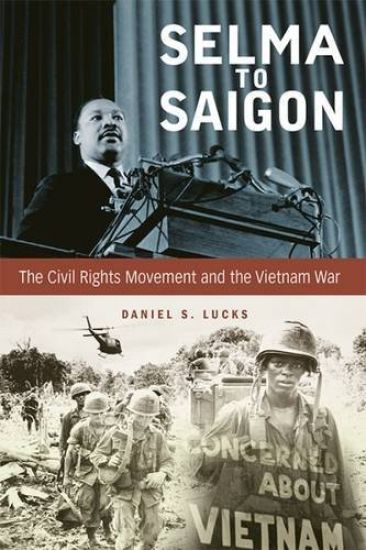
The civil rights and anti--Vietnam War movements were the two greatest protests of twentieth-century America. The dramatic escalation of U.S. involvement in Vietnam in 1965 took precedence over civil rights legislation, which had dominated White House and congressional attention during the first half of the decade. The two issues became intertwined on January 6, 1966, when the Student Nonviolent Coordinating Committee (SNCC) became the first civil rights organization to formally oppose the war, protesting the injustice of drafting African Americans to fight for the freedom of the South Vietnamese people when they were still denied basic freedoms at home.Selma to Saigon explores the impact of the Vietnam War on the national civil rights movement. Before the war gained widespread attention, the New Left, the SNCC, and the Congress of Racial Equality (CORE) worked together to create a biracial alliance with the potential to make significant political and social gains in Washington. Contention over the war, however, exacerbated preexisting generational and ideological tensions that undermined the coalition, and Lucks analyzes the causes and consequences of this disintegration.This powerful narrative illuminates the effects of the Vietnam War on the lives of leaders such as Whitney Young Jr., Stokely Carmichael, Roy Wilkins, Bayard Rustin, and Martin Luther King Jr., as well as other activists who faced the threat of the military draft along with race-related discrimination and violence. Providing new insights into the evolution of the civil rights movement, this book fills a significant gap in the literature about one of the most tumultuous periods in American history.
Selma to Saigon

Selma to Saigon

Daniel S. Lucks

The University Press of Kentucky
2017
nidottu
The civil rights and anti--Vietnam War movements were the two greatest protests of twentieth-century America. The dramatic escalation of U.S. involvement in Vietnam in 1965 took precedence over civil rights legislation, which had dominated White House and congressional attention during the first half of the decade. The two issues became intertwined on January 6, 1966, when the Student Nonviolent Coordinating Committee (SNCC) became the first civil rights organization to formally oppose the war, protesting the injustice of drafting African Americans to fight for the freedom of the South Vietnamese people when they were still denied basic freedoms at home.Selma to Saigon explores the impact of the Vietnam War on the national civil rights movement. Before the war gained widespread attention, the New Left, the SNCC, and the Congress of Racial Equality (CORE) worked together to create a biracial alliance with the potential to make significant political and social gains in Washington. Contention over the war, however, exacerbated preexisting generational and ideological tensions that undermined the coalition, and Lucks analyzes the causes and consequences of this disintegration.This powerful narrative illuminates the effects of the Vietnam War on the lives of leaders such as Whitney Young Jr., Stokely Carmichael, Roy Wilkins, Bayard Rustin, and Martin Luther King Jr., as well as other activists who faced the threat of the military draft along with race-related discrimination and violence. Providing new insights into the evolution of the civil rights movement, this book fills a significant gap in the literature about one of the most tumultuous periods in American history.
Selma, Lord, Selma

Selma, Lord, Selma

Sheyann Webb; Rachel West Nelson

The University of Alabama Press
1997
nidottu
When Dr. Martin Luther King arrived in Selma, Alabama, in January, 1965 to organize peaceful demonstrations against discriminatory voting, Sheyann Webb was aged eight and Rachel West Nelson aged nine. This is their account of the events of the winter of 1965 which changed American history.
Sailor Jack Goes North, by Selma and Jack Wassermann. Pictures by Bob Jones

Sailor Jack Goes North, by Selma and Jack Wassermann. Pictures by Bob Jones

Selma Wassermann; Jack Joint Author Wassermann

Hassell Street Press
2021
sidottu
This work has been selected by scholars as being culturally important and is part of the knowledge base of civilization as we know it.This work is in the public domain in the United States of America, and possibly other nations. Within the United States, you may freely copy and distribute this work, as no entity (individual or corporate) has a copyright on the body of the work.Scholars believe, and we concur, that this work is important enough to be preserved, reproduced, and made generally available to the public. To ensure a quality reading experience, this work has been proofread and republished using a format that seamlessly blends the original graphical elements with text in an easy-to-read typeface.We appreciate your support of the preservation process, and thank you for being an important part of keeping this knowledge alive and relevant.
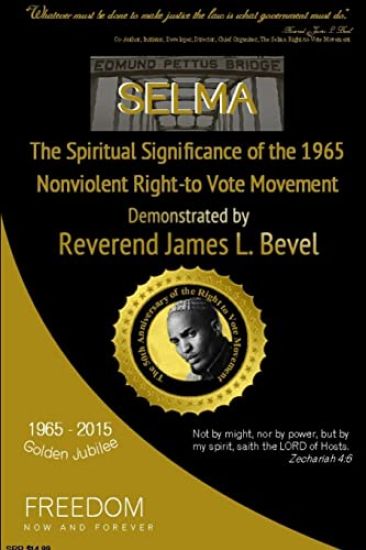
SELMA, The Spiritual Significance of the Right-to-Vote Movement, Demonstrated by Reverend James L. Bevel
The history of the Nonviolent Right To Vote Movement is incomplete without the work of James Luther Bevel. If there had not been a James Bevel there would not have been a voting rights act. As the initiation, developer, organizer and director of the movement, he galvanized people to join him in eradicating the barriers to voting. It is the complete story that allows people to understand how a movement takes place. As the strategist for this movement his knowledge is of ultimate value.
Selma Lagerlof

Selma Lagerlof

Hanna Astrup Larsen

Literary Licensing, LLC
2011
sidottu
Selma Lagerlof by Hanna Astrup Larsen is a biography of the famous Swedish author and Nobel Prize winner. The book explores Lagerlof's life, from her childhood in rural Sweden to her rise as one of the most celebrated writers of the early 20th century. The author delves into Lagerlof's personal struggles, including her battle with chronic pain and her unconventional relationships with women. The book also examines Lagerlof's literary works, including her most famous novel, The Wonderful Adventures of Nils, and her efforts to use her writing as a tool for social change. Through extensive research and interviews with Lagerlof's family and friends, Larsen provides a detailed and intimate portrait of this iconic figure in Swedish literature. This book is a must-read for anyone interested in the life and work of Selma Lagerlof, as well as those interested in the history of literature and feminism.A Short Biography Of The First Woman Winner Of The Nobel Prize For Literature.This scarce antiquarian book is a facsimile reprint of the old original and may contain some imperfections such as library marks and notations. Because we believe this work is culturally important, we have made it available as part of our commitment for protecting, preserving, and promoting the world's literature in affordable, high quality, modern editions, that are true to their original work.
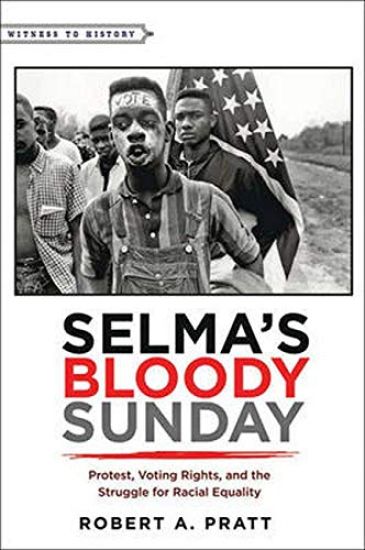
Selma’s Bloody Sunday

Selma’s Bloody Sunday

Robert A. Pratt

Johns Hopkins University Press
2017
sidottu
On Sunday afternoon, March 7, 1965, roughly six hundred peaceful demonstrators set out from Brown Chapel A.M.E. Church in a double-file column to march from Selma, Alabama, to the state capital of Montgomery. Leading the march were Hosea Williams of the Southern Christian Leadership Conference and John Lewis of the Student Nonviolent Coordinating Committee. Upon reaching Broad Street, the marchers turned left to cross the Edmund Pettus Bridge that spanned the Alabama River. "When we reached the crest of the bridge," recalls John Lewis, "I stopped dead still. So did Hosea. There, facing us at the bottom of the other side, stood a sea of blue-helmeted, blue-uniformed Alabama state troopers, line after line of them, dozens of battle-ready lawmen stretched from one side of U.S. Highway 80 to the other. Behind them were several dozen more armed men-Sheriff Clark's posse-some on horseback, all wearing khaki clothing, many carrying clubs the size of baseball bats." The violence and horror that was about to unfold at the foot of the bridge would forever mark the day as "Bloody Sunday," one of the pivotal moments of the civil rights movement. Alabama state troopers fell on the unarmed protestors as they crossed the bridge, beating and tear gassing them. In Selma's Bloody Sunday, Robert A. Pratt offers a vivid account of that infamous day and the indelible triumph of black and white protest over white resistance. He explores how the march itself-and the 1965 Voting Rights Act that followed-represented a reaffirmation of the nation's centuries-old declaration of universal equality and the fulfillment of the Fifteenth Amendment to the Constitution. Selma's Bloody Sunday offers a fresh interpretation of the ongoing struggle by African Americans to participate freely in America's electoral democracy. Jumping forward to the present day, Pratt uses the march as a lens through which to examine disturbing recent debates concerning who should, and who should not, be allowed to vote. Drawing on archival materials, secondary sources, and eyewitness accounts of the brave men and women who marched, this gripping account offers a brief and nuanced narrative of this critical phase of the black freedom struggle.
Selma’s Bloody Sunday

Selma’s Bloody Sunday

Robert A. Pratt

Johns Hopkins University Press
2017
pokkari
On Sunday afternoon, March 7, 1965, roughly six hundred peaceful demonstrators set out from Brown Chapel A.M.E. Church in a double-file column to march from Selma, Alabama, to the state capital of Montgomery. Leading the march were Hosea Williams of the Southern Christian Leadership Conference and John Lewis of the Student Nonviolent Coordinating Committee. Upon reaching Broad Street, the marchers turned left to cross the Edmund Pettus Bridge that spanned the Alabama River. "When we reached the crest of the bridge," recalls John Lewis, "I stopped dead still. So did Hosea. There, facing us at the bottom of the other side, stood a sea of blue-helmeted, blue-uniformed Alabama state troopers, line after line of them, dozens of battle-ready lawmen stretched from one side of U.S. Highway 80 to the other. Behind them were several dozen more armed men-Sheriff Clark's posse-some on horseback, all wearing khaki clothing, many carrying clubs the size of baseball bats." The violence and horror that was about to unfold at the foot of the bridge would forever mark the day as "Bloody Sunday," one of the pivotal moments of the civil rights movement. Alabama state troopers fell on the unarmed protestors as they crossed the bridge, beating and tear gassing them. In Selma's Bloody Sunday, Robert A. Pratt offers a vivid account of that infamous day and the indelible triumph of black and white protest over white resistance. He explores how the march itself-and the 1965 Voting Rights Act that followed-represented a reaffirmation of the nation's centuries-old declaration of universal equality and the fulfillment of the Fifteenth Amendment to the Constitution. Selma's Bloody Sunday offers a fresh interpretation of the ongoing struggle by African Americans to participate freely in America's electoral democracy. Jumping forward to the present day, Pratt uses the march as a lens through which to examine disturbing recent debates concerning who should, and who should not, be allowed to vote. Drawing on archival materials, secondary sources, and eyewitness accounts of the brave men and women who marched, this gripping account offers a brief and nuanced narrative of this critical phase of the black freedom struggle.