Kirjojen hintavertailu. Mukana 11 244 527 kirjaa ja 12 kauppaa.

Kirjahaku

Etsi kirjoja tekijän nimen, kirjan nimen tai ISBN:n perusteella.

1000 tulosta hakusanalla Stephanie Modell

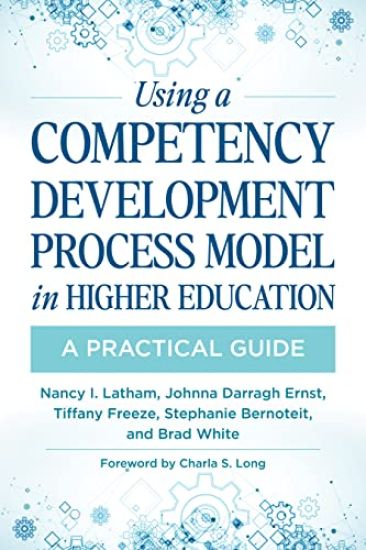
Using a Competency Development Process Model in Higher Education

Using a Competency Development Process Model in Higher Education

Nancy Latham; Johnna Darragh Ernst; Tiffany Freeze; Stephanie Bernoteit; Bradford White

TAYLOR FRANCIS INC
2023
nidottu
What if educational programs designed curriculum with the end in mind, teaching and assessing only the knowledge and skills necessary for success in the workplace and broader life applications? Competency-Based Education (CBE) provides an answer to questions such as this one that key stakeholders such as employers, learners, parents, and educators are asking. In this book, the authors offer a Competency Development Process Model (CDPM) with unique features that emphasize the interdependence of competencies, assessments, and a robust learning journey within a fully developed career pathway. Two case examples are used throughout the book to contextualize the CDPM. There are seven steps of the model: ·Step 1: Define the Problem·Step 2: Establish the Competency Framework·Step 3: Draft the Competency Statements·Step 4: Establish Competency Measurability·Step 5: Develop Competency Assessments·Step 6: Adopt and Implement Competencies in Learning Journey and Credentialing Systems·Step 7: Evaluate Impact Over TimeThe model addresses the importance of situating competencies within a professional learning context using a backward design approach. In doing so, the model aims to elevate the work of designing competencies from merely developing a list of expectations to in-depth analysis and design, with the goal of developing competencies that can be readily used for assessment and career pathway development.Each step in the CDPM is treated as a chapter, and each chapter identifies the central question that must be answered, provides an overview of the tasks in the step, and illustrates the steps in action through the two case examples. Each chapter concludes with “Your Turn”—guiding questions for the reader to apply the step to their own context.

Lineare Modelle in Der Psychophysik Des Hitzeschmerzes
Zur Messung der Wahrnehmung nahezu aller Sinnesmodalitaten wird in der Psychophysik traditionell die Potenzfunktion verwendet. Dieses Messmodell erscheint zur Quantifizierung klinischer und experimenteller Schmerzen jedoch nur als bedingt geeignet. Moglicherweise sind andere psychophysikalische Funktionen, wie lineare Modelle, zur Abbildung der Wahrnehmungsintensitat im Schmerzbereich besser geeignet. Diese Arbeit liefert daher einen systematischen Vergleich traditioneller und -alternativer- psychophysikalischer Messmodelle der Wahrnehmung experimenteller Schmerzreize."
Objektorientierte Modellierung von ATM-Netzknoten
Diplomarbeit aus dem Jahr 1996 im Fachbereich Elektrotechnik, Note: 1,3, Universität Duisburg-Essen (Datenverarbeitung), Sprache: Deutsch, Abstract: ATM ist die Abkürzung für Asynchronous Transfer Mode und ist die Übertragungsart der Zukunft. Dabei handelt es sich um eine Art der digitalen Datenübertragung. Bei ATM werden die zu übertra-genden Daten in kleine Pakete aufgeteilt, die dann vom Sender zum Empfänger über Netzwerkknoten hinweg geschickt werden. ATM benutzt ein besonderes Paketformat, welches ATM-Zelle genannt wird. Jede dieser Zellen hat die gleiche Größe und besteht aus einem Zellkopf, auch Header genannt, und einem Informationsfeld. Im Header befinden sich alle Parameter, die nötig sind, um eine ATM-Zelle durch das Netzwerk zu lenken und zu identifizieren. Im Informationsfeld befinden sich die zu übertragenden Informationen. Der Begriff "asynchronous" spielt darauf an, daß die Zeitabstände, in denen einzelne Pakete einer Verbindung den Empfänger erreichen, nicht gleich sein müssen. Eine Zelle wird nicht aufgrund ihrer zeitlichen Lage innerhalb eines Übertragungsfensters identifiziert, wie es z.B. beim STM (Synchro-nous Transfer Mode) der Fall wäre. Bei ATM handelt es sich um eine verbindungsorientierte Übertragungsart. Vor der eigentlichen Ü-bertragung wird eine Verbindung zwischen Sender und Empfänger aufgebaut. Dabei handelt es sich um eine virtuelle Verbindung. Bei dem Verbindungsaufbau legen die beteiligten Netzwerkknoten ei-nen Weg von Sender nach Empfänger fest. Das bedeutet, daß alle Zellen einer Verbindung denselben Weg durch das Netzwerk nehmen. Das zeitaufwendige Routing findet nur ein einziges Mal je Verbindung statt. Die ausgewählten Netzwerkknoten merken sich mit Hilfe von sogenannten Ver-bindungstabellen, wo Zellen einer bestimmten Verbindung während des Verbindungsaufbaus herkamen, und wo sie hingeleitet wurden. * ATM ist für jegliche Art von Diensten geeignet. Seien es Telephon, Bildtelephon, Fax, Datenübertragung, Fernsehprogrammübertragung etc. * ATM hat einen entscheidenden Vorteil: Es ist schnell. Übertragungsraten von bis zu 622 Mbit/s werden damit möglich sein * ATM ermöglicht eine gute Ausnutzung der Bandbreite durch Dienste variabler Bitrate, d. h. ATM ermöglicht die Benutzung nicht genutzter Bandbreite, indem es diese nicht genutzte Bandbreite anderen Verbindungen zur Verfügung stellen kann * ATM ist das Übertragungsprotokoll des ISDN-Nachfolgers B-ISDN
Financial Modeling

Financial Modeling

Stephane Crepey

Springer-Verlag Berlin and Heidelberg GmbH Co. K
2013
sidottu
Backward stochastic differential equations (BSDEs) provide a general mathematical framework for solving pricing and risk management questions of financial derivatives. They are of growing importance for nonlinear pricing problems such as CVA computations that have been developed since the crisis. Although BSDEs are well known to academics, they are less familiar to practitioners in the financial industry. In order to fill this gap, this book revisits financial modeling and computational finance from a BSDE perspective, presenting a unified view of the pricing and hedging theory across all asset classes. It also contains a review of quantitative finance tools, including Fourier techniques, Monte Carlo methods, finite differences and model calibration schemes. With a view to use in graduate courses in computational finance and financial modeling, corrected problem sets and Matlab sheets have been provided. Stéphane Crépey’s book starts with a few chapters on classical stochastic processes material, and then... fasten your seatbelt... the author starts traveling backwards in time through backward stochastic differential equations (BSDEs). This does not mean that one has to read the book backwards, like a manga! Rather, the possibility to move backwards in time, even if from a variety of final scenarios following a probability law, opens a multitude of possibilities for all those pricing problems whose solution is not a straightforward expectation. For example, this allows for framing problems like pricing with credit and funding costs in a rigorous mathematical setup. This is, as far as I know, the first book written for several levels of audiences, with applications to financial modeling and using BSDEs as one of the main tools, and as the song says: "it's never as good as the first time".Damiano Brigo, Chair of Mathematical Finance, Imperial College LondonWhile the classical theory of arbitrage free pricinghas matured, and is now well understood and used by the finance industry, the theory of BSDEs continues to enjoy a rapid growth and remains a domain restricted to academic researchers and a handful of practitioners. Crépey’s book presents this novel approach to a wider community of researchers involved in mathematical modeling in finance. It is clearly an essential reference for anyone interested in the latest developments in financial mathematics. Marek Musiela, Deputy Director of the Oxford-Man Institute of Quantitative Finance
Financial Modeling

Financial Modeling

Stephane Crepey

Springer-Verlag Berlin and Heidelberg GmbH Co. K
2015
nidottu
Backward stochastic differential equations (BSDEs) provide a general mathematical framework for solving pricing and risk management questions of financial derivatives. They are of growing importance for nonlinear pricing problems such as CVA computations that have been developed since the crisis. Although BSDEs are well known to academics, they are less familiar to practitioners in the financial industry. In order to fill this gap, this book revisits financial modeling and computational finance from a BSDE perspective, presenting a unified view of the pricing and hedging theory across all asset classes. It also contains a review of quantitative finance tools, including Fourier techniques, Monte Carlo methods, finite differences and model calibration schemes. With a view to use in graduate courses in computational finance and financial modeling, corrected problem sets and Matlab sheets have been provided. Stéphane Crépey’s book starts with a few chapters on classical stochastic processes material, and then... fasten your seatbelt... the author starts traveling backwards in time through backward stochastic differential equations (BSDEs). This does not mean that one has to read the book backwards, like a manga! Rather, the possibility to move backwards in time, even if from a variety of final scenarios following a probability law, opens a multitude of possibilities for all those pricing problems whose solution is not a straightforward expectation. For example, this allows for framing problems like pricing with credit and funding costs in a rigorous mathematical setup. This is, as far as I know, the first book written for several levels of audiences, with applications to financial modeling and using BSDEs as one of the main tools, and as the song says: "it's never as good as the first time".Damiano Brigo, Chair of Mathematical Finance, Imperial College LondonWhile the classical theory of arbitrage free pricinghas matured, and is now well understood and used by the finance industry, the theory of BSDEs continues to enjoy a rapid growth and remains a domain restricted to academic researchers and a handful of practitioners. Crépey’s book presents this novel approach to a wider community of researchers involved in mathematical modeling in finance. It is clearly an essential reference for anyone interested in the latest developments in financial mathematics. Marek Musiela, Deputy Director of the Oxford-Man Institute of Quantitative Finance
Systemdynamische Modellbildung Und Simulation Im Kaufmaennischen Unterricht
Diese Arbeit versucht einen Bruckenschlag zwischen vorliegenden methodologischen und theoretischen Begrundungen fur das Lernen mit systemdynamischer Modellbildung und Simulation, welche die Bewaltigung von dynamischer Komplexitat in den Blick nimmt. Fur die Vermittlung von komplexem Denken liegen unterschiedliche theoriegeleitete Ansatze vor, die auch Umsetzungskonzepte beinhalten, allerdings wird die Diagnostik weniger in den Blick genommen. Um Auskunft uber die Effekte des Lernens geben zu koennen, wird in diesem Ansatz ein besonderer Stellenwert auf die Diagnostik gelegt, welche die verschiedenen umgesetzten methodischen Zugange im Unterricht mit Modellbildung und Simulation uber die von den Lernenden offen gelegten Lernexplikate widerspiegeln koennen.
Das 4CID Modell erklart am Beispiel des Bildungswissenschaftler/in im Bereich der Medienpadagogik
Studienarbeit aus dem Jahr 2011 im Fachbereich P dagogik - Medienp dagogik, Note: 1,7, FernUniversit t Hagen, Sprache: Deutsch, Abstract: Medien als Bestandteil menschlicher Lebensbereiche beeinflussen das Handeln, die Interaktion und Kommunikation der Menschen in zunehmendem Ma e und sind aus einer modernen Gesellschaft nicht mehr wegzudenken. Auch der Staat hat die Chancen der Mediennutzung erkannt und f rdert den Einsatz neuer Medien im Unterricht. Mit zunehmender Mediennutzung steigt der Bedarf an medienp dagogischer Arbeit sowohl im Bildungsbereich als auch im au erschulischem Bereich. Um den gestiegenen Bedarf zu decken, bedarf es einer effizienten Methode, Bildungswissenschaftler im Bereich Medienp dagogik auf den vielf ltigen und anspruchsvollen Aufgabenbereich und die damit zusammenh ngenden komplexen kognitiven F higkeiten m glichst realit tsnah vorzubereiten. Dazu bietet sich das von Jeroen van Merri nboer wissenschaftlich und empirisch erforschte Vier-Komponente-Instruktionsdesign-Modell (4C/ID) an. Das Modell mit seinen vier Komponenten Lernaufgaben, unterst tzende Informationen, Just-in-time Informationen und Part-task Practise, ist speziell auf das Training von komplexen kognitiven F higkeiten ausgerichtet. Ziel dieser Arbeit ist die Entwicklung eines Lehrplanentwurfs (Blueprint) f r einen angehenden Bildungswissenschaftler im Bereich Medienp dagogik auf der Basis des 4C/ID Modells. Anhand dieses Entwurfs soll dargestellt werden, wie das Modell versucht, durch authentische und variable Lernaufgaben realit tsnahe Lernsituationen herzustellen und so Transferwissen zur L sung komplexer Probleme in der praktischen Anwendung zu erzeugen. Im Anschluss an den praktischen Teil dieser Hausarbeit werden im theoretischen Teil einige lerntheoretischen berlegungen und Aspekte des situierten Lernens dargestellt. Nach der berlegung, welche didaktischen Szenarien sich zur Integration in das 4C/ID Modell eignen, werden geeignete Medien zur Unterst tzung des Blueprin
Small Scale Modeling and Simulation of Incompressible Turbulent Multi-Phase Flow

Small Scale Modeling and Simulation of Incompressible Turbulent Multi-Phase Flow

Stéphane Vincent; Jean-Luc Estivalèzes; Ruben Scardovelli

Springer International Publishing AG
2022
sidottu
The book provides basic and recent research insights concerning the small scale modeling and simulation of turbulent multi-phase flows. By small scale, it has to be understood that the grid size for the simulation is smaller than most of the physical time and space scales of the problem. Small scale modeling of multi-phase flows is a very popular topic since the capabilities of massively parallel computers allows to go deeper into the comprehension and characterization of realistic flow configurations and at the same time, many environmental and industrial applications are concerned such as nuclear industry, material processing, chemical reactors, engine design, ocean dynamics, pollution and erosion in rivers or on beaches. The work proposes a complete and exhaustive presentation of models and numerical methods devoted to small scale simulation of incompressible turbulent multi-phase flows from specialists of the research community. Attention has also been paid to promote illustrations and applications, multi-phase flows and collaborations with industry. The idea is also to bring together developers and users of different numerical approaches and codes to share their experience in the development and validation of the algorithms and discuss the difficulties and limitations of the different methods and their pros and cons. The focus will be mainly on fixed-grid methods, however adaptive grids will be also partly broached, with the aim to compare and validate the different approaches and models.
Origami pour Halloween: 10 modèles d'origami faciles, créatifs et amusants pour tous, y compris les enfants et les débutants
Apprenez plier 10 mod les d'origami originaux, dont: - de jolis fant mes avec peu de plis et beaucoup de personnalit , - un cr ne colorier et d corer comme une Calavera mexicaine, - une chauve-souris avec des yeux en forme de diamants, - une bo te citrouille pour mettre vos bonbons, - et m me une citrouille parlante et une toile d'araign e en 3D Tous les mod les sont fournis avec des instructions et des diagrammes en couleur, et sont disponibles en vid o si vous avez besoin d'aide.
Origami para Halloween: 10 modelos de origami fáciles y divertidos para todos, incluidos niños y principiantes
Aprende c mo plegar 10 modelos originales de origami: - fantasmas con mucha personalidad pero f ciles de doblar, - una calavera que puedes decorar como las calaveras mexicanas, - una calabaza cajita para guardar tus dulces, - adem s otra genial calabaza que habla y una telara a en 3D. Todos los modelos traen diagramas e intrucciones, y los videos est n disponibles si necesitas ayuda. Das vida al papel con tan solo unos pliegues, imprimi ndole un toque muy personal Me gusta crear modelos que son simples de plegar pero que tienen mucha personalidad. Los modelos de este libro dan espacio a tu propia interpretaci n: - Puedes personalizar muchos de ellos eligiendo el tama o de los ojos, dientes, brazos y alas. - La mayor a no requieren pliegues muy precisos. Las imperfecciones peque as o grandes har n de tu origami algo nico y con mucha personalidad. - Experimenta Casi todos los modelos se pueden doblar r pidamente por lo que puedes hacerlos varias veces, agregando o cambiando algunos pliegues, para darle a tu modelo un toque novedoso. Espero que goces de tus pliegues, seas un ni o, un principiante o un origamista experimentado, doblando e interpretando los modelos de este libro.
Mikrogeographische Marktsegmentierung mit Mixture-Modellen
?Der Begriff der Marktsegmentierung fand schon Mitte der 1950er Jahre Eingang in wissen-schaftliche Untersuchungen zum Marketing. Darunter versteht man, dass unterschiedliche Produktpräferenzen zu einer Unterteilung des heterogenen Gesamtmarktes in mehrere homogene Teilmärkte führen. Homogenität bezeichnet dabei die Tatsache, dass sich die Konsumenten eines Segmentes möglichst nicht mehr in ihrem Konsumverhalten unterscheiden. Der wohl am weitesten verbreitete Ansatz ist dabei die soziographische Marktsegmentierung, bei der die Merkmale allerdings nur bedingt relevant für das Kaufverhalten sind. Deshalb wurden diese soziodemographischen Merkmale bald um mikrogeographische Merkmale ergänzt; dies führte dann zur mikrogeographischen Marktsegmentierung, der sich die Autorin ausführlich widmet. Ein entscheidendes Problem neben der Auswahl von problemadäquaten Segmentierungs-kriterien ist allerdings die Wahl einer geeigneten Segmentierungsmethode, für die regelmäßig multivariate statistische Methoden eingesetzt werden. Ziel der Arbeit ist es, die klassische Theorie der Marktsegmentierung um die neueren Aspekte der mikrogeographischen Marktsegmentierung zu erweitern und mit Hilfe von Mixture Modellen die Segmentierung konkret durchzuführen. Dabei soll neben der Theorie dieser Modelle auch deren zielgerichteter Einsatz für ein empirisches Segmentierungsproblem dargestellt werden.