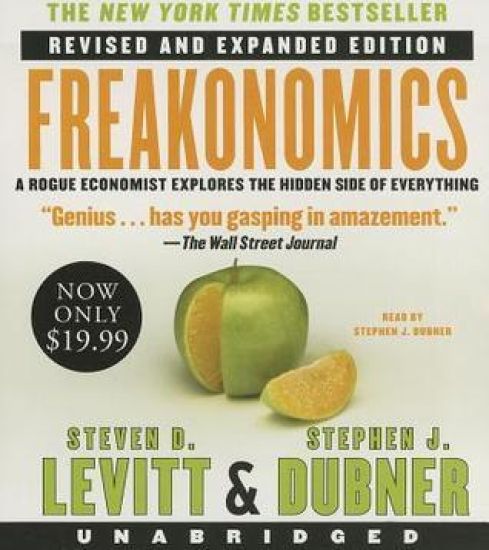
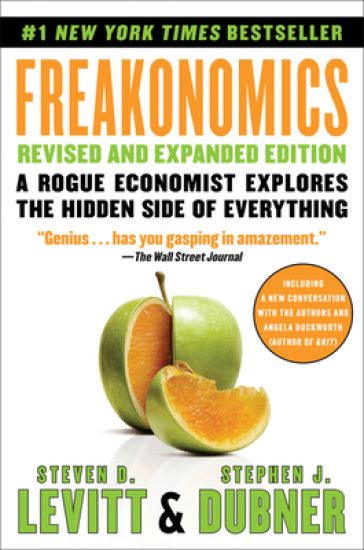
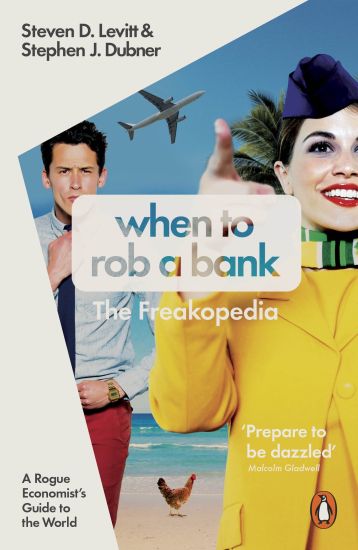
Steven D. Levitt and Stephen J. Dubner offer the long-awaited paperback edition of Freakonomics, the runaway bestseller, including six Freakonomics columns from the New York Times Magazine and a Q & A with the authors.
In celebration of the 10th anniversary of the landmark book Freakonomics comes this curated collection from the most readable economics blog in the universe. It's the perfect solution for the millions of readers who love all things Freakonomics. Surprising and erudite, eloquent and witty, When to Rob a Bank demonstrates the brilliance that has made the Freakonomics guys an international sensation, with more than 7 million books sold in 40 languages, and 150 million downloads of their Freakonomics Radio podcast.When Freakonomics was first published, the authors started a blog--and they've kept it up. The writing is more casual, more personal, even more outlandish than in their books. In When to Rob a Bank, they ask a host of typically off-center questions: Why don't flight attendants get tipped? If you were a terrorist, how would you attack? And why does KFC always run out of fried chicken?Over the past decade, Steven D. Levitt and Stephen J. Dubner have published more than 8,000 blog posts on the Freakonomics website. Many of them, they freely admit, were rubbish. But now they've gone through and picked the best of the best. You'll discover what people lie about, and why; the best way to cut gun deaths; why it might be time for a sex tax; and, yes, when to rob a bank. (Short answer: never; the ROI is terrible.) You'll also learn a great deal about Levitt and Dubner's own quirks and passions, from gambling and golf to backgammon and the abolition of the penny.
In celebration of the 10th anniversary of the landmark book Freakonomics comes this curated collection from the most readable economics blog in the universe. It's the perfect solution for the millions of readers who love all things Freakonomics. Surprising and erudite, eloquent and witty, When to Rob a Bank demonstrates the brilliance that has made the Freakonomics guys an international sensation, with more than 7 million books sold in 40 languages, and 150 million downloads of their Freakonomics Radio podcast.When Freakonomics was first published, the authors started a blog--and they've kept it up. The writing is more casual, more personal, even more outlandish than in their books. In When to Rob a Bank, they ask a host of typically off-center questions: Why don't flight attendants get tipped? If you were a terrorist, how would you attack? And why does KFC always run out of fried chicken?Over the past decade, Steven D. Levitt and Stephen J. Dubner have published more than 8,000 blog posts on the Freakonomics website. Many of them, they freely admit, were rubbish. But now they've gone through and picked the best of the best. You'll discover what people lie about, and why; the best way to cut gun deaths; why it might be time for a sex tax; and, yes, when to rob a bank. (Short answer: never; the ROI is terrible.) You'll also learn a great deal about Levitt and Dubner's own quirks and passions, from gambling and golf to backgammon and the abolition of the penny.
In celebration of the 10th anniversary of the landmark book Freakonomics comes this curated collection from the most readable economics blog in the universe. It's the perfect solution for the millions of readers who love all things Freakonomics. Surprising and erudite, eloquent and witty, When to Rob a Bank demonstrates the brilliance that has made the Freakonomics guys an international sensation, with more than 7 million books sold in 40 languages, and 150 million downloads of their Freakonomics Radio podcast.When Freakonomics was first published, the authors started a blog--and they've kept it up. The writing is more casual, more personal, even more outlandish than in their books. In When to Rob a Bank, they ask a host of typically off-center questions: Why don't flight attendants get tipped? If you were a terrorist, how would you attack? And why does KFC always run out of fried chicken?Over the past decade, Steven D. Levitt and Stephen J. Dubner have published more than 8,000 blog posts on Freakonomics.com. Many of them, they freely admit, were rubbish. But now they've gone through and picked the best of the best. You'll discover what people lie about, and why; the best way to cut gun deaths; why it might be time for a sex tax; and, yes, when to rob a bank. (Short answer: never; the ROI is terrible.) You'll also learn a great deal about Levitt and Dubner's own quirks and passions, from gambling and golf to backgammon and the abolition of the penny. --The A.V. Club
In celebration of the 10th anniversary of the landmark book Freakonomics comes this curated collection from the most readable economics blog in the universe. It's the perfect solution for the millions of readers who love all things Freakonomics. Surprising and erudite, eloquent and witty, When to Rob a Bank demonstrates the brilliance that has made the Freakonomics guys an international sensation, with more than 7 million books sold in 40 languages, and 150 million downloads of their Freakonomics Radio podcast.When Freakonomics was first published, the authors started a blog--and they've kept it up. The writing is more casual, more personal, even more outlandish than in their books. In When to Rob a Bank, they ask a host of typically off-center questions: Why don't flight attendants get tipped? If you were a terrorist, how would you attack? And why does KFC always run out of fried chicken?Over the past decade, Steven D. Levitt and Stephen J. Dubner have published more than 8,000 blog posts on the Freakonomics website. Many of them, they freely admit, were rubbish. But now they've gone through and picked the best of the best. You'll discover what people lie about, and why; the best way to cut gun deaths; why it might be time for a sex tax; and, yes, when to rob a bank. (Short answer: never; the ROI is terrible.) You'll also learn a great deal about Levitt and Dubner's own quirks and passions, from gambling and golf to backgammon and the abolition of the penny.
The legendary bestseller that made millions look at the world in a radically different way returns in a new edition, now including an exclusive discussion between the authors and bestselling professor of psychology Angela Duckworth.Which is more dangerous, a gun or a swimming pool? Which should be feared more: snakes or french fries? Why do sumo wrestlers cheat? In this groundbreaking book, leading economist Steven Levitt--Professor of Economics at the University of Chicago and winner of the American Economic Association's John Bates Clark medal for the economist under 40 who has made the greatest contribution to the discipline--reveals that the answers. Joined by acclaimed author and podcast host Stephen J. Dubner, Levitt presents a brilliant--and brilliantly entertaining--account of how incentives of the most hidden sort drive behavior in ways that turn conventional wisdom on its head.
Cult bestseller, new buzz word... Freakonomics is at the heart of everything we see and do and the subjects that bedevil us daily: from parenting to crime, sport to politics, fat to cheating, fear to traffic jams. Asking provocative and profound questions about human motivation and contemporary living and reaching some astonishing conclusions, Freakonomics will make you see the familiar world through a completely original lens. Keep up-to-date with the Freakonomists by reading their regular blog: www.freakonomics.com/blog
Modern life can be baffling and chaotic. Is there any way of making sense of it? The answer, explains groundbreaking thinker Steven Levitt, lies in economics. Not ordinary economics, but freakonomics. It is at the heart of everything we see and do and the subjects that bedevil us daily: from parenting to crime, sport to politics, fat to cheating, fear to traffic jams. In Freakonomics Levitt turns conventional economics on its head, stripping away the jargon and calculations of the experts' to explore the riddles of everyday life and examine topics such as: how chips are more likely to kill you than murder or a terrorist attack; why sportsmen cheat and how fraud can be spotted; why violent crime can be linked not to gun laws, policing or poverty, but to abortion; why a road is more efficient when everyone travels at 20mph; how the name you give your child can give them an advantage in later life; and what really causes obesity epidemics. Ultimately, he shows us that economics is all about how people get what they want, and what makes them do it. Asking provocative and profound questions about human motivation and contemporary living and reaching some astonishing conclusions, Freakonomics will make you see the familiar world through a completely original lens.
In this Freak 'how-to' guide, the mavericks behind the Freakonomics phenomenon teach you their secrets: how to challenge conventional wisdom, unravel life's secret codes and think differently - that is, think like a Freak. Levitt and Dubner see the world like no-one else. Now you can too.'My gut reaction to this life-changing book is "Where have you been all my life?" You will turn pages with delight' Jeffery Taylor, Sunday Express'Captivating, intellectually robust, funny, surprising and wise. What else can one ask?' Daniel Finkelstein, The Times 'Illuminating, good fun, endearing, genial ... I was delighted' Philip Roscoe, The Times Higher Education'It's about how to look at the world, and see the ugly truth ... excellent stuff' William Leith, Spectator'A phenomenon ... their approach has won them a cult following' Observer
This is the ultimate guide to the world of the Freak. Renegade thinkers and bestselling sensations Levitt and Dubner have carefully curated the very best of their blogs, conversations, wisecracks and advice from the last decade to reveal the outlandish truth about everything from lying to bankrobbing, fast food to sex taxes.'We are all Freakonomists now' Washington Post'A phenomenon ... their approach has won them a cult following' Observer'Lie back and let Levitt and Dubner's bouncy prose style carry you along from one peculiarity to the next' Sunday Telegraph'You are guaranteed a good time' Financial Times
Examining the perennial claim that constitutional law somehow embodies a commitment to governance by "reason," this book shows how the lofty intentions of yesterday's framers and today's scholars have culminated in rampant confusion and elaborate sophistry. The Constitution and the Pride of Reason gives readers a provocative overview of the noble aspirations and tragic failures of American constitutionalism, offering iconoclastic assessments of constitutionalists ranging from Madison and Jefferson to Dworkin and Bork. "This is not a book for specialists in constitutional doctrine. It draws upon political and moral philosophy, history, constitutional theory, and political science to sustain a thesis which should interest all thinking Americans. It is also refreshingly well-written, very clear, and precise, often witty."--Gerald V. Bradley, University of Notre Dame
Can the ethical mission of health care survive among organizations competing for survival in the marketplace? On this question hinges not only the future of health care in the US, but that of the health care systems of all advanced countries. This book presents both an analytic framework and a menu of pragmatic answers. The team of authors, physician-ethicists from Harvard Medical School and the National Institutes of Health, worked with a consortium of health care organizations to explore some of the most challenging dilemmas in health care today: How can health plans determine medical necessity in a way that ensures quality care, controls costs, and builds trust with patients and physicians? What are the strategies for caring for vulnerable populations that meet their special needs without dramatically increasing costs? To answer these and other similar questions the authors blend ethical analysis with real-world example. The outcome is a rich analysis of the ethical challenges facing health care organizations, combined with tangible examples of exemplary methods to address these challenges. This book will help health care leaders, regulators, and policy makers incorporate exemplary practices, and the underlying themes they embody, into the very heart and soul of health care organizations.
Mimicry is a classic example of adaptation through natural selection. The traditional focus of mimicry research has been on defence in animals, but there is now also a highly-developed and rapidly-growing body of research on floral mimicry in plants. This has coincided with a revolution in genomic tools, making it possible to explore which genetic and developmental processes underlie the sometimes astonishing changes that give rise to floral mimicry. Being literally rooted to one spot, plants have to cajole animals into acting as couriers for their pollen. Floral mimicry encompasses a set of evolutionary strategies whereby plants imitate the food sources, oviposition sites, or mating partners of animals in order to exploit them as pollinators. This first definitive book on floral mimicry discusses the functions of visual, olfactory, and tactile signals, integrating them into a broader theory of organismal mimicry that will help guide future research in the field. It addresses the fundamental question of whether the evolutionary and ecological principles that were developed for protective mimicry in animals can also be applied to floral mimicry in plants. The book also deals with the functions of floral rewardlessness, a condition which often serves as a precursor to the evolution of mimicry in plant lineages. The authors pay particular attention to the increasing body of research on chemical cues: their molecular basis, their role in cognitive misclassification of flowers by pollinators, and their implications for plant speciation. Comprehensive in scope and conceptual in focus, Floral Mimicry is primarily aimed at senior undergraduates, graduate students, and researchers in plant science and evolutionary biology.
Mimicry is a classic example of adaptation through natural selection. The traditional focus of mimicry research has been on defence in animals, but there is now also a highly-developed and rapidly-growing body of research on floral mimicry in plants. This has coincided with a revolution in genomic tools, making it possible to explore which genetic and developmental processes underlie the sometimes astonishing changes that give rise to floral mimicry. Being literally rooted to one spot, plants have to cajole animals into acting as couriers for their pollen. Floral mimicry encompasses a set of evolutionary strategies whereby plants imitate the food sources, oviposition sites, or mating partners of animals in order to exploit them as pollinators. This first definitive book on floral mimicry discusses the functions of visual, olfactory, and tactile signals, integrating them into a broader theory of organismal mimicry that will help guide future research in the field. It addresses the fundamental question of whether the evolutionary and ecological principles that were developed for protective mimicry in animals can also be applied to floral mimicry in plants. The book also deals with the functions of floral rewardlessness, a condition which often serves as a precursor to the evolution of mimicry in plant lineages. The authors pay particular attention to the increasing body of research on chemical cues: their molecular basis, their role in cognitive misclassification of flowers by pollinators, and their implications for plant speciation. Comprehensive in scope and conceptual in focus, Floral Mimicry is primarily aimed at senior undergraduates, graduate students, and researchers in plant science and evolutionary biology.
Community economic development (CED) is an increasingly essential factor in the revitalization of low- to moderate-income communities. This cutting-edge text explores the intersection of CED and social work practice, which both focus on the well-being of indigent communities and the empowerment of individuals and the communities in which they live. This unique textbook emphasizes a holistic approach to community building that combines business and real-estate development with a focus on stimulating family self-reliance and community empowerment. The result is an innovative approach to rehabilitating communities in decline while preserving resident demographics. The authors delve deep into the social, political, human, and financial capital involved in effecting change and how race and regional issues can complicate approaches and outcomes. Throughout, they integrate case examples to illustrate their strategies and conclude with a consideration of the critical role social workers can play in developing CED's next phase.
Community economic development (CED) is an increasingly essential factor in the revitalization of low- to moderate-income communities. This cutting-edge text explores the intersection of CED and social work practice, which both focus on the well-being of indigent communities and the empowerment of individuals and the communities in which they live. This unique textbook emphasizes a holistic approach to community building that combines business and real-estate development with a focus on stimulating family self-reliance and community empowerment. The result is an innovative approach to rehabilitating communities in decline while preserving resident demographics. The authors delve deep into the social, political, human, and financial capital involved in effecting change and how race and regional issues can complicate approaches and outcomes. Throughout, they integrate case examples to illustrate their strategies and conclude with a consideration of the critical role social workers can play in developing CED's next phase.
While the rise of the charmingly simple, brilliantly evocative haiku is often associated with the seventeenth-century Japanese poet Matsuo Basho, the form had already flourished for more than four hundred years before Basho even began to write. These early poems, known as hokku, are identical to haiku in syllable count and structure but function differently as a genre. Whereas each haiku is its own constellation of image and meaning, a hokku opens a series of linked, collaborative stanzas in a sequence called renga. Under the mastery of Basho, hokku first gained its modern independence. His talents contributed to the evolution of the style into the haiku beloved by so many poets around the world--Richard Wright, Jack Kerouac, and Billy Collins being notable devotees. Haiku Before Haiku presents 320 hokku composed between the thirteenth and early eighteenth centuries, from the poems of the courtier Nijo Yoshimoto to those of the genre's first "professional" master, Sogi, and his disciples. It features 20 masterpieces by Basho himself. Steven D. Carter introduces the history of haiku and its aesthetics, classifying these poems according to style and context. His rich commentary and notes on composition and setting illuminate each work, and he provides brief biographies of the poets, the original Japanese text in romanized form, and earlier, classical poems to which some of the hokku allude.
While the rise of the charmingly simple, brilliantly evocative haiku is often associated with the seventeenth-century Japanese poet Matsuo Basho, the form had already flourished for more than four hundred years before Basho even began to write. These early poems, known as hokku, are identical to haiku in syllable count and structure but function differently as a genre. Whereas each haiku is its own constellation of image and meaning, a hokku opens a series of linked, collaborative stanzas in a sequence called renga. Under the mastery of Basho, hokku first gained its modern independence. His talents contributed to the evolution of the style into the haiku beloved by so many poets around the world--Richard Wright, Jack Kerouac, and Billy Collins being notable devotees. Haiku Before Haiku presents 320 hokku composed between the thirteenth and early eighteenth centuries, from the poems of the courtier Nijo Yoshimoto to those of the genre's first "professional" master, Sogi, and his disciples. It features 20 masterpieces by Basho himself. Steven D. Carter introduces the history of haiku and its aesthetics, classifying these poems according to style and context. His rich commentary and notes on composition and setting illuminate each work, and he provides brief biographies of the poets, the original Japanese text in romanized form, and earlier, classical poems to which some of the hokku allude.
How to Read a Japanese Poem offers a comprehensive approach to making sense of traditional Japanese poetry of all genres and periods. Steven D. Carter explains to Anglophone students the methods of composition and literary interpretation used by Japanese poets, scholars, and critics from ancient times to the present, and adds commentary that will assist the modern reader.How to Read a Japanese Poem presents readings of poems by major figures such as Saigyo and Basho as well as lesser known poets, with nearly two hundred examples that encompass all genres of Japanese poetry. The book gives attention to well-known forms such as haikai or haiku, as well as ancient songs, comic poems, and linked verse. Each chapter provides examples of a genre in chronological order, followed by notes about authorship and other contextual details, including the time of composition, physical setting, and social occasion. The commentaries focus on a central feature of Japanese poetic discourse: that poems are often occasional, written in specific situations, and are best read in light of their milieu. Carter elucidates key concepts useful in examining Japanese poetics as well as the technical vocabulary of Japanese poetic discourse, familiarizing students with critical terms and concepts. An appendix offers succinct definitions of technical terms and essays on aesthetic ideals and devices.