Kirjojen hintavertailu. Mukana 11 342 296 kirjaa ja 12 kauppaa.

Kirjahaku

Etsi kirjoja tekijän nimen, kirjan nimen tai ISBN:n perusteella.

1000 tulosta hakusanalla Steven H. Wander

A Disturbance in the Field

A Disturbance in the Field

Steven H. Cooper

Routledge
2010
nidottu
The field, as Steven Cooper describes it, is comprised of the inextricably related worlds of internalized object relations and interpersonal interaction. Furthermore, the analytic dyad is neither static nor smooth sailing. Eventually, the rigorous work of psychoanalysis will offer a fraught opportunity to work through the most disturbing elements of a patient's inner life as expressed and experienced by the analyst - indeed, a disturbance in the field. How best to proceed when such tricky yet altogether common therapeutic situations arise, and what aspects of transference/countertransference should be explored in the service of continued, productive analysis?These are two of the questions that Steven Cooper explores in this far-ranging collection of essays on potentially thorny areas of the craft. His essays try to locate some of the most ineffable types of situations for the analyst to take up with patients, such as the underlying grandiosity of self-criticism; the problems of too much congruence between what patients fantasize about and analysts wish to provide; and the importance of analyzing hostile and aggressive aspects of erotic transference. He also tries to turn inside-out the complexity of hostile transference and countertransference phenomena to find out more about what our patients are looking for and repudiating. Finally, Cooper raises questions about some of our conventional definitions of what constitutes the psychoanalytic process. Provocatively, he takes up the analyst's countertransference to the psychoanalytic method itself, including his responsibility and sources of gratification in the work. It is at once a deeply clinical book and one that takes a post-tribal approach to psychoanalytic theory - relational, contemporary Kleinian, and contemporary Freudian analysts alike will find much to think about and debate here.
Latchup

Latchup

Steven H. Voldman

John Wiley Sons Inc
2007
sidottu
Interest in latchup is being renewed with the evolution of complimentary metal-oxide semiconductor (CMOS) technology, metal-oxide-semiconductor field-effect transistor (MOSFET) scaling, and high-level system-on-chip (SOC) integration. Clear methodologies that grant protection from latchup, with insight into the physics, technology and circuit issues involved, are in increasing demand. This book describes CMOS and BiCMOS semiconductor technology and their sensitivity to present day latchup phenomena, from basic over-voltage and over-current conditions, single event latchup (SEL) and cable discharge events (CDE), to latchup domino phenomena. It contains chapters focusing on bipolar physics, latchup theory, latchup and guard ring characterization structures, characterization testing, product level test systems, product level testing and experimental results. Discussions on state-of-the-art semiconductor processes, design layout, and circuit level and system level latchup solutions are also included, as well as: latchup semiconductor process solutions for both CMOS to BiCMOS, such as shallow trench, deep trench, retrograde wells, connecting implants, sub-collectors, heavily-doped buried layers, and buried grids – from single- to triple-well CMOS; practical latchup design methods, automated and bench-level latchup testing methods and techniques, latchup theory of logarithm resistance space, generalized alpha (a) space, beta (b) space, new latchup design methods– connecting the theoretical to the practical analysis, and;examples of latchup computer aided design (CAD) methodologies, from design rule checking (DRC) and logical-to-physical design, to new latchup CAD methodologies that address latchup for internal and external latchup on a local as well as global design level. Latchup acts as a companion text to the author’s series of books on ESD (electrostatic discharge) protection, serving as an invaluable reference for the professional semiconductor chip and system-level ESD engineer. Semiconductor device, process and circuit designers, and quality, reliability and failure analysis engineers will find it informative on the issues that confront modern CMOS technology. Practitioners in the automotive and aerospace industries will also find it useful. In addition, its academic treatment will appeal to both senior and graduate students with interests in semiconductor process, device physics, computer aided design and design integration.
Billions of Drops in Millions of Buckets

Billions of Drops in Millions of Buckets

Steven H. Goldberg

John Wiley Sons Inc
2009
sidottu
Praise for BILLIONS OF DROPS in MILLIONS OF BUCKETS "Billions of Drops in Millions of Buckets provides a bracing and original look at philan-thropy that offers a much-needed corrective to conventional wisdom. Steve Goldberg combines a resolve to understand why so much philanthropy accomplishes so little enduring social change with a timely and serious proposal to reinvigorate nonprofit capital markets through the simplest of insights: getting more of the money to where it can do the most good. This book will change how forward-looking philanthropists, foundations, and policymakers think about the relationship between charitable giving and the transformative capacity of social entrepreneurs." —Jerr Boschee, founder and Executive Director, The Institute for Social Entrepreneurs; Visiting Professor of the Practice in Social Enterprise, Carnegie Mellon University "Goldberg's arguments are logical next steps in the rapidly evolving discussion of social capital markets. He offers ambitious proposals informed by the reality of current practices and focused on an achievable set of goals. He fully recognizes the potential for restructuring that is inherent in this time of financial hardship. Real change relies on big ideas, and Steve Goldberg offers us several." —Lucy Bernholz, author of Creating Philanthropic Capital Markets: The Deliberate Evolution "When I first heard about 'evidence-based medicine,' I thought: 'you mean it isn't?' Read this book and that's how you'll feel about 'performance-based philanthropy.' Goldberg takes some of the best current management thinking and applies it to social enterprise, illuminating both the encouraging successes of social entrepreneurs and the barriers they face. Even better, he presents compelling ideas for making the social sector vastly more effective." —Christopher Meyer, Chief Executive, Monitor Networks "Goldberg calls for more 'performance-driven philanthropy,' where nonprofits are rewarded based on their results, in place of the current dysfunction. It is an important call and a valuable contribution to discussions about how to improve nonprofits in the U.S. and internationally." —Martin Brookes, Chief Executive, New Philanthropy Capital "Billions of Drops... is a must-read romp through emerging fields of social entrepre-neurship and nonprofit capital markets." —George Overholser, founder and Managing Director, NFF Capital Partners
ESD

ESD

Steven H. Voldman

John Wiley Sons Inc
2009
sidottu
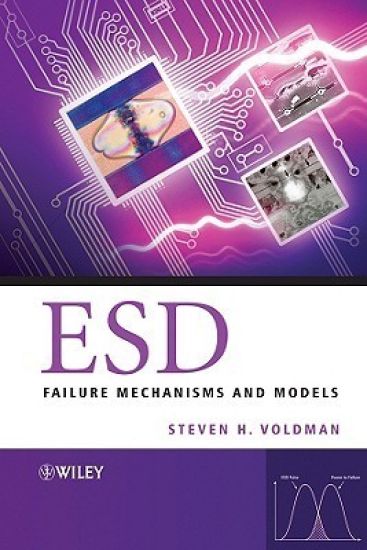
Electrostatic discharge (ESD) failure mechanisms continue to impact semiconductor components and systems as technologies scale from micro- to nano-electronics. This book studies electrical overstress, ESD, and latchup from a failure analysis and case-study approach. It provides a clear insight into the physics of failure from a generalist perspective, followed by investigation of failure mechanisms in specific technologies, circuits, and systems. The book is unique in covering both the failure mechanism and the practical solutions to fix the problem from either a technology or circuit methodology. Look inside for extensive coverage on: failure analysis tools, EOS and ESD failure sources and failure models of semiconductor technology, and how to use failure analysis to design more robust semiconductor components and systems;electro-thermal models and technologies; the state-of-the-art technologies discussed include CMOS, BiCMOS, silicon on insulator (SOI), bipolar technology, high voltage CMOS (HVCMOS), RF CMOS, smart power, gallium arsenide (GaAs), gallium nitride (GaN), magneto-resistive (MR) , giant magneto-resistors (GMR), tunneling magneto-resistor (TMR), devices; micro electro-mechanical (MEM) systems, and photo-masks and reticles; practical methods to use failure analysis for the understanding of ESD circuit operation, temperature analysis, power distribution, ground rule development, internal bus distribution, current path analysis, quality metrics, (connecting the theoretical to the practical analysis);the failure of each key element of a technology from passives, active elements to the circuit, sub-system to package, highlighted by case studies of the elements, circuits and system-on-chip (SOC) in today’s products. ESD: Failure Mechanisms and Models is a continuation of the author’s series of books on ESD protection. It is an essential reference and a useful insight into the issues that confront modern technology as we enter the Nano-electronic era.
ESD Testing

ESD Testing

Steven H. Voldman

John Wiley Sons Inc
2016
sidottu
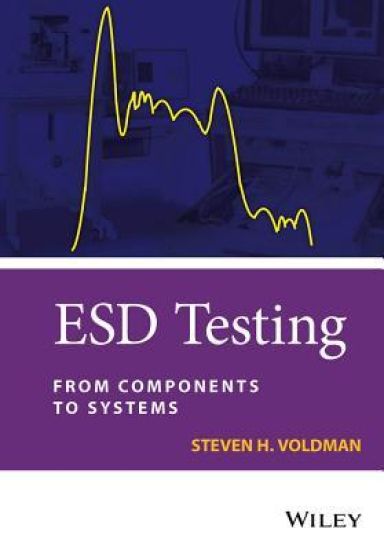
With the evolution of semiconductor technology and global diversification of the semiconductor business, testing of semiconductor devices to systems for electrostatic discharge (ESD) and electrical overstress (EOS) has increased in importance. ESD Testing: From Components to Systems updates the reader in the new tests, test models, and techniques in the characterization of semiconductor components for ESD, EOS, and latchup. Key features: Provides understanding and knowledge of ESD models and specifications including human body model (HBM), machine model (MM), charged device model (CDM), charged board model (CBM), cable discharge events (CDE), human metal model (HMM), IEC 61000-4-2 and IEC 61000-4-5.Discusses new testing methodologies such as transmission line pulse (TLP), to very fast transmission line pulse (VF-TLP), and future methods of long pulse TLP, to ultra-fast TLP (UF-TLP).Describes both conventional testing and new testing techniques for both chip and system level evaluation.Addresses EOS testing, electromagnetic compatibility (EMC) scanning, to current reconstruction methods.Discusses latchup characterization and testing methodologies for evaluation of semiconductor technology to product testing. ESD Testing: From Components to Systems is part of the authors’ series of books on electrostatic discharge (ESD) protection; this book will be an invaluable reference for the professional semiconductor chip and system-level ESD and EOS test engineer. Semiconductor device and process development, circuit designers, quality, reliability and failure analysis engineers will also find it an essential reference. In addition, its academic treatment will appeal to both senior and graduate students with interests in semiconductor process, device physics, semiconductor testing and experimental work.
ESD

ESD

Steven H. Voldman

John Wiley Sons Inc
2011
sidottu
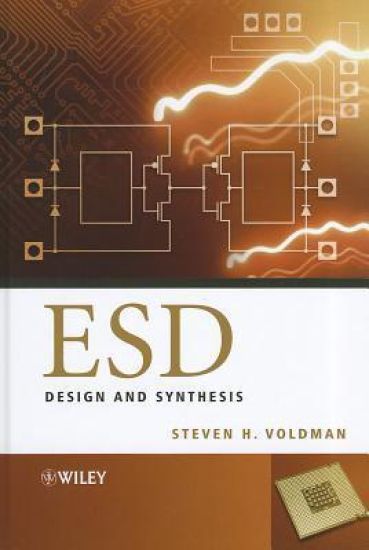
Electrostatic discharge (ESD) continues to impact semiconductor components and systems as technologies scale from micro- to nano-electronics. This book studies electrical overstress, ESD, and latchup from a whole-chip ESD design synthesis approach. It provides a clear insight into the integration of ESD protection networks from a generalist perspective, followed by examples in specific technologies, circuits, and chips. Uniquely both the semiconductor chip integration issues and floorplanning of ESD networks are covered from a ‘top-down' design approach. Look inside for extensive coverage on: integration of cores, power bussing, and signal pins in DRAM, SRAM, CMOS image processing chips, microprocessors, analog products, RF components and how the integration influences ESD design and integrationarchitecturing of mixed voltage, mixed signal, to RF design for ESD analysisfloorplanning for peripheral and core I/O designs, and the implications on ESD and latchupguard ring integration for both a ‘bottom-up' and ‘top-down' methodology addressing I/O guard rings, ESD guard rings, I/O to I/O, and I/O to coreclassification of ESD power clamps and ESD signal pin circuitry, and how to make the correct choice for a given semiconductor chipexamples of ESD design for the state-of-the-art technologies discussed, including CMOS, BiCMOS, silicon on insulator (SOI), bipolar technology, high voltage CMOS (HVCMOS), RF CMOS, and smart powerpractical methods for the understanding of ESD circuit power distribution, ground rule development, internal bus distribution, current path analysis, quality metrics ESD: Design and Synthesis is a continuation of the author's series of books on ESD protection. It is an essential reference for: ESD, circuit, and semiconductor engineers; design synthesis team leaders; layout design, characterisation, floorplanning, test and reliability engineers; technicians; and groundrule and test site developers in the manufacturing and design of semiconductor chips. It is also useful for graduate and undergraduate students in electrical engineering, semiconductor sciences, and manufacturing sciences, and on courses involving the design of ESD devices, chips and systems. This book offers a useful insight into the issues that confront modern technology as we enter the nano-electronic era.
ESD

ESD

Steven H. Voldman

John Wiley Sons Inc
2004
sidottu
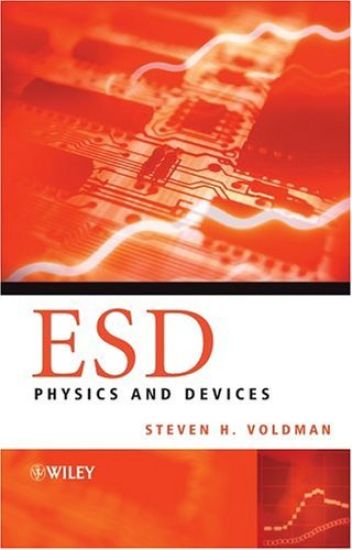
This volume is designed as the first in a series of three books addressing Electrostatic Discharge (ESD) physics, devices, circuits and design across the full range of integrated circuit technologies. ESD Physics and Devices provides a concise treatment of the ESD phenomenon and the physics of devices operating under ESD conditions. Voldman presents an accessible introduction to the field for engineers and researchers requiring a solid grounding in this important area. Coverage will complement the approach taken by Amerasekera and Duvvury as Voldman focuses on new semiconductor technologies such as Silicon Germanium, Gallium Nitride and Indium Phosphide. *Provides a clear understanding of ESD device physics and the fundamentals of ESD phenomena. *Analyses the behaviour of semiconductor devices under ESD conditions. *Addresses the growing awareness of the problems resulting from ESD phenomena in advanced integrated circuits. *Covers ESD testing, failire criteria and scaling theory for CMOS, SOI (silicon on insulator), BiCMOS and BiCMOS SiGe (Silicon Germanium) technologies for the first time. *Discusses the design and development implications of ESD in semiconductor technologies. An invaluable reference for EMC non-specialist engineers and researchers working in the fields of IC and transistor design. Also, suitable for researchers and advanced students in the fields of device/circuit modelling and semiconductor reliability.
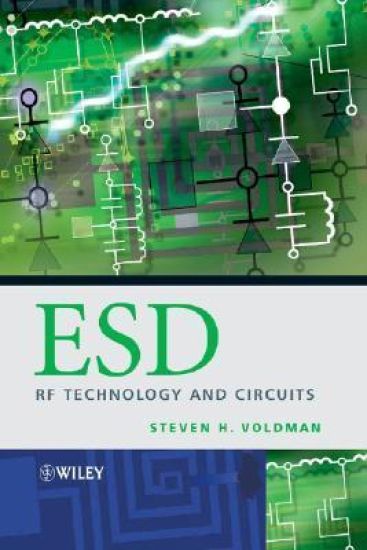
ESD

ESD

Steven H. Voldman

John Wiley Sons Inc
2006
sidottu
With the growth of high-speed telecommunications and wireless technology, it is becoming increasingly important for engineers to understand radio frequency (RF) applications and their sensitivity to electrostatic discharge (ESD) phenomena. This enables the development of ESD design methods for RF technology, leading to increased protection against electrical overstress (EOS) and ESD. ESD: RF Technology and Circuits: Presents methods for co-synthesizisng ESD networks for RF applications to achieve improved performance and ESD protection of semiconductor chips; discusses RF ESD design methods of capacitance load transformation, matching network co-synthesis, capacitance shunts, inductive shunts, impedance isolation, load cancellation methods, distributed loads, emitter degeneration, buffering and ballasting; examines ESD protection and design of active and passive elements in RF complementary metal-oxide-semiconductor (CMOS), RF laterally-diffused metal oxide semiconductor (LDMOS), RF BiCMOS Silicon Germanium (SiGe), RF BiCMOS Silicon Germanium Carbon (SiGeC), and Gallim Arsenide technology; gives information on RF ESD testing methodologies, RF degradation effects, and failure mechanisms for devices, circuits and systems; highlights RF ESD mixed-signal design integration of digital, analog and RF circuitry; sets out examples of RF ESD design computer aided design methodologies; covers state-of-the-art RF ESD input circuits, as well as voltage-triggered to RC-triggered ESD power clamps networks in RF technologies, as well as off-chip protection concepts. Following the authors series of books on ESD, this book will be a thorough overview of ESD in RF technology for RF semiconductor chip and ESD engineers. Device and circuit engineers working in the RF domain, and quality, reliability and failure analysis engineers will also find it a valuable reference in the rapidly growing are of RF ESD design. In addition, it will appeal to graduate students in RF microwave technology and RF circuit design.
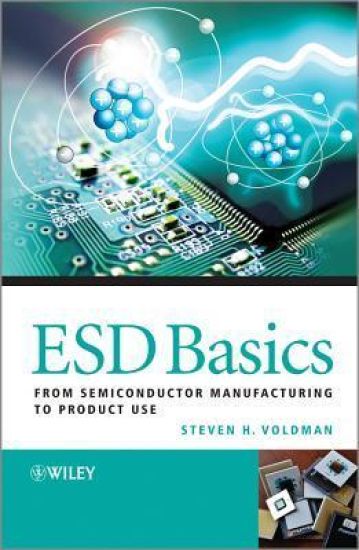
ESD Basics

ESD Basics

Steven H. Voldman

John Wiley Sons Inc
2012
sidottu
Electrostatic discharge (ESD) continues to impact semiconductor manufacturing, semiconductor components and systems, as technologies scale from micro- to nano electronics. This book introduces the fundamentals of ESD, electrical overstress (EOS), electromagnetic interference (EMI), electromagnetic compatibility (EMC), and latchup, as well as provides a coherent overview of the semiconductor manufacturing environment and the final system assembly. It provides an illuminating look into the integration of ESD protection networks followed by examples in specific technologies, circuits, and chips. The text is unique in covering semiconductor chip manufacturing issues, ESD semiconductor chip design, and system problems confronted today as well as the future of ESD phenomena and nano-technology. Look inside for extensive coverage on: The fundamentals of electrostatics, triboelectric charging, and how they relate to present day manufacturing environments of micro-electronics to nano-technologySemiconductor manufacturing handling and auditing processing to avoid ESD failuresESD, EOS, EMI, EMC, and latchup semiconductor component and system level testing to demonstrate product resilience from human body model (HBM), transmission line pulse (TLP), charged device model (CDM), human metal model (HMM), cable discharge events (CDE), to system level IEC 61000-4-2 testsESD on-chip design and process manufacturing practices and solutions to improve ESD semiconductor chip solutions, also practical off-chip ESD protection and system level solutions to provide more robust systemsSystem level concerns in servers, laptops, disk drives, cell phones, digital cameras, hand held devices, automobiles, and space applicationsExamples of ESD design for state-of-the-art technologies, including CMOS, BiCMOS, SOI, bipolar technology, high voltage CMOS (HVCMOS), RF CMOS, smart power, magnetic recording technology, micro-machines (MEMs) to nano-structures ESD Basics: From Semiconductor Manufacturing to Product Use complements the author’s series of books on ESD protection. For those new to the field, it is an essential reference and a useful insight into the issues that confront modern technology as we enter the Nano-electronic Era.
Oath Betrayed

Oath Betrayed

Steven H. Miles

University of California Press
2009
pokkari
The news that the United States tortured prisoners in the war on terror has brought shame to the nation, yet little has been written about the doctors and psychologists at these prisons. In "Oath Betrayed", medical ethics expert and physician Steven H. Miles tells how doctors, psychologists, and medics cleared prisoners for interrogation, advised and monitored abuse, falsified documents - including death certificates - and were largely silent as the scandal unfolded. This updated and expanded paperback edition gives newly uncovered details about the policies that engage clinicians in torture. It discusses the ongoing furor over psychologists' participating in interrogations. Most explosively this new edition shows how interrogation psychologists may have moved from information-gathering to coercive experiments, warning all of us about a new direction in U.S. policy and military medicine - a direction that not so long ago was unthinkable.
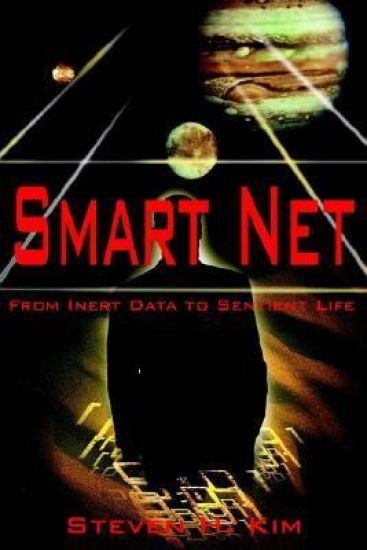
Smart Net

Smart Net

Steven H Kim

iUniverse
2002
pokkari
Advances in digital technology have swept away worn assumptions concerning information access, knowledge capture, and business practice. The new order has been proclaimed a second industrial revolution. Amidst the ferment, a steady stream of publications has reported on computer systems, network standards, and online tactics. Despite the wealth of information—or perhaps because of it—there has been a dearth of frameworks to organize the myriad tools, applications, and strategies. This book presents a panoramic view, filters the melody from the noise, and offers pointers toward the future. The primer begins with an overview of key techniques and applications. This is followed by guideposts to orient the newcomer to the virtual frontier. For members of the digital economy, the book offers global models to assess the environment, devise a competitive strategy, and construct an enterprise system. The volume provides a compact survey of Internet technologies and their role in personal productivity as well as corporate advantage. The manual can serve as a guide to emerging trends for the general reader, or as an aid to strategic planning for the decision maker. The handbook should interest readers in all walks of life and roles at work, from front-line employees and seasoned professionals to senior executives and policy makers. The book is also addressed to students of all ages with an interest in the evolution of our digital society.