

Kirjahaku
Etsi kirjoja tekijän nimen, kirjan nimen tai ISBN:n perusteella.
1000 tulosta hakusanalla Steven Philip Jones

Contained within this title are H.P. Lovecraft's tales originally known as Grewsome Tales and later dubbed Herbert West - Reanimator. In addition, award winning writer Steven Philip Jones provides an all new Reanimator tale plus the script for the audio version From the Dark story. As a bonus, an essay written by Lovecraft, Supernatural Horror in Literature, is presented within this collection. A must gift for any H.P. Lovecraft reader or collector, fan of Lovecraft Country, or those that enjoy macabre storytelling.

A chilling collection of four Lovecraft tales adapted by award winning comic writer Steven Philip Jones. Lovecraft is considered one of America's most innovative and popular American horror writers. The master of the weird tale during the first decades of the 20th Century until his premature death in 1937, Lovecraft's distinctive style and canon of work has influenced many authors. Jones takes the classic tales and while remaining true to the source, brings them into the modern age which can sometimes make the horror even more terrifying. These tales are illustrated by Octavio Cariello who has worked on DC's Green Lantern, Deathstroke, and Black Lightning comic series. The four illustrated stories within this Volume are "The Lurking Fear" where Arthur Monroe explores a sinkhole where bodies are found, savagely torn apart is if by wild animals. "Beyond the Wall of Sleep" shows that the power of the mind is a mysterious thing and when a researcher finds that he and a criminal patient are somehow linked, the effect can go beyond just mysterious. "The Tomb" tells the tale of Jervas Dudley, who is convinced ghosts exist and when he visits the site where his ancestors perished 200 years ago, he might just find out for sure, and "The Alchemist", for over 600 years the male descendants of the Chabrillane family have all inexplicably perished on their 32nd birthday. Now, the last Count de Chabrillane is about to turn 32. Further adaptions can be found in H.P. Lovecraft's Worlds - Volume Two: Dagon and Other Tales.Published by Caliber Comics
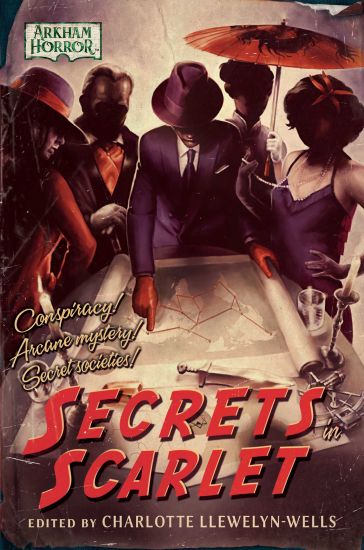
Secrets in Scarlet
James Fadeley; Carrie Harris; Davide Mana; Josh Reynolds; David Annandale; MJ Newman; Lisa Smedman; Steven Philip Jones; Jason Fischer
Aconyte Books
2023
pokkari
A secret organization ruthlessly seeks power over supernatural terrors in this globe-trotting anthology of arcane mystery and adventure, from the bestselling world of Arkham HorrorBeyond our world lies another, one full of paranormal forces and eldritch horrors, and once that membrane has been pierced, life can never be the same again. In every corner of the globe, a secret international organization is seizing objects of extreme supernatural power. They declare themselves defenders of humanity, fighting off the darkness which presses against the veil shrouding our reality from the unknowable. But do their claims of altruism ring true? And should a shadowy cabal be permitted to wield such power alone? From the world of Arkham Horror comes an exciting new anthology that delves into the mysterious Red Coterie and those who seek to stop them.

The American Southeast at the End of the Ice Age
David G. Anderson; Derek T. Anderson; Katherine McMillan Barry; Kara Bridgman Sweeney; Samuel O. Brookes; Adam M. Burke; Stephen B. Carmody; Philip J. Carr; William A. Childress; I. Randolph Daniel; Ryan Duggins; Grayal E. Farr; Michael K. Faught; Brendan Fenerty; Jay D. Franklin; Lauren M. Franklin; J. Christopher Gillam; Joseph A. M. Gingerich; Jessi J. Halligan; Kandace D. Hollenbach; Vance T. Holliday; Thomas A. Jennings; K. C. Jones; Shawn A. Joy; Jerald Ledbetter; Greg J. Maggard; Steven M. Meredith; D. Shane Miller
THE UNIVERSITY OF ALABAMA PRESS
2022
sidottu
The definitive book on what is known about the Late Pleistocene and Early Holocene archaeological record in the Southeast The 1996 benchmark volume The Paleoindian and Early Archaic Southeast, edited by David G. Anderson and Kenneth E. Sassaman, was the first study to summarize what was known of the peoples who lived in the Southeast when ice sheets covered the northern part of the continent and mammals such as mammoths, saber-toothed cats, and ground sloths roamed the landscape.The American Southeast at the End of the Ice Age provides an updated, definitive synthesis of current archaeological research gleaned from an array of experts in the region. It is organized in three parts: state records, the regional perspective, and reflections and future directions. Chapters survey a diversity of topics including the distribution of the earliest archaeological sites in the region, chipped-stone tool technology, the expanding role of submerged archaeology, hunter-gatherer lifeways, past climate changes and the extinction of megafauna on the transitional landscape, and evidence of demographic changes at the end of the Ice Age. Discussion of the ethical responsibilities regarding the use of private collections and the relationship of archaeologists and the avocational community, insight from outside the Southeast, and considerations for future research round out the volume.
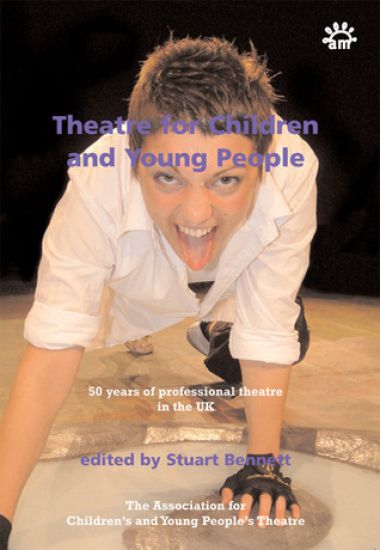
Theatre for Children and Young People
Wolfgang Schneider; Stuart Bennet; Eirwen Hopkins; Jeremy Turner; Tony Reekie; Richard Croxford; Paul Harman; Sarah Kettlewell; Henning Fangauf; David Pammenter; Tony Graham; Annie Wood; Steve Ball; Philip Clark; Margaret Jones; David Wood; Dave Holman; Rosamunde Hutt; Thomas Kell; Jude Merrill; Cath Greig; Vicky Ireland; Olivia Jacobs; Toby Mitchell; Claudette Bryanston; Ian Yeoman; Anthony Haddon; Jain Boon; Andrew Breakwell; Carey English; Tim Webb; Peter Rumney; Dominic Rai; Julie Ward; Michael Dalton; David Farmer
Aurora Metro Publications
2005
nidottu
It is the first publication to give the whole story of Theatre for Children and Young People and its development in the UK. It is essential reading for drama and theatre practitioners and for students of contemporary British theatre everywhere. Stuart Bennett was one of the original company of Actor-Teachers who developed Theatre in Education at the Belgrade Theatre Coventry. He went on to develop Drama School training for actors in TIE, then as Director of the Cockpit Theatre was involved in theatre in schools and the community.

France's political leaders have been deeply committed both to maintaining France's independence and to asserting its leadership role in Europe. The end of the Cold War, the demise of the Europe of Yalta, as well as the unification of Germany, have forced France to rethink its European and international strategies. The purpose of this study is to analyze France's effort to redefine its role in the post-Cold War era and in an integrated Europe, and what that redefined role might mean to France, to Europe, and to the United States. In examining France's international role after the Cold War, Steven Philip Kramer seeks to answer the question, does France still count?

France's political leaders have been deeply committed both to maintaining France's independence and to asserting its leadership role in Europe. The end of the Cold War, the demise of the Europe of Yalta, as well as the unification of Germany, have forced France to rethink its European and international strategies. The purpose of this study is to analyze France's effort to redefine its role in the post-Cold War era and in an integrated Europe, and what that redefined role might mean to France, to Europe, and to the United States. In examining France's international role after the Cold War, Steven Philip Kramer seeks to answer the question, does France still count?
This is a book about what it meant to be a socialist in Western Europe for the generation which came to maturity after World War I. It attempts to capture the subjective aspect of the socialist experience through interviews conducted with socialist leaders who held a significant place in the movement from the 1930s on.

This book explores what socialism in Western Europe meant for the generation that came to maturity after World War I. Dr. Kramer captures individual aspects of the socialist experience through interviews with socialist leaders who have been a significant part of the movement since the 1930s and who represent the great diversity of European socialis
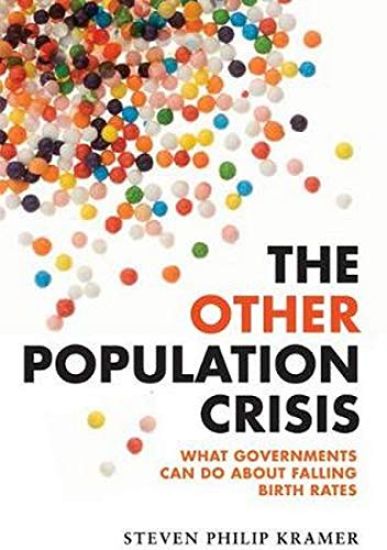
The programs in Italy, Japan, and Singapore, which have failed so far, have not devoted sufficient resources consistently enough to make a difference and do not support gender equality and women’s work-family balance, Kramer finds.
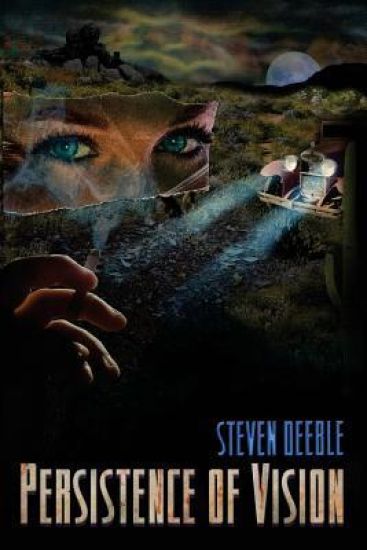
Memorial Day, 1929. A private investigator is found dead in the Palm Springs home of a Hollywood starlet. In the icebox - a reel of movie film. Detective Daniel Moretti's investigation takes him from the desert heat of Palm Springs and Joshua Tree to the cool ocean breezes of Long Beach. Along the way he crosses paths with the Hollywood elite - Chaplin, Barrymore, Stan Laurel, Lon Chaney. Persistence of Vision' is a taut noir thriller in the manner of Hammett, Chandler, and Ellroy. Its characters and locales are vividly drawn, and colorfully portray a time of great style and elegance.


A landmark biography of one of our most prominent chroniclers of American life In this groundbreaking literary biography, Steven J. Zipperstein captures the complex life and astonishing work of Philip Roth (1933–2018), one of America’s most celebrated writers. Born in Newark, New Jersey—where his short stories and books were often set—Roth wrote with ambition and awareness of what was required to produce great literature. No writer was more dedicated to his craft, even as he was rubbing shoulders with the Kennedys and engaging in a spate of famous and infamous romances. And yet, as much as Roth wrote about sex and self, he viewed himself as socially withdrawn, living much like an “unchaste monk” (his words). Zipperstein explores the unprecedented range of Roth’s work—from “Goodbye, Columbus” and Portnoy’s Complaint to the Pulitzer Prize–winning American Pastoral and The Plot Against America. Drawing on extensive archival materials and over one hundred interviews, including conversations with Roth about his life and work, Zipperstein provides an intimate and insightful look at one of the twentieth century’s most influential writers, placing his work in the context of his obsessions, as well as American Jewishness, freedom, and sexuality.

This book comprehensively surveys Philip Roth's published and unpublished works, focusing on the thematic unity which binds them together: the memory of the Holocaust and the altered universe born of that memory. The Holocaust is understood as the orienting event for Roth's fiction and non-fiction, the force that surrounds the characters and the narratives at all times. Roth's obsession with questions of the Holocaust, questions of responsibility, meaning, and powerlessness, explains his recurring discussion of entrapment, dehumanization, nihilism, guilt, and coercion.The concentrationary universe of the title is defined, in this work, as not only the universe of camps, but also the universe that exists after the devastation. Moral and philosophical norms are revoked in this new world. Roth's early works are presented on a desolate landscape. The introduction explicates this landscape, specifically by invoking an early play of Roth's, a play which is set in a Jewish ghetto during the Holocaust. This unpublished work introduces the historical period that shapes the visions of Roth's future protagonists.The next three chapters study Roth's relentless excavation of the dilemmas of fathers, mothers, authority figures, and the inner discord of need and purpose. These seemingly quotidian problems are exacerbated and intensified by the Holocaust's shadowy presence. No relationship, no effort at fulfillment, no action is untempered by history in Roth's varied fictions.Chapters four and five look directly at Roth's allusions to the Holocaust. They explore, through each of Roth's works, how the Holocaust-thematic -the play of ideology and nihilism-and the Holocaust-pattern -the idea of the past encroaching upon the present -work through Roth's career, informing his readers not only of his fascination with the Holocaust, but of his particularly human way of dealing with it.The last chapter briefly summarizes the findings of the previous chapter and connects Roth's specific concentrationary universe to the larger world. The linguistic clues of Roth's novels are revealed and investigated, pointing to Roth's celebration of ambiguity and individuality as parts of an imperfect formula for writing and living in the debased aftermath of the Holocaust.
This book comprehensively surveys Philip Roth's published and unpublished works, focusing on the thematic unity which binds them together: the memory of the Holocaust and the altered universe born of that memory. The Holocaust is understood as the orienting event for Roth's fiction and non-fiction, the force that surrounds the characters and the narratives at all times. Roth's obsession with questions of the Holocaust, questions of responsibility, meaning, and powerlessness, explains his recurring discussion of entrapment, dehumanization, nihilism, guilt, and coercion. The concentrationary universe of the title is defined, in this work, as not only the universe of camps, but also the universe that exists after the devastation. Moral and philosophical norms are revoked in this new world. Roth's early works are presented on a desolate landscape. The introduction explicates this landscape, specifically by invoking an early play of Roth's, a play which is set in a Jewish ghetto during the Holocaust. This unpublished work introduces the historical period that shapes the visions of Roth's future protagonists. The next three chapters study Roth's relentless excavation of the dilemmas of fathers, mothers, authority figures, and the inner discord of need and purpose. These seemingly quotidian problems are exacerbated and intensified by the Holocaust's shadowy presence. No relationship, no effort at fulfillment, no action is untempered by history in Roth's varied fictions. Chapters four and five look directly at Roth's allusions to the Holocaust. They explore, through each of Roth's works, how the Holocaust-thematic -the play of ideology and nihilism-and the Holocaust-pattern -the idea of the past encroaching upon the present -work through Roth's career, informing his readers not only of his fascination with the Holocaust, but of his particularly human way of dealing with it. The last chapter briefly summarizes the findings of the previous chapter and connects Roth's specific concentrationary universe to the larger world. The linguistic clues of Roth's novels are revealed and investigated, pointing to Roth's celebration of ambiguity and individuality as parts of an imperfect formula for writing and living in the debased aftermath of the Holocaust.
Philip Carchman Et UX., Petitioners, V. Korman Corporation. U.S. Supreme Court Transcript of Record with Supporting Pleadings
Parker H Wilson; Steven A Arbittier; Paul W Tressler
Gale Ecco, U.S. Supreme Court Records
2011
pokkari
The Knowledge Illusion: Why We Never Think Alone
Steven Sloman; Philip Fernbach
Riverhead Books
2018
nidottu
Humans have built hugely complex societies and technologies, but most of us don't even know how a pen or a toilet works. How have we achieved so much despite understanding so little? Cognitive scientists Steven Sloman and Philip Fernbach argue that we survive and thrive despite our mental shortcomings because we live in a rich community of knowledge. The key to our intelligence lies in the people and things around us. We're constantly drawing on information and expertise stored outside our heads: in our bodies, our environment, our possessions, and the community with which we interact-and usually we don't even realize we're doing it.The human mind is both brilliant and pathetic. We have mastered fire, created democratic institutions, stood on the moon, and sequenced our genome. And yet each of us is error prone, sometimes irrational, and often ignorant. The fundamentally communal nature of intelligence and knowledge explains why we often assume we know more than we really do, why political opinions and false beliefs are so hard to change, and why individual-oriented approaches to education and management frequently fail. But our collaborative minds also enable us to do amazing things. The Knowledge Illusion contends that true genius can be found in the ways we create intelligence using the community around us.

Molecular Similarity - Concepts and Applications for Pharmaceutical Research
Hajduk Philip; Muchmore Steven
John Wiley Sons Inc
2011
sidottu
Molecular similarity is the foundational principle for drug design, wherein new molecules are designed that are "similar enough" to known compounds to have a good chance at being active but "different enough" to have a chance at being superior. Quantifying the level of similarity or dissimilarity between two molecules has been a long-standing area of investigation, and decades of research have yielded an impressive array of tools and techniques for measuring and calculating these relationships.Molecular Similarity: Concepts and Applications for Pharmaceutical Research provides a comprehensive review of "best practices" within the field of molecular similarity as it applies to drug design, covering fundamentals and concepts, case studies, and strategies for integration. Topics covered include: - theory and concepts in molecular similarity - 1-D, 2-D and 3-D methods for chemical similarity - biochemical similarity - target similarity - pockets and docking - integrating multiple approaches to chemical similarity - case studies in lead discovery, optimization and target discovery; kinome/GPCR profiling; polypharmacology; and off-target discoveryMolecular Similarity: Concepts and Applications for Pharmaceutical Research will appeal to both the newcomer and the expert, providing a foundational text upon which to gain familiarity with the field, develop localized strategies, and conduct further research.
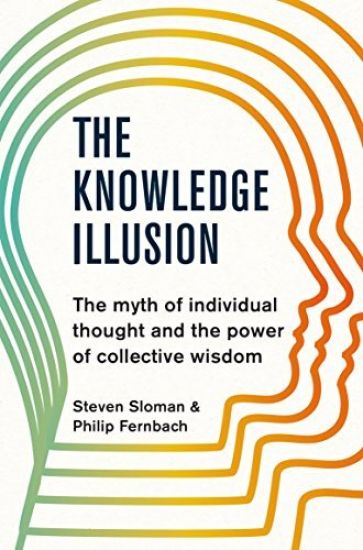
A compelling case from two leading cognitive scientists that people are like bees and society is like a beehive: true intelligence lies not in our individual brains but in the collective mind.