Kirjojen hintavertailu. Mukana 11 244 527 kirjaa ja 12 kauppaa.

Kirjahaku

Etsi kirjoja tekijän nimen, kirjan nimen tai ISBN:n perusteella.

1000 tulosta hakusanalla Sumit Saxena

The Snowden Reader

The Snowden Reader

Sumit Ganguly

Indiana University Press
2015
sidottu
When Edward Snowden began leaking NSA documents in June 2013, his actions sparked impassioned debates about electronic surveillance, national security, and privacy in the digital age. The Snowden Reader looks at Snowden's disclosures and their aftermath. Critical analyses by experts discuss the historical, political, legal, and ethical issues raised by the disclosures. Over forty key documents related to the case are included, with introductory notes explaining their significance: documents leaked by Snowden; responses from the NSA, the Obama administration, and Congress; statements by foreign leaders, their governments, and international organizations; judicial rulings; findings of review committees; and Snowden's own statements. This book provides a valuable introduction and overview for anyone who wants to go beyond the headlines to understand this historic episode.
The Snowden Reader

The Snowden Reader

Sumit Ganguly

Indiana University Press
2015
pokkari
When Edward Snowden began leaking NSA documents in June 2013, his actions sparked impassioned debates about electronic surveillance, national security, and privacy in the digital age. The Snowden Reader looks at Snowden's disclosures and their aftermath. Critical analyses by experts discuss the historical, political, legal, and ethical issues raised by the disclosures. Over forty key documents related to the case are included, with introductory notes explaining their significance: documents leaked by Snowden; responses from the NSA, the Obama administration, and Congress; statements by foreign leaders, their governments, and international organizations; judicial rulings; findings of review committees; and Snowden's own statements. This book provides a valuable introduction and overview for anyone who wants to go beyond the headlines to understand this historic episode.
Beyond Nationalist Frames

Beyond Nationalist Frames

Sumit Sarkar

Indiana University Press
2002
sidottu
The political context in which historians of India find themselves today, says Sumit Sarkar, is dominated by the advance of the Hindu Right and globalized forms of capitalism, while the historian's intellectual context is dominated by the marginalization of all varieties of Marxism and an academic shift to cultural studies and postmodern critique. In Beyond Nationalist Frames, one of India's foremost contemporary historians offers his view of how the craft of history should be practiced in this complex conjuncture. In studies of colonial time-keeping, Rabindranath Tagore's fiction, and pre-Independence Bengal, Sarkar explores new approaches to the writing of history. Essays on contemporary politics consider the implications of the "Hindu Bomb," the rewriting of national history textbooks by Hindu fundamentalists, and the issue of conversion to Christianity. Scholars in all the fields touched by recent developments in South Asian historiography—anthropology, feminist theory, comparative literature, cultural studies—will find this a stimulating and provocative collection of essays, as will anyone interested in Indian politics.
History and Collective Memory in South Asia, 1200–2000

History and Collective Memory in South Asia, 1200–2000

Sumit Guha

University of Washington Press
2019
pokkari
In this far-ranging and erudite exploration of the South Asian past, Sumit Guha discusses the shaping of social and historical memory in world-historical context. He presents memory as the result of both remembering and forgetting and of the preservation, recovery, and decay of records. By describing how these processes work through sociopolitical organizations, Guha delineates the historiographic legacy acquired by the British in colonial India; the creation of the centralized educational system and mass production of textbooks that led to unification of historical discourses under colonial auspices; and the divergence of these discourses in the twentieth century under the impact of nationalism and decolonization.Guha brings together sources from a range of languages and regions to provide the first intellectual history of the ways in which socially recognized historical memory has been made across the subcontinent. This thoughtful study contributes to debates beyond the field of history that complicate the understanding of objectivity and documentation in a seemingly post-truth world.
History and Collective Memory in South Asia, 1200–2000

History and Collective Memory in South Asia, 1200–2000

Sumit Guha

University of Washington Press
2019
sidottu
In this far-ranging and erudite exploration of the South Asian past, Sumit Guha discusses the shaping of social and historical memory in world-historical context. He presents memory as the result of both remembering and forgetting and of the preservation, recovery, and decay of records. By describing how these processes work through sociopolitical organizations, Guha delineates the historiographic legacy acquired by the British in colonial India; the creation of the centralized educational system and mass production of textbooks that led to unification of historical discourses under colonial auspices; and the divergence of these discourses in the twentieth century under the impact of nationalism and decolonization.Guha brings together sources from a range of languages and regions to provide the first intellectual history of the ways in which socially recognized historical memory has been made across the subcontinent. This thoughtful study contributes to debates beyond the field of history that complicate the understanding of objectivity and documentation in a seemingly post-truth world.
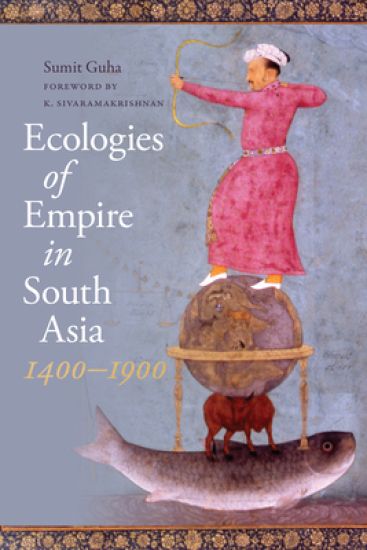
Ecologies of Empire in South Asia, 1400-1900

Ecologies of Empire in South Asia, 1400-1900

Sumit Guha; K. Sivaramakrishnan

UNIVERSITY OF WASHINGTON PRESS
2023
sidottu
Reveals how imperial power and local resistance have shaped landscapesThe perception, valuation, and manipulation of human environments all have their own layered histories. So Sumit Guha argues in this sweeping examination of a pivotal five hundred years when successive empires struggled to harness lands and peoples to their agendas across Asia. Ecologies of Empire in South Asia, 1400–1900 compares the practices of the Mughal and British Empires to demonstrate how their fluctuating capacity for domination was imbricated in the formation of environmental knowledge itself. The establishment of imperial control transforms local knowledge of the world into the aggregated information that reproduces centralized power over it. That is the political ecology that reshapes entire biomes. Animals and plants are translocated; human communities are displaced or destroyed. Some species proliferate; others disappear. But these state projects are overlaid upon the many local and regional geographies made by sacred cosmologies and local sites, pilgrimage routes and river fords, hot springs and fluctuating aquifers, hunting ranges and nesting grounds, notable trees and striking rocks.Guha uncovers these ecological histories by scrutinizing little-used archival sources. His historically based political ecology demonstrates how the biomes of a vast subcontinent were changed by struggles to make and to resist empire.
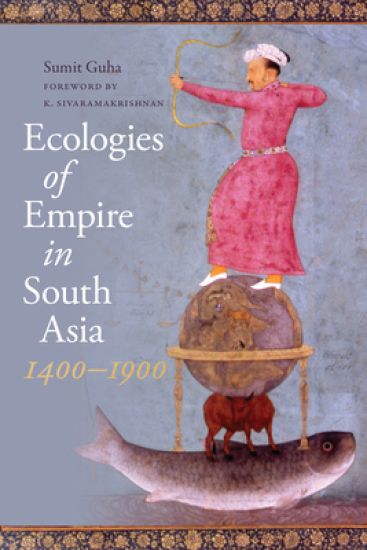
Ecologies of Empire in South Asia, 1400-1900

Ecologies of Empire in South Asia, 1400-1900

Sumit Guha; K. Sivaramakrishnan

UNIVERSITY OF WASHINGTON PRESS
2023
pokkari
Reveals how imperial power and local resistance have shaped landscapesThe perception, valuation, and manipulation of human environments all have their own layered histories. So Sumit Guha argues in this sweeping examination of a pivotal five hundred years when successive empires struggled to harness lands and peoples to their agendas across Asia. Ecologies of Empire in South Asia, 1400–1900 compares the practices of the Mughal and British Empires to demonstrate how their fluctuating capacity for domination was imbricated in the formation of environmental knowledge itself. The establishment of imperial control transforms local knowledge of the world into the aggregated information that reproduces centralized power over it. That is the political ecology that reshapes entire biomes. Animals and plants are translocated; human communities are displaced or destroyed. Some species proliferate; others disappear. But these state projects are overlaid upon the many local and regional geographies made by sacred cosmologies and local sites, pilgrimage routes and river fords, hot springs and fluctuating aquifers, hunting ranges and nesting grounds, notable trees and striking rocks.Guha uncovers these ecological histories by scrutinizing little-used archival sources. His historically based political ecology demonstrates how the biomes of a vast subcontinent were changed by struggles to make and to resist empire.
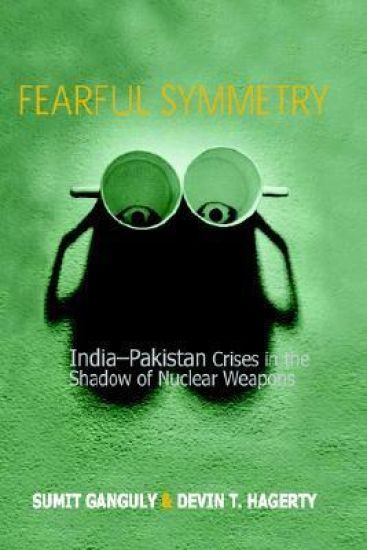
Fearful Symmetry

Fearful Symmetry

Sumit Ganguly; Devin T. Hagerty

University of Washington Press
2006
pokkari
With the nuclearization of the Indian subcontinent, Indo-Pakistani crisis behavior has acquired a deadly significance. The past two decades have witnessed no fewer than six crises against the backdrop of a vigorous nuclear arms race. Except for the Kargil war of 1998-9, all these events were resolved peacefully.Nuclear war was avoided despite bitter mistrust, everyday tensions, an intractable political conflict over Kashmir, three wars, and the steady refinement of each side's nuclear capabilities. Sumit Ganguly and Devin T. Hagerty carefully analyze each crisis, reviewing the Indian and Pakistani domestic political systems and key decisions during the relevant period.This lucid and comprehensive study of the two nations' crisis behavior in the nuclear age is the first work on Indo-Pakistani relations to take systematic account of the role played by the United States in South Asia's security dynamics over the past two decades in the context of unipolarization, and formulates a blueprint for American policy toward a more positive and productive India-Pakistan relationship.
Fearful Symmetry

Fearful Symmetry

Sumit Ganguly; Devin T. Hagerty

University of Washington Press
2015
sidottu
With the nuclearization of the Indian subcontinent, Indo-Pakistani crisis behavior has acquired a deadly significance. The past two decades have witnessed no fewer than six crises against the backdrop of a vigorous nuclear arms race. Except for the Kargil war of 1998-9, all these events were resolved peacefully.Nuclear war was avoided despite bitter mistrust, everyday tensions, an intractable political conflict over Kashmir, three wars, and the steady refinement of each side's nuclear capabilities. Sumit Ganguly and Devin T. Hagerty carefully analyze each crisis, reviewing the Indian and Pakistani domestic political systems and key decisions during the relevant period.This lucid and comprehensive study of the two nations' crisis behavior in the nuclear age is the first work on Indo-Pakistani relations to take systematic account of the role played by the United States in South Asia's security dynamics over the past two decades in the context of unipolarization, and formulates a blueprint for American policy toward a more positive and productive India-Pakistan relationship.
Steinert's Cataract Surgery

Steinert's Cataract Surgery

Sumit Garg; Douglas D. Koch

Elsevier - Health Sciences Division
2023
sidottu
Offering authoritative coverage, Steinert's Cataract Surgery, 4th Edition, takes you step by step from preoperative evaluation and preparation through the full range of surgical techniques and the mitigation and management of complications. New editors, Drs. Sumit (Sam) Garg and Douglas D. Koch, along with a who's who list of top international experts, provide practical technical guidance on all aspects of cataract surgery in a newly streamlined, easy-to-read format. From IOL calculations to glaucoma and astigmatism considerations, perioperative drug delivery to methods of iris repair, this up-to-date 4th Edition delivers essential clinical information, core foundational knowledge, and advanced techniques from cover to cover. Features expert tips on common pitfalls in cataract surgery, including advanced surgical pearls to maximize patient outcomes. Contains 10 new chapters covering Modular Intraocular Lenses (IOLs), Femtosecond-Laser-Assisted Cataract Surgery, Preoperative Evaluation and Considerations of Astigmatism, Toric Intraocular Lenses (IOLs), Managing Residual Postoperative Astigmatism, Retinal Considerations in Cataract Surgery, Management of Dysphotopsia, Refractive Enhancements after Cataract Surgery, and more. Provides rich visual guidance with more than 1,200 diagnostic, clinical, and surgical photos and illustrations with clear explanations. Includes more than 100 videos of narrated surgical footage performed by the authors, offering real-time guidance on the full range of the latest cataract surgery techniques. Enhanced eBook version included with purchase. Your enhanced eBook allows you to access all of the text, figures, and references from the book on a variety of devices.
Mending Fences

Mending Fences

Sumit Ganguly

TAYLOR FRANCIS LTD
2021
sidottu
Exploring the long history of conflict in South Asia, this book assesses the role of confidence- and security-building measures (CSBMs) in reducing tension. Using a comparative framework, the contributors draw lessons for South Asia from the experiences of the states in Cold War Europe and in the Middle East. Despite the significant historical, political and geographic differences among regions, the contributors illustrate how the implementation of CSBM's elsewhere has important implications for limiting interstate conflict in South Asia.
The Calcutta Kerani and the London Clerk in the Nineteenth Century
This book examines the location and representation of the colonial clerk or the kerani within the cultural and social space of nineteenth century colonial India. It provides a comparative history of the clerk in Calcutta vis-à-vis the clerk in contemporary London in order to understand the manifestations of modernity in these two disparate but intimately related spaces.The volume traces the socio-historical life of the clerk in the newly emerged city-space of Calcutta and reveals how the Bengali kerani became a complex and distinct figure of bureaucratic and colonial modernity. It analyses the techniques of surveillance and ethical training given to the native clerks and offers insights into the role of education in the production and dissemination of knowledge and hegemony in the colonial setting. The author, through a reading of clerk manuals, handbooks and literary representations, highlights the class and cultural identity of the English educated colonial clerk in the new city-space. He also focuses on the ambivalence and unreliability of the clerk or colonial babu who became complicit and gave legitimacy to the empire while personifying a complex modernity within the networks of the colonial administration.This book will be of great interest to students and researchers of colonial and imperial history, literature, cultural studies, city studies, British studies, area studies, commonwealth studies and South Asian studies, particularly those interested in colonial Bengal.
Mending Fences

Mending Fences

Sumit Ganguly

TAYLOR FRANCIS LTD
2023
nidottu
Exploring the long history of conflict in South Asia, this book assesses the role of confidence- and security-building measures (CSBMs) in reducing tension. Using a comparative framework, the contributors draw lessons for South Asia from the experiences of the states in Cold War Europe and in the Middle East. Despite the significant historical, political and geographic differences among regions, the contributors illustrate how the implementation of CSBM's elsewhere has important implications for limiting interstate conflict in South Asia.
The Origins Of War In South Asia

The Origins Of War In South Asia

Sumit Ganguly

Routledge
2019
sidottu
In examining the forces that made the Indo-Pakistani relationship prone to conflict, Dr. Ganguly focusses first on the nature of the British colonial disengagement policy, a hasty and ill-conceived procedure that served to exacerbate the ideological differences between India's major political parties, the Congress and the Muslim League. Their competing views–the Congress espoused a secular polity while the League drew its inspiration from Islamic tenets–formed the basis of the two polities that emerged from the collapse of the British Indian empire. Disputes also arose over the uncertain status of Kashmir. With the lapse of the British doctrine of paramountcy (recognition of the British as the sovereign power in India), the so-called princely states had to join either India or Pakistan on the basis of geographic location and demographic composition. Kashmir posed a problem because of its location and because it had a Hindu monarch ruling a Muslim majority population. This peculiar status made it the center of a Pakistani irredentist claim. This claim was rejected by India, iintent upon demonstrating that all minorities could thrive under the aegis of secular government. Once set in motion by the interplay of domestic, regional, and systematic factors, these three forces--disengagement, ideological differences, and the conflict over Kashmir--brought the subcontinent to war in 1947-1948, 1965, and 1971. Dr. Ganguly provides a comprehensive and comparative analysis of these three Indo-Pakistani conflicts as well as an assessment of both the impact of the Soviet invasion of Afghanistan on the security of South Asia and the changes in the perceptions of that security.
The Origins Of War In South Asia

The Origins Of War In South Asia

Sumit Ganguly

Routledge
2020
nidottu
In examining the forces that made the Indo-Pakistani relationship prone to conflict, Dr. Ganguly focusses first on the nature of the British colonial disengagement policy, a hasty and ill-conceived procedure that served to exacerbate the ideological differences between India's major political parties, the Congress and the Muslim League. Their competing views–the Congress espoused a secular polity while the League drew its inspiration from Islamic tenets–formed the basis of the two polities that emerged from the collapse of the British Indian empire. Disputes also arose over the uncertain status of Kashmir. With the lapse of the British doctrine of paramountcy (recognition of the British as the sovereign power in India), the so-called princely states had to join either India or Pakistan on the basis of geographic location and demographic composition. Kashmir posed a problem because of its location and because it had a Hindu monarch ruling a Muslim majority population. This peculiar status made it the center of a Pakistani irredentist claim. This claim was rejected by India, iintent upon demonstrating that all minorities could thrive under the aegis of secular government. Once set in motion by the interplay of domestic, regional, and systematic factors, these three forces--disengagement, ideological differences, and the conflict over Kashmir--brought the subcontinent to war in 1947-1948, 1965, and 1971. Dr. Ganguly provides a comprehensive and comparative analysis of these three Indo-Pakistani conflicts as well as an assessment of both the impact of the Soviet invasion of Afghanistan on the security of South Asia and the changes in the perceptions of that security.
The Calcutta Kerani and the London Clerk in the Nineteenth Century
This book examines the location and representation of the colonial clerk or the kerani within the cultural and social space of nineteenth century colonial India. It provides a comparative history of the clerk in Calcutta vis-à-vis the clerk in contemporary London in order to understand the manifestations of modernity in these two disparate but intimately related spaces.The volume traces the socio-historical life of the clerk in the newly emerged city-space of Calcutta and reveals how the Bengali kerani became a complex and distinct figure of bureaucratic and colonial modernity. It analyses the techniques of surveillance and ethical training given to the native clerks and offers insights into the role of education in the production and dissemination of knowledge and hegemony in the colonial setting. The author, through a reading of clerk manuals, handbooks and literary representations, highlights the class and cultural identity of the English educated colonial clerk in the new city-space. He also focuses on the ambivalence and unreliability of the clerk or colonial babu who became complicit and gave legitimacy to the empire while personifying a complex modernity within the networks of the colonial administration.This book will be of great interest to students and researchers of colonial and imperial history, literature, cultural studies, city studies, British studies, area studies, commonwealth studies and South Asian studies, particularly those interested in colonial Bengal.
Composite Materials

Composite Materials

Sumit Sharma

CRC Press
2021
sidottu
Composite materials find diverse applications in areas including aerospace, automotive, architecture, energy, marine and military. This comprehensive textbook discusses three important aspects including manufacturing, mechanics and dynamic mechanical analysis of composites. The textbook comprehensively presents fundamental concepts of composites, manufacturing techniques and advanced topics including as advances in composite materials in various fields, viscoelastic behavior of composites, toughness of composites and Nano mechanics of composites in a single volume. Topics such as polymer matrix composites, metal matrix composites, ceramic matrix composites, micromechanical behavior of a lamina, micromechanics and nanomechanics are discussed in detail.Aimed at senior undergraduate and graduate students for a course on composite materials in the fields of mechanical engineering, automobile engineering and electronics engineering, this book: Discusses mechanics and manufacturing techniques of composite materials in a single volume. Explains viscoelastic behavior of composites in a comprehensive manner. Covers fatigue, creep and effect of thermal stresses on composites. Discusses concepts including bending, buckling and vibration of laminated plates in detail. Explains dynamic mechanical analysis (DMA) of composites.
Composite Materials

Composite Materials

Sumit Sharma

TAYLOR FRANCIS LTD
2024
nidottu
Composite materials find diverse applications in areas including aerospace, automotive, architecture, energy, marine and military. This comprehensive textbook discusses three important aspects including manufacturing, mechanics and dynamic mechanical analysis of composites. The textbook comprehensively presents fundamental concepts of composites, manufacturing techniques and advanced topics including as advances in composite materials in various fields, viscoelastic behavior of composites, toughness of composites and Nano mechanics of composites in a single volume. Topics such as polymer matrix composites, metal matrix composites, ceramic matrix composites, micromechanical behavior of a lamina, micromechanics and nanomechanics are discussed in detail.Aimed at senior undergraduate and graduate students for a course on composite materials in the fields of mechanical engineering, automobile engineering and electronics engineering, this book: Discusses mechanics and manufacturing techniques of composite materials in a single volume. Explains viscoelastic behavior of composites in a comprehensive manner. Covers fatigue, creep and effect of thermal stresses on composites. Discusses concepts including bending, buckling and vibration of laminated plates in detail. Explains dynamic mechanical analysis (DMA) of composites.
Principles of Secure Network Systems Design

Principles of Secure Network Systems Design

Sumit Ghosh; H. Lawson

Springer-Verlag New York Inc.
2002
sidottu
As e-commerce becomes the norm of business transactions and information be­ comes an essential commodity, it is vital that extensive efforts be made to examine and rectify the problems with the underlying architectures, processes, methods, that are involved in providing and and tools, as well as organizational structures, utilizing services relating to information technology. Such a holistic view of the relevant structures is required in order to identify all of the key aspects that can affect network security. Unfortunately, today's systems and practices, although they have proved to be useful and become widespread, contain significant unnecessary complexity. This complexity provides many loopholes that make systems and practices vulnerable to malicious attacks by hackers as well as by individual and organized criminals. FUrther, there are enormous risks due to malfunction of the systems. The holes in the network system cannot simply be plugged up by the use of cryptography and firewalls. While many changes need to be made in operating systems and system software with respect to security, this alone does not solve the problem. The problems cannot be solved by addressing only a single key aspect of network security. A holistic approach is required. Sumit Ghosh has provided in this book such a holistic view of the area of network security. Thus, it is a most welcome contribution.
Algorithm Design for Networked Information Technology Systems

Algorithm Design for Networked Information Technology Systems

Sumit Ghosh; C.V. Ramamoorthy

Springer-Verlag New York Inc.
2003
sidottu
I felt deeply honored when Professor Sumit Ghosh asked me to write the foreword to his book with an extraordinary perspective. I have long admired him, ?rst as a student leader at Stanford, where he initiated the ?rst IEEE Computer Society’s student chapter, and later as an esteemed and inspiring friend whose transdisciplinary research broadened and enhanced the horizons of practitioners of computer science and engineering, including my own. His ideas, which are derived from his profound vision, deep critical thinking, and personal intuition, reach from information technology to bioscience, as - hibited in this excellent book. To me, an ordinary engineer, it opens up a panoramic view of the Universe of Knowledge that keeps expanding and - spiring,likethegoodIndianproverb,whichsays,“agoodbookinformsyou,an excellent book teaches you, and a great book changes you. ” I sincerely believe that Professor Ghosh’s book will help us change and advance the methods of systems engineering and technology. Vision Inspired vision sees ahead of others what will or may come to be, a vivid, imagined concept or anticipation. An inspired vision personi?es what is good and what like-minded individuals hope for. Our vision is one of creating an Internet of minds, where minds are Web sites or knowledge centers, which create, store, and radiate knowledge through interaction with other minds connected by a universal shared network. This vision will not just hasten the death of distance, but will also - carcerate ignorance.