Kirjojen hintavertailu. Mukana 11 244 527 kirjaa ja 12 kauppaa.

Kirjahaku

Etsi kirjoja tekijän nimen, kirjan nimen tai ISBN:n perusteella.

1000 tulosta hakusanalla Theda Braddock; Lisa Berntsen

The Columbia Guide to American Indians of the Southeast

The Columbia Guide to American Indians of the Southeast

Theda Perdue; Michael Green

Columbia University Press
2001
sidottu
Though they speak several different languages and organize themselves into many distinct tribes, the Native American peoples of the Southeast share a complex ancient culture and a tumultuous history. This volume examines and synthesizes their history through each of its integral phases: the complex and elaborate societies that emerged and flourished in the Pre-Columbian period; the triple curse of disease, economic dependency, and political instability brought by the European invasion; the role of Native Americans in the inter-colonial struggles for control of the region; the removal of the "Five Civilized Tribes" to Oklahoma; the challenges and adaptations of the post-removal period; and the creativity and persistence of those who remained in the Southeast.
The Columbia Guide to American Indians of the Southeast

The Columbia Guide to American Indians of the Southeast

Theda Perdue; Michael Green

Columbia University Press
2005
pokkari
Though they speak several different languages and organize themselves into many distinct tribes, the Native American peoples of the Southeast share a complex ancient culture and a tumultuous history. This volume examines and synthesizes their history through each of its integral phases: the complex and elaborate societies that emerged and flourished in the Pre-Columbian period; the triple curse of disease, economic dependency, and political instability brought by the European invasion; the role of Native Americans in the inter-colonial struggles for control of the region; the removal of the "Five Civilized Tribes" to Oklahoma; the challenges and adaptations of the post-removal period; and the creativity and persistence of those who remained in the Southeast.

Nations Remembered

Nations Remembered

Theda Perdue

Praeger Publishers Inc
1980
sidottu
The five largest southeastern Indian groups - the Cherokees, Chickasaws, Choctaws, Creeks, and Seminoles - were forced to emigrate west to the Indian territory (now Oklahoma) in the 1830s. Here, from WPA interviews, are those Indians' own stories of the troubled years between the Civil War and Oklahoma statehood - a period of extraordinary turmoil. During this period, Oklahoma Indians functioned autonomously, holding their own elections, enforcing their own laws, and creating their own society from a mixture of old Indian customs and the new ways of the whites. The WPA informants describe the economic realities of the era: a few wealthy Indians, the rest scraping a living out of subsistence farming, hunting, and fishing. They talk about education and religion - Native American and Christian - as well as diversions of the time: horse races, fairs, ball games, cornstalk shooting, and traditional ceremonies such as the Green Corn Dance.
Boomerang

Boomerang

Theda Skocpol

WW Norton Co
1997
pokkari
In this incisive account, a prize-winning social scientist offers deep insights into the changing terrain of U.S. politics and public policy. Because of far-reaching changes in the Reagan era, Theda Skocpol shows, the Clinton Health Security bill became a perfect foil for antigovernment mobilization. Thus its defeat provides a unique window into the new political landscape.
The Missing Middle

The Missing Middle

Theda Skocpol

WW Norton Co
2001
nidottu
In the opening pages of this powerful examination of American politics, Theda Skocpol reveals a curious pattern: Our politicians argue over programs for the very poor or tax cuts for the very rich, and they worry over the precarious security of our longer-living grandparents and the educational neglect and corresponding bleak future of our children. But, with the spotlight on the youngest, the oldest, the richest, and the poorest, rarely do we find policies concerned with average working men and women of modest means, those the author terms the "missing middle." Skocpol draws us into the history of this disturbing trend and reveals the repercussions of the increasingly simplistic and moralistic stands being taken by our politicians. Taking lessons from the root causes of this shift, she presents a compelling case for family-oriented populism and identifies the bold reforms needed to revitalize American democracy.
Social Revolutions in the Modern World

Social Revolutions in the Modern World

Theda Skocpol

Cambridge University Press
1994
pokkari
In this collection of essays, Theda Skocpol, author of the award-winning book States and Social Revolutions (1979), updates her arguments about social revolutions. How are we to understand recent revolutionary upheavals in countries across the globe? Why have social revolutions happened in some countries, but not in others that seem similar? Skocpol shows how she and other scholars have used ideas about states and societies to identify the particular types of regimes that are susceptible to the growth of revolutionary movements and vulnerable to transfers of state power to revolutionary challengers. Skocpol engages in thoughtful dialogue with critics, and she suggests how culture and ideology can properly be incorporated into historical and comparative studies. She also vigorously defends the value of an institutionalist, comparative and historical approach against recent challenges from Marxists, rational choice theorists, and culturally oriented interpreters of particular revolutions.
Obama and America’s Political Future

Obama and America’s Political Future

Theda Skocpol; Daniel Carpenter

Harvard University Press
2012
sidottu
Barack Obama’s galvanizing victory in 2008, coming amid the greatest economic crisis since the 1930s, opened the door to major reforms. But the president quickly faced skepticism from supporters and fierce opposition from Republicans, who scored sweeping wins in the 2010 midterm election. Here, noted political scientist Theda Skocpol surveys the political landscape and explores its most consequential questions: What happened to Obama’s “new New Deal”? Why have his achievements enraged opponents more than they have satisfied supporters? How has the Tea Party’s ascendance reshaped American politics?Skocpol’s compelling account rises above conventional wisdom and overwrought rhetoric. The Obama administration’s response to the recession produced bold initiatives—health care reform, changes in college loans, financial regulation—that promise security and opportunity. But these reforms are complex and will take years to implement. Potential beneficiaries do not readily understand them, yet the reforms alarm powerful interests and political enemies, creating the volatile mix of confusion and fear from which Tea Party forces erupted. Skocpol dissects the popular and elite components of the Tea Party reaction that has boosted the Republican Party while pushing it far to the right at a critical juncture for U.S. politics and governance.Skocpol’s analysis is accompanied by contributions from two fellow scholars and a former congressman. At this moment of economic uncertainty and extreme polarization, as voters prepare to render another verdict on Obama’s historic presidency, Skocpol and her respondents help us to understand its triumphs and setbacks and see where we might be headed next.
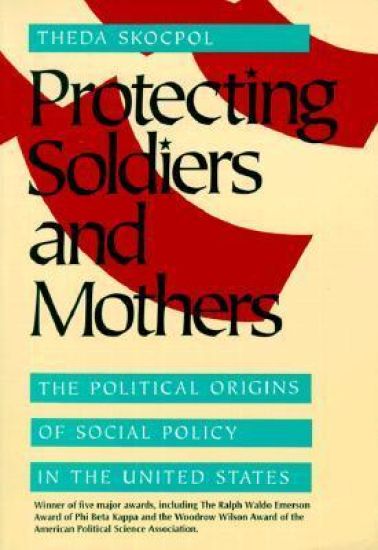
Protecting Soldiers and Mothers

Protecting Soldiers and Mothers

Theda Skocpol

The Belknap Press
1995
nidottu
It is a commonplace that the United States lagged behind the countries of Western Europe in developing modern social policies. But, as Theda Skocpol shows in this startlingly new historical analysis, the United States actually pioneered generous social spending for many of its elderly, disabled, and dependent citizens. During the late nineteenth century, competitive party politics in American democracy led to the rapid expansion of benefits for Union Civil War veterans and their families.Some Americans hoped to expand veterans' benefits into pensions for all of the needy elderly and social insurance for workingmen and their families. But such hopes went against the logic of political reform in the Progressive Era. Generous social spending faded along with the Civil War generation.Instead, the nation nearly became a unique maternalist welfare state as the federal government and more than forty states enacted social spending, labor regulations, and health education programs to assist American mothers and children. Remarkably, as Skocpol shows, many of these policies were enacted even before American women were granted the right to vote. Banned from electoral politics, they turned their energies to creating huge, nation-spanning federations of local women's clubs, which collaborated with reform-minded professional women to spur legislative action across the country.Blending original historical research with political analysis, Skocpol shows how governmental institutions, electoral rules, political parties, and earlier public policies combined to determine both the opportunities and the limits within which social policies were devised and changed by reformers and politically active social groups over the course of the late nineteenth and early twentieth centuries.By examining afresh the institutional, cultural, and organizational forces that have shaped U.S. social policies in the past, Protecting Soldiers and Mothers challenges us to think in new ways about what might be possible in the American future.
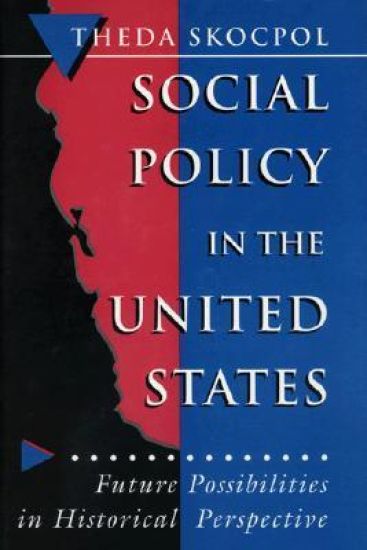
Social Policy in the United States

Social Policy in the United States

Theda Skocpol

Princeton University Press
1996
pokkari
Health care, welfare, Social Security, employment programs--all are part of ongoing national debates about the future of social policy in the United States. In this wide-ranging collection of essays, Theda Skocpol shows how historical understanding, centered on governmental institutions and political alliances, can illuminate the limits and possibilities of American social policymaking both past and present. Skocpol dispels the myth that Americans are inherently hostile to social spending and suggests why President Clinton's health care agenda was so quickly attacked despite the support of most Americans for his goals.
What a Mighty Power We Can Be

What a Mighty Power We Can Be

Theda Skocpol; Ariane Liazos; Marshall Ganz

Princeton University Press
2008
pokkari
From the nineteenth through the mid-twentieth centuries, millions of American men and women participated in fraternal associations--self-selecting brotherhoods and sisterhoods that provided aid to members, enacted group rituals, and engaged in community service. Even more than whites did, African Americans embraced this type of association; indeed, fraternal lodges rivaled churches as centers of black community life in cities, towns, and rural areas alike. Using an unprecedented variety of secondary and primary sources--including old documents, pictures, and ribbon-badges found in eBay auctions--this book tells the story of the most visible African American fraternal associations. The authors demonstrate how African American fraternal groups played key roles in the struggle for civil rights and racial integration. Between the 1890s and the 1930s, white legislatures passed laws to outlaw the use of important fraternal names and symbols by blacks. But blacks successfully fought back. Employing lawyers who in some cases went on to work for the NAACP, black fraternalists took their cases all the way to the Supreme Court, which eventually ruled in their favor. At the height of the modern Civil Rights movement in the 1950s and 1960s, they marched on Washington and supported the lawsuits through lobbying and demonstrations that finally led to legal equality. This unique book reveals a little-known chapter in the story of civic democracy and racial equality in America.
Myth and Environment in Recent Southwestern Literature
The romantic perception of the American Southwest as a wild and dangerous frontier where heroic settlers prove their endurance has often responded to a common human desire to escape from the pressures of civilization and experience an “authentic” relationship with nature. This idealized notion about life in the Southwest, however, has contributed the subjugation of the indigenous populations and the natural world while helping rationalize the conquest of both. In Myth and Environment in Recent Southwestern Literature, Theda Wrede brings contemporary Southwestern American literature under the microscope to examine the ways in which the mythic narrative has influenced attitudes toward the land in the region. Focusing on popular novels by Corrmac McCarthy, Barbara Kingsolver, Leslie Marmon Silko, and Denise Chávez, Wrede explores the psychology behind the myth and discusses the ways in which the four authors deploy the mythic narrative, interrogate its validity, and offer visions for alternative modes of inhabiting the Southwest. In combining ideas from a culturally sensitive ecofeminist theory, psychoanalysis, postcolonial studies, and literary studies, the study offers an innovative conceptual framework for discussions about environmental responsibility in the twenty-first century. Finally, it also encourages its readers to partake in the process of mythogenesis by imagining “sustainable” narratives to help rescue the promise of the Southwest for the new millennium.
Zuni Jewelry

Zuni Jewelry

Theda and Michael Bassman

Schiffer Publishing Ltd
2006
nidottu
This newly revised book presents the beautiful jewelry of the prolific Zuni Indians of New Mexico, who are known the world over for their distinctive designs. From stone, shell, inlay, and silver, Zuni craftsmen have been developing jewelry forms for more than 125 years. Contemporary makers both reflect the traditional designs and explore new styles, all shown here with many examples. The lovely inlay work for which the Zuni are world famous is shown in all of its popular forms for men and women. 90 brilliant color photographs present hundreds of carefully chosen jewelry forms with a brand new price guide to tempt and delight collectors all over Europe and America. The modern artists are identified and credited with the skillful techniques that produce such exquisite jewelry.
Cherokee Women

Cherokee Women

Theda Perdue

University of Nebraska Press
1999
pokkari
“An interesting and effective overview. . . . It is to the author’s considerable credit that she is able to re-create the values and behavior of Cherokee women through court records, myths, and observers’ accounts. By examining women’s roles in farming and community life, Perdue argues that women were coequal contributors to Cherokee culture.”-ChoiceTheda Perdue examines the roles and responsibilities of Cherokee women during the eighteenth and nineteenth centuries, a time of intense cultural change. While building on the research of earlier historians, she develops a uniquely complex view of the effects of contact on Native gender relations, arguing that Cherokee conceptions of gender persisted long after contact. Maintaining traditional gender roles actually allowed Cherokee women and men to adapt to new circumstances and adopt new industries and practices.
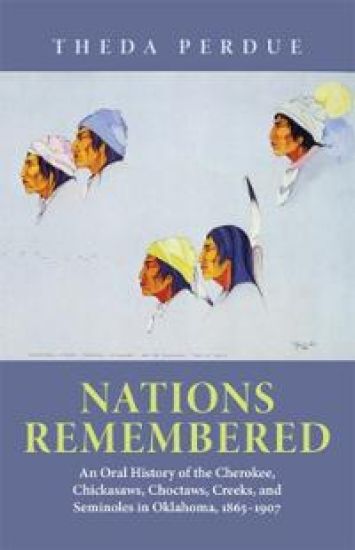
Nations Remembered

Nations Remembered

Theda Perdue

University of Oklahoma Press
1993
nidottu
The five largest southeastern Indian groups - the Cherokees, Choctaws, Chicksaws, Creeks and Seminoles - were forced to emigrate west to the Indian territory (now Oklahoma) in the 1830s. This book contains the Indians' own stories - taken from WPA interviews - of the troubled years between the Civil War and Oklahoma statehood. During this period, Oklahoma Indians functioned autonomously, holding their own elections, enforcing their own laws and creating their own society from a mixture of old Indian customs and the new ways of the whites. The WPA informants describe the economic realities of the era: a few wealthy Indians, the rest scraping a living out of subsistence farming, hunting and fishing. They talk about education and religion - Native American and Christian - as well as diversions of the time: horse races, fairs, ball games, cornstalk shooting and traditional ceremonies such as the Green Corn Dance. Theda Perdue provides an introduction to each chapter which provides the background necessary to integrate the oral accounts into a more coherent historical overview.
Diminished Democracy

Diminished Democracy

Theda Skocpol

University of Oklahoma Press
2004
nidottu
Pundits and social observers have voiced alarm each year as fewer Americans involve themselves in voluntary groups that meet regularly. Thousands of nonprofit groups have been launched in recent times, but most are run by professionals who lobby Congress or deliver social services to clients. What will happen to U.S. democracy if participatory groups and social movements wither, while civic involvement becomes one more occupation rather than every citizen's right and duty? In Diminished Democracy, Theda Skocpol shows that this decline in public involvement has not always been the case in this country - and how, by understanding the causes of this change, we might reverse it.
Mixed Blood Indians

Mixed Blood Indians

Theda Perdue

University of Georgia Press
2005
pokkari
On the southern frontier in the eighteenth and early nineteenth centuries, European men—including traders, soldiers, and government agents—sometimes married Native women. Children of these unions were known by whites as "half-breeds." The Indian societies into which they were born, however, had no corresponding concepts of race or "blood." Moreover, counter to European customs and laws, Native lineage was traced through the mother only. No familial status or rights stemmed from the father."Mixed Blood" Indians looks at a fascinating array of such birth- and kin-related issues as they were alternately misunderstood and astutely exploited by both Native and European cultures. Theda Perdue discusses the assimilation of non-Indians into Native societies, their descendants' participation in tribal life, and the white cultural assumptions conveyed in the designation "mixed blood." In addition to unions between European men and Native women, Perdue also considers the special cases arising from the presence of white women and African men and women in Indian society.From the colonial through the early national era, "mixed bloods" were often in the middle of struggles between white expansionism and Native cultural survival. That these "half-breeds" often resisted appeals to their "civilized" blood helped foster an enduring image of Natives as fickle allies of white politicians, missionaries, and entrepreneurs. "Mixed Blood" Indians rereads a number of early writings to show us the Native outlook on these misperceptions and to make clear that race is too simple a measure of their—or any peoples'—motives.
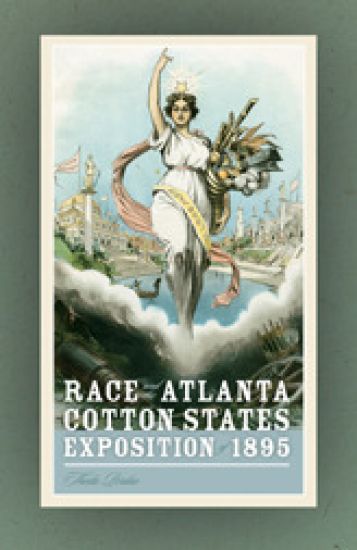
Race and the Atlanta Cotton States Exposition of 1895

Race and the Atlanta Cotton States Exposition of 1895

Theda Perdue

University of Georgia Press
2010
sidottu
The Cotton States Exposition of 1895 was a world’s fair in Atlanta held to stimulate foreign and domestic trade for a region in an economic depression. Theda Perdue uses the exposition to examine the competing agendas of white supremacist organizers and the peoples of color who participated.White organizers had to demonstrate that the South had solved its race problem in order to attract business and capital. As a result, the exposition became a venue for a performance of race that formalized the segregation of African Americans, the banishment of Native Americans, and the incorporation of other people of color into the region’s racial hierarchy.White supremacy may have been the organizing principle, but exposition organizers gave unprecedented voice to minorities. African Americans used the Negro Building to display their accomplishments, to feature prominent black intellectuals, and to assemble congresses of professionals, tradesmen, and religious bodies. American Indians became more than sideshow attractions when newspapers published accounts of the difficulties they faced. And performers of ethnographic villages on the midway pursued various agendas, including subverting Chinese exclusion and protesting violations of contracts. Close examination reveals that the Cotton States Exposition was as much about challenges to white supremacy as about its triumph.
Race and the Atlanta Cotton States Exposition of 1895

Race and the Atlanta Cotton States Exposition of 1895

Theda Perdue

University of Georgia Press
2011
pokkari
The Cotton States Exposition of 1895 was a world’s fair in Atlanta held to stimulate foreign and domestic trade for a region in an economic depression. Theda Perdue uses the exposition to examine the competing agendas of white supremacist organizers and the peoples of color who participated.White organizers had to demonstrate that the South had solved its race problem in order to attract business and capital. As a result, the exposition became a venue for a performance of race that formalized the segregation of African Americans, the banishment of Native Americans, and the incorporation of other people of color into the region’s racial hierarchy.White supremacy may have been the organizing principle, but exposition organizers gave unprecedented voice to minorities. African Americans used the Negro Building to display their accomplishments, to feature prominent black intellectuals, and to assemble congresses of professionals, tradesmen, and religious bodies. American Indians became more than sideshow attractions when newspapers published accounts of the difficulties they faced. And performers of ethnographic villages on the midway pursued various agendas, including subverting Chinese exclusion and protesting violations of contracts. Close examination reveals that the Cotton States Exposition was as much about challenges to white supremacy as about its triumph.