Kirjojen hintavertailu. Mukana 11 232 919 kirjaa ja 12 kauppaa.

Kirjahaku

Etsi kirjoja tekijän nimen, kirjan nimen tai ISBN:n perusteella.

1000 tulosta hakusanalla Theodor Gettinger

Theodor Boveri

Theodor Boveri

Fritz Baltzer

University of California Press
2021
sidottu
This title is part of UC Press's Voices Revived program, which commemorates University of California Press’s mission to seek out and cultivate the brightest minds and give them voice, reach, and impact. Drawing on a backlist dating to 1893, Voices Revived makes high-quality, peer-reviewed scholarship accessible once again using print-on-demand technology. This title was originally published in 1967.
Theodor Fontane: The Major Novels

Theodor Fontane: The Major Novels

Alan Bance

Cambridge University Press
2010
pokkari
This 1982 book examines the novels of Theodor Fontane, one of the most important German novelists of the nineteenth century. He has been well served by English translations and is now regarded as a writer of international standing. Professor Bance begins by setting Fontane's work in the context of nineteenth-century Europe in general, and Germany in particular, which was struggling with its late modernization. The increasing materialism of modern industrial society found its literary correlative in the rise of prose fiction to supplant poetry as the predominant literary mode. Fontane's career reflects this development: beginning as a writer of ballads and balladesque novels, he gradually developed into a realistic novelist capable of treating the most complex social relations. Professor Bance argues that Fontane's oeuvre can be seen in terms of a tension between a desire to present the facts and a desire to assert some transcendent poetic truth.
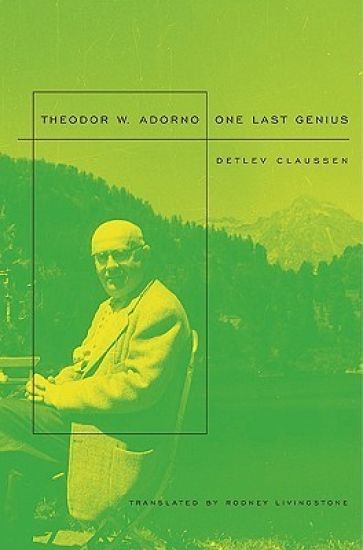
Theodor W. Adorno

Theodor W. Adorno

Detlev Claussen

The Belknap Press
2010
nidottu
He was famously hostile to biography as a literary form. And yet this life of Adorno by one of his last students is far more than literary in its accomplishments, giving us our first clear look at how the man and his moment met to create “critical theory.” An intimate picture of the quintessential twentieth-century transatlantic intellectual, the book is also a window on the cultural ferment of Adorno’s day—and its ongoing importance in our own.The biography begins at the shining moment of the German bourgeoisie, in a world dominated by liberals willing to extend citizenship to refugees fleeing pogroms in Eastern Europe. Detlev Claussen follows Theodor Wiesengrund Adorno (1903–1969) from his privileged life as a beloved prodigy to his intellectual coming of age in Weimar Germany and Vienna; from his exile during the Nazi years, first to England, then to the United States, to his emergence as the Adorno we know now in the perhaps not-so-unlikely setting of Los Angeles. There in 1943 with his collaborator Max Horkheimer, Adorno developed critical theory, whose key insight—that to be entertained is to give one’s consent—helped define the intellectual landscape of the twentieth century.In capturing the man in his complex relationships with some of the century’s finest minds—including, among others, Arnold Schoenberg, Walter Benjamin, Thomas Mann, Siegfried Kracauer, Georg Lukács, Hannah Arendt, and Bertolt Brecht—Claussen reveals how much we have yet to learn from Theodor Adorno, and how much his life can tell us about ourselves and our time.
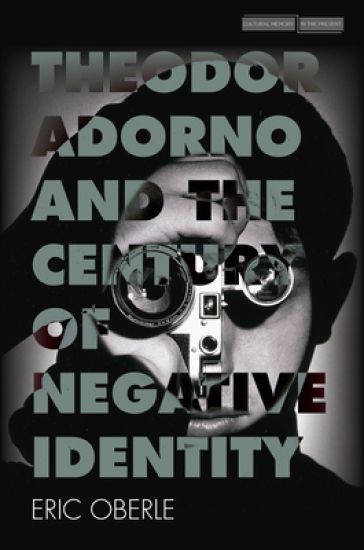
Theodor Adorno and the Century of Negative Identity

Theodor Adorno and the Century of Negative Identity

Eric Oberle

STANFORD UNIVERSITY PRESS
2018
sidottu
Identity has become a central feature of national conversations: identity politics and identity crises are the order of the day. We celebrate identity when it comes to personal freedom and group membership, and we fear the power of identity when it comes to discrimination, bias, and hate crimes. Drawing on Isaiah Berlin's famous distinction between positive and negative liberty, Theodor Adorno and the Century of Negative Identity argues for the necessity of acknowledging a dialectic within the identity concept. Exploring the intellectual history of identity as a social idea, Eric Oberle shows the philosophical importance of identity's origins in American exile from Hitler's fascism. Positive identity was first proposed by Frankfurt School member Erich Fromm, while negative identity was almost immediately put forth as a counter-concept by Fromm's colleague, Theodor Adorno. Oberle explains why, in the context of the racism, authoritarianism, and the hard-right agitation of the 1940s, the invention of a positive concept of identity required a theory of negative identity. This history in turn reveals how autonomy and objectivity can be recovered within a modern identity structured by domination, alterity, ontologized conflict, and victim blaming.
Theodor Storm's Novellen

Theodor Storm's Novellen

E. Allen McCormick

The University of North Carolina Press
2020
pokkari
These six essays elucidate some of the more significant aspects of Storm's literary technique. The treatments of some of Storm's Novellen, including Am Kamin, Aquis Submersus and two versions of Immensee, show how Storm used structure, symbolism, elements of tragedy and other narrative devices in his prodigious body of works of German Realism.
Theodor W. Adorno

Theodor W. Adorno

Gerhard Schweppenhäuser

Duke University Press
2009
sidottu
Theodor W. Adorno (1903–1969) was one of the twentieth century’s most important thinkers. In light of two pivotal developments-the rise of fascism, which culminated in the Holocaust, and the standardization of popular culture as a commodity indispensable to contemporary capitalism-Adorno sought to evaluate and synthesize the essential insights of Western philosophy by revisiting the ethical and sociological arguments of his predecessors: Kant, Nietzsche, Hegel, and Marx. This book, first published in Germany in 1996, provides a succinct introduction to Adorno’s challenging and far-reaching thought. Gerhard SchweppenhÄuser, a leading authority on the Frankfurt School of critical theory, explains Adorno’s epistemology, social and political philosophy, aesthetics, and theory of culture.After providing a brief overview of Adorno’s life, SchweppenhÄuser turns to the theorist’s core philosophical concepts, including post-Kantian critique, determinate negation, and the primacy of the object, as well as his view of the Enlightenment as a code for world domination, his diagnosis of modern mass culture as a program of social control, and his understanding of modernist aesthetics as a challenge to conceive an alternative politics. Along the way, SchweppenhÄuser illuminates the works widely considered Adorno’s most important achievements: Minima Moralia, Dialectic of Enlightenment (co-authored with Horkheimer), and Negative Dialectics. Adorno wrote much of the first two of these during his years in California (1938–49), where he lived near Arnold Schoenberg and Thomas Mann, whom he assisted with the musical aesthetics at the center of Mann’s novel Doctor Faustus.
Theodor W. Adorno

Theodor W. Adorno

Gerhard Schweppenhäuser

Duke University Press
2009
pokkari
Theodor W. Adorno (1903–1969) was one of the twentieth century’s most important thinkers. In light of two pivotal developments-the rise of fascism, which culminated in the Holocaust, and the standardization of popular culture as a commodity indispensable to contemporary capitalism-Adorno sought to evaluate and synthesize the essential insights of Western philosophy by revisiting the ethical and sociological arguments of his predecessors: Kant, Nietzsche, Hegel, and Marx. This book, first published in Germany in 1996, provides a succinct introduction to Adorno’s challenging and far-reaching thought. Gerhard SchweppenhÄuser, a leading authority on the Frankfurt School of critical theory, explains Adorno’s epistemology, social and political philosophy, aesthetics, and theory of culture.After providing a brief overview of Adorno’s life, SchweppenhÄuser turns to the theorist’s core philosophical concepts, including post-Kantian critique, determinate negation, and the primacy of the object, as well as his view of the Enlightenment as a code for world domination, his diagnosis of modern mass culture as a program of social control, and his understanding of modernist aesthetics as a challenge to conceive an alternative politics. Along the way, SchweppenhÄuser illuminates the works widely considered Adorno’s most important achievements: Minima Moralia, Dialectic of Enlightenment (co-authored with Horkheimer), and Negative Dialectics. Adorno wrote much of the first two of these during his years in California (1938–49), where he lived near Arnold Schoenberg and Thomas Mann, whom he assisted with the musical aesthetics at the center of Mann’s novel Doctor Faustus.

Theodor Storm

Theodor Storm

David Jackson

BLOOMSBURY PUBLISHING PLC
1992
sidottu
A work which discusses Storm's significance and artistic stature as a champion of democratic humanitarian traditions and aspirations in 19th century Germany. It highlights his critique of Christianity, his vision of capitalism and his analysis of class relationships. The study contends that his literary form, techniques and strategies were shaped by the need to respond to specific socio-political constraints and prejudices of publishers, editors and readers. The book advocates new approaches to Storm's work and uses many unpublished primary materials.
Theodor Fahrner  Jewelry

Theodor Fahrner Jewelry

Ulrike von Hase-Schmundt

Schiffer Publishing Ltd
1997
sidottu
Stunning Art Nouveau, Art Deco, and modern jewelry was manufactured by the firm of Theodor Fahrner for a hundred and twenty-five years (1855-1979.) Growing into a major producer of style-conscious jewelry, the company both led and was inspired by the major European art movements of Arts and Crafts, Art Nouveau, Art Deco, Art Moderne, and Contemporary styles. This new book is profusely color-illustrated, documenting the designs and the people who made them. Working in silver, enamels, marcasites, iron, and semi-precious stones, the designers made each contemporary style of jewelry available to a wide segment of the population. From their workshops in Pforzheim, Germany, they exported large quantities to near and distant cities, including London and the U.S.A. A detailed chronological study, the volume displays Fahrner jewelry through precise, original research and over 480 photographs, most in full color. Sections include advertisements, original design sketches, all known marks, pictures of the important people, and, most of all, hundreds of pieces of jewelry.