Thomas F. Rogers is a prominent Playwright, traveler and observer of Humanity. He is also a life-long member of the Church of Jesus Christ of Latter-day Saints. Mission President in Russia, Drama Ambassador, Professor of Russian, Director of plays, are just a few of his titles, next to Husband and Father. In the seven plays in this volume, "Huebener," "Fire In The Bones," "First Trump," "Reunion," "Set Apart," "The Anointed" (a musical theatre play), and "Petunia Passes" (a short play), the worlds of belief, faith, devotion, belonging, yearning to know God, and standing true when those worlds are challenged, make up the heart of Dr. Rogers' dramas. With this volume, they are available for study and perusal by Professors, Scholars, and Students, Actors, Directors, Producers and others ready to settle down into a fine drama and experience life through someone else's courageous and religious heart.
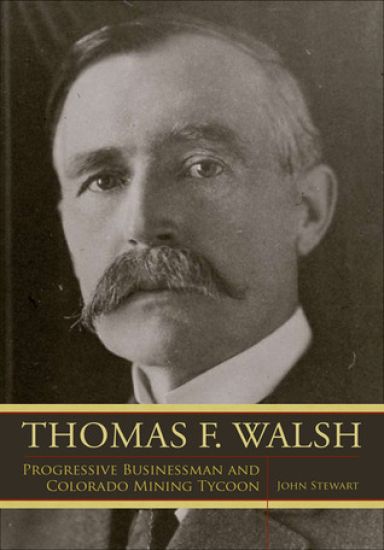
Thomas F. Walsh tells the story of one of the West's wealthiest mining magnates - an Irish American prospector and lifelong philanthropist who struck it rich in Ouray County, Colorado. In the first complete biography of Thomas Walsh, John Stewart recounts the tycoon's life from his birth in 1850 and his beginnings as a millwright and carpenter in Ireland to his tenacious, often fruitless mining work in the Black Hills and Colorado, which finally led to his discovery of an extremely rich vein of gold ore in the Imogene Basin. Walsh's Camp Bird Mine yielded more than $20 million worth of gold and other minerals in twenty years, and the mine's 1902 sale to British investors made Walsh very wealthy. He achieved national prominence, living with his family in mansions in Colorado and Washington, D.C., and maintaining a rapport with Presidents McKinley, Theodore Roosevelt, and Taft, as well as King Leopold II of Belgium. Despite his fame and lavish lifestyle, Walsh is remembered as an unassuming and philanthropic man who treated his employees well. In addition to making many anonymous donations, he established the Walsh Library in Ouray and a library near his Irish birthplace, and helped establish a research fund for the study of radium and other rare western minerals at the Colorado School of Mines. Walsh gave his employees at the Camp Bird Mine top pay and lodged them in an alpine boardinghouse featuring porcelain basins, electric lighting, and excellent food. Stewart's engaging account explores the exceptional path of this Colorado mogul in detail, bringing Walsh and his time to life.
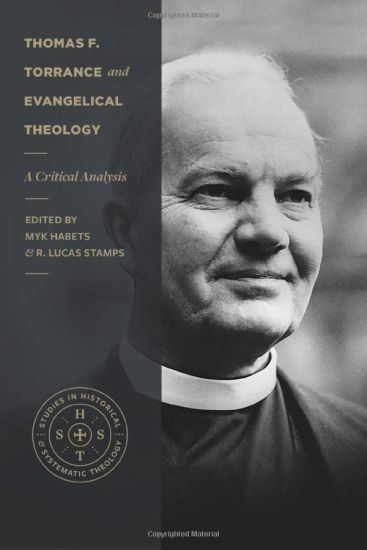
Thomas F. Torrance invites evangelicals to think more ChristianlyThomas F. Torrance and Evangelical Theology: A Critical Analysis brings Torrance into closer conversation with evangelical theology on a range of key theological topics.Thomas F. Torrance and the Evangelical Tradition (Thomas A. Noble)Torrance, The Tacit Dimension, and The Church Fathers (Jonathan Warren P. (Pag n))Torrance and the Doctrine of Scripture (Andrew T. B. McGowan)Revelation, Rationalism, and an Evangelical Impasse (Myk Habets)Theology and Science in Torrance (W. Ross Hastings)A Complexly Relational Account of the Imago Dei in Torrance's Vision of Humanity (Marc Cortez)Barth, Torrance, and Evangelicals: Critiquing and Reinvigorating the Idea of a "Personal Relationship with Jesus" (Marty Folsom)Torrance and Atonement (Christopher Woznicki)Torrance and Christ's Assumption of Fallen Human Nature: Toward Clarification and Closure (Jerome Van Kuiken)Torrance, Theosis, and Evangelical Reception (Myk Habets)Thinking and Acting in Christ: Torrance on Spiritual Formation (Geordie W. Ziegler)'Seeking Love, Justice and Freedom for All' Using the Work of T.F. and J.B. Torrance to Address Domestic and Family Violence (Jenny Richards)Toward a Trinitarian Theology of Work (Peter K. W. McGhee)Torrance and Global Evangelicalism: Some Potential Generative Exchanges with Contemporary Indian Evangelical Theology (Stavan Narendra John)Thomas Forsyth Torrance (1913-2007) was one of the most important theologians of the twentieth century, yet his work remains relatively neglected by evangelicals. A diverse collection of contributors engage Torrance's pioneering and provocative thought, deriving insights from theological loci such as Scripture, Christology, and atonement, as well as from broader topics like domestic violence and science. These stimulating essays reveal how Torrance can help evangelical theologians articulate richer and deeper theology.
"Thomas F's siste nedtegnelser til almenheten" inneholder to noveller. Den første handler om forholdet mellom den mistenkte Carl Lange og hans etterforsker. Tittelnovellen skildrer Thomas F., en gammel mann som ikke føler seg helt hjemme i tilværelsen. For denne samlingen mottok Kjell Askildsen Kritikerprisen i 1983. I 2006 ble den kåret av Dagbladet til den beste boken de siste 25 årene.
"Thomas F's siste nedtegnelser til almenheten" inneholder to noveller. Den første handler om forholdet mellom den mistenkte Carl Lange og hans etterforsker. Tittelnovellen skildrer Thomas F., en gammel mann som ikke føler seg helt hjemme i tilværelsen. For denne samlingen mottok Kjell Askildsen Kritikerprisen i 1983. I 2006 ble den kåret av Dagbladet til den beste boken de siste 25 årene.
Observera att förlaget som ger ut denna produkt baserar innehållet i sina produkter på fria källor som Wikipedia. Boken är med stor sannolikhet endast ett utdrag ur dessa informationskällor, alltså inte en vanlig bok i den bemärkelsen.
This book provides a constructive analysis of Thomas F. Torrance’s ecclesiology. Holding the doctrine of the Trinity to be the “ground and grammar of theology,” Torrance viewed the doctrine of the Trinity as foundational for all ecclesiological reflection: What does it mean to be the people of the God whom Christians name as Father, Son, and Spirit? Tyler examines Torrance’s development of the rich potential of the metaphor koinonia, involving both a vertical dimension––the Church’s union with Christ through the Spirit––and a horizontal dimension––its visible existence in human history, lived out in space and time, and considers how the relationship between these two dimensions informs the structured forms of the Church’s life, its ecumenical breadth, and its missional vision.
An Outline of the Public Life and Services of Thomas F. Bayard - Senator of the United States from the State of Delaware, 1869-1880 is an unchanged, high-quality reprint of the original edition of 1880. Hansebooks is editor of the literature on different topic areas such as research and science, travel and expeditions, cooking and nutrition, medicine, and other genres. As a publisher we focus on the preservation of historical literature. Many works of historical writers and scientists are available today as antiques only. Hansebooks newly publishes these books and contributes to the preservation of literature which has become rare and historical knowledge for the future.
This handbook explores Thomas F. Torrance's importance in modern theology, with each contribution bringing Torrance's deep and nuanced insights to a broad range of contemporary theological concerns. The contributors to this volume present cutting-edge Torrance scholarship for a new generation, which will enable readers to see the timely significance of Torrance for today.Comprising both contexts and dogmatics, these essays not only introduce key themes in Torrance's extensive published writings – including his work on the Trinity, ecumenism, incarnation, atonement, and eschatology - but also provide fresh interpretations fully conversant with theological problems facing the church in the world today. Designed as both a guide for students and a reference point for scholars, this handbook thoroughly explores the frameworks of key debates related to Torrance's theology, while also suggesting fresh interpretative strategies concerning his thought.
This handbook explores Thomas F. Torrance's importance in modern theology, with each contribution bringing Torrance's deep and nuanced insights to a broad range of contemporary theological concerns. The contributors to this volume present cutting-edge Torrance scholarship for a new generation, which will enable readers to see the timely significance of Torrance for today.Comprising both contexts and dogmatics, these essays not only introduce key themes in Torrance's extensive published writings – including his work on the Trinity, ecumenism, incarnation, atonement, and eschatology - but also provide fresh interpretations fully conversant with theological problems facing the church in the world today. Designed as both a guide for students and a reference point for scholars, this handbook thoroughly explores the frameworks of key debates related to Torrance's theology, while also suggesting fresh interpretative strategies concerning his thought.
Leading systematic theologian, Paul D. Molnar examines the theology of Thomas F. Torrance in three powerful essays. In a ground-breaking chapter, Molnar discusses whether Chalcedon needs to be repaired in order to recognize and maintain the full and complete humanity of Jesus Christ as the incarnate Word.He also delves into Torrance's view of justification by grace alone and emphasizes its relation to Liberation Theology. Additionally, comparing the approaches of Karl Rahner and T. F. Torrance, this book explores and explains how a number of Rahner’s presuppositions and conclusions differ from the positions espoused by Torrance, all in order to illustrate the importance of grace in theologies of both thinkers.