The New York Times bestseller?and the candid voice of an American president In 1974, Newsweek correspondent Thomas M. DeFrank was interviewing Gerald Ford when the Vice President blurted out something astonishingly indiscreet. He then extracted a promise not to publish it. ?Write it when I?m dead, ? Ford said? and thus began a thirty-two-year relationship. During the last fifteen years of their conversations, Ford opened up to DeFrank, speaking in a way few presidents ever have. Here the award-winning journalist reveals these private talks, as Ford discusses his experiences with his fellow presidents, the Warren Commission, and his exchanges with Bill Clinton during the latter's impeachment process. In addition, he shares his thoughts about both Bush administrations, the Iraq war, his beloved wife Betty, and the frustrations of aging. Write It When I?m Gone is not only a historical document but an unprecedented portrait of a president.
This book sets out a thematic presentation of human action, especially as it relates to morality, in the three most significant figures in Medieval Scholastic thought: Thomas Aquinas, John Duns Scotus, and William of Ockham. Thomas, along with his teacher Albert the Great, was instrumental in the medieval reception of the action theory of Aristotle’s Nicomachean Ethics. Scotus and Ockham were part of a later Franciscan theological tradition. Thomas, Scotus, and Ockham worked in the context of a new moral theology that focused on the description and evaluation of human acts. Organized thematically, discussing the causes of human action, the role of practical reasoning, the stages of action, the specification of moral action, and an act’s supernatural and natural worth. Each chapter compares the three main figures on the same set of issues.The book shows that although the different philosophies of action cannot be explained in terms of any one major difference or principle, there are some common themes that deserve attention. The most notable themes are 1) a developing separation between nature and the will, 2) an increased emphasis on the will’s activity, and 3) a changing view of mental causation. The book is important for those who are interested in medieval philosophy, the philosophy of action, and the intellectual background to Reformation and early modern thought.
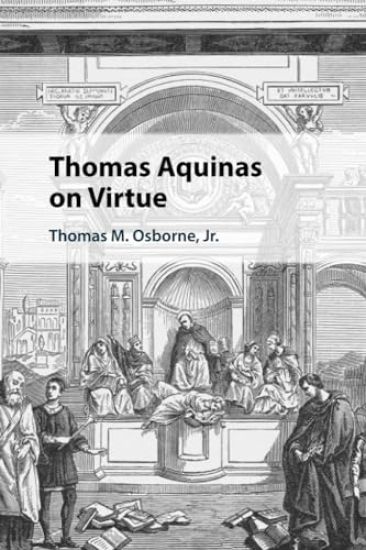
Thomas Aquinas produced a voluminous body of work on moral theory, and much of that work is on virtue, particularly the status and value of the virtues as principles of virtuous acts, and the way in which a moral life can be organized around them schematically. Thomas Osborne presents Aquinas's account of virtue in its historical, philosophical and theological contexts, to show the reader what Aquinas himself wished to teach about virtue. His discussion makes the complexities of Aquinas's moral thought accessible to readers despite the differences between Thomas's texts themselves, and the distance between our background assumptions and his. The book will be valuable for scholars and students in ethics, medieval philosophy, and theology.
Thomas Aquinas produced a voluminous body of work on moral theory, and much of that work is on virtue, particularly the status and value of the virtues as principles of virtuous acts, and the way in which a moral life can be organized around them schematically. Thomas Osborne presents Aquinas's account of virtue in its historical, philosophical and theological contexts, to show the reader what Aquinas himself wished to teach about virtue. His discussion makes the complexities of Aquinas's moral thought accessible to readers despite the differences between Thomas's texts themselves, and the distance between our background assumptions and his. The book will be valuable for scholars and students in ethics, medieval philosophy, and theology.
This book has been considered by academicians and scholars of great significance and value to literature. This forms a part of the knowledge base for future generations. So that the book is never forgotten we have represented this book in a print format as the same form as it was originally first published. Hence any marks or annotations seen are left intentionally to preserve its true nature.
Clothing The Soldier Of World War II: Q. M. C. Historical Studies, No. 16 is a book written by Erna Risch that provides a comprehensive overview of the clothing worn by soldiers during World War II. The book is part of the Q. M. C. Historical Studies series and is the sixteenth installment in the series. The book covers a wide range of topics related to the clothing worn by soldiers during the war, including the development of uniforms, the types of clothing worn by soldiers in different theaters of war, and the materials used to make the clothing. The book also includes detailed descriptions of the various pieces of clothing worn by soldiers, such as jackets, trousers, and boots. In addition to providing detailed information about the clothing worn by soldiers, the book also includes numerous photographs and illustrations that help to bring the clothing to life. The photographs and illustrations show the clothing in various stages of development, from initial sketches to finished products, and provide a unique and fascinating insight into the design and manufacture of military clothing during the war. Overall, Clothing The Soldier Of World War II: Q. M. C. Historical Studies, No. 16 is an essential resource for anyone interested in the history of military clothing during World War II. The book is well-written, informative, and engaging, and is sure to be of interest to military historians, collectors, and enthusiasts alike.Historical Section, Office Of The Quartermaster General.This scarce antiquarian book is a facsimile reprint of the old original and may contain some imperfections such as library marks and notations. Because we believe this work is culturally important, we have made it available as part of our commitment for protecting, preserving, and promoting the world's literature in affordable, high quality, modern editions, that are true to their original work.
Featuring extraordinarily detailed, hand-drawn illustrations and concise, clear text, The Marine Biology Coloring Book allows you to explore the earth's delicate, complex underwater world. Essential to understanding aquatic life, The Marine Biology Coloring Book includes information on habitats, marine birds, invertebrates, fish, and reptiles, and the symbiotic relationships among marine organisms. This excellent educational resource and interactive guide also examines deep-sea diving research vessels and other technology used to study the ocean, and provides clear explanations of ocean currents and global weather patterns, including Upwelling and El Nino.Key features: Details on the natural coloration of the plants and animals illustrated will help you create an accurate picture of the ocean world.The text provides a clear introduction to major marine environments as well as an examination of the lifestyles and interactions of the organisms that inhabit them.This expanded edition offers vital information on ocean currents and global weather, including an explanation of El Nino, the deep-sea realm, and the newest deep-sea diving research vessels.The process of coloring will focus your attention and leave a visual imprint on your memory.
Cancers in the Urban Environment: How Malignant Diseases Are Caused and Distributed among the Diverse People and Neighborhoods of a Major Global Metropolis, Second Edition, provides a detailed description of the occurrence of common forms of cancer in the ethnically, socially and environmentally complex milieu of a modern urban complex. The location is Los Angeles County, and the patterns of 72 different malignancies are described according to race, age, sex, social class calendar time (since 1972) and most notably, individual neighborhood, using detailed maps of high risk. This second edition uses twice as many cases and more demographic diversity. Physicians and scientific investigators in California and elsewhere can use the material provided to counsel patients and evaluate the consistency of any specific pattern of occurrence with each specific causal hypothesis. A detailed appendix describes the source of data, provides the basis for the choices made in the production of the volume, and gives a perspective on the search for "clusters" of malignancy.
'I am not Number 6. I am not a prisoner. I am a free man.'This is the classic novel of the TV series The Prisoner, by cult author Thomas M. Disch. First published in 1968, this new edition celebrates the long-awaited remake of the series, from ITV1 and the producers of Mad Men, starring Sir Ian McKellen and Jim Caviezel.Combining the power of a great spy thriller with Orwellian science fiction, The Prisoner follows a former British secret agent who has quit the force, only to find himself trapped in an anonymous place called the Village. Known only as 'Number 6,' he struggles to maintain his identity in the face of the nameless powers-that-be, who use increasingly sophisticated and terrifying methods to extract his secrets.