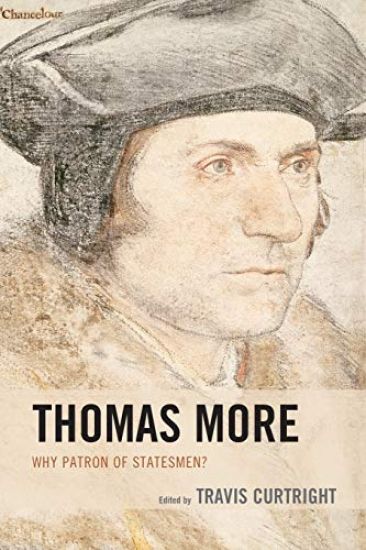
The year 2015 marks the 15th anniversary of St. Pope John Paul II’s promulgation of Thomas More as Patron Saint of Statesmen and Politicians. Yet during these years no serious answer has been given by a community of scholars as to why More was named such. What were More’s guiding principles of leadership and in what ways might they remain applicable? This collection of essays addresses these questions by investigating More through his writings, his political actions, and in recent artistic depictions.
Famously censored by the Master of Revels and then revised—probably by Shakespeare himself—this is the story of Henry VIII’s chancellor, executed for failing to arrange Henry’s divorce from Catherine of Aragon. A collaborative effort, the manuscript includes three pages in what may be Shakespeare’s own handwriting.
The Wisdom and Wit of Blessed Thomas More - Being extracts from such of his works as were written in English is an unchanged, high-quality reprint of the original edition of 1892. Hansebooks is editor of the literature on different topic areas such as research and science, travel and expeditions, cooking and nutrition, medicine, and other genres. As a publisher we focus on the preservation of historical literature. Many works of historical writers and scientists are available today as antiques only. Hansebooks newly publishes these books and contributes to the preservation of literature which has become rare and historical knowledge for the future.
The Household of Sir Thomas More is an unchanged, high-quality reprint of the original edition of 1896. Hansebooks is editor of the literature on different topic areas such as research and science, travel and expeditions, cooking and nutrition, medicine, and other genres. As a publisher we focus on the preservation of historical literature. Many works of historical writers and scientists are available today as antiques only. Hansebooks newly publishes these books and contributes to the preservation of literature which has become rare and historical knowledge for the future.
Discover a story 400 years in the making - the definitive biography of the man who dominated England in the first half of the sixteenth century 'Engrossing' THE TIMES 'In this excellent study, Thomas More is reborn as a complex, absorbing man' DAILY TELEGRAPH '[A] immersive, richly told account of life, death, faith and politics at the early Tudor court' SPECTATOR 'THE definitive biography of one of history's most complex and often inscrutable characters' NATHEN AMIN 'Significant. Terrific. Meticulously researched. Beautifully written' LITERARY REVIEW Born into the English Wars of the Roses, educated in the European Renaissance, enthralled by the Age of Exploration and ultimately destroyed by Henry VIII, Thomas More is one of the most famous - or notorious - figures in English history. Is he a saintly scholar, the visionary author of Utopia and an inspiration for statesmen, socialists and intellectuals even today? Or is he the stubborn zealot famously portrayed in Hilary Mantel's Wolf Hall? Thomas More: A Life and Death in Tudor England is the definitive biography of this hypnotic, flawed figure. Overturning many received interpretations of the sixteenth century, Joanne Paul shows Thomas More to have been an intellectual and political giant of his age, central to the making of modern Europe. Based on new archival discoveries and drawing on more than a decade's research into More's life and work, this is a richly-told story of family, faith and politics, and a compelling portrait of a man who, more than four hundred years after his death, remains the most brilliant mind of the Renaissance. __ MORE PRAISE FOR THOMAS MORE 'Paul has created a portrait of Thomas More that is epic, intimate and profoundly relatable to the modern reader' LEAH REDMOND CHANG, Women's Prize longlisted historian of Young Queens 'Very impressive' ALISON WEIR 'Wonderful, riveting, subtle. Captures beautifully the life of More and the fading world he died to preserve' WALL STREET JOURNAL 'A proper scholarly history as well as a wonderful narrative read' SUSANNAH LIPSCOMB 'Paul gives us a movingly human picture of a family man, scholar, politician and, ultimately, political martyr' ELIZABETH NORTON
Thomas More: Humanism and Heresy offers a clear and engaging introduction to one of the most influential and contested figures of the English Renaissance. Situating More’s major works within the humanist movement and the debates surrounding the Lutheran ‘heresy’ and the Tudor court, Andrew Hadfield and Joanne Paul reveal how his ideas grew from – yet often strained against – the intellectual currents of his time. Through vivid contemporary illustrations and quotations, they bring fresh clarity to More's texts, from Utopia to his late polemics, while offering original insights into the character and convictions behind them. By tracing both the brilliance and tensions of More’s legacy, this book invites readers to reconsider the man who helped shape modern debates about faith, reason and political conscience.
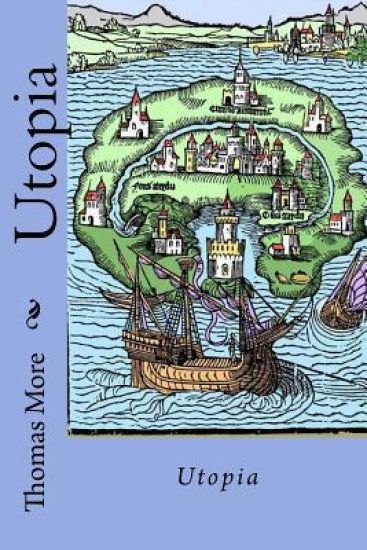
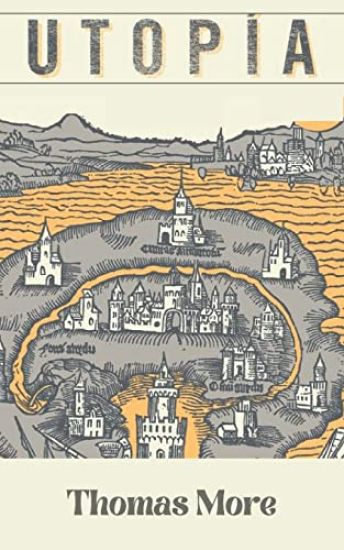
Thomas More imagines a beautiful island community where multitudes live in peace and harmony, men and women are both educated, and all property is common in his most well-known and contentious book, Utopia. More explores the theories underlying war, political disputes, social conflicts, and wealth distribution through dialogue and correspondence between the main character Raphael Hythloday and his friends and contemporaries. More also imagines the day-to-day lives of those citizens enjoying freedom from fear, oppression, violence, and suffering. This utopian vision, which was originally written in Latin, is also a biting satire of Europe in the sixteenth century, and it has had a significant impact on utopian fiction even today.
Thomas More's Utopia in Early Modern Europe provides the first complete account of all the editions of Utopia, whether vernacular or Latin, printed before 1650, together with a transcription of all the prefatory materials they contain. The reception of the idea of Utopia in early modern Europe has been studied extensively before: what has been lacking is a composite picture of how Utopia moved by means of translation from culture to culture and of the ways in which particular versions offered themselves to their readers.Part I consists of a series of chapters which provide a contextual and interpretative framework for each national group of translations; in Part II, the substantive paratexts of all the extant translations of Utopia printed between 1524 and 1643 are reproduced both in the original language and in English translation. The book also contains a chapter sketching the fortunes of the Latin paratexts and editions up to 1650, and a transcription of a single Latin paratext which has never, to our knowledge, been printed in modern times.This book will be of interest to specialists in early modern cultural history and history of the book, to graduate students working in these fields, and to anyone for whom the extraordinary success of More’s Utopia as a book published on the European market remains a perennial fascination.
Thomas More's Utopia in Early Modern Europe provides the first complete account of all the editions of Utopia, whether vernacular or Latin, printed before 1650, together with a transcription of all the prefatory materials they contain. The reception of the idea of Utopia in early modern Europe has been studied extensively before: what has been lacking is a composite picture of how Utopia moved by means of translation from culture to culture and of the ways in which particular versions offered themselves to their readers.Part I consists of a series of chapters which provide a contextual and interpretative framework for each national group of translations; in Part II, the substantive paratexts of all the extant translations of Utopia printed between 1524 and 1643 are reproduced both in the original language and in English translation. The book also contains a chapter sketching the fortunes of the Latin paratexts and editions up to 1650, and a transcription of a single Latin paratext which has never, to our knowledge, been printed in modern times.This book will be of interest to specialists in early modern cultural history and history of the book, to graduate students working in these fields, and to anyone for whom the extraordinary success of More’s Utopia as a book published on the European market remains a perennial fascination.
The term ""statesman"" entered the English language during the Renaissance as a result of the widespread return to the Greek and Roman classics. Sir Thomas More, who brought his careful study of Plato and Aristotle, Cicero and Augustine to bear upon his political life, contributed most to the recovery of the ancient Greco-Roman concept of the statesman. Throughout More's writings and his actions one finds a consistent and principled approach to statesmanship that emphasizes the free character of the human person and integrates classical and Christian thought with the best of England's common law tradition of self-rule. This study is the first to examine More's complete works in view of his concept of statesmanship, and, in the process, link More's humanism, his faith, and his legal and political vocations into a coherent narrative. In Part One Gerard B. Wegemer sets forth More's theory of statesmanship, drawing heavily from the entire corpus of his work. In the second part he presents More's understanding of literature and applies this understanding to his book Utopia. In Part Three he investigates the two most controversial events in More's life: his treatment of heretics and his refusal to obey his king. More presented a consistent defense of institutional arrangements now taken as basic to all democratic government: rule of law, division of power, separation of church and state, elected representation, and protected forms of free and public deliberation. He believed that the essential work of the statesman is to draw upon the nation's deepest and longest-standing consensus, as expressed in its literature and its laws, in order to govern with the people's consent. More was convinced that law, not individual persons, should rule.This book, which integrates the literature, philosophy, history, and politics of the Renaissance, will appeal across disciplines to scholars of early modern England and to anyone fascinated by the life and times of St. Thomas More. Gerard B. Wegemer is the author of Thomas More: A Portrait of Courage (1995) and has written about More and his times for such journals as Renascence, Philosophy and Rhetoric, Moreana, and The Review of Politics. He holds master's degrees in political philosophy and literature from Boston College and Georgetown respectively, and a doctorate in English literature from Notre Dame. He is associate professor of literature at the University of Dallas, and he teaches and lectures regularly on St. Thomas More. -------------------------------------------------------------------------------- ""Professor Wegemer's book is an extraordinary work of interpretation. The key to its success is a comprehensive grasp of More's life and work, rooted in a profound sympathy for the man and his goals. With a calm and confident hand, Wegemer sheds new light on More's views of statesmanship and its requirements, on the inner structure of his enigmatic and playful masterpiece Utopia, and on the guiding conceptions of his practical political life. Rarely do authors show such a capacity for leaping across the chasm of culture and years to understand the vision that makes sense of a man's life and thought.""-- Professor Christopher Wolfe, Department of Political Science, Marquette UniversityTable of ContentsIntroductionI. More's Understanding of the Statesman's Work1. Can Reason Rule the Free?2. First, Self-Rule3. Ruling Citizens: What Is Needed?II. Utopia: A Statesman's Puzzle4. Literature and the Acquisition of Political Prudence5. Utopia 1 and 2: Dramatizing Competing Philosophies of Life6. Utopia 1: Ciceronian Statesmanship7. Utopia 2: Augustinian RealistIII. Issues in More's Career as Statesman8. The Limits of Reason and the Need for Law9. Reform over Revolution: In Defense of Free
The book considers Thomas More's early life-choices. An early letter is cited by biographers but most miss More's reference to the market place. More's great-grandson, Cresacre, a Londoner, understood it correctly, and that gives reason to trust him on other aspects of More's youth.This study is based on early testimonies, those of Erasmus, Roper, Harpsfield, Stapleton and Cresacre More, as well as More's early writings, the Pageant Verses, and his additions/omissions to the Life of Pico; evidence drawn from authors he recommended, like Hilton and Gerson; and finally, his epitaph. Attention is given to his lectures on St Augustine's City of God, and to St John Chrysostom. It is argued More studied Chrysostom's Homilies on the Gospel of St Matthew from a Greek manuscript. Chrysostom, in the introductory homily, spoke of the city and the market place, as the setting in which Christians practice the teaching of Christ.More practiced law and taught it. He was attracted to becoming a Christian humanist alongside Grocyn, Colet, Linacre, and Lily. With them he studied Greek, the classics and Fathers of the Church. Helped by them he became a man of prayer, aware of the need to seek holiness in the midst of the world as a layman. Faced with the dilemma of the humanist in choosing between the contemplative life of the philosopher and an active life of engagement with the world, he deliberately chose the active life in service to society, and the contemplative life of the Christian as a married man. This awareness and choice is what is called vocation, implying determination to persevere throughout life: More saw his life as a pilgrimage towards heaven as described in the last chapter focusing on More's last work, De tristitia, tedio, pavore, etoratione christi ante captionem eius.
This book is a study of the relations between tow outstanding contemporaries of whom an acquaintance wrote shortly after the two friends were dead. "Erasmus, the glory of our times, lived in the heart of More. More, the sole light of Britain, his country, lived in the heart of Erasmus. The one exchanged life with the other; each lived a life not his own. It is no marvel that, with the death of More, Erasmus wished for death,unwilling to live longer. The author knows the history of this era intimately and through his previous books, notably his account of "The Trial of St. Thomas More", has established a reputation for his ability to narrate history in a way that constantly maintains a high level of interest in his readers. The accent in this book falls contrapuntally, now on Erasmus, now on More, as the author follows the intertwining threads of two full and lively careers, treating in well-documented detail the main events in the lives of each and relating the men and their work to the personalities, ideas and happenings of the time. The result is a historical reconstruction of social, religious, academic and literary life in fifteen and sixteen century Europe that could be of real interest to a very wide readership.
The 500th anniversary of the first publication of Thomas More’s Utopia invites a reappraisal of its significance, not just as an ironic and playful fiction, but as a serious contribution to social and political thought. More delivers a searing critique of the injustices of his time and imagines a radical alternative based on common ownership and representative government. In this new interpretation, Wilde surveys the context from which Utopia emerged and analyses its key themes – politics, economics, social relations, crime and punishment, war and religion. Although the society of the Utopians is created as a remedy to the ailments of the old world, there are restrictions on individual freedom which reflect More’s suspicion of human nature’s innate fragility. Wilde argues that this should not detract from the power of the book in challenging the root causes of inequality and oppression. The true legacy of Utopia lies in its plea for social justice in the face of a world driven by greed and the lust for power. A compelling case is made for the continued relevance of this masterpiece, a legacy that should not be diminished by attempts to discredit More’s character, which are dealt with here in the epilogue. Offering a new perspective on this important historical text, this book is essential reading for students and scholars working in radical politics, the history of social thought and literature, as well as anyone interested in learning more about this fascinating work.