Kirjojen hintavertailu. Mukana 11 424 844 kirjaa ja 12 kauppaa.

Kirjahaku

Etsi kirjoja tekijän nimen, kirjan nimen tai ISBN:n perusteella.

1000 tulosta hakusanalla Timothy M. Hagle

Savage Will

Savage Will

Timothy M. Gay

New American Library
2014
pokkari
In the tradition of incredible true stories from The Great Escape to Argo, Savage Will recounts a tale of survival, daring, and evasion behind enemy lines: that of American medics and nurses stranded for two months in Nazi-occupied Albania. In 1943, men and women of the 807th Medical Air Evacuation Squadron boarded a routine flight from Sicily to the Italian mainland to care for wounded soldiers. En route, their plane drifted hundreds of miles off course and crash-landed in remote mountainous Albania. The unarmed Americans were trapped hundreds of blizzard-plagued miles from Allied lines, in a country torn apart by rival bands of pro- and anti-German guerrillas. Hunted by German soldiers, the castaways relied on what one survivor called their "savage will" to elude their enemy and find their way to freedom. What followed is the most thrilling untold story of World War II--a saga reaching from President Roosevelt and top Allied intelligence officials to a host of brave Albanian Resistance fighters, the British and U.S. Mediterranean air forces, and the dashing English lieutenant and the tenacious American captain sent behind enemy lines to carry out a heroic rescue.

Brokers and Bureaucrats

Brokers and Bureaucrats

Timothy M. Frye

The University of Michigan Press
2000
nidottu
A classic problem of social order prompts the central questions of this book: Why are some groups better able to govern themselves than others? Why do state actors sometimes delegate governing power to other bodies? How do different organizations including the state, the business community, and protection rackets come to govern different markets? Scholars have used both sociological and economic approaches to study these questions; here Timothy Frye argues for a different approach. He seeks to extend the theoretical and empirical scope of theories of self-governance beyond groups that exist in isolation from the state and suggests that social order is primarily a political problem.Drawing on extensive interviews, surveys, and other sources, Frye addresses these question by studying five markets in contemporary Russia, including the currency futures, universal and specialized commodities, and equities markets. Using a model that depicts the effect of state policy on the prospects for self-governance, he tests theories of institutional performance and offers a political explanation for the creation of social capital, the formation of markets, and the source of legal institutions in the postcommunist world. In doing so, Frye makes a major contribution to the study of states and markets.The book will be important reading for academic political scientists, economists (especially those who study the New Institutional Economics), legal scholars, sociologists, business-people, journalists, and students interested in transitions.Timothy Frye is Assistant Professor of Political Science, The Ohio State University.
Brokers and Bureaucrats

Brokers and Bureaucrats

Timothy M. Frye

The University of Michigan Press
2000
sidottu
A classic problem of social order prompts the central questions of this book: Why are some groups better able to govern themselves than others? Why do state actors sometimes delegate governing power to other bodies? How do different organizations including the state, the business community, and protection rackets come to govern different markets? Scholars have used both sociological and economic approaches to study these questions; here Timothy Frye argues for a different approach. He seeks to extend the theoretical and empirical scope of theories of self-governance beyond groups that exist in isolation from the state and suggests that social order is primarily a political problem.Drawing on extensive interviews, surveys, and other sources, Frye addresses these question by studying five markets in contemporary Russia, including the currency futures, universal and specialized commodities, and equities markets. Using a model that depicts the effect of state policy on the prospects for self-governance, he tests theories of institutional performance and offers a political explanation for the creation of social capital, the formation of markets, and the source of legal institutions in the postcommunist world. In doing so, Frye makes a major contribution to the study of states and markets.The book will be important reading for academic political scientists, economists (especially those who study the New Institutional Economics), legal scholars, sociologists, business-people, journalists, and students interested in transitions.Timothy Frye is Assistant Professor of Political Science, The Ohio State University.
Parasitism

Parasitism

Timothy M. Goater; Cameron P. Goater; Gerald W. Esch

Cambridge University Press
2013
sidottu
Reflecting the enormous advances made in the field over the past ten years, this text synthesizes the latest developments in the ecology and evolution of animal parasites against a backdrop of parallel advances in parasite systematics, biodiversity and life cycles. This second edition has been thoroughly revised to meet the needs of a new generation of parasitology students. Balancing traditional approaches in parasitology with modern studies in parasite ecology and evolution, the authors present basic ecological principles as a unifying framework to help students understand the complex phenomenon of parasitism. Richly illustrated with over 250 figures, the text is accompanied by case study boxes designed to help students appreciate the complexity and diversity of parasites and the scientists who study them. This unique approach, presented clearly and with a minimum of jargon and mathematical detail, encourages students from diverse backgrounds to think generally and conceptually about parasites and parasitism.
The British Aesthetic Tradition

The British Aesthetic Tradition

Timothy M. Costelloe

Cambridge University Press
2013
sidottu
The British Aesthetic Tradition: From Shaftesbury to Wittgenstein is the first single volume to offer readers a comprehensive and systematic history of aesthetics in Britain from its inception in the early eighteenth century to major developments in Britain and beyond in the late twentieth century. The book consists of an introduction and eight chapters, and is divided into three parts. The first part, The Age of Taste, covers the eighteenth-century approaches of internal sense theorists, imagination theorists and associationists. The second, The Age of Romanticism, takes readers from debates over the picturesque through British Romanticism to late Victorian criticism. The third, The Age of Analysis, covers early twentieth-century theories of Formalism and Expressionism to conclude with Wittgenstein and a number of views inspired by his thought.
The British Aesthetic Tradition

The British Aesthetic Tradition

Timothy M. Costelloe

Cambridge University Press
2013
pokkari
The British Aesthetic Tradition: From Shaftesbury to Wittgenstein is the first single volume to offer readers a comprehensive and systematic history of aesthetics in Britain from its inception in the early eighteenth century to major developments in Britain and beyond in the late twentieth century. The book consists of an introduction and eight chapters, and is divided into three parts. The first part, The Age of Taste, covers the eighteenth-century approaches of internal sense theorists, imagination theorists and associationists. The second, The Age of Romanticism, takes readers from debates over the picturesque through British Romanticism to late Victorian criticism. The third, The Age of Analysis, covers early twentieth-century theories of Formalism and Expressionism to conclude with Wittgenstein and a number of views inspired by his thought.
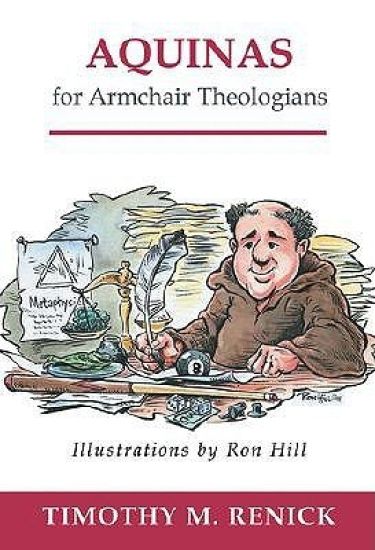
Aquinas for Armchair Theologians

Aquinas for Armchair Theologians

Timothy M. Renick

Westminster/John Knox Press,U.S.
2002
nidottu
Thomas Aquinas was one of the most influential thinkers in the history of Christianity and in western civilization. Yet his theological views are complex and presume acquaintance with technical philosophical language. Now Timothy Renick has produced an attractive and accessible account of Aquinas's life and thought that will make his views clear to nonspecialists. The topics dealt with include God, angels, evil, metaphysics, morality, sex, war, abortion, and politics. Illustrations are interspersed throughout the text and humorously illuminate key points providing an engaging introduction to an all-important theologian.Written by experts but designed for the novice, the Armchair series provides accurate, concise, and witty overviews of some of the most profound moments and theologians in Christian history. These books are essential supplements for first-time encounters with primary texts, lucid refreshers for scholars and clergy, and enjoyable reads for the theologically curious.
No-Nonsense Networking

No-Nonsense Networking

Timothy M Houston

Houston-CB Group, Incorporated
2016
pokkari
Are you struggling to make your networking work for you? Do you want to get more referrals, recommendations and endorsements from others? Do you HATE going to networking events and try to avoid them as much as you can? Do you feel like you're wasting time (or your time is being wasted) when you talk or meet the wrong people at networking events? Most businesspeople do and yet, they don't have a strategy or plan to make their networking effective. In No-Nonsense Networking, #1 International Bestselling author, speaker and entrepreneur, Tim Houston, teaches you what to do before, during and after your networking efforts to make productive, profitable and prosperous contacts and connections. In this straightforward, "down and dirty" guide, you will learn time-tested techniques and proven strategies that really work. No fluff. No hype.No untried theories. No-Nonsense. You will be able to implement many of these new skills and strategies right away to make your networking more productive, profitable and prosperous Includes a special contribution by Susan RoAne, speaker and author of the 1 Million+ bestseller, How To Work A Room.
Revolving Door Lobbying

Revolving Door Lobbying

Timothy M. LaPira; Herschel F. Thomas

University Press of Kansas
2017
sidottu
In recent decades Washington has seen an alarming rise in the number of “revolving door lobbyists”—politicians and officials cashing in on their government experience to become influence peddlers on K Street. These lobbyists, popular wisdom suggests, sell access to the highest bidder. Revolving Door Lobbying tells a different, more nuanced story. As an insider interviewed in the book observes, where the general public has the “impression that lobbyists actually get things done, I would say 90 percent of what lobbyists do is prevent harm to their client from the government.”
Applied Strategic Planning

Applied Strategic Planning

Timothy M. Nolan; Leonard D. Goodstein; Jeanette Goodstein

Jossey-Bass Inc.,U.S.
2008
nidottu
This guidebook provides an overview to the proven Applied Strategic Planning process. Written for the planning team and other key members who will participate in the process, this important resource offers encouragement for the team who must provide data for the planning process and helps to identify questions for further discussion. The Applied Strategic Planning approach helps organizations identify their ideal future and develop a plan to achieve that future. ASP is highly responsive to environments undergoing rapid change, where the very rules of doing business are constantly shifting. The companion The Applied Strategic Planning Consultant’s Toolkit—written by the consultants who created the process—includes the tools, techniques and processes that can help guide an organization through the strategic planning process.
The International Regulation of Extinction

The International Regulation of Extinction

Timothy M. Swanson

New York University Press
1994
sidottu
During the summer of 1992, the United Nations Conference on Environment and Development in Rio de Janeiro was hailed as a watershed moment in the ecology movement. Over 100 nations signed a new international treaty intended to conserve biological diversity. Yet, every day, species-many not even discovered-are driven into extinction and the ecological crisis continues to be a pressing global problem.Stressing the need to build bridges between the scientific community and international policymakers, Timothy Swanson here develops a new theory of the interplay between human society and the biological world. Biodiversity regulation, he argues, must focus specifically on the regulation of the global economic forces driving species into extinction. As the global development process becomes increasingly sophisticated, the spectre of a homogenized biosphere looms large.Yet, while biological diversity is responsible for a host of global benefits, it confers few tangible gains onto individual nations that offset the financial advantages of exploiting these same natural resources.The same economic rationale that drives farmers to grow coca leafs instead of grain compels countries to exploit natural resources, rather than conserve them. In order to stave off the decline of biological diversity, Swanson proposes the creation of specific policies that will internalize the benefits of biodiversity on a national level.
Twisting Arms and Flexing Muscles

Twisting Arms and Flexing Muscles

Timothy M. Shaw

CRC Press Inc
2017
sidottu
Military force is considered essentially a non-military pursuit in international relations, specifically, humanitarian intervention and peacebuilding. This coherent and interrelated study makes an important contribution to the existing literature by concentrating on empirical analyses. It is illustrated by key case studies which consider the complexities and dynamics associated with the application of military force. Of particular importance in this context is the emphasis on areas of recent crisis, such as Africa and the Balkans. The book considers whether our understanding of military force and its utility is outdated and finds that new considerations are required in order to capture the demands of the new environment and generate more appropriate and effective responses. The volume will have wide appeal, ranging from students and academic researchers to high-level policy makers and policy analysts in the military, governance and democratization and peacebuilding communities, as well as area-specialists and non-governmental organizations.