Kirjojen hintavertailu. Mukana 11 393 044 kirjaa ja 12 kauppaa.

Kirjahaku

Etsi kirjoja tekijän nimen, kirjan nimen tai ISBN:n perusteella.

1000 tulosta hakusanalla Tom Cooper

In the Claws of the Tomcat

In the Claws of the Tomcat

Tom Cooper

Helion Company
2021
nidottu
Equipped with well-balanced air wings, huge aircraft carriers have formed the backbone of the United States Navy’s doctrine and strategy since the Second World War. Packing an enormous punch, their purpose is to exercise control over enormous portions of airspace – in the offence or defence. From the mid-1970s until the mid-2000s, the spear tip of the USN air wings was the famous Grumman F-14 Tomcat – widely considered one of the finest air superiority systems in the world. Originally designed as a fast, manoeuvrable and well-armed fighter, the Tomcat entered service as the ultimate long-range fleet defender and became the biggest, most complex and most expensive naval aircraft of its time. Including a unique and exceptional combination of flight characteristics, detection systems and weapons, it earned itself the status of a legend by the mid-1980s. The F-14 Tomcats of the US Navy achieved their first aerial victories during freedom of navigation exercises off Libya in 1981. However, the period during which they saw most combat followed several years later, during Operations Earnest Will and then Desert Storm, from 1987 until 1991. To date, very little has been published about the operations in question. Indeed, the widespread belief is that USN F-14s saw next to no air combat against Iran, and even less so during Operation Desert Storm in 1991. As so often, the reality is entirely different: Tomcats engaged dozens of opponents, often on the verge of the engagement envelope of their powerful AWG-9 radars and AIM-54 Phoenix long-range air-to-air missiles, and sometimes at such close ranges that their pilots selected ‘guns’. Weather- and communications-related problems, but also the incredible discipline of their crews prevented them from scoring up to a dozen aerial victories: however, it is perfectly possible that they scored at least one, perhaps more previously entirely unknown aerial victories – and also lost one of their own to an enemy fighter. Richly illustrated by over 100 photographs and authentic colour profiles, ‘Tomcats of the Storm’ is an exclusive source of reference about some of least-well known air combats fought by US Navy’s fighter crews in recent history.
Syrian Conflagration

Syrian Conflagration

Tom Cooper

HELION COMPANY
2022
pokkari
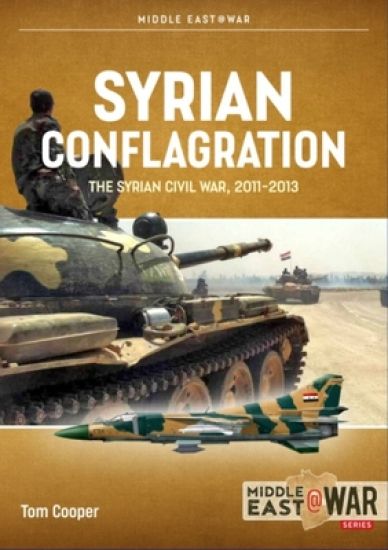
The Syrian Civil War, (the colloquial name of the ongoing conflict in Syria), has experienced an entirely unexpected transformation during its first two years. It started as unrest within the Syrian population and a series of mass demonstrations within the context of wider protest movements in the Middle East and North Africa in 2011, known as the Arab Spring. Contrary to events in Egypt, Libya, Tunisia and Yemen, where oppressive governments were toppled by the end of that year, the government of Syria deployed the full force of its military, its intelligence apparatus, and para-military groups, launching an unprecedented crackdown that resulted in the arrest, detention and killing of many thousands. Despite its brutality, this effort back-fired: it provoked mass desertions of the Syrian military and then an armed uprising. The emerging insurgency was generally successful through 2012, although failing to capture Damascus, it did secure more than half of Aleppo and Homs, the provincial capital of Raqqa, and nearly all of north-eastern and north-western Syria under its control. Although propped-up by economic and military support from the Islamic Republic of Iran and the Russian Federation, the government of Syria was nearing the brink of collapse during the first half of 2013 when, prompted by Tehran, the Hezbollah - a Shi'a Islamic militant group (and political party) from Lebanon - entered the conflict on its side. Soon after, the Hezbollah was reinforced by significant contingents of Iranian-sponsored Shi'a from Iraq, Lebanon and elsewhere, and then by volunteers from Iran, including crack units of the Islamic Revolutionary Guards Corps. Meanwhile, already split along the lines of Syria's complex demography, much of the insurgency transformed from a secular and non-sectarian movement into proxies of various foreign powers, foremost Saudi Arabia and Qatar, but also Turkey and Kuwait. Furthermore, foreign Jihadists motivated by al-Qaida joined the fray, aiming to establish an Islamist state and clandestinely cooperating with the government, they fell into the back of insurgency. Thus, an extremely complex conflict - which meanwhile not only spilled over the border into Lebanon, but is having a major impact upon Iranian-Saudi relations, and relations between the West, Iran and a number of Arab countries - came into being, the outcome of which is presently anything but predictable.Drawing on extensive research, including first hand accounts it provides a compelling overview of the first three years of the ongoing conflict in Syria. The book features around 120 photos, 16 artworks and 3-4 maps.
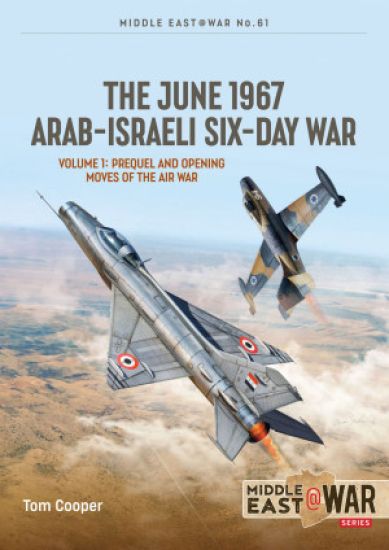
The June 1967 Arab-Israeli War Volume 2

The June 1967 Arab-Israeli War Volume 2

Tom Cooper; Efim Sandler

HELION COMPANY
2025
pokkari
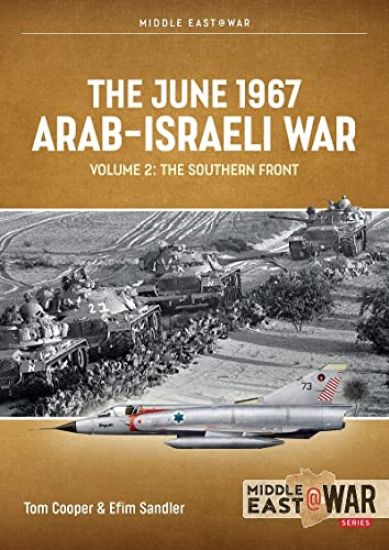
In June 1967 Israel, which seemed on the verge of being annihilated by its Arab neighbors, took six days to redraw the Middle Eastern strategic map in one of the most dramatic reversals of fortune in modern times.The success was almost a decade in the making following the Suez Crisis of 1956 with the Israeli forces being radically changed under the direction of the Magi. These changes created an army and air force upon which the country would rely when it became obvious the international community would take no action to implement guarantees made after the Suez Crisis.The Israeli forces were honed in low-level clashes during the 1960s, notably the Water Wars which the Israelis did so much to provoke. By contrast the Arab forces became complacent, usually due to supplies of arms from the Warsaw Pact, but - with proper training - this complacency could have been turned into military effectiveness. The Arab forces were, however, plagued by the fact that command too often depended upon political reliability rather than military effectiveness.In the case of the Egyptian forces their effectiveness was further undermined by their commitment to the debilitating Yemen Civil War which meant they were in no condition to confront Israel. Syria and Jordan, whose forces alone could not fight the Israelis, complained loudly about President Nasser's lack of action against Israel. In the spring of 1967 Nasser decided to regain the prestige he had lost since the heady days of the Suez Crisis with a demonstration in the Sinai Peninsula. This was interpreted by the Israelis as preparations for an invasion and Nasser did nothing to persuade them otherwise. When it was clear the international community would do nothing, the Israelis decided to strike.Initially Israel aimed to attack only Egypt, but Syria and Jordan then provoked attacks upon their territory. The Israeli campaign was heralded by a massive surprise air attack first on the Egyptians and then on the other neighboring states. Ground offensives then followed in succession as the war, like Topsy in Uncle Tom's Cabin 'just growed.' These campaigns were not always examples of military perfection, as will be scene, and the general post-war back-slapping drowned out serious questions about the future of Israel's army.
Lebanese Civil War

Lebanese Civil War

Tom Cooper; Efim Sandler

HELION COMPANY
2022
pokkari
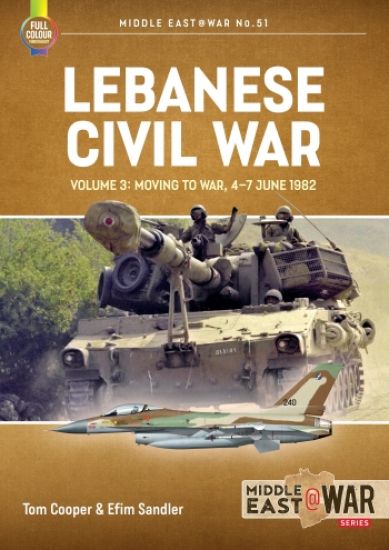
Following years of growing tensions, in June 1982 Israel launched an all-out invasion of Lebanon. During the night from 5 to 6 June 1982, four armored divisions of the Israeli Defense Force moved into starting positions near the border with Lebanon, while a full paratrooper division was embarked on amphibious assault ships. Looking forward to engaging the enemy, the Israelis then crossed the border late on the morning of 6 June, and promptly became involved in the bitter battle of Tyre, landings at Awali, and the highly-symbolic assault on Beaufort Castle. The next day saw a further intensification of combat, with the Israelis securing Tyre and then attacking Sidon, and clashing with the Syrian armed forces for the first time in years. Fighting for Jezzine and Ein Zehalta quickly conflagrated into major armored engagements, while after their landing, the sea-borne Israeli forces launched their advance on Beirut through the positions of Palestinian militants and their Lebanese allies, and then onto some of the best units of the Syrian Arab Army.Based on extensive interviews with veterans from all involved parties, focusing on minute reconstructions of combat operations, and richly illustrated with exclusive photography, Lebanese Civil War, Volume 3, offers unsurpassed coverage of one of the most spectacular and most tragic conflicts of the late twentieth century.
Lebanese Civil War Volume 4

Lebanese Civil War Volume 4

Tom Cooper; Efim Sandler

HELION COMPANY
2025
pokkari
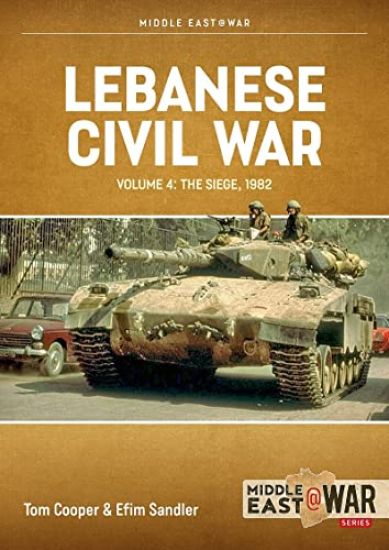
Following years of growing tensions, in June 1982 Israel launched an all-out invasion of Lebanon. Following initial advances on Palestinian-controlled Tyre and Sidon, Beaufort Castle, and the amphibious landing at Awali, on 8 June 1982 the Israeli Defense Force initiated operations against the Syrian armed forces deployed in southern-central Lebanon. What were initially minor firefights for Jezzine and Ein Zehalta developed into major armor battles in which Syrian Gazelle helicopters took a heavy toll of Israeli armor. The following battles of Ein el-Hilweh, Khalde, and Kfar Sil are remembered by participants from all parties for their ferocity and the relentless resistance of Palestinian and Syrian combatants.Finding no other solution, on 9 June 1982 the Israelis initiated Operation Mole Cricket 19, aiming to destroy the integrated air defense system of the Syrian Arab Air Force and the Syrian Arab Air Defense Force deployed in eastern-central Lebanon. On the ground, the Israeli and Syrian armies clashed in a major battle at Lake Qaroun, which soon expanded all the way to the Syrian border.On the other side of the country, the Israeli forces fought their way to Beirut Airport. In a headlong rush for the crucial road connecting Beirut and Damascus, on 10 and 11 June an Israeli armored battalion advanced on the village of Sultan Yacoub, provoking an epic battle. Finally, on 11 June 1982, the Israelis exacted revenge of a sort when their units, equipped with US-made BGM-71 TOW anti-tank guided missiles, ambushed Syrian armor at Jebel Barouch.Based on extensive interviews with veterans from all parties, focusing on minute reconstructions of combat operations, and richly illustrated with exclusive photography, Lebanese Civil War, Volume 4, offers unsurpassed coverage of one of most spectacular and most tragic conflicts of the late twentieth century.
Ripped Apart. Volume 1

Ripped Apart. Volume 1

Tom Cooper; Dimitris Vassilopoulos; Dave Watson

HELION COMPANY
2023
pokkari
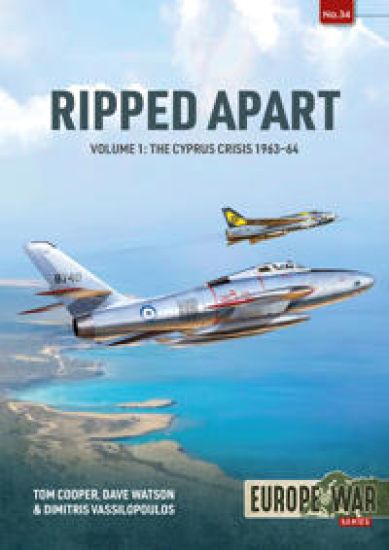
The 'Cyprus Problem' - also known as the Cyprus dispute, Cyprus issue, Cyprus question or Cyprus conflict - is an ongoing dispute between Greek Cypriots, Turkish Cypriots, Greece and Turkey. It has bedeviled not only their relations, but also those within the European Union, NATO, and the United Nations for more than 60 years.Following a long insurgency against British colonial rule - the so-called 'Cyprus Emergency' - Cyprus gained independence in 1960. Almost instantly, high tensions emerged between the Greek and Turkish Cypriots. A complex set of constitutional provisions and international treaties designed to safeguard the new state, and countless attempts to resolve the conflict through diplomacy failed. On the contrary, in 1963-1964, the repeated attempts to solve the disputes failed and fighting erupted between the communities in Nicosia, that soon spread across the rest of the island. As the power-sharing government collapsed, and additional peace-making efforts failed, in 1967 the conflict escalated into armed violence again, this time with the involvement of the Greek and Turkish armed forces. Subsequently, the situation was only made worse, culminating in the Greek coup d' tat and the Turkish invasion of 1974.Positioning this conflict within its historical context, Ripped Apart offers an inclusive, incisive, even-handed, and a richly illustrated account of the military history of Cyprus since independence. Beginning with the tensions that emerged between the Greek and Turkish Cypriots through the 1960s, leading to the events that resulted in the series of bitter armed clashes of 1967, and then the Turkish invasion of 1974, Ripped Apart helps to provide a better understanding of a highly controversial conflict.
War in Ukraine Volume 2

War in Ukraine Volume 2

Tom Cooper; Adrien Fontanellaz; Edward Crowther; Milos Sipos

HELION COMPANY
2023
pokkari
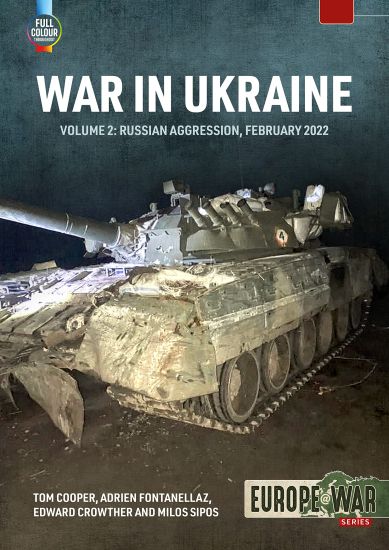
On 24 February 2022, President of the Russian Federation Vladimir Putin ordered a full-scale invasion of neighboring Ukraine. Taking place after the Russian invasion of eastern Ukraine and illegal annexation of Crimea of 2014-2015, and eight years of low-scale warfare in Donbas, as well as countless incidents on the ground and the sea, cyberwarfare, and political tensions, the onslaught was expected - both by multiple Western and multiple Russian intelligence services - to quickly topple the democratically elected government in Kyiv, and overrun and disarm the Ukrainian armed forces with help of collaborationists in a matter of between 3 and 14 days.Early on 24 February, Armed Forces of the Russian Federation (VSRF) launched a series of missile and artillery strikes on main air bases and dozens of military facilities in Ukraine. Immediately afterwards, VSRF launched ground invasion, with its forces advancing on (clockwise) Kyiv, Chernihiv, Kharkiv, Mariupol, Melitopol, and Kherson. Although following a build-up that began already in April 2021, and expected by many, the onslaught still came as a major surprise - for the Ukrainian government, for Ukrainian armed forces, for its allies in the West, but also for the mass of officers and other ranks of the VSRF. Moreover, the deeper the Russians rolled into Ukraine, the more resistance they have encountered: while some Russian units performed as expected, entire armies began falling apart while ordered to advance at maximum possible speed - and that without the necessary fire and logistic support. After suffering catastrophic losses while failing to reach the downtown Kyiv, and failing to reach and enter Chernihiv and Kharkiv, the war in northern and north-eastern Ukraine quickly settled down into a bloody stalemate. However, in the south, the Russians initially advanced at amazing rate, taking Melitopol already during the first day of their invasion, and Kherson only few days later. Indeed, it was only once President Putin attempted to accelerate the rate of advance through heliborne operations deeper into Ukraine, that the VSRF suffered a severe blow in the fighting for Voznesensk and Mykolaiv, and its advance in this part of the country came to an end.Richly illustrated, providing a detailed study of the involved armed forces, and the fighting in northern and southern Ukraine during the first two weeks of the Russian invasion in February 2022, War in Ukraine, Volume 2 is the first concise military history of this drama.
Fitters in the Middle East

Fitters in the Middle East

Tom Cooper; Milos Sipos

HELION COMPANY
2025
pokkari
Frequently overshadowed by rival designs of the Mikoyan i Gurevich Design Bureau, the family of fighter-bombers of the aircraft design bureau headed by Pavel O. Sukhoi and developed in the 1950s, 1960s, and 1970s are far less-well-known in the West. Reestablished in the early 1950s, the Sukhoi Design Bureau initially followed the same path as its primary competitor and designed two fighters, one equipped with swept wing, and the other with delta-wing. In the West, they became known under the ASCC/NATO-codename 'Fitter'.Through the 1960s, and unlike MiG, Sukhoi continued developing its 'Fitters', resulting in an entire family of airframes, equipped with ever better avionics and more powerful engines. Its Su-7BMKs (ASCC/NATO-codename 'Fitter-A') entered service with Egypt in 1966, Syria and Iraq in 1967, followed by Algeria a year later. In 1972-1973, Su-17, and then Su-20 - the second generation of this design, and the first equipped with variable-sweep wing - entered service in Egypt, followed by Iraq and Syria. Finally, in 1978-1979, the third and final generation - including variants such as the Su-22, Su-22M, Su-22M-3, and Su-22M-4 (ASCC/NATO-codenames 'Fitter F/G/J/K', respectively) - entered service in Iraq, followed by Libya, Syria, and Yemen. Highly appreciated - and often outright beloved - by their pilots and ground crews alike, they formed the backbone of the fighter-bomber fleets of these six air forces, and saw action in about a dozen different wars.Richly illustrated with a host of exclusive photographs and custom-drawn color profiles, Fitters of the Middle East is the first title ever offering a comprehensive and inclusive operational history of 'Fitters' with six major air forces. As such it is an indispensable single-point source of reference.
Lebanese Civil War Volume 5: Rushing to the Deadline, 11-12 June 1982
The days of 11-13 June, 1982, proved that Arik Sharon's plan was over-ambitious and adventuristic. Dragging the IDF into the fight with Syrians appeared to be more complicated despite IDF superiority in technology and training. The armored units were moving too slowly and were stuck in numerous engagements all over the place.In the Western zone, after several failed attempts to take higher ground and open the road to Beirut, IDF finally made its gain and secured Kfar Sil after a very tough fight that lasted not less than 18 hours.In the Central zone, after getting the upper hand over the Syrian forces in Ein Zhalta and Jezzine, Israelis continued to crawl towards Beirut-Damascus Highway but the tempo had been lost and it was obvious that the Sharon expectation could not be matched.In Bekaa Valley, Eastern zone, IDF moved 399 Brigade to the north in order to reach Beirut Damascus Highway in the quickest possible way. That move turned out to be a disaster and one of the worst fights in IDF history. It took tremendous effort of two Israeli divisions to recover the troubled Brigade while suffering losses in men and machines.Besides the major battles, Israeli forces continued to clear the area while having tough opposition hotspots like Ein-Hilweh and finally, the controversial engagement between IDF anti-tank units and Syrian T-72s.
War in Ukraine Volume 6

War in Ukraine Volume 6

Tom Cooper; Adrien Fontanellaz; Milos Sipos

HELION COMPANY
2024
nidottu
On 24 February 2022, the armed forces of the Russian Federation initiated an invasion of Ukraine. Thus began the biggest and longest air war fought in Europe since 1945, and a conflict that saw the deployment of full spectrum of the Russian air power: strategic bombers deployed hundreds of cruise missiles combined with strikes by tactical ballistic missiles; the Russian Air-Space Force deployed its tactical and helicopter aviation into large-scale airborne and heliborne operations deep into Ukraine, while the Ukrainian Air Force fought back with its interceptors and attack helicopters.Taking place after the Russian invasion of eastern Ukraine and illegal annexation of Crimea of 2014-2015, and eight years of low-scale warfare in Donbas, as well as countless incidents on the ground and at sea, cyberwarfare, and political tensions, the onslaught was expected by many Western and Russian intelligence services to quickly topple the democratically elected government in Kyiv, and overrun and disarm the Ukrainian armed forces - with help of collaborators - in just three to 14 days.Despite the realisation of a full-scale Russian assault and invasion coming as a surprise to many, the Ukrainian Air Force (PSU) offered fierce resistance. The result was weeks of high-intensity air warfare, which ended only once the ground-based air defences of both sides were deployed in force to block the airspace for tactical aircraft of both sides.Richly illustrated and providing a detailed study of the participating air forces, and the fighting in the air during the Russian invasion, War in Ukraine, Volume 6 is the first concise and inclusive military history of this drama.
War in Ukraine Volume 7

War in Ukraine Volume 7

Tom Cooper; Adrien Fontanellaz; Milos Sipos

HELION COMPANY
2025
nidottu
Volume 7 of War in Ukraine provides a detailed account of the air war as it developed during 2023, a period in which Russia made extensive use of Tu-95 and Tu-22 bombers and their missiles to bring about the collapse of the power supply system in Ukraine.The second year of the War in Ukraine began with the Russian attempt to collapse the power supply and power grid of Ukraine through an offensive with ballistic- and cruise missiles. Lasting months, this operation saw the sustained deployment of Tu-95 and Tu-22 bombers and their missiles, combined with tactical precision guided munitions and Iranian-made Shahed unmanned aerial vehicles (UAVs). Highly promising, early on, the offensive failed because of last-minute deliveries of advanced air defence systems and a large number of power generators from the West: even then, it was a close call, with the government in Kyiv almost making the decision to evacuate the capital. Hard on the heels of this episode, the USA and Germany rushed PAC-2/3 Patriot air defence systems to Ukraine, which Russia attempted to knock out with its Kinzhal hypersonic missiles. Around the same time, the Russians also began deploying MPK/UMPK glide bombs to strike targets along the frontline from outside the range of Ukrainian air defences.War In Ukraine: Volume 7, Air War, January - December 2023 continues the detailed military history of this ongoing conflict, the largest in Europe since the end of the Second World War in 1945. This volume is illustrated throughout with original color photographs and includes specially commissioned color artworks.
Iranian F-14 Tomcat Units in Combat

Iranian F-14 Tomcat Units in Combat

Tom Cooper; Farzad Bishop

Osprey Publishing
2004
nidottu
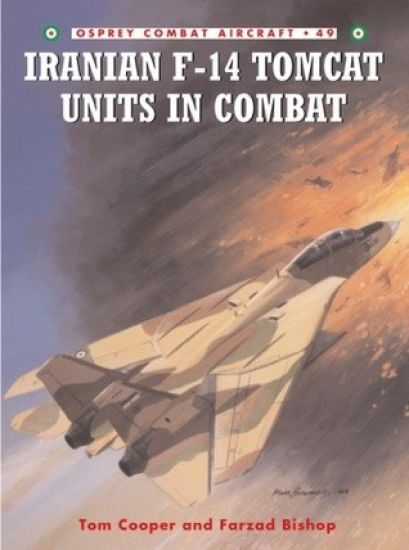
So formidable an opponent did the Iraqi airforce consider the F-14 that during the Iran-Iraq war, they ordered their pilots not to engage F-14s and the presence of one in an area was usually enough to empty it of Iraqi aircraft. Officially losses where tiny; only one F-14 was lost in aerial combat (to a MiG-21), one to a control problem and one downed by a ground-to-air missile. This book looks at the F-14's Iranian combat history and includes first hand accounts from the pilots themselves. It will consider key engagements and the central figures involved, illustrating the realities, successes and failures of the Iranian air campaign.
Libyan Air Wars Part 2: 1985-1986

Libyan Air Wars Part 2: 1985-1986

Tom Cooper; Albert Grandolini

Helion Company
2016
nidottu
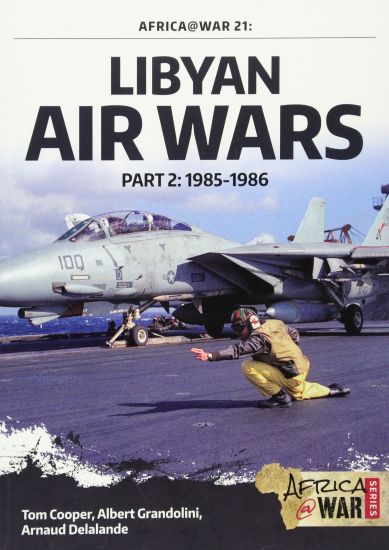
While the first volume in this mini-series spanned the first decade of confrontations between Libya and several of its neighbours, but foremost the USA and France, between 1973 and 1985, the second is to cover the period of less than a year – between mid-1985 and March 1986, when this confrontation reached its first climax. Through mid and late 1985, relations between France and Libya became tense over the situation in Chad. By early 1986, the French felt forced to deploy their air force for an airstrike on the crucial Libyan air base at Wadi Doum, in the north of that country. Tripoli reacted with a high-profile aerial attack on N’Djamena IAP and by bolstering support for its proxies. This eventually provoked Paris to launch its third military intervention in that country, OperationÉpervier. Meanwhile, a series of terror attacks on US citizens and interests in Europe and the Mediterranean area took place. While most of these saw the involvement of Iran and Syria too, Libya was recognized as major supporter of the activities in question. In the aftermath of several traumatic experiences, the US administration began planning for direct action against the government in Tripoli and various terrorist organizations supported by it. As the Pentagon planners prepared a contingency list of targets in Libya, and the US Air Force began planning its involvement, ships and aircraft of the US Navy launched intensive operations off the Libyan coast with the aim of provoking an incident that could be used as a reason for major military attack on Libya. Eventually, these operations culminated in Operation Prairie Fire– a series of short but sharp clashes between the US Navy and Libyan air defences and the Navy, in March 1986. Part 2 of this mini-series provides an unprecedentedly detailed and richly illustrated description of the involved air forces, their equipment and markings, and related military aerial operations, many of which have remained unknown until today, while others have been forgotten outright.
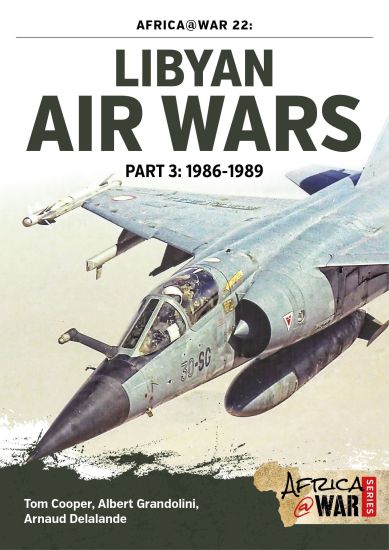
Libyan Air Wars Part 3: 1985-1989

Libyan Air Wars Part 3: 1985-1989

Tom Cooper; Albert Grandolini

Helion Company
2016
nidottu
Confrontations between Libya, and the USA and France reached their highest point in the period between April 1986 and early 1989. In response to a Libyan-instigated and supported series of terror attacks against US citizens and interests in Europe, in April 1986 the USA launched Operation El Dorado Canoyon – a series of raids against carefully selected targets in Libya. Simultaneously, the USA and France bolstered the military of the Chadian government, enabling it to subsequently launch an all-out advance against Libyan troops and proxy forces in the north of Libya. This culminated in the series of spectacular campaigns better known as ‘Toyota Wars’, characterised by high speed of operations and surprise. The Chadian Army defeated its opponents in 1987 and nearly launched an invasion of Libya in 1988, successfully concluding this conflict. This title closes the Libyan Air Wars mini-series with a detailed insight into the final US–Libyan confrontation, which took place in early 1989, and culminated in another high-profile air combat between the most modern jet fighters of the Libyan Arab Air Force, and the US Navy. As usual, the volume is richly illustrated by well over 150 contemporary and exclusive photographs, colour profiles, and maps, detailing the history, training, equipment, markings and tactics of the involved air forces.
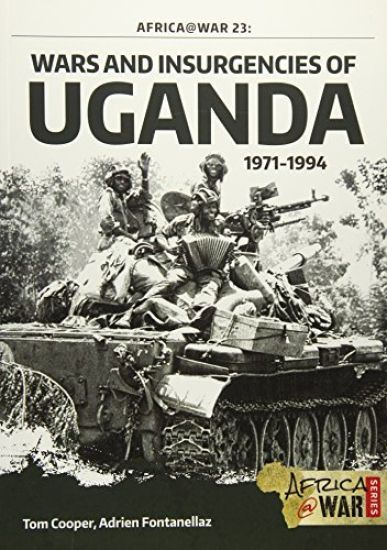
Wars and Insurgencies of Uganda 1971-1994

Wars and Insurgencies of Uganda 1971-1994

Tom Cooper; Adrien Fontanellaz

Helion Company
2015
nidottu
In 1971, Idi Amin Dada, a former officer of the King’s African Rifles and commander of the Ugandan Army, seized power in a military coup in Uganda. Characterised by human rights abuses, political repression, ethnic persecution, extrajudicial killings, nepotism, corruption and gross economic mismanagement, Amin’s rule drove thousands into exile. Amin shifted the country’s orientation in international relations from alliances with the West and Israel, to cooperation with the Soviet Union. With Tanzanian leader Julius Nyerere offering sanctuary to Uganda’s ousted president, Milton Obote, Ugandan relations with Tanzania soon became strained too. Already in 1972, a group of Tanzania-based exiles attempted, unsuccessfully, to invade Uganda and remove Amin. By late 1978, following another attempted coup against him, Amin deployed his troops against the mutineers, some of whom fled across the Tanzanian border. The rebellion against him thus spilled over into Tanzania, against whom Uganda then declared a state of war. Opening with an overview of the ascent of crucial military and political figures, and the build-up of the Tanzanian and Ugandan militaries during the 1960s and 1970s, this volume provides an in-depth study of the related political and military events, but foremost of military operations during the Kagera War– also known as ‘A Just War’ – fought between Tanzania and Uganda in 1978–1979. It further traces the almost continuous armed conflict in Uganda of 1981–1994, which became renowned for emergence of several insurgent movements notorious for incredible violence against civilian population, some of which remain active in central Africa to this day. This book is illustrated with an extensive selection of photographs, colour profiles, and maps, describing the equipment, markings, and tactics of the involved military forces.
The Rwandan Patriotic Front 1990-1994

The Rwandan Patriotic Front 1990-1994

Tom Cooper; Adrien Fontanellaz

Helion Company
2015
nidottu
On 1 October 1990, hundreds of Banyarawanda militants that served with the Ugandan Army deserted their posts to form the Rwandan Patriotic Front (RPF) and invade Rwanda. Thus began the Rwandan Civil War, which was to culminate in the famous genocide of nearly one million of Tutsi and moderate Hutus, in 1994. Starting with in-depth descriptions of the history of Rwandan political, military and security development, this volume traces the history of the RPA from its emergence as a small-scale insurgent group formed from the ranks of Rwandan refugee diaspora in Uganda; its military operations and related experiences during nearly four years of war against the Rwandan government; and its establishment of control over Kigali, in July 1994. As such, the narrative presented here provides a fascinating and unique insight into the military story behind the emergence of modern-day Rwanda and its military; considered by many to be the‘Israel of Africa’. Providing minute details about RPF’s tactics and doctrine – that strongly influenced developments in a number of other modern-day African wars – this volume is foremost an offering that provides highly interesting backgrounds for and a prequel to, nearly all of the subsequent wars in the neighbouring Democratic Republic of the Congo. Illustrated with over 150 photographs, colour profiles, and maps describing the equipment, colours, and markings, and tactics of the RPF and its opponents, this is a unique study about the emergence of one of the most important US allies on the African continent.
Hawker Hunters at War

Hawker Hunters at War

Tom Cooper; Patricia Salti

Helion Company
2016
nidottu
Designed by Sydney Camm as a swept wing, daytime interceptor with excellent manoeuvrability, the Hunter became the first jet aircraft manufactured by Hawker for the Royal Air Force. It set numerous aviation records and saw widespread service with a large number of RAF units in Europe and abroad. When the Royal Air Force received newer aircraft capable of supersonic speeds to perform the interceptor duties, many Hunters were modified and re-equipped for ground-attack and reconnaissance missions instead. Because they were deemed surplus to British requirements, most of these were subsequently refurbished and exported to foreign customers – so also to Iraq and Jordan. Hawker Hunters at War covers every aspect of Hunter’s service in the two countries, from in-depth coverage of negotiations related to their export to Iraq and Jordan, to all-important details of their operational service during 1958-67. It culminates in detailed examination of their role in the June 1967 Arab-Israeli War (also known as the ‘Six Days War’) and extensive tables listing all aircraft delivered and their fates. Almost entirely based on interviews with retired commanding officers and pilots of the former Royal Iraqi Air Force, Iraqi Air Force and Royal Jordanian Air Force - as well as plenty of unpublished official documents from British, Iraqi and Jordanian archives - the narrative is providing an unprecedented insight into a number of contemporary affairs. Profusely illustrated with well over 100 photographs and 15 colour profiles showing all aspects of camouflage, markings and various equipment, Hawker Hunters at War is the ultimate profile of Hunter’s colourful and action-packed service in Iraq and Jordan during a period when this legendary type formed the backbone of local air forces.
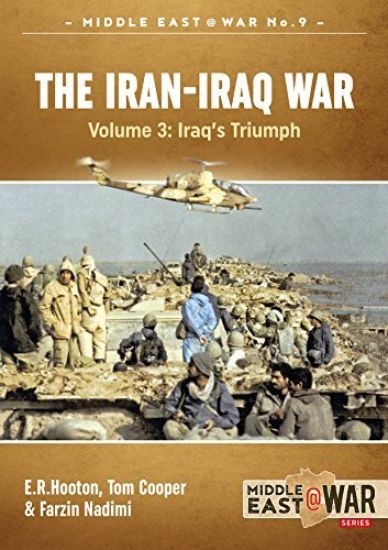
The Iran- Iraq War

The Iran- Iraq War

Tom Cooper; E. R. Hooton; Farzin Nadimi

Helion Company
2017
nidottu
The Iran-Iraq War was one of the bloodiest conflicts of the 20th Century and accidentally created the current nightmare of Islamic fundamentalist terrorism. There have been many books on the conflict but this is the first detailed military history using materials from both sides, as well as materials obtained from US Intelligence circles and British Governmental archives. It provides a unique insight into a war which began through miscalculation and rapidly escalated into the longest conventional conflict in the post-Second World War era. Part 4 in this mini-series coversthe warfare between Iran and Iraq on the Central and Northern Fronts. Difficult terrain made it problematic for either side to assemble overwhelming superiority. Following initial Iraqi attacks that seized some territory, the Iranians began gradually nibbling back until achieving some success in the centre, in 1982. Subsequently, the Central Front saw only minor conventional battles until Iraq launched several major blows in 1988. In the north, fighting primarily revolved around several Kurdish insurgencies in northern Iraq, and culminated in the horror of the Halabcheh gas attack. The final campaign of the war saw Iraq-supported Iranian émigrés launching a spectacular, but also a swiftly-crushed, invasion of their homeland.