Kirjojen hintavertailu. Mukana 11 463 970 kirjaa ja 12 kauppaa.

Kirjahaku

Etsi kirjoja tekijän nimen, kirjan nimen tai ISBN:n perusteella.

1000 tulosta hakusanalla Valerij Bochkov

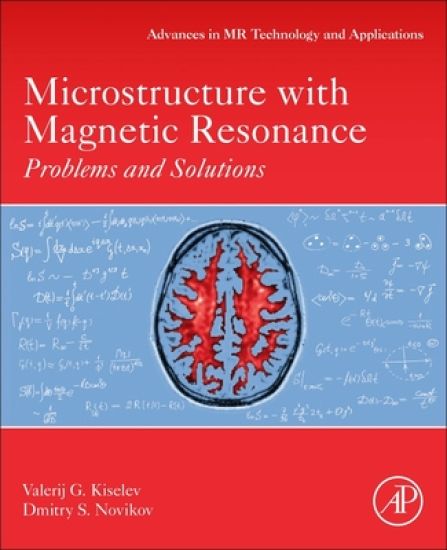
Microstructure with Magnetic Resonance

Microstructure with Magnetic Resonance

Valerij G. Kiselev; Dmitry S. Novikov

Academic Press Inc
2025
nidottu
Microstructure with Magnetic Resonance: Problems and Solutions responds to the challenge of how to see the invisible with magnetic resonance imaging. Technically, the goal is to quantify cellular-level properties of biological tissues and microarchitecture of porous media orders of magnitude below the achievable resolution of MR. While the interest in this area has grown exponentially, current research involves physics outside the scope of standard NMR and MRI textbooks. Microstructure with Magnetic Resonance: Problems and Solutions introduces readers to methods of describing complex media in statistical terms, and covers the effects of complex microenvironments on the MR signal phase, on the transverse relaxation, and on different facets of the diffusion-weighted signal.The book presents the material as a set of problems with detailed solutions, that build on each other, stimulating a hands-on approach to learning. Each chapter begins with a short introduction to the topic, followed by problems, solutions, and a summary of key points. The problems start from the basics, and bring the reader step-by-step to the frontier of current knowledge. The overall focus is on gaining physical insight, by drawing on simple physical analogies and dimensional analysis, which help to reproduce the essence of the results obtained in classical and recent studies. The necessary mathematics is collected in dedicated appendices.With this book the reader will:• Understand the classic and current literature on microstructure mapping with NMR and MRI• Become familiar with the modern trends in microstructure MR• Be able to design new experiments using MR based on a solid theoretical foundation

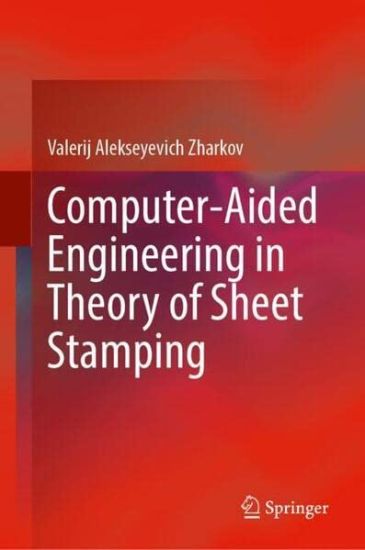
Computer-Aided Engineering in Theory of Sheet Stamping

Computer-Aided Engineering in Theory of Sheet Stamping

Valerij Alekseyevich Zharkov

Springer International Publishing AG
2023
sidottu
It is the unique first-ever fully color book on the engineering theory of the sheet stamping, developed by V. A. Zharkov with analytical dependences and Zharkov's laws and regularities in a large quantity of formulas. This theory is developed on the basis of mathematical theories of elasticity and plasticity and allows to calculate with an accuracy, sufficient for practice, the fundamental parameters of processes of sheet stamping for the purpose of designing the stamps and the choice of press equipment. If the computer-aided design/computer-aided engineering system is applied to designing the processes of stamping, then Zharkov's theory allows to understand at first the mechanism of deformation of blank at stamping a detail and then correctly to develop the project in the CAD/CAE system and correctly to analyze the results of the CAD/CAE modeling, taking into account the hardening and anisotropy of blank and springback of a detail after stamping. This book briefly describes the results of modeling by Zharkov of the main processes of stamping in the most powerful CAD/CAE system Marc of MSC Software Corporation (USA) with reference to the previous books of Zharkov, where this modeling step-by-step is described. This book consists of the eight sections: Zharkov's theory of bending of sheets, strips and profiles, including a bending of sheets for airframes of rockets, Zharkov's theory of deep drawing of sheet blanks, Zharkov's theory of stretch forming of sheets, strips and profiles, Zharkov's theory and methodology of designing in the CAD/CAE system of one-operational and multi-operational deep drawing of details from blanks taking into account their anisotropy, Zharkov's theory of formability testing of sheet materials taking into account the hardening and anisotropy of specimens and blanks, the fundamental equations of Zharkov's theory of sheet stamping, Zharkov’s theory of stamping of anisotropy blanks, Zharkov’s theory of finite element method for modeling of processes of stamping, and the sections consist of 31 chapters. Following the circumstantial step-by-step instructions in the book, any user, even without special preparation, can quickly model, study, research and use into practice the processing of blank, to reduce the design time of processing and the cost price of manufacture of stamped details in automobile, aircraft, electrotechnical, crockery, packing and other industries. The book is intended for engineers and scientists, working in various industries, and also for students and teachers of technical institutes and universities.
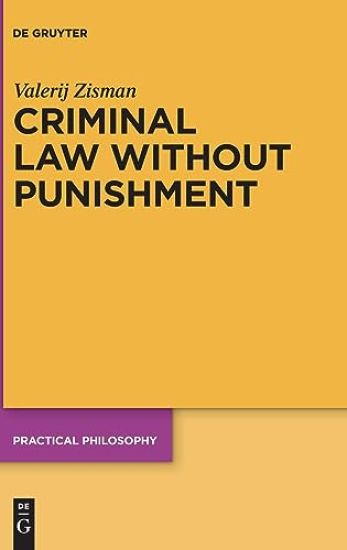
Criminal Law Without Punishment

Criminal Law Without Punishment

Valerij Zisman

De Gruyter
2023
sidottu
How can criminal punishment be morally justified? Zisman addresses this classical question in legal philosophy. He provides two maybe surprising answers to the question. First, as for a methodological claim, it argues that this question cannot be answered by philosophers and legal scholars alone. Rather, we need to take into account research from social psychology, economy, anthropology, and so on in order to properly analyze the arguments in defense of criminal punishment. Second, the book argues that when such research is properly accounted for, none of the current attempts to justify criminal punishment succeed. But that does not imply that the state should do nothing about criminal wrongdoing. Rather, the arguments that were supposed to justify criminal punishment actually speak in favor of an alternative approach to criminal law: restitution to the victim and restorative justice. That is to say, the state should coerce offenders to provide restitution for the harm inflicted on victims, and whenever possible restorative approaches should be taken to address criminal wrongdoing.
Criminal Law Without Punishment

Criminal Law Without Punishment

Valerij Zisman

De Gruyter
2025
isokokoinen pokkari
How can criminal punishment be morally justified? Zisman addresses this classical question in legal philosophy. He provides two maybe surprising answers to the question. First, as for a methodological claim, it argues that this question cannot be answered by philosophers and legal scholars alone. Rather, we need to take into account research from social psychology, economy, anthropology, and so on in order to properly analyze the arguments in defense of criminal punishment. Second, the book argues that when such research is properly accounted for, none of the current attempts to justify criminal punishment succeed. But that does not imply that the state should do nothing about criminal wrongdoing. Rather, the arguments that were supposed to justify criminal punishment actually speak in favor of an alternative approach to criminal law: restitution to the victim and restorative justice. That is to say, the state should coerce offenders to provide restitution for the harm inflicted on victims, and whenever possible restorative approaches should be taken to address criminal wrongdoing.