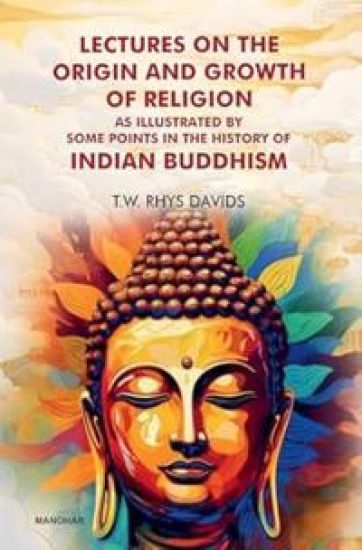
"The remarkable fact is, that we have here set forth a view of religion entirely independent of the soul theories, on which all the various philosophies and religions then current in India were based; entirely free from the idolatries and superstitions of the day.... We are struck at once with the analogy between it and the ideals of the last pagan thinkers in Europe before the rise of Christianity, and of some of the most advanced thinkers to-day. And the similarity is no mere chance." -from "The Signs, the Path, and the Fetters"What firsthand sources of information do we have about the life of the Buddha? What are the stages of the Wheel of Life? How well do modes of Eastern and Western thought mesh? One of the late 19th century's foremost experts on sacred Buddhist texts offered this layman's introduction to India's great religious tradition in a series of popular lectures delivered in 1894-1895 at a variety of highly respected educational institutions, including Cornell University, Columbia College, and the Lowell Institute. Published in book form in 1896, the lectures cover: . Religious Theories in India Before Buddhism . Authorities on Which Our Knowledge of Buddhism Is Based . Notes on the Life of the Buddha . The Secret of Buddhism . Some Notes on the History of Buddhism Lucid and informative, this remains an excellent primer on Buddhistic beliefs and practices.
The Sacred Books of the East - Buddhishm The Questions Of King Milinda Part 2 Of 2 - Vol. 36 is an unchanged, high-quality reprint of the original edition of 1894. Hansebooks is editor of the literature on different topic areas such as research and science, travel and expeditions, cooking and nutrition, medicine, and other genres. As a publisher we focus on the preservation of historical literature. Many works of historical writers and scientists are available today as antiques only. Hansebooks newly publishes these books and contributes to the preservation of literature which has become rare and historical knowledge for the future.
The Sacred Books of the East - Buddhishm The Questions Of King Milinda Part 1 Of 2 - Vol. 35 is an unchanged, high-quality reprint of the original edition of 1890. Hansebooks is editor of the literature on different topic areas such as research and science, travel and expeditions, cooking and nutrition, medicine, and other genres. As a publisher we focus on the preservation of historical literature. Many works of historical writers and scientists are available today as antiques only. Hansebooks newly publishes these books and contributes to the preservation of literature which has become rare and historical knowledge for the future.
Buddhism - Its history and literature is an unchanged, high-quality reprint of the original edition of 1896. Hansebooks is editor of the literature on different topic areas such as research and science, travel and expeditions, cooking and nutrition, medicine, and other genres. As a publisher we focus on the preservation of historical literature. Many works of historical writers and scientists are available today as antiques only. Hansebooks newly publishes these books and contributes to the preservation of literature which has become rare and historical knowledge for the future.
Buddhist Birth Stories: or, Jataka Tales - The Oldest Collection of Folk-lore extant, being The Jatakatthavannana. Vol. 1 is an unchanged, high-quality reprint of the original edition of 1880. Hansebooks is editor of the literature on different topic areas such as research and science, travel and expeditions, cooking and nutrition, medicine, and other genres. As a publisher we focus on the preservation of historical literature. Many works of historical writers and scientists are available today as antiques only. Hansebooks newly publishes these books and contributes to the preservation of literature which has become rare and historical knowledge for the future.
This book has been considered by academicians and scholars of great significance and value to literature. This forms a part of the knowledge base for future generations. So that the book is never forgotten we have represented this book in a print format as the same form as it was originally first published. Hence any marks or annotations seen are left intentionally to preserve its true nature.
This book has been considered by academicians and scholars of great significance and value to literature. This forms a part of the knowledge base for future generations. So that the book is never forgotten we have represented this book in a print format as the same form as it was originally first published. Hence any marks or annotations seen are left intentionally to preserve its true nature.
In a world divided into three Realms, magic is both a death sentence and destiny's greatest gift. A second son was meant to live in his brother's shadow - until visions of flame, crown, and throne began haunting his dreams. Now his forbidden power to cast magic has marked him as either savior or destroyer. In the Realm of Humans, magic-wielding witches are hunted without mercy by the Faithful. To the east, the Realm of Magic teeters on the brink of chaos under its desperate Head Witch. And in the shadows of the Dark Realm, an immortal witch queen and her murderous brother plot their conquest. As ancient prejudices threaten to tear the world apart, one young man's choice between darkness and light, between unification and conquest, will determine the fate of all three Realms. But with betrayal lurking around every corner and his prophetic visions growing stronger, his greatest battle may be the one within himself.
This book was published under the Hibbert Lecture Series, 1881. The volume talks about Buddhism, its origins, and its development as a mainstream religion. The first lecture talks about philosophy during its emerging stage, and it is discussed in parallel to certain concepts which were prevalent before Buddhism such as monotheism, transmigration, pantheism, animism, polytheism, and other reformation made before the establishment of Buddhism, etc. This series also covers the assessment of certain Buddhist canons like Pali pitakas and discusses the fundamental Buddhist concepts such as karma.
Title: Teithiau yn Nghymru; ref, Cyfieithiad o'r "Tours in Wales" ... Ynghyda chyfieithiad o'r nodiadau a'r rhagymadrodd, yn yr argraffiad Seisoneg diweddaf. Gan ... John Rhys ... Hefyd, nodiadau, hanes bywyd yr awdwr, a rhagarweiniad i hanes y llwythau gan W. Trevor Parkins. With plates, including a portrait.]Publisher: British Library, Historical Print EditionsThe British Library is the national library of the United Kingdom. It is one of the world's largest research libraries holding over 150 million items in all known languages and formats: books, journals, newspapers, sound recordings, patents, maps, stamps, prints and much more. Its collections include around 14 million books, along with substantial additional collections of manuscripts and historical items dating back as far as 300 BC.The HISTORY OF TRAVEL collection includes books from the British Library digitised by Microsoft. This collection contains personal narratives, travel guides and documentary accounts by Victorian travelers, male and female. Also included are pamphlets, travel guides, and personal narratives of trips to and around the Americas, the Indies, Europe, Africa and the Middle East. ++++The below data was compiled from various identification fields in the bibliographic record of this title. This data is provided as an additional tool in helping to insure edition identification: ++++ British Library Pennant, Thomas; Parkins, William Trevor; Rhys, John; 1883 xxxvii., 15]-635 p.; 8 . 010370.k.82.
This is Volume IX of sixteen in a series on Buddhism. Originally published in 1880, this study offers the first part of the oldest collection of folk-lore, the Jataka Tales. Translated from Pali.
This is Volume IX of sixteen in a series on Buddhism. Originally published in 1880, this study offers the first part of the oldest collection of folk-lore, the Jataka Tales. Translated from Pali.
In this work an attempt has been made to describe ancient India during the period of Buddhist ascendancy, from the points of view, not so much of the Brahmins as of the Rajputs. The two points of view obviously differ very much. In those parts of India which came very early under the influence of Buddhism there were surviving a number of small republics and four kingdoms of considerable extent and power and also a dozen or more smaller kingdoms. There was a tendency to absorb these domains and republics into the neighbouring kingdoms. This social condition of India in the sixth and seventh centuries bc was hitherto unnoticed by scholars either in Europe or in India who relied for their information exlusively on the books by Brahmin scholars.