Starting a cattle ranch in new country isn't supposed to be easy, and for big Jim Wade, it won't be. He and his foreman, Bob Jackson, have brought two starter herds from West Texas to the Tonto Basin of central Arizona Territory. There's plenty of work, and troubles, for Jim, Bob, and the crew of Texans they brought with them to Green Valley. And doing things the Texas way means if a rustler isn't lucky enough to be shot when they catch up to him, he'll be hung.And as if fighting off Apaches, bears, mountain lions, and the notorious Hashknife riders isn't enough trouble for Jim and the Rye Creek Ranch outfit, along comes Bob Jackson's niece, Miss Della Barlow. Della, a recent Kansas City Normal School for Teachers graduate, has come to Rye Creek Ranch for the summer before taking up her teaching position in Denver in the fall, assuming Jim doesn't get up the courage to ask her to stay.Wayne A. Walter's western adventure, Rye Creek Rancher, is set in the Tonto Basin, just south of the Mogollon Rim, an escarpment measuring as much as two thousand feet above the basin floor, and stretching halfway across Arizona. In the latter half of the 1800s the land was considered prime cattle country, and many a rancher, and would-be rancher, came to the Tonto Basin to make his fortune.The competition to be a successful cattleman was fierce. The rancher waged a constant battle against wild predators, raiding Apaches, rustlers, and less-than-honest cattlemen. Some, like Big Jim Wade, and his crew of Texas cowhands, would win the war.
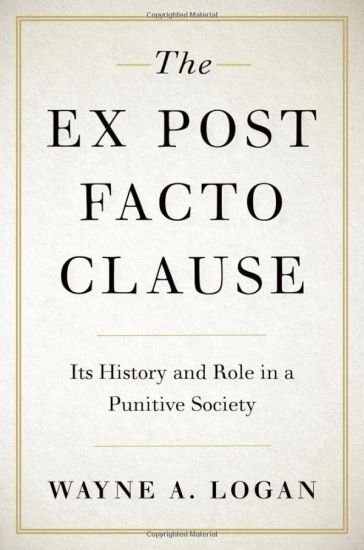
The first comprehensive examination of the US Constitution's Ex Post Facto Clause, surveying its history and the critical role it can and should play in combatting the punitive tendencies of American legislatures. The Ex Post Facto Clause, one of the few civil liberty protections found in the body of the US Constitution, reflects the Framers' acute concern over the tendency of legislatures to enact burdensome retroactive laws targeting unpopular individuals. Over time, a broad array of Americans have invoked the protective cloak of the Clause, including Confederate sympathizers in the late 1860s; immigrants in the early 1900s; Communist Party members in the 1950s; and, since the 1990s, convicted sex offenders. Although the Supreme Court enforced the Clause with vigor during the first several decades of the nation's history, of late the justices have been less than zealous defenders of the security it was intended to provide. And, even more problematic, they have done so amid major changes in the nation's social, political, and institutional life that have made the protections of the Ex Post Facto Clause all the more important. The Ex Post Facto Clause provides the first book-length examination of the history of the Clause and its potential for tempering the punitive impulses of modern American legislatures. Wayne A. Logan chronicles and critiques the evolving treatment of ex post facto claims by the Supreme Court, which has created a body of law that is both at odds with the Framers' intent and ill-suited to the unforgiving and harshly punitive nation that America has become. Drawing on Framing Era history, seminal Supreme Court decisions, and the global embrace of the values underlying the Ex Post Facto Clause, Logan provides a blueprint for how the Clause can play a reinvigorated and more robust role in guarding against the penal populism besetting modern American legislatures.
Despite dire predictions in the late twentieth century that public libraries would not survive the turn of the millennium, their numbers have only increased. Two of three Americans frequent a public library at least once a year, and nearly that many are registered borrowers. Although library authorities have argued that the public library functions primarily as a civic institution necessary for maintaining democracy, generations of library patrons tell a different story. In Part of Our Lives, Wayne A. Wiegand delves into the heart of why Americans love their libraries. The book traces the history of the public library, featuring records and testimonies from as early as 1850. Rather than analyzing the words of library founders and managers, Wiegand listens to the voices of everyday patrons who cherished libraries. Drawing on newspaper articles, memoirs, and biographies, Part of Our Lives paints a clear and engaging picture of Americans who value libraries not only as civic institutions, but also as public places that promote and maintain community. Whether as a public space, a place for accessing information, or a home for reading material that helps patrons make sense of the world around them, the public library has a rich history of meaning for millions of Americans. From colonial times through the recent technological revolution, libraries have continuously adapted to better serve the needs of their communities. Wiegand demonstrates that, although cultural authorities (including some librarians) have often disparaged reading books considered not "serious," the commonplace reading materials users obtained from public libraries have had a transformative effect for many, including people such as Ronald Reagan, Bill Moyers, Edgwina Danticat, Philip Roth, Toni Morrison, Sonia Sotomayor, and Oprah Winfrey. A bold challenge to conventional thinking about the American public library, Part of Our Lives is an insightful look into of America's most beloved cultural institutions.
Nondescriptive Meaning and Reference extends Wayne Davis's groundbreaking work on the foundations of semantics. Davis revives the classical doctrine that meaning consists in the expression of ideas, and advances the expression theory by showing how it can account for standard proper names, and the distinctive way their meaning determines their reference. He also shows how the theory can handle interjections, syncategorematic terms, conventional implicatures, and other cases long seen as difficult for both ideational and referential theories. The expression theory is founded on the fact that thoughts are event types with a constituent structure, and that thinking is a fundamental propositional attitude, distinct from belief and desire. Thought parts ('ideas' or 'concepts') are distinguished from both sensory images and conceptions. Word meaning is defined recursively: sentences and other complex expressions mean what they do in virtue of what thought parts their component words express and what thought structure the linguistic structure expresses; and unstructured words mean what they do in living languages in virtue of evolving conventions to use them to express ideas. The difficulties of descriptivism show that the ideas expressed by names are atomic or basic. The reference of a name is the extension of the idea it expresses, which is determined not by causal relations, but by its identity or content together with the nature of objects in the world. Hence a name's reference is dependent on, but not identical to, its meaning. A name is directly and rigidly referential because the extension of the idea it expresses is not determined by the extensions of component ideas. The expression theory thus has the strength of Fregeanism without its descriptivist bias, and of Millianism without its referentialist or causalist shortcomings. The referential properties of ideas can be set out recursively by providing a generative theory of ideas, assigning extensions to atomic ideas, and formulating rules whereby the semantic value of a complex idea is determined by the semantic values of its components. Davis also shows how referential properties can be treated using situation semantics and possible worlds semantics. The key is to drop the assumption that the values of intension functions are the referents of the words whose meaning they represent, and to abandon the necessity of identity for logical modalities. Many other pillars of contemporary philosophical semantics, such as the twin earth arguments, are shown to be unfounded.
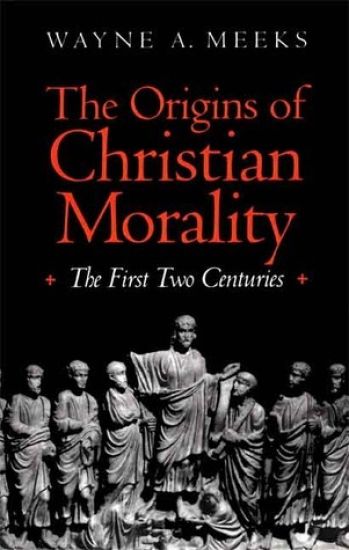
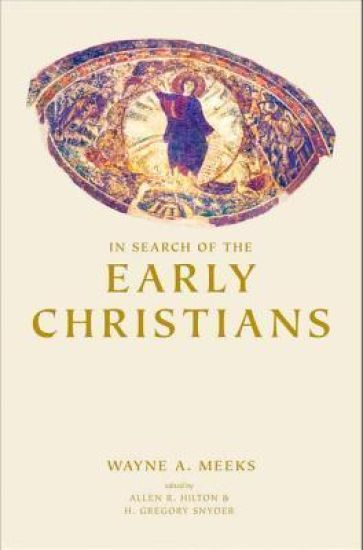
By the time Christianity became a political and cultural force in the Roman Empire, it had come to embody a new moral vision. This wise and eloquent book describes the formative years—from the crucifixion of Jesus to the end of the second century of the common era—when Christian beliefs and practices shaped their unique moral order.Wayne A. Meeks examines the surviving documents from Christianity's beginnings (some of which became the New Testament) and shows that they are largely concerned with the way converts to the movement should behave. Meeks finds that for these Christians, the formation of morals means the formation of community; the documents are addressed not to individuals but to groups, and they have among their primary aims the maintenance and growth of these groups. Meeks paints a picture of the process of socialization that produced the early forms of Christian morality, discussing many factors that made the Christians feel that they were a single and "chosen" people. He describes, for example, the impact of conversion; the rapid spread of Christian household cult-associations in the cities of the Roman Empire; the language of Christian moral discourse as revealed in letters, testaments, and "moral stories"; the rituals, meetings, and institutionalization of charity; the Christians' feelings about celibacy, sex, and gender roles; and their sense of the end-time and final judgment. In each of these areas Meeks seeks to determine what is distinctive about the Christian viewpoint and what is similar to the moral components of Greco-Roman or Jewish thought.
A central figure in the reconception of early Christian history over the last three decades, Wayne A. Meeks offers here a selection of his most influential writings on the New Testament and early Christianity. His essays illustrate recent changes in our thinking about the early Christian movement and pose provocative questions regarding the history of this period. Meeks explores a fascinating range of topics, from the figure of the androgyne in antiquity to the timeless matter of God’s reliability, from Paul’s ethical rhetoric to New Testament pictures of Christianity’s separation from Jewish communities. Meeks’ introduction offers a retrospective on New Testament studies of the past thirty years and explains the intersection of these studies with a variety of exploratory and revisionist movements in the humanities, embracing social theory, history, anthropology, and literature. In an epilogue the author reflects on future directions for New Testament scholarship.
In this classic work, Wayne A. Meeks analyzes the earliest extant documents of Christianity—the letters of Paul—to describe the tensions and the texture of life of the first urban Christians. In a new introduction, he describes the evolution of the field of New Testament scholarship over the past twenty years, including new developments in fields such as archaeology and social history.Praise for the earlier edition:“Many readers are likely to join me in feeling that they have never been so close to their mixed and mixed-up spiritual ancestors as Meeks helps them to be. For those who are open to the possibility that they can find fresh angles on the familiar, this book is not only recommended; it is urged.”—Martin E. Marty, Christian Century“A much-needed authoritative study.”—J. L. Houlden, Times Literary Supplement"Those with any historical bent will be intrigued by the way a story usually overlaid with thick layers of theological speculation is unraveled. . . . And those who simply have an interest in how groups form in any era . . . will be fascinated by this case study of one particular community that has ramifications for understanding all other communities."—Robert McAfee Brown, New York Times Book Review "Should fascinate any reader with an interest in the history of human thought."--Phoebe-Lou Adams, Atlantic Monthly
An essential resource to support student's learning experience and enhance comprehension of systematic theology.This workbook accompanies the 2nd edition of Wayne Grudem's widely used Systematic Theology. Following the textbook's structure, it features review material and exercises for every chapter, and all major areas of Christian doctrine are covered, including: The Word of GodGodHumanityChrist and the Holy SpiritThe Application of RedemptionThe ChurchThe FutureSections in each workbook chapter include: Opening Prayer: oriented around the content of the chapter to help prepare reader's hearts as they get ready to study and reflect.Chapter Review: questions to help the reader identify and interact with key concepts.Thinking Critically: questions for readers to consider on how the content should influence their beliefs and actions.Personal Engagement: practical application questions that connect theology to daily life.The workbook further maintains the clear writing, friendly tone, and frequent applications to life found in the textbook. Students will benefit from this hands-on engagement with the important teachings in Systematic Theology.
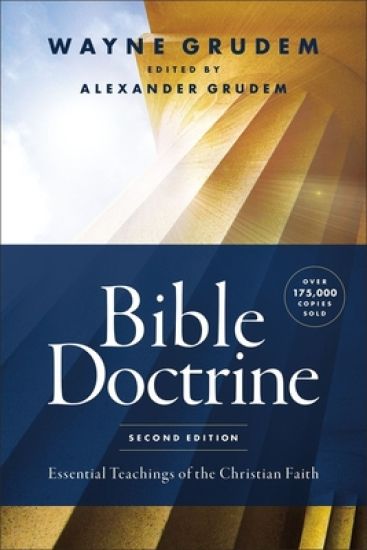
Explore Answers to Life's Most Important Theological Questions. Over 175,000 Copies Sold!How do we know the Bible is God's Word? What is sin and where did it come from? How is Jesus fully God and fully man? What are spiritual gifts? When and how will Christ return?If you've asked questions like these, then systematic theology is no abstract term. It's an approach to finding answers every Christian needs to know. The second edition of Bible Doctrine takes a widely used upper-level textbook on systematic theology and makes it accessible. Abridged from the second edition of Wayne Grudem's award-winning Systematic Theology, Bible Doctrine covers the same essentials of the faith, giving you a firm grasp on seven key topics:The Doctrine of the Word of GodThe Doctrine of GodThe Doctrine of ManThe Doctrine of ChristThe Doctrine of the Application of RedemptionThe Doctrine of the ChurchThe Doctrine of the Future.You don't need to have had several years of Bible college or seminary training to reap the benefits of Bible Doctrine. It's easy to understand and packed with biblical answers to your most pressing theological questions.This new edition now includes:New, thoughtful critiques of open theism, the new perspective on Paul, Molinism (or "middle knowledge"), "Free Grace" theology, and the preterist view of Christ's second comingCompletely revised, stronger chapter on the clarity of ScriptureCompletely revised, stronger chapter on creation and evolution. New discussion of how biblical inerrancy applies to some specific "problem verses" in the GospelsAdditional material respectfully explaining evangelical Protestant differences with Roman Catholicism (with extensive interaction with the Catechism of the Roman Catholic Church), Protestant liberalism, and MormonismCompletely updated bibliographiesAll Scripture quotations updated from RSV to ESVAn explanation of why monogenes in John 3:16 and elsewhere should be translated as "only begotten" rather than merely "only"An extensive discussion on the eternal submission of the Son to the FatherA discussion of recent criticisms of the penal substitutionary view of the atonementNumerous other updates and corrections that have be prompted by letters and emails from people around the world and by interaction with the students Wayne has taught over the last 26 years both at Trinity Evangelical Divinity School and at Phoenix Seminary
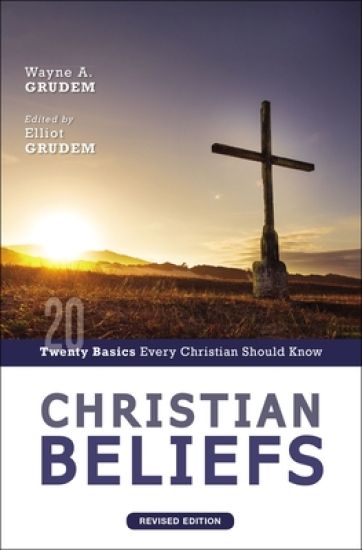
Learn the Teachings of the Bible that Every Christian Must Know. Now Revised and Updated. Over 300,000 Copies Sold!Not every Christian needs to go to seminary, but there are certain teachings of the Bible that every Christian should know. Whether you're a relatively new believer in Jesus or a mature Christian looking for a better understanding of basics of the faith, Christian Beliefs is for you.This readable guide to twenty basic Christian beliefs condenses Wayne Grudem's award-winning book Systematic Theology, prized by pastors and teachers everywhere. He and his son, pastor Elliot Grudem, have boiled down the essentials of theology for everyday Christians and made them both clear and applicable to life. Each brief chapter concludes with questions for personal review or group discussion.In this revised and updated edition of Christian Beliefs, you will learn about:The Bible and its authority for our livesThe characteristics of GodThe importance of prayerAngels and the reality of spiritual warfareWhat it means that we are created in the image of GodWhat God has done for us in ChristThe purpose of the churchWhat will happen when Christ returnsThe biblical understanding of heavenAnd much moreChristian Beliefs is the ideal book for every Christian who wants a solid foundation for understanding the most basic and essential teachings of the Bible.