Kirjojen hintavertailu. Mukana 11 627 463 kirjaa ja 12 kauppaa.

Kirjahaku

Etsi kirjoja tekijän nimen, kirjan nimen tai ISBN:n perusteella.

1000 tulosta hakusanalla William H Schaberg

William H. Carmalt

William H. Carmalt

John E. (John Edward) 1872-1933 Lane

Hassell Street Press
2021
nidottu
This work has been selected by scholars as being culturally important and is part of the knowledge base of civilization as we know it.This work is in the public domain in the United States of America, and possibly other nations. Within the United States, you may freely copy and distribute this work, as no entity (individual or corporate) has a copyright on the body of the work.Scholars believe, and we concur, that this work is important enough to be preserved, reproduced, and made generally available to the public. To ensure a quality reading experience, this work has been proofread and republished using a format that seamlessly blends the original graphical elements with text in an easy-to-read typeface.We appreciate your support of the preservation process, and thank you for being an important part of keeping this knowledge alive and relevant.
The William H. Gass Reader

The William H. Gass Reader

William H. Gass

VINTAGE
2019
nidottu
Throughout his career, William Gass relentlessly pushed at the boundaries of language, celebrating the music of the sentence and the aesthetics of the written word. Now, the best and most important of his work is collected in one volume. There are essays on Plato, Hobbes, James, Joyce, Beckett, Stein, Gaddis, Sterne, Ford Madox Ford, Thomas Mann. There are pieces that examine the inner workings of writing. There is his masterful short fiction, from the perfectly crafted novella "In Camera" to the mythical "In the Heart of the Heart of the Country." And there are excerpts from his novels, including his magnum opus, The Tunnel. Taken together, this collection is a peerless, essential celebration of literature--and an invaluable guide for anyone who wants to understand how great writing works.
Changes in Family Life (Works of William H. Beveridge)
This volume is the printed version of a survey carried out in conjunction with a B.B.C. series called "The changing world" which was broadcast in 1932. Four of the talks were monologues by Beveridge (The changing family, The family and the population question, Nature and nurture and The enduring family: a first impression of the returns). The others were dialogues: Hugh Dalton and Eleanor Barton (of the Women's Co-operative Guild) on The economics of family life; Beveridge and Morris Ginsberg on The family as a social group; and, Beveridge and Jennie Laurel Adamson on Some problems for solution. The talks were part of an attempt by the BBC to collect information from listeners which would be useful for social scientists. The BBC would arrange the talks and distribute/collect the forms and the LSE would analyse the forms.
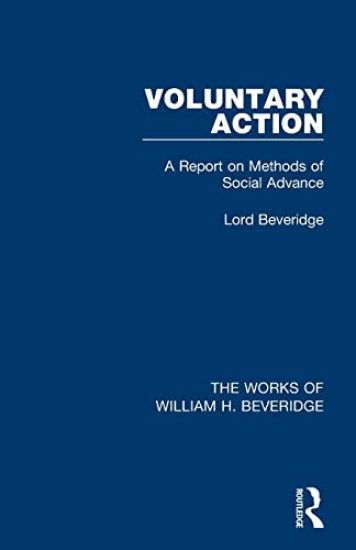
Voluntary Action (Works of William H. Beveridge)
It is the author’s contention that an abundance of voluntary action outside the citizen’s home, both individually and collectively, for bettering his own and his fellows’ lives, are the distinguishing marks of a truly free society. This volume is a study of how such action can be kept alive in the face of the inevitable development of State action and suggests the new forms which co-operation between the State and voluntary Organizations may take, leaving a maximum of freedom and responsibility to the individual. Voluntary Action is a text of unique value because Beveridge here develops his vision of how a large ‘voluntary action’ sector could function as a type of buffer zone between the state and the market.
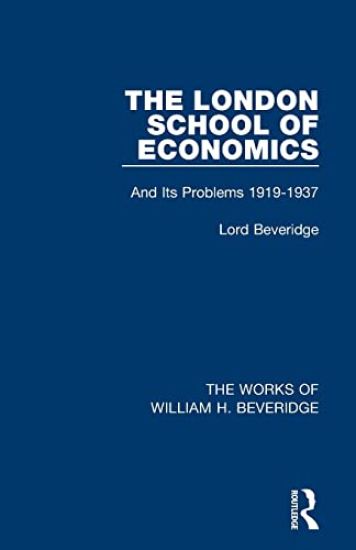
The London School of Economics (Works of William H. Beveridge)
The eighteen years when William Beveridge was Director of the LSE, saw some of the School’s greatest expansion. The years between the wars presented a number of problems discussed in this book, such as those of finding space in the heart of London, of the proper scope and method of economics, of academic self-government and of political activity by university readers of social sciences. The last chapter tells of the author’s forty years of friendship with Sidney and Beatrice Webb, using letters between him and them that had not been published before publication of this book in 1960.
Changes in Family Life (Works of William H. Beveridge)
This volume is the printed version of a survey carried out in conjunction with a B.B.C. series called "The changing world" which was broadcast in 1932. Four of the talks were monologues by Beveridge (The changing family, The family and the population question, Nature and nurture and The enduring family: a first impression of the returns). The others were dialogues: Hugh Dalton and Eleanor Barton (of the Women's Co-operative Guild) on The economics of family life; Beveridge and Morris Ginsberg on The family as a social group; and, Beveridge and Jennie Laurel Adamson on Some problems for solution. The talks were part of an attempt by the BBC to collect information from listeners which would be useful for social scientists. The BBC would arrange the talks and distribute/collect the forms and the LSE would analyse the forms.
Voluntary Action (Works of William H. Beveridge)
It is the author’s contention that an abundance of voluntary action outside the citizen’s home, both individually and collectively, for bettering his own and his fellows’ lives, are the distinguishing marks of a truly free society. This volume is a study of how such action can be kept alive in the face of the inevitable development of State action and suggests the new forms which co-operation between the State and voluntary Organizations may take, leaving a maximum of freedom and responsibility to the individual. Voluntary Action is a text of unique value because Beveridge here develops his vision of how a large ‘voluntary action’ sector could function as a type of buffer zone between the state and the market.
The London School of Economics (Works of William H. Beveridge)
The eighteen years when William Beveridge was Director of the LSE, saw some of the School’s greatest expansion. The years between the wars presented a number of problems discussed in this book, such as those of finding space in the heart of London, of the proper scope and method of economics, of academic self-government and of political activity by university readers of social sciences. The last chapter tells of the author’s forty years of friendship with Sidney and Beatrice Webb, using letters between him and them that had not been published before publication of this book in 1960.
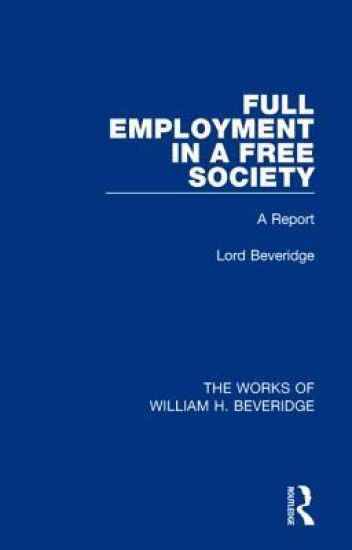
Full Employment in a Free Society (Works of William H. Beveridge)
Beveridge defined full employment as a state where there are slightly more vacant jobs than there are available workers, or not more than 3% of the total workforce. This book discusses how this goal might be achieved, beginning with the thesis that because individual employers are not capable of creating full employment, it must be the responsibility of the state. Beveridge claimed that the upward pressure on wages, due to the increased bargaining strength of labour, would be eased by rising productivity, and kept in check by a system of wage arbitration. The cooperation of workers would be secured by the common interest in the ideal of full employment. Alternative measures for achieving full employment included Keynesian-style fiscal regulation, direct control of manpower, and state control of the means of production. The impetus behind Beveridge's thinking was social justice and the creation of an ideal new society after the war. The book was written in the context of an economy which would have to transfer from wartime direction to peace time. It was then updated in 1960, following a decade where the average unemployment rate in Britain was in fact nearly 1.5%.
Full Employment in a Free Society (Works of William H. Beveridge)
Beveridge defined full employment as a state where there are slightly more vacant jobs than there are available workers, or not more than 3% of the total workforce. This book discusses how this goal might be achieved, beginning with the thesis that because individual employers are not capable of creating full employment, it must be the responsibility of the state. Beveridge claimed that the upward pressure on wages, due to the increased bargaining strength of labour, would be eased by rising productivity, and kept in check by a system of wage arbitration. The cooperation of workers would be secured by the common interest in the ideal of full employment. Alternative measures for achieving full employment included Keynesian-style fiscal regulation, direct control of manpower, and state control of the means of production. The impetus behind Beveridge's thinking was social justice and the creation of an ideal new society after the war. The book was written in the context of an economy which would have to transfer from wartime direction to peace time. It was then updated in 1960, following a decade where the average unemployment rate in Britain was in fact nearly 1.5%.