Kirjojen hintavertailu. Mukana 11 238 995 kirjaa ja 12 kauppaa.

Kirjahaku

Etsi kirjoja tekijän nimen, kirjan nimen tai ISBN:n perusteella.

1000 tulosta hakusanalla Write Everyday

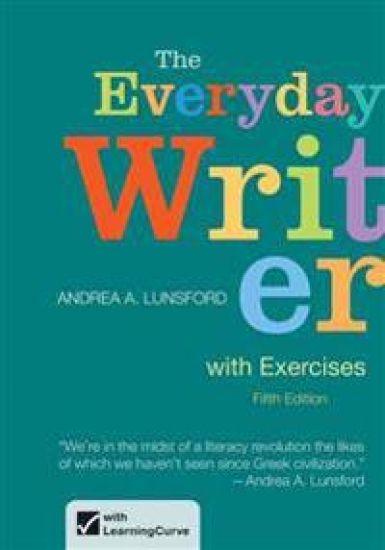
The Everyday Writer

The Everyday Writer

Andrea A Lunsford

Bedford/Saint Martin's
2012
kierre
Andrea Lunsford's research shows that students are writing more than ever -- in classrooms, workplaces, and social spaces, in local communities and around the world. The Everyday Writer, Fifth Edition, is the first tabbed handbook to help the participants in this "literacy revolution" build on the smart decisions they make as social writers -- and use their skills in their academic and professional work. With Andrea Lunsford's trademark attention to rhetorical choice and language, and with new chapters on public writing, critical reading, and understanding how and why to use documentation, The Everyday Writer gives today's students the information they need to be effective, ethical writers. New illustrations by graphic artist G.B. Tran make complicated concepts clear and inviting for students. And now LearningCurve, game-like adaptive quizzing, gives students a new way to see what they know.
The Everyday Writer

The Everyday Writer

Bedford/saint Martins
2012
pokkari
From managing a research project to writing on Facebook, The Everyday Writer takes students through every writing situation. New research into student writing informs every page of the fully revised fifth edition, which contains a new chapter on writing for purposes beyond university.
Everyday White People Confront Racial and Social Injustice
While we are all familiar with the lives of prominent Black civil rights leaders, few of us have a sense of what is entailed in developing a White anti-racist identity. Few of us can name the White activists who joined the struggle against discrimination, let alone understand the complexities, stresses and contradictions of doing this work while benefiting from the privileges they enjoyed as Whites. This book fills that gap by vividly presenting – in their own words – the personal stories, experiences and reflections of fifteen prominent White anti-racists. They recount the circumstances that led them to undertake this work, describe key moments and insights along their journeys, and frankly admit their continuing lapses and mistakes. They make it clear that confronting oppression (including their own prejudices) – whether about race, sexual orientation, ability or other differences – is a lifelong process of learning. The chapters in this book are full of inspirational and lesson-rich stories about the expanding awareness of White social justice advocates and activists who grappled with their White privilege and their early socialization and decided to work against structural injustice and personal prejudice. The authors are also self-critical, questioning their motivations and commitments, and acknowledging that – as Whites and possessors of other privileged identities – they continue to benefit from White privilege even as they work against it.This is an eye-opening book for anyone who wants to understand what it means to be White and the reality of what is involved in becoming a White anti-racist and social justice advocate; is interested in the paths taken by those who have gone before; and wants to engage reflectively and critically in this difficult and important work.Contributing AuthorsWarren J. BlumenfeldAbby L. FerberJane K. FernandesMichelle FineDiane J. GoodmanPaul C. GorskiHeather W. HackmanGary R. HowardKevin JenningsFrances E. KendallPaul KivelJames W. LoewenPeggy McIntoshJulie O’MaraAlan RabinowitzAndrea RabinowitzChristine E. Sleeter
Everyday White People Confront Racial and Social Injustice
While we are all familiar with the lives of prominent Black civil rights leaders, few of us have a sense of what is entailed in developing a White anti-racist identity. Few of us can name the White activists who joined the struggle against discrimination, let alone understand the complexities, stresses and contradictions of doing this work while benefiting from the privileges they enjoyed as Whites. This book fills that gap by vividly presenting – in their own words – the personal stories, experiences and reflections of fifteen prominent White anti-racists. They recount the circumstances that led them to undertake this work, describe key moments and insights along their journeys, and frankly admit their continuing lapses and mistakes. They make it clear that confronting oppression (including their own prejudices) – whether about race, sexual orientation, ability or other differences – is a lifelong process of learning. The chapters in this book are full of inspirational and lesson-rich stories about the expanding awareness of White social justice advocates and activists who grappled with their White privilege and their early socialization and decided to work against structural injustice and personal prejudice. The authors are also self-critical, questioning their motivations and commitments, and acknowledging that – as Whites and possessors of other privileged identities – they continue to benefit from White privilege even as they work against it.This is an eye-opening book for anyone who wants to understand what it means to be White and the reality of what is involved in becoming a White anti-racist and social justice advocate; is interested in the paths taken by those who have gone before; and wants to engage reflectively and critically in this difficult and important work.Contributing AuthorsWarren J. BlumenfeldAbby L. FerberJane K. FernandesMichelle FineDiane J. GoodmanPaul C. GorskiHeather W. HackmanGary R. HowardKevin JenningsFrances E. KendallPaul KivelJames W. LoewenPeggy McIntoshJulie O’MaraAlan RabinowitzAndrea RabinowitzChristine E. Sleeter
20,000 Words In 4 Days: Write Faster, Outline Better And Write More Every Day!
Once upon a time, I became a writer. My life, once empty, now had purpose. And I, a regular fellow, had a dream to strive for. It took me 4 years to hone my skills as a writer. In that time, I was able to transform myself from an index finger writer to a 20,000 words in 4 days kind of writer. In this book, you will be introduced to a number of different techniques and principles that guarantee to double your wordcount at minimum. You'll learn: 1. How I write 5000 words a day without fail. 2. Practical techniques to get started on an idea. 3. An array of ideas I use to craft a book quickly. 4. Easy principles that level up your word count. 5. How to never face writer's block. 6. Essential writing tips 7. The 3 arc formula 8. And more... The time to start is Right Now
What things can make you cheer up?: Write them down every day!

What things can make you cheer up?: Write them down every day!

Kevin Hwu

Createspace Independent Publishing Platform
2018
nidottu
This is a notebook to develop positive thinking habits, and make you be a happy person. For example, if you have completed a project, met a person you want to see, did something to make others happy, read a good article, think of a good idea, solved a problem or your favorite person say something to you ...... This series of Plan, Diary, Journal, divided into three kinds of books, there are 60p, 120p, 180p, suitable for office workers, students, employers, housewives to use. This horizontal line grid notebook has 180p.
The Everyday Language of White Racism

The Everyday Language of White Racism

Jane H. Hill

JOHN WILEY AND SONS LTD
2024
nidottu
A groundbreaking critical discourse analysis of everyday language, reveals the underlying racist stereotypes circulating in American culture In The Everyday Language of White Racism, prominent linguist Jane H. Hill provides an incisive analysis of the relationship between language, race, and culture. First published in 2008, this classic textbook employs an innovative framework to reveal the underlying racist stereotypes that continue to persist in White American culture and sustain structures of White Supremacy. Detailed yet accessible chapters integrate a broad range of literature from across disciplines, including sociology, social psychology, critical legal studies, anthropology, and sociolinguistics. Throughout the book, students are encouraged to engage with the linguistic data available through observation of racialized communication in their everyday lives. Edited by a team of leading scholars, the second edition of The Everyday Language of White Racism brings Hill's contributions to the study of racism into conversation with the most current literature on language and racism in the United States. Topics such as racial profiling, police violence, the Black Lives Matter movement, White nationalism, White fragility, and various forms of institutional racism are addressed within Hill's broader framework of White racial projects and the “White folk” theory of race and racism. New chapter-by-chapter annotations clarify and contextualize theoretical concepts, accompanied by new discussion questions that offer guidance for analytical conversations in classrooms. Provides resources for critical discussions on contemporary racial issues that continue to limit and endanger BIPOC (Black, Indigenous, and People of Color) individuals and communitiesDispels the common assumption that White racism is fading in the US and the Western worldIllustrates how racist effects can be produced in interaction without any single person intending discriminationContains an overview of the theory of race and racism, with definitions of terms and conceptsIncludes recent statistical data on U.S. racial gaps across a variety of categories and access to a companion website with additional resources The Everyday Language of White Racism, Second Edition remains an indispensable resource for undergraduate and graduate students in Critical Race Studies and Linguistic Anthropology courses across the Humanities and Social Sciences.
The Everyday Language of White Racism

The Everyday Language of White Racism

Jane H. Hill

Wiley-Blackwell (an imprint of John Wiley Sons Ltd)
2008
sidottu
In The Everyday Language of White Racism, Jane H. Hill provides an incisive analysis of everyday language to reveal the underlying racist stereotypes that continue to circulate in American culture. provides a detailed background on the theory of race and racismreveals how racializing discourse—talk and text that produces and reproduces ideas about races and assigns people to them—facilitates a victim-blaming logicintegrates a broad and interdisciplinary range of literature from sociology, social psychology, justice studies, critical legal studies, philosophy, literature, and other disciplines that have studied racism, as well as material from anthropology and sociolinguisticsPart of the Blackwell Studies in Discourse and Culture Series
Every Day I Write the Book

Every Day I Write the Book

Amitava Kumar

Duke University Press
2020
sidottu
Amitava Kumar's Every Day I Write the Book is for academic writers what Annie Dillard's The Writing Life and Stephen King's On Writing are for creative writers. Alongside Kumar's interviews with an array of scholars whose distinct writing offers inspiring examples for students and academics alike, the book's pages are full of practical advice about everything from how to write criticism to making use of a kitchen timer. Communication, engagement, honesty: these are the aims and sources of good writing. Storytelling, attention to organization, solid work habits: these are its tools. Kumar's own voice is present in his essays about the writing process and in his perceptive and witty observations on the academic world. A writing manual as well as a manifesto, Every Day I Write the Book will interest and guide aspiring writers everywhere.
Every Day I Write the Book

Every Day I Write the Book

Amitava Kumar

Duke University Press
2020
pokkari
Amitava Kumar's Every Day I Write the Book is for academic writers what Annie Dillard's The Writing Life and Stephen King's On Writing are for creative writers. Alongside Kumar's interviews with an array of scholars whose distinct writing offers inspiring examples for students and academics alike, the book's pages are full of practical advice about everything from how to write criticism to making use of a kitchen timer. Communication, engagement, honesty: these are the aims and sources of good writing. Storytelling, attention to organization, solid work habits: these are its tools. Kumar's own voice is present in his essays about the writing process and in his perceptive and witty observations on the academic world. A writing manual as well as a manifesto, Every Day I Write the Book will interest and guide aspiring writers everywhere.
Brain Games - Everyday Mindfulness Word Search (White)

Brain Games - Everyday Mindfulness Word Search (White)

Publications International Ltd; Brain Games

Publications International, Ltd.
2018
kierre
Everyday Mindfulness Word Search contains 84 word search puzzles to help you relax and unwind.The word search puzzles cover a variety of themes, and will keep your mind engaged without stressing you out.The book includes some unique word searches where you'll have to answer clues or reveal a hidden message.Spiral binding and complete answer key make this book easy to carry, solve, and check your answers.192 pages*This is an alternate cover option of ISBN-13: 9781645582168 Brain Games - Mindfulness Word Search (Yellow).
365 Song Titles - Write A New Song Every Day for a Year

365 Song Titles - Write A New Song Every Day for a Year

Laura Burke

Createspace Independent Publishing Platform
2018
nidottu
Get inspiration from these song title prompts and write a song every day for a year. This is a great 365 project for any songwriter or lyric writer. It includes an area for alternate titles that come to mind, which will give you lots of ideas and directions to go. There's a place to draw or attach anything that reflects the mood of the song or inspires the lyrics. And of course, it has blank lines for composing your lyrics This journal can also be used to write poems or other prose; it's not limited to writing songs