Kirjojen hintavertailu. Mukana 12 083 983 kirjaa ja 12 kauppaa.

Kirjahaku

Etsi kirjoja tekijän nimen, kirjan nimen tai ISBN:n perusteella.

1000 tulosta hakusanalla Annette Wolf

Und Schier Zerflossen Raum Und Zeit.: Zu Den Texten Der Annette Von Droste-Hulshoff
"Meine Lieder werden leben, / Wenn ich langst entschwand, / Mancher wird vor ihnen beben, / Der gleich mir empfand," so dichtete selbstbewusst 1820 die 23-jahrige Annette von Droste-Hulshoff, die noch mit keiner Zeile an die Offentlichkeit getreten war. Ihre erste Gedichtausgabe erschien 1838 bei Aschendorff in Munster, blieb jedoch ohne groaere Resonanz. Dies geschah erst fur kurze Zeit 1841 mit der Publikation der "Judenbuche" und 1844 mit ihrer ersten groaen Gedichtausgabe bei Cotta in Stuttgart. Der geringe Erfolg machte ihr nichts, sie war sich ihres Wertes bewusst. Sie wolle lieber ihre "blasirte Zeit und ihre Zustande ganzlich mit dem Rucken" ansehen, "ich mag und will jetzt nicht beruhmt werden, aber nach hundert Jahren mocht ich gelesen werden." Um die Jahrhundertwende zahlte die Droste zu Deutschlands bedeutendsten Autoren. Der vorliegende Band von dem bekannten Droste-Forscher Winfried Woesler, Universitatsprofessor in Osnabruck und langjahriger Vorsitzender der Droste-Gesellschaft in Munster, versammelt ein Dutzend ausgewahlter Beitrage. Seine intensive Beschaftigung mit den Texten der Droste fordert erstaunlich Modernes zutage und regt an, mehr von der Dichterin zu erfahren und zu lesen.
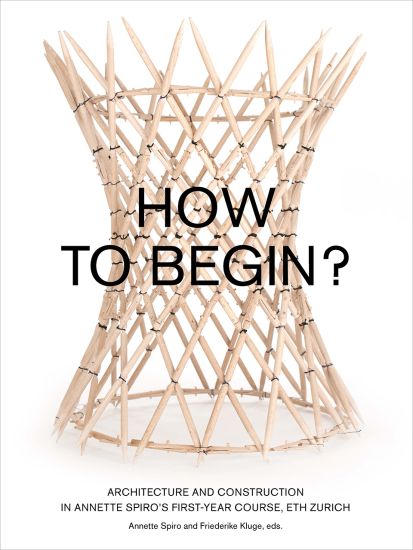
How to Begin? Architecture and Construction in Annette Spiro's First-Year Course, ETH Zurich
How does one teach architecture and construction in the first year of studies; and how does one handle pre-existing experience and the different potential of the prospective architects? Annette Spiro, architect and ETH Professor, has dealt intensively with these questions over many years. As a passionate teacher it has been a constant concern of hers to introduce her students to the subject with adept expertise but also with her own great curiosity. Her aim is to spark the students' enthusiasm and delight for their own projects and their qualities. In six sections the book spotlights the various different aspects and influences that come into play in the students' designs during the first year of studies. In this process the lectures assume as much significance as the projects themselves and the personal surroundings of the students who express their experience of the course in interviews. The weekly exercises delineate the essential elementary terms and principles that are taught in the first year. A glossary addresses important key ideas and theses in architecture, while the logbook presents accompanying events and publications that contribute in shaping the first year of studies.
Acrossborders 2: Living in New Kingdom Sai: With Contributions by Johannes Auenmuller, Annette M. Hansen, Frits Heinrich, Veronica Hinterhuber, Ptolem
This volume is the second in a series of monographs presenting the results of the ERC project "AcrossBorders" on the island of Sai in Sudan. Findings from excavations and surveys in various areas of the Egyptian town are used to reconstruct life in the New Kingdom (c. 1530-1070 BC). The architecture, the material culture, but also the geology, botanical remains and animal bones are analysed. Overall, the findings presented here for the first time not only emphasize the important role of Sai in the New Kingdom, but also give new insights into the lives of its inhabitants.
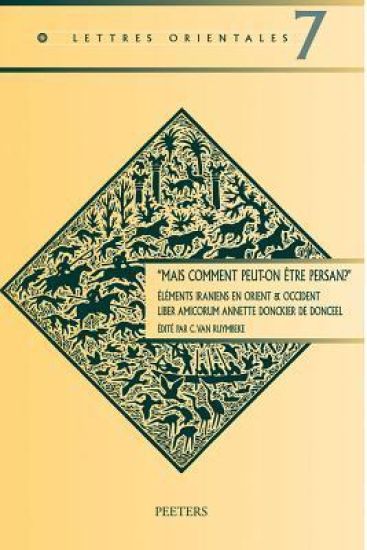
Mais Comment Peut-On Etre Persan?'. Elements Iraniens En Orient & Occident: Liber Amicorum Annette Donckier de Donceel
Mais comment peut-on etre Persan" contains the contributions of colleagues and students written in honour of Professor Annette Donckier de Donceel, who held the chair of Persian studies and of History and Art History of the Islamic world at the Universite Libre de Bruxelles (Belgium) for over 20 years before retiring in 1999.The theme of this Liber Amicorum is the influence exercised by Iran on other civilisations. The 12 contributions gathered here cover a wide range of subjects. They fluctuate from the indo-european concepts of mages and paradise to present day disputes between Orientalists, from astral conjunctions presented by Medieval Islamic Scholars to the career of a 17th century Dutch Orientalist, from a romantic Polish music composer to a plague outbreak in early 20th century Persia, from the influence of Zoroaster on Greek thinkers to the names of flowers in Arabic, from the oral poetry in present day Badakhshan, to the fables of 17th century La Fontaine, from the sun and moon symbolism in the writings of Sadr al-din Shirazi (17th c.), to the Naqshbandiyya in Bosnia Herzegovina.What better way to show the richness of the Persian culture and its remarkable resilience and strength? What better way, also, to thank Annette Donckier de Donceel for her "outstanding service" to Persian studies over the years?
Structure and Functions of The Body - A Hand-Book of Anatomy and Physiology for Nurses and others desiring a Practical knowledge of the Subject Annette Fiske
Although there are already in existence many books on anatomy and physiology for nurses, none with which I am acquainted has seemed to me to provide in concise form just the knowledge needed by the nurse in her profession. Most of them, moreover, separate the anatomy from the physiology and all treat the different systems of tissues separately, first the bones, then the muscles, and so on. These defects, as they seem to me, I have attempted to correct not only by weaving the physiology in with the anatomy, but by treating first the general structures found throughout the body and then describing the structure and function of each part in detail. Thus, the first chapter is devoted to a description of the general structure of all the tissues, a separate chapter being devoted, however, to the skin, itsappendages, and function, including the sense of touch. Then the head with its bones, muscles, and organs of special sense is described, while the brain is treated with the rest of the nervous system, thus forming the connecting link between the head and the body. In the same way the back, chest, abdomen, pelvis, and extremities are taken up in turn and the bones, muscles, blood-vessels, nerves, and special organs of each, together with their functions, described.