

Kirjahaku
Etsi kirjoja tekijän nimen, kirjan nimen tai ISBN:n perusteella.
1000 tulosta hakusanalla David Edgar
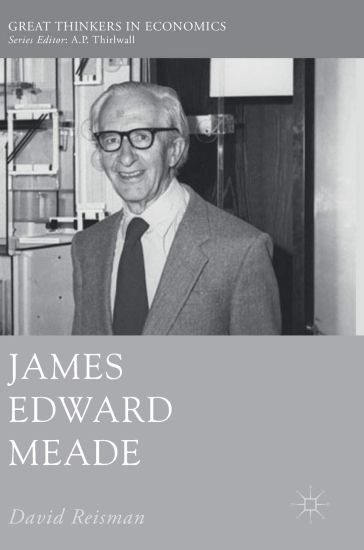
This book reviews James Meade's prolific contribution to economics and its lasting impact. Few economists have written so much and on so many different topics. Meade was awarded the Nobel Prize in Economics in 1977 (jointly with Bertil Ohlin) for his contribution to international economics, but could just as easily have been awarded this for his contribution to the economics and politics of the managed economy. His commitment to the middle ground, neither free market nor command, runs through the whole of his published work, from Planning and the Price Mechanism in the shadow of post-war rationing to The Intelligent Radical’s Guide to Economic Policy and Full Employment Regained? when inflation combined with stagnation reopened the debate between the monetarists and the Keynesians. Meade was active in politics, most prominently in the debates in the 1960s about the European Economic Community and in the 1980s on the formation of Britain’s Social DemocraticParty. As a person, he can best be described as a cultured Englishman, quiet and open, much in the mould of Coase, Mirrlees or Hicks. This book draws upon the whole of Meade’s published work. It incorporates insights from unpublished papers and surviving correspondence kept at the London School of Economics and Political Science as well as interviews with family members and associates. The book will be of interest to economists but also to the students of politics and philosophy that Meade himself would have wanted to reach.

This book reviews James Meade's prolific contribution to economics and its lasting impact. Few economists have written so much and on so many different topics. Meade was awarded the Nobel Prize in Economics in 1977 (jointly with Bertil Ohlin) for his contribution to international economics, but could just as easily have been awarded this for his contribution to the economics and politics of the managed economy. His commitment to the middle ground, neither free market nor command, runs through the whole of his published work, from Planning and the Price Mechanism in the shadow of post-war rationing to The Intelligent Radical’s Guide to Economic Policy and Full Employment Regained? when inflation combined with stagnation reopened the debate between the monetarists and the Keynesians. Meade was active in politics, most prominently in the debates in the 1960s about the European Economic Community and in the 1980s on the formation of Britain’s Social DemocraticParty. As a person, he can best be described as a cultured Englishman, quiet and open, much in the mould of Coase, Mirrlees or Hicks. This book draws upon the whole of Meade’s published work. It incorporates insights from unpublished papers and surviving correspondence kept at the London School of Economics and Political Science as well as interviews with family members and associates. The book will be of interest to economists but also to the students of politics and philosophy that Meade himself would have wanted to reach.


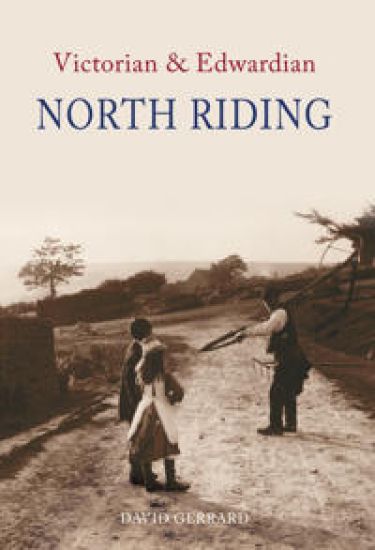
The North Riding of Yorkshire is a fortunate land - favoured by some of the most magnificent scenery in England and with a number of the country's most attractive towns. A century ago this remote and sparsely populated area stubbornly maintained a distinctive way of life. For most, that life was a struggle against ferocious winters and unforgiving agricultural land. And although the county was spared the worst brutalities of the Industrial Revolution, lead-miners, woolknitters, quarrymen and others led a daily existence that was harsh, narrow and inescapable. But there were compensations. When working life was so punitive, entertainment of any kind was savoured to the full. Weddings, fairs, markets, brass bands and travelling showmen were enjoyed with a special intensity. For the more affluent members of society this was truly a 'Golden Age'. Labour was cheap, the sun was always shining on some domain of the British Empire and (almost) everyone knew his place. Their leisured lifestyle contrasts painfully with the stark conditions endured by their less fortunate neighbours. But what emerges most powerfully from this fascinating compilation of photographs and words is the mutual respect and tolerance that flourished among the people of this time, one that must have seemed indestructible. This collection comprises about one hundred and fifty old photographs, reproduced to an exceptional standard, complemented by contemporary accounts of life a century ago. Together they record a lively community of strong-minded personalities, linked by closely shared interests and concerns, and offer the reader an insight into the lives of those who are separated from the modern world by only a few generations.

Edward the Confessor, the last great king of Anglo-Saxon England, canonized nearly 100 years after his death, is in part a figure of myths created in the late middle ages.In this revealing portrait of England's royal saint, David Woodman traces the course of Edward's twenty-four-year-long reign through the lens of contemporary sources, from the Anglo-Saxon Chronicle and the Vita AEdwardi Regis to the Bayeux Tapestry, to separate myth from history and uncover the complex politics of his life. He shows Edward to be a shrewd politician who, having endured a long period of exile from England in his youth, ascended the throne in 1042 and came to control a highly sophisticated and powerful administration.The twists and turns of Edward's reign are generally seen as a prelude to the Norman Conquest in 1066. Woodman explains clearly how events unfolded and personalities interacted but, unlike many, he shows a capable and impressive king at the centre of them.
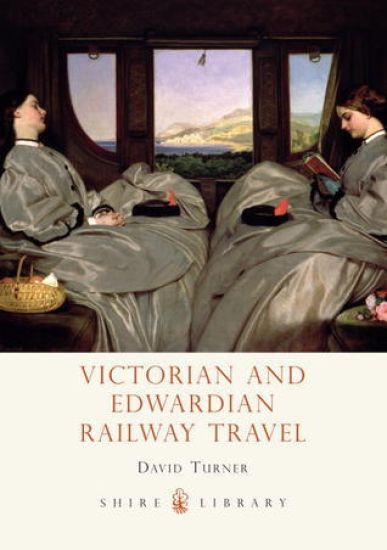
The railway was one of the main modes of long distance travel for Victorian Britons, and its processes – checking the timetable, buying a ticket, taking a seat – were central to both the industry and leisure of the period. David Turner here tells the story of travelling by rail between 1830 and the First World War: the development of stations, passenger carriages, waiting rooms and tickets; less familiar phenomena such as smoking and 'ladies only' compartments, and excursion trains; and the danger of accidents. This introduction to the Victorian and Edwardian railways shows the face of an era reflected in its new method of travel, and will allow the reader to note fascinating similarities between travel in that period and our own.
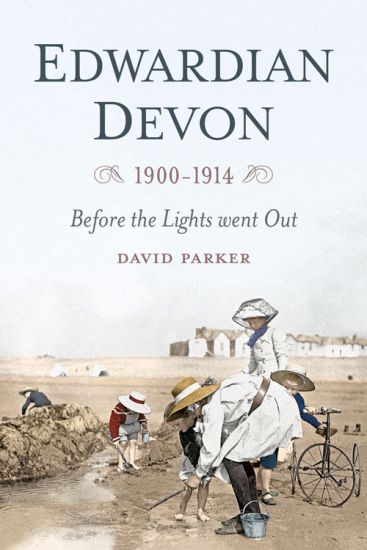
A century ago, Britain was locked in a devastating worldwide conflict that would change every aspect of society. This book explores life in Devon between 1900 and 1914, offering a revealing glimpse of a world now long-vanished before war broke out. Devon was no backwater; its railways and shipping were busy bringing tourists in and sending vast quantities of produce out. It was, though, a county of contrasts and change. Farming had reinvented itself after the late Victorian depression, but villages were in decline; churches and chapels were full but religion bitterly divided communities; the wealthy enjoyed extravagant lifestyles on great estates but their authority was under attack. Devon’s upper-, middle- and lower-class schools perfectly reflected the Edwardian social hierarchy, but as the county’s elections revealed, society was being torn asunder by bitter controversies over exactly who should have the vote, rule the country, and control the Empire. It was a worrying time overseas too: Great Britain’s supremacy was increasingly challenged, and the warships in Devon’s harbours and army manoeuvres on the moors drew many comments as the storm clouds began to gather over Europe. Using mainly contemporary sources, this engaging book examines the attitudes and experiences of people across all social classes in this tumultuous era.

This work has been selected by scholars as being culturally important and is part of the knowledge base of civilization as we know it.This work is in the public domain in the United States of America, and possibly other nations. Within the United States, you may freely copy and distribute this work, as no entity (individual or corporate) has a copyright on the body of the work.Scholars believe, and we concur, that this work is important enough to be preserved, reproduced, and made generally available to the public. To ensure a quality reading experience, this work has been proofread and republished using a format that seamlessly blends the original graphical elements with text in an easy-to-read typeface.We appreciate your support of the preservation process, and thank you for being an important part of keeping this knowledge alive and relevant.






David Blaize and the Blue Door
E F (Edward Frederic) Benson; H J (Henry Justice) Ford
Anson Street Press
2025
pokkari
This fully updated second edition uses the career of Edward the Black Prince to explore key developments in the history of late medieval Europe.The eruption of the Hundred Years War, the arrival of the Black Death, England’s first religious heresy, and major innovations in the role of parliament all took place during Edward’s lifetime. As king-in-waiting and one of the most significant noblemen in the realm, the prince was a major influence over local and international politics, and his example helped reshape concepts of lordship throughout the Plantagenet estates. This thoroughly revised edition includes new sources and builds on the wealth of scholarship which has been published in recent years about the fourteenth century. It includes considerations of the prince’s military career in France and Iberia, his household and the ‘colonial’ characteristics of his administrations in Wales and Aquitaine. The prince’s career also reveals the influence of the chivalric ethic and the importance of Gascony to the English crown, while his relationship with Joan, ‘the Fair Maid’ of Kent is suggestive of the changing character of female agency in the later middle ages. Drawing on central themes such as plague, chivalry, lordship, parliament, gender, and religion, Edward the Black Prince is essential reading for all students and scholars concerned with society, culture, and power in medieval Europe.
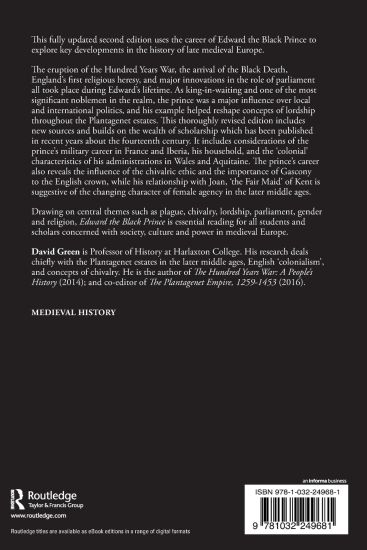
This fully updated second edition uses the career of Edward the Black Prince to explore key developments in the history of late medieval Europe.The eruption of the Hundred Years War, the arrival of the Black Death, England’s first religious heresy, and major innovations in the role of parliament all took place during Edward’s lifetime. As king-in-waiting and one of the most significant noblemen in the realm, the prince was a major influence over local and international politics, and his example helped reshape concepts of lordship throughout the Plantagenet estates. This thoroughly revised edition includes new sources and builds on the wealth of scholarship which has been published in recent years about the fourteenth century. It includes considerations of the prince’s military career in France and Iberia, his household and the ‘colonial’ characteristics of his administrations in Wales and Aquitaine. The prince’s career also reveals the influence of the chivalric ethic and the importance of Gascony to the English crown, while his relationship with Joan, ‘the Fair Maid’ of Kent is suggestive of the changing character of female agency in the later middle ages. Drawing on central themes such as plague, chivalry, lordship, parliament, gender, and religion, Edward the Black Prince is essential reading for all students and scholars concerned with society, culture, and power in medieval Europe.