Kirjojen hintavertailu. Mukana 11 717 486 kirjaa ja 12 kauppaa.

Kirjahaku

Etsi kirjoja tekijän nimen, kirjan nimen tai ISBN:n perusteella.

1000 tulosta hakusanalla Edmundo LLAMAS ALBA

Edmund Spenser's 'The Faerie Queene'

Edmund Spenser's 'The Faerie Queene'

Andrew Zurcher

Edinburgh University Press
2011
nidottu
Introduces a Renaissance masterpiece to a modern audience. This Guide will help new readers to understand and enjoy The Faerie Queene, drawing attention to its various ironies, its self-reflexive construction, its visual emphasis and the timeless ethical, political, and literary questions that it asks of all of us. The book includes key selections from the poem (each accompanied by a headnote, commentary and glosses), historical and critical discussions, teaching and learning plans and a guide to further resources in electronic and print media. Key Features * Contains substantial selections from The Faerie Queene * Provides an integrated introduction to Spenser's life, the intellectual and historical context of his writing and the poem's critical reception * Includes a range of suggestions for teaching and learning about the poem, both in formal seminars and through independent study * Contains a bibliography of further resources, including a list of editions, a list of key critical studies of the poem and a selection of useful websites
Edmund Gosse

Edmund Gosse

Ann Thwaite

The History Press Ltd
2007
nidottu
The life of Edmund Gosse was one of continuous contradiction. He was a precocious only child brought up by a father whose thinking was dominated by the Bible and the "Actinologica Britannica". This book presents a picture of Edmund Gosse without ignoring his many contradictions, showing how they reflect the complexity of his singular genius.
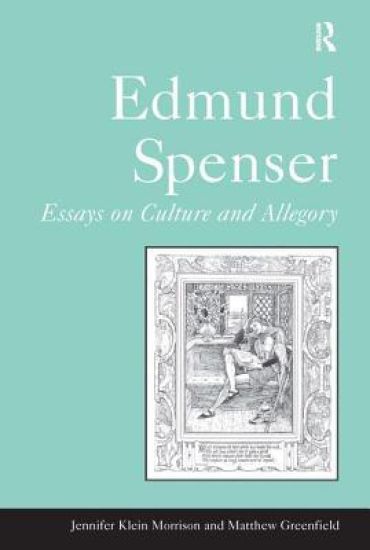
Edmund Spenser

Edmund Spenser

Jennifer Klein Morrison; Matthew Greenfield

Ashgate Publishing Limited
2000
sidottu
Though his writings have long been integral to the canon of early modern English literature, it is only in very recent scholarship that Edmund Spenser has been understood as a preeminent anthropologist whose work develops a complex theory of cultural change. The contributors to this volume approach Spenser’s work from that new perspective, rethinking his contribution as a theorist of culture in light of his poetics. The essays in the collection begin with close readings of Spenser’s writings and end by challenging the ethnographic allegories that shape our knowledge of early modern England. In this book Spenser is proven to be not only a powerful theorist of allegory and poetics but also a profound and subtle ethnographer of England and Ireland. This is an interdisciplinary volume, incorporating studies on history and art history as well as literary criticism. The essays are based on papers presented at The Faerie Queen in the World, 1596-1996: Edmund Spenser among the Disciplines, a conference which took place at the Yale Center for British Art in September 1996.
Edmund Burke

Edmund Burke

Ashgate Publishing Limited
2009
sidottu
Edmund Burke’s iconic stance against the French Revolution and its supposed Enlightenment inspiration, has ensured his central role in debates about the nature of modernity and freedom. It has now been rendered even more complex by post-modern radicalism’s repudiation of the Enlightenment as repressive and its reason as illusionary. Not only did Burke’s own work cover a huge range - from aesthetics through history to constitutional politics and political theory - it has generated an enormous literature drawing on many disciplines, as well as continuing to be recruited in a range of contemporary polemics. In Edmund Burke, Iain Hampsher Monk presents a representative selection of articles and essays from the last 50 years of this scholarship. His introduction provides a brief biography and seeks to guide the reader through the chosen pieces as well as indicating its relationship to other and more substantial studies that form the critical heritage of this major figure.
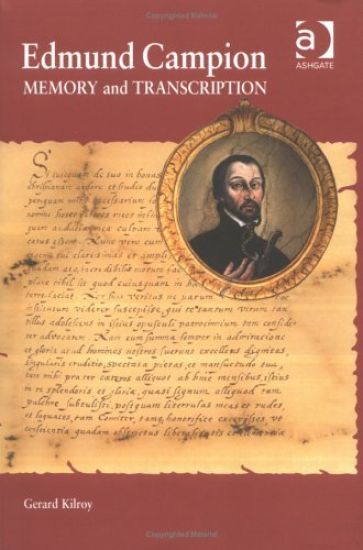
Edmund Campion

Edmund Campion

Gerard Kilroy

Ashgate Publishing Limited
2005
sidottu
The death of Edmund Campion in 1581 marked a disjunction between the world of printed untruth and private, handwritten, truth in early modern England. Gerard Kilroy traces the circulation of manuscripts connected with Campion to reveal a fascinating network that not only stretched from the Court to Warwickshire and East Anglia but also crossed the confessional boundaries. Kilroy shows that in this intricate web Sir John Harington was a key figure, using his disguise as a wit to conceal a lifelong dedication to Campion's memory. Sir Thomas Tresham is shown as expressing his devotion to Campion both in his coded buildings and in a previously unpublished manuscript, Bodleian MS Eng. th. b. 1-2, whose theological and cultural riches are here fully explored. This book provides startling new views about Campion's literary, historical and cultural impact in early modern England. The great strength of this study is its exploitation of archival manuscript sources, offering the first printed text and translation of Campion's Virgilian epic, a fully collated text of 'Why doe I use my paper, ynke and pen', and Harington's four decades of theological epigrams, printed for the first time in the order he so carefully designed. Edmund Campion: Memory and Transcription lays the foundations of the first full literary assessment of Campion the scholar, the impact he had on the literature of early modern England, and the long legacy in manuscript writing.
Edmund W. Gordon

Edmund W. Gordon

JAI Press Inc.
2001
sidottu
The initial volume in this new series focuses on the work of Edmund W. Gordon, the John M. Musser Professor of Psychology Emeritus at Yale University. Gordon had a tremendous influence on contemporary thinking in psychology, education and social policy and the implications of his work for the schooling of lower status youth and children of color, in America. For some, this volume will reacquaint them with Gordon and many of the young persons, now senior scholars themselves, who have learned from him. For others, this volume will simply inform them of the magnitude of the man and the legacy of researchers and research he has spawned. This important work challenges some of the basic assumptions under-pinning American social science research. Scholars from diverse fields of economics, anthropology, law, education, political science, sociology, psychology, and public health question traditional assumptions with respect to low status populations and persons of color, and analyze some of the intended and unintended consequences of those assumptions. The essays in this volume are well reasoned, provocative in the subject matter that they cover, and thoughtful in their conclusions. There is little doubt that the central focus of the book - the influence of Edmund W. Gordon and his liberatory scholarship - is a topic the examination of which is long overdue. The volume is divided into four sections: relevance of social divisions in research and development; population sensitive intervention; explanatory investigations; and, context responsibility. The final word in the volume, in the Epilogue, rightfully belongs to Edmund W. Gordon himself.
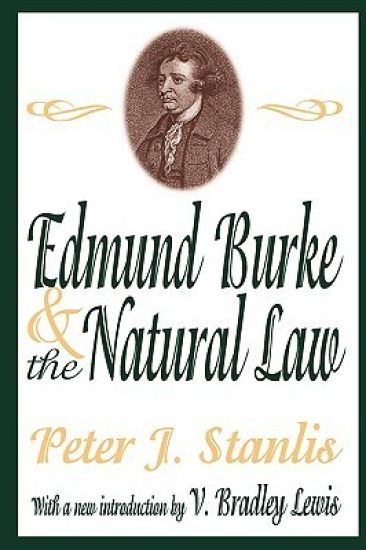
Edmund Burke and the Natural Law

Edmund Burke and the Natural Law

Peter Stanlis

Transaction Publishers
2003
nidottu
Today the idea of natural law as the basic ingredient in moral, legal, and political thought presents a challenge not faced for almost two hundred years. On the surface, there would appear to be little room in the contemporary world for a widespread belief in natural law. The basic philosophies of the opposition--the rationalism of the philosophes, the utilitarianism of Bentham, the materialism of Marx--appear to have made prior philosophies irrelevant. Yet these newer philosophies themselves have been overtaken by disillusionment born of conflicts between "might" and "right." Many thoughtful people who were loyal to secular belief have become dissatisfied with the lack of normative principles and have turned once more to natural law.This first book-length study of Edmund Burke and his philosophy, originally published in 1958, explores this intellectual giant's relationship to, and belief in, the natural law. It has long been thought that Edmund Burke was an enemy of the natural law, and was a proponent of conservative utilitarianism. Peter J. Stanlis shows that, on the contrary, Burke was one of the most eloquent and profound defenders of natural law morality and politics in Western civilization. A philosopher in the classical tradition of Aristotle and Cicero, and in the Scholastic tradition of Aquinas, Burke appealed to natural law in the political problems he encountered in American, Irish, Indian, and British affairs, and in reaction to the French Revolution.This book is as relevant today as it was when it was first published, and will be mandatory reading for students of philosophy, political science, law, and history.
Edmund Husserl Bibliography
This bibliography contains the publications of Husserl and the main secondary literature on Husserl, from Husserl's earliest publication (1887) till today (1997). As the collection of material was conduded in lune 1997, the list of publications for the year 1997 is of course incomplete. In this bibliography publications in the following languages have been induded: German, English, French, Italian, Spanish, Portuguese and Dutch - for both primary and secondary literature. Since this bibliography has been based primarily on the consultation of the induded documents (and not restricted to copying already existing bibliographies), it was not possible to indude publications in languages other than those mentioned. The bibliography has been constructed in the following way: 1. The list of Husserl's works and secondary literature by individual authors is preceded by a list of all edited volumes in which a text by or on Husserl is published. This list is ordered chronologica11y and runs from 1921 ti11 1997 (inclusive). Edited volumes of the same year are classified according to language, and this in the order mentioned above: German, English, French, etc. Edited volumes with a title in more than one language are classified according to the above order of languages (this of course concerns only the title of the edited volume, not the title(s) of the individual contributions). This order is maintained throughout the other parts of the bibliography.
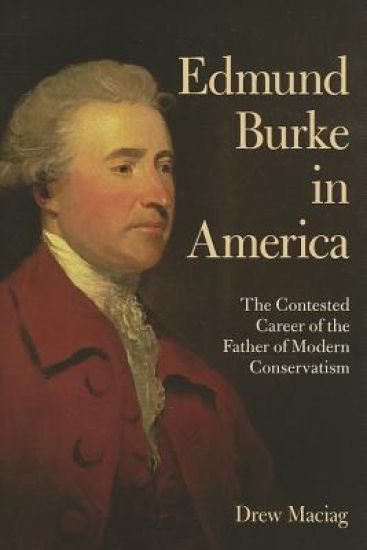
Edmund Burke in America

Edmund Burke in America

Drew Maciag

Cornell University Press
2013
sidottu
The statesman and political philosopher Edmund Burke (1729–1797) is a touchstone for modern conservatism in the United States, and his name and his writings have been invoked by figures ranging from the arch Federalist George Cabot to the twentieth-century political philosopher Leo Strauss. But Burke's legacy has neither been consistently associated with conservative thought nor has the richness and subtlety of his political vision been fully appreciated by either his American admirers or detractors. In Edmund Burke in America, Drew Maciag traces Burke's reception and reputation in the United States, from the contest of ideas between Burke and Thomas Paine in the Revolutionary period, to the Progressive Era (when Republicans and Democrats alike invoked Burke's wisdom), to his apotheosis within the modern conservative movement. Throughout, Maciag is sensitive to the relationship between American opinions about Burke and the changing circumstances of American life. The dynamic tension between conservative and liberal attitudes in American society surfaced in debates over the French Revolution, Jacksonian democracy, Gilded Age values, Progressive reform, Cold War anticommunism, and post-1960s liberalism. The post–World War II rediscovery of Burke by New Conservatives and their adoption of him as the "father of conservatism" provided an intellectual foundation for the conservative ascendancy of the late twentieth century. Highlighting the Burkean influence on such influential writers as George Bancroft, E. L. Godkin, and Russell Kirk, Maciag also explores the underappreciated impact of Burke's thought on four U.S. presidents: John Adams and John Quincy Adams, Theodore Roosevelt, and Woodrow Wilson. Through close and keen readings of political speeches, public lectures, and works of history and political theory and commentary, Maciag offers a sweeping account of the American political scene over two centuries.
The Works of Edmund Spenser

The Works of Edmund Spenser

Edmund Spenser

Johns Hopkins University Press
2002
pokkari
Originally published between 1932 and 1945, the eleven-volume Works of Edmund Spenser collects The Faerie Queene along with Spenser's minor poems, prose works, and Alexander C. Judson's The Life of Edmund Spenser.
The Works of Edmund Spenser

The Works of Edmund Spenser

Edmund Spenser

Johns Hopkins University Press
2002
pokkari
Originally published between 1932 and 1945, the eleven-volume Works of Edmund Spenser collects The Faerie Queene along with Spenser's minor poems, prose works, and Alexander C. Judson's The Life of Edmund Spenser.
The Works of Edmund Spenser

The Works of Edmund Spenser

Edmund Spenser

Johns Hopkins University Press
2002
pokkari
Originally published between 1932 and 1945, the eleven-volume Works of Edmund Spenser collects The Faerie Queene along with Spenser's minor poems, prose works, and Alexander C. Judson's The Life of Edmund Spenser.
The Works of Edmund Spenser

The Works of Edmund Spenser

Edmund Spenser

Johns Hopkins University Press
2002
pokkari
Originally published between 1932 and 1945, the eleven-volume Works of Edmund Spenser collects The Faerie Queene along with Spenser's minor poems, prose works, and Alexander C. Judson's The Life of Edmund Spenser.
The Works of Edmund Spenser

The Works of Edmund Spenser

Edmund Spenser

Johns Hopkins University Press
2002
pokkari
Originally published between 1932 and 1945, the eleven-volume Works of Edmund Spenser collects The Faerie Queene along with Spenser's minor poems, prose works, and Alexander C. Judson's The Life of Edmund Spenser.
The Works of Edmund Spenser

The Works of Edmund Spenser

Edmund Spenser

Johns Hopkins University Press
2002
pokkari
Originally published between 1932 and 1945, the eleven-volume Works of Edmund Spenser collects The Faerie Queene along with Spenser's minor poems, prose works, and Alexander C. Judson's The Life of Edmund Spenser.
The Works of Edmund Spenser

The Works of Edmund Spenser

Edmund Spenser

Johns Hopkins University Press
2002
pokkari
Originally published between 1932 and 1945, the eleven-volume Works of Edmund Spenser collects The Faerie Queene along with Spenser's minor poems, prose works, and Alexander C. Judson's The Life of Edmund Spenser.