Kirjojen hintavertailu. Mukana 11 717 486 kirjaa ja 12 kauppaa.

Kirjahaku

Etsi kirjoja tekijän nimen, kirjan nimen tai ISBN:n perusteella.

1000 tulosta hakusanalla John Hardingham

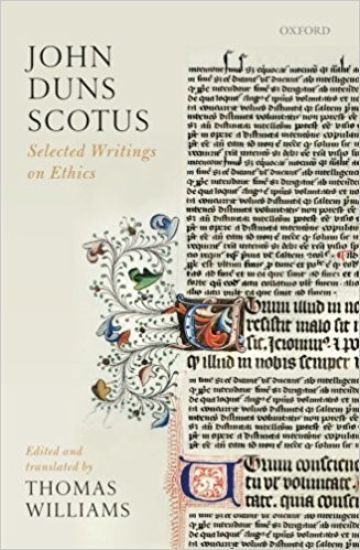
John Duns Scotus

John Duns Scotus

Oxford University Press
2017
nidottu
Thomas Williams presents the most extensive collection of John Duns Scotus's work on ethics and moral psychology available in English. John Duns Scotus: Selected Writings on Ethics includes extended discussions-and as far as possible, complete questions-on divine and human freedom, the moral attributes of God, the relationship between will and intellect, moral and intellectual virtue, practical reasoning, charity, the metaphysics of goodness and rightness, the various acts, affections, and passions of the will, justice, the natural law, sin, marriage and divorce, the justification for private property, and lying and perjury. Relying on the recently completed critical edition of the Ordinatio and other critically edited texts, this collection presents the most reliable and up-to-date versions of Scotus's work in an accessible and philosophically informed translation.
John Donne and the Conway Papers

John Donne and the Conway Papers

Daniel Starza Smith

Oxford University Press
2014
sidottu
How and why did men and women send handwritten poetry, drama, and literary prose to their friends and social superiors in the seventeenth century-and what were the consequences of these communications? Within this culture of manuscript publication, why did John Donne (1572-1631), an author who attempted to limit the circulation of his works, become the most transcribed writer of his age? John Donne and the Conway Papers examines these questions in great detail. Daniel Starza Smith investigates a seventeenth-century archive, the Conway Papers, in order to explain the relationship between Donne and the archive's owners, the Conway family. Drawing on an enormous amount of primary material, he situates Donne's writings within the broader workings of manuscript circulation, from the moment a scribe identified a source text, through the process of transcription and onwards to the social ramifications of this literary circulation. John Donne and the Conway Papers offers the first full-length analysis of three generations of the Conway family between Elizabeth's succession and the end of the Civil War, explaining what the Conway Papers are and how they were amassed, how the archive came to contain a concentration of manuscript poetry by Donne, and what the significance of this fact is, in terms of seventeenth-century politics, patronage, and culture. Answers to these questions cast new light on the early transmission of Donne's verse and prose. Throughout, John Donne and the Conway Papers emphasizes the importance of Donne's closest friends and earliest readers--such as George Garrard, Rowland Woodward, and Sir Henry Goodere--in the dissemination of his poetry. Goodere in particular emerges as a key agent in the early circulation of Donne's verse, and this book offers the first sustained account of his literary activities.
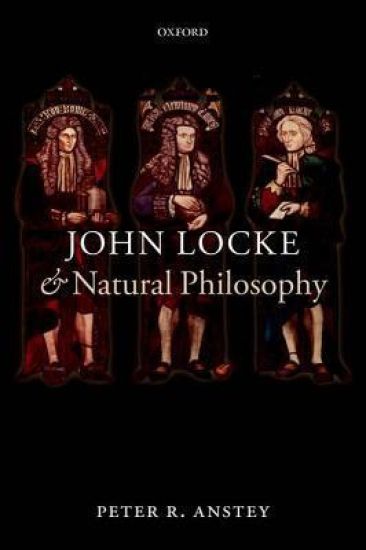
John Locke and Natural Philosophy

John Locke and Natural Philosophy

Peter R. Anstey

Oxford University Press
2013
nidottu
Peter Anstey presents a thorough and innovative study of John Locke's views on the method and content of natural philosophy. Focusing on Locke's Essay concerning Human Understanding, but also drawing extensively from his other writings and manuscript remains, Anstey argues that Locke was an advocate of the Experimental Philosophy: the new approach to natural philosophy championed by Robert Boyle and the early Royal Society who were opposed to speculative philosophy. On the question of method, Anstey shows how Locke's pessimism about the prospects for a demonstrative science of nature led him, in the Essay, to promote Francis Bacon's method of natural history, and to downplay the value of hypotheses and analogical reasoning in science. But, according to Anstey, Locke never abandoned the ideal of a demonstrative natural philosophy, for he believed that if we could discover the primary qualities of the tiny corpuscles that constitute material bodies, we could then establish a kind of corpuscular metric that would allow us a genuine science of nature. It was only after the publication of the Essay, however, that Locke came to realize that Newton's Principia provided a model for the role of demonstrative reasoning in science based on principles established upon observation, and this led him to make significant revisions to his views in the 1690s. On the content of Locke's natural philosophy, it is argued that even though Locke adhered to the Experimental Philosophy, he was not averse to speculation about the corpuscular nature of matter. Anstey takes us into new terrain and new interpretations of Locke's thought in his explorations of his mercurialist transmutational chymistry, his theory of generation by seminal principles, and his conventionalism about species.
John Aubrey: Brief Lives with An Apparatus for the Lives of our English Mathematical Writers
This is the first scholarly edition of Aubrey's Brief Lives since 1898, the first to include the complete text of the three Brief Lives manuscripts (including censored and deleted material, title-pages, antiquarian notes, and the indices), and the first to provide a full general and critical introduction and comprehensive commentary. This edition is the first to respect the original arrangement of the Lives in Aubrey's manuscripts. Brief Lives is presented as an antiquarian and collaborative text, containing the autograph papers of biographical subjects, the annotations of those among whom the manuscripts circulated, and wax seals. As well as 25 facsimile pages, there are over 160 images, reproducing for the first time all Aubrey's horoscopes, pedigrees, coats of arms, and topographical sketches as they are found in the manuscripts. The text respects the mise-en-page of the manuscript and its status as an incomplete and heavily revised work-in-progress while presenting an edited, rather than a diplomatic, text. The commentary presents extensive new research on manuscript sources including much material not previously known to be Aubrey's or associated with him. It also reflects the state of current scholarship. Each life is introduced by a headnote placing the life in context. This gives the dates and sequence of composition and an account of Aubrey's relationship with the biographical subject, the circulation of knowledge of that subject in Aubrey's circle, and a full account of Aubrey's notes on the subject of the life in other manuscripts and correspondence. Aubrey's biographical informants also have a long note, as do uncompleted or missing Lives. Winner of the Rose Mary Crawshay Prize 2017 and Times Literary Supplement Book of the Year 2015
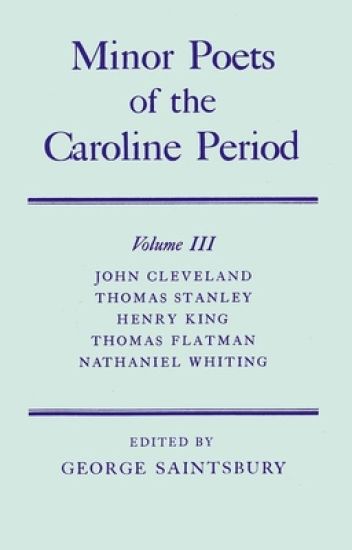
Minor Poets of the Caroline Period: Volume III: John Cleveland, Thomas Stanley, Henry King, Thomas Flatman, Nathaniel Whiting

Minor Poets of the Caroline Period: Volume III: John Cleveland, Thomas Stanley, Henry King, Thomas Flatman, Nathaniel Whiting

John Cleveland; Thomas Stanley; Henry King; Thomas Flatman; Nathaniel Whiting

Oxford University Press
1968
sidottu
A scholarly edition of poems by John Cleveland, Thomas Stanley, Henry King, Thomas Flatman, and Nathaniel Whiting. The edition presents an authoritative text, together with an introduction, commentary notes, and scholarly apparatus.
John F. Kennedy

John F. Kennedy

Robert Dallek

Oxford University Press Inc
2011
sidottu
Robert Dallek's masterful John F. Kennedy: An Unfinished Life was a number one national bestseller, and it remains the most widely read one-volume biography of the 35th President. Now, in this marvelous short biography of John F. Kennedy, Dallek achieves a miracle of compression, capturing in a small space the essence of his renowned full-length masterpiece. Here readers will find the fascinating insights and groundbreaking revelations found in An Unfinished Life. The heart of the book focuses on Kennedy's political career, especially the presidency. The book sheds light on key foreign affairs issues such as the Bay of Pigs debacle, Khrushchev's misguided bullying of Kennedy in Vienna, the Cuban Missile crisis, the nuclear test ban, the race for space, and the initial dealings with Southeast Asia, especially Laos. It also highlights the difficulties Kennedy faced getting a domestic agenda passed, from a tax cut to spur the economy, to federal aid to education, Medicare, and civil rights. Dallek reveals the thinking behind Robert Kennedy's appointment as Attorney General and convincingly argues that Kennedy would never have expanded the war in Vietnam the way that Lyndon Johnson did. The book also addresses questions about Kennedy's assassination and concludes with his presidential legacy and why he remains so popular despite serving only a thousand days in office.
John Henry: Roark Bradford's Novel and Play
Roark Bradford's 1931 novel and 1939 play dealing with the legendary folk-hero John Henry (both titled John Henry) were extremely influential in their own time, but have since then been nearly forgotten. Steven C. Tracy has united these hard-to-find works in a single critical edition that helps contextualize-and revive-both texts. An expansive introduction explores Bradford's life; recounts critical responses to his works; and surveys John Henry's pervasiveinfluence in folk, literary, and popular culture. The volume also features a wide array of supplementary materials including a selected bibliography and discography, transcriptions of folksong texts and recordings available during the 1930s, and a chronology of the lives of both Bradford and Henry. As Tracy'sintroduction makes clear, such a consideration of Bradford-set in the context of writers, both black and white, drawing upon African American folklore and using dialects along with stereotypical and non-stereotypical portrayals-is long overdue. This new edition is a windfall for scholars and students of folklore and African American literature.
John Owen and English Puritanism

John Owen and English Puritanism

Crawford Gribben

Oxford University Press Inc
2016
sidottu
John Owen was a leading theologian in 17th-century England. As vice-chancellor of Oxford University, he was a man of immense intellectual and cultural significance. Through his association with Oliver Cromwell in particular, he exercised considerable influence on central government, and became the premier religious statesman of the Interregnum. The restoration of the monarchy pushed Owen into dissent, criminalizing his religious practice and inspiring his writings in defense of high Calvinism and religious toleration. But Owen transcended his many experiences of defeat, and his claims to quietism were frequently undermined by rumors of his involvement in anti-government conspiracies. Crawford Gribben's biography documents Owen's interactions with the intellectual and print cultures of his social, political and religious environments; its narrative is structured around Owen's own publications. In contrast to the current scholarly consensus, this book emphasizes Owen's importance as a controversial theologian deeply involved with his social and political environment. Far from personifying the Reformed tradition, he helped to undermine it, offering an individualist account of Christian faith which downplayed the significance of the Church's means of grace. His work contributed to the formation of the new religious movement known as evangelicalism, where his influence still can be seen today.
John Stuart Mill and the Art of Life

John Stuart Mill and the Art of Life

Oxford University Press Inc
2012
nidottu
The "Art of Life" is John Stuart Mill's name for his account of practical reason. In this volume, eleven leading scholars elucidate this fundamental, but widely neglected, element of Mill's thought. Mill divides the Art of Life into three "departments": "Morality, Prudence or Policy, and Aesthetics." In the volume's first section, Rex Martin, David Weinstein, Ben Eggleston, and Dale E. Miller investigate the relation between the departments of morality and prudence. Their papers ask whether Mill is a rule utilitarian and, if so, whether his practical philosophy must be incoherent. The second section contains papers by Jonathan Riley and Wendy Donner, who explore the relation between the departments of morality and aesthetics. They discuss issues ranging from supererogation to aesthetic pleasure and humanity's relationship with nature. The papers in the third section consider the Art of Life's axiological first principle, the principle of utility. Elijah Millgram contends that Mill's own life refutes his claim that the Art of Life has a single axiological first principle. Philip Kitcher maintains that Mill has a dynamic axiology requiring us to continually refine our conception of the good. In the final section, three papers address what it means to put the Art of Life into practice. Robert Haraldsson locates an 'Art of Ethics' in On Liberty that is in tension with the Art of Life. Nadia Urbinati plumbs the classical roots of Mill's view of the good life. Finally, Colin Heydt develops Mill's suggestion that we regard our own lives as works of art.