Talvez, nada neste mundo, nem mesmo a posse de riqueza abundante, possa desafiar a maravilha e o mist rio do AMOR. de fato a coisa mais importante que sustenta a exist ncia humana como a conhecemos. Acredito nisso porque acredito no amor quando escolho viver de maneira simples, mas pac fica e gratificante. No entanto, a pr pria vida vicissitude; e o amor, por outro lado, certamente n o sempre um conto de fadas rom ntico; dependendo do ponto de vista, ou como algu m pode defini-lo. Esta uma das v rias raz es pelas quais Maria Dulce Leitao Reis escreveu "MELODIA DAS PALAVRAS", uma vez que ilustra e expressa a sua mais ntima verdade, paix o, dor e solid o; o anseio por amor genu no, bem como o lamentar de relacionamento frustrado.
Twilight, True Blood and The Vampire Diaries have sparked intense fan activity and generated a large quantity of fan fiction: stories which test the limits of an already existing fictional work and explore gaps and discrepancies within it. Working from the idea that texts constitute archives, expanded and altered by each addition, close readings of a selection of fanfics illustrate particular transformative practices in the online environment. The central figure of the vampire is read through the lens of fanfic authors' contributions to the archives, particularly regarding how figuratively or literally refanged versions of the trope are used to subvert norms established in the source texts concerning depictions of sexuality, sexual practices, and monstrosity. Complex relationships between authorial power and subversion, between mainstream messages and individual interpretations, are examined through fanfic analyses, the findings contributing to discussions about contemporary literary creativity.
From antebellum times, Louisiana's unique multipartite society included a legal and social space for intermediary racial groups such as Acadians, Creoles, and Creoles of Color. In Becoming Cajun, Becoming American, Maria Hebert-Leiter explores how American writers have portrayed Acadian culture over the past 150 years. Combining a study of Acadian literary history with an examination of Acadian ethnic history in light of recent social theories, she offers insight into the Americanization process experienced by Acadians - who over time came to be known as Cajuns - during the nineteenth and twentieth centuries.Hebert-Leiter examines the entire history of the Acadian, or Cajun, in American literature, beginning with Henry Wadsworth Longfellow's poem Evangeline and the writings of George Washington Cable, including his novel Bonaventure. The cultural complexity of Acadian and Creole identities led many writers to rely on stereotypes in Acadian characters, but as Hebert-Leiter shows, the ambiguity of Louisiana's class and racial divisions also allowed writers to address complex and controversial - and sometimes taboo - subjects. She emphasises the fiction of Kate Chopin, whose short stories contain Acadian characters accepted as white Americans during the nineteenth and early twentieth centuries. Representations of the Acadian in literature reflect the Acadians' path towards assimilation, as they celebrated their differences while still adopting an all-American notion of self. In twentieth-century writing, Acadian figures came to be more often called Cajun, and increasingly outsiders perceived them not simply as exotic or mythic beings but as complex persons who fit into traditional American society while reflecting its cultural diversity. Hebert-Leiter explores this transition in Ernest Gaines's novel A Gathering of Old Men and James Lee Burke's detective novels featuring Dave Robicheaux. She also discusses the works of Ada Jack Carver, Elma Godchaux, Shirley Ann Grau, and other writers.From Longfellow through Tim Gautreaux, Acadian and Cajun literature captures the stages of this fascinating cultural dynamism, making it a pivotal part of any history of American ethnicity and of Cajun culture in particular. Concise and accessible, Becoming Cajun, Becoming American provides an excellent introduction to American Acadian and Cajun literature.
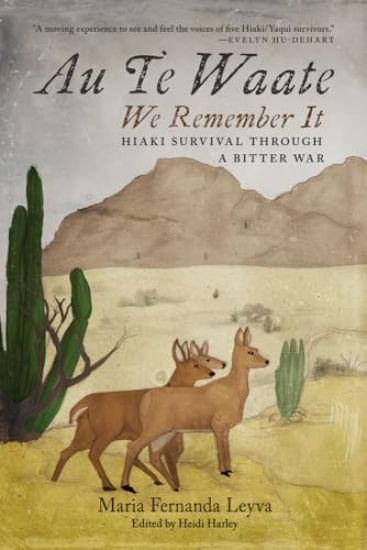
This compelling work delves into the personal narratives of Hiaki (Yaqui) individuals who endured the tumultuous period from 1900 to 1930, when they faced systematic attacks, conscription, deportation, and enslavement under Mexican government policies. Presented in both the original Hiaki language and English translation, these accounts offer an unparalleled glimpse into the lives of those who resisted and survived the era’s harsh realities. The narratives describe military engagements, the struggles of refugee life, forced labor, and the resilience of families under extreme duress. This work provides a unique and unvarnished account of the impacts of Mexican colonialism and aggression on individuals and families, completely from the Hiaki perspective. Au Te Waate / We Remember It is not just a historical account but a linguistic treasure, preserving the naturally produced speech of five Hiaki speakers from a previous era. Transcriptions of interviews recorded by author Maria Fernanda Leyva with family members and friends provide invaluable insights into the Hiaki language. The interviews document and preserve the narrative styles, vocabulary, and grammatical constructions of the time. This work also serves as a crucial resource for scholars of linguistics and history alike, capturing dialect variation and illustrating the linguistic evolution of the Hiaki community. Additionally, for Hiaki people studying their own language, this book stands as a rich repository of cultural and linguistic heritage, meticulously maintained through side-by-side translations and contextual historical introductions. The narratives in this book are anchored by the experiences of five Hiaki speakers, whose stories of displacement, survival, and resistance provide a deeply personal perspective on the broader historical events of the Porfirio DÍaz dictatorship and the early years of the Mexican Revolution. Au Te Waate / We Remember It stands as an important record, preserving these critical voices for future generations and offering profound insights into the resilience of the Hiaki people.
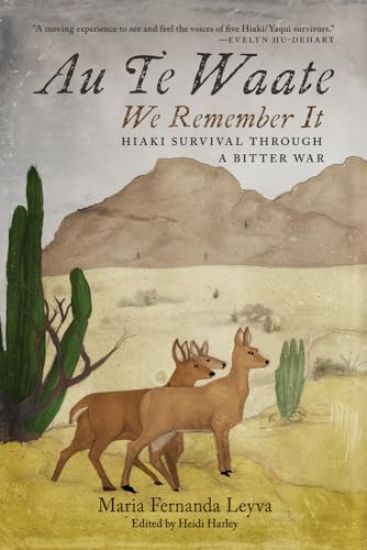
This compelling work delves into the personal narratives of Hiaki (Yaqui) individuals who endured the tumultuous period from 1900 to 1930, when they faced systematic attacks, conscription, deportation, and enslavement under Mexican government policies. Presented in both the original Hiaki language and English translation, these accounts offer an unparalleled glimpse into the lives of those who resisted and survived the era’s harsh realities. The narratives describe military engagements, the struggles of refugee life, forced labor, and the resilience of families under extreme duress. This work provides a unique and unvarnished account of the impacts of Mexican colonialism and aggression on individuals and families, completely from the Hiaki perspective. Au Te Waate / We Remember It is not just a historical account but a linguistic treasure, preserving the naturally produced speech of five Hiaki speakers from a previous era. Transcriptions of interviews recorded by author Maria Fernanda Leyva with family members and friends provide invaluable insights into the Hiaki language. The interviews document and preserve the narrative styles, vocabulary, and grammatical constructions of the time. This work also serves as a crucial resource for scholars of linguistics and history alike, capturing dialect variation and illustrating the linguistic evolution of the Hiaki community. Additionally, for Hiaki people studying their own language, this book stands as a rich repository of cultural and linguistic heritage, meticulously maintained through side-by-side translations and contextual historical introductions. The narratives in this book are anchored by the experiences of five Hiaki speakers, whose stories of displacement, survival, and resistance provide a deeply personal perspective on the broader historical events of the Porfirio DÍaz dictatorship and the early years of the Mexican Revolution. Au Te Waate / We Remember It stands as an important record, preserving these critical voices for future generations and offering profound insights into the resilience of the Hiaki people.
This book is written in Portuguese. This book is based on the premise that A Pedra do Reino is a kaleidoscopic composition formed by the dynamic interaction of several contrasting narrative genres. A wide variety of critical theories is applied to the text to identify and characterize each individual narrative genre, its corresponding point of view and the effects of their interaction. The author's purpose it to demonstrate that the structural complexity of this work is derived from structures and techniques present in the popular literature of the Brazilian Northeast.
A highly effective and efficient way to retain knowledge!Developed to provide users with a proven method for rapidly learning and retaining new information, these sturdy flashcards deliver more than 750 exam-style Q&As with detailed rationales to help nurse practitioners prepare for their high-stakes certification exam. The flashcards are distilled from Maria Codina Leik’s Adult-Gerontology Nurse Practitioner Certification Intensive Review, Fourth Edition, and are color coded by exam blueprint topic for easy access. Shuffle the deck to randomize the questions or study one exam topic at a time.Key FeaturesDelivers more than 750 top-notch comprehensive exam-style questions to help you prepare for test dayFacilitates critical thinking with application-based questions and robust remediating answer rationalesDesigned for standalone use or as a companion to Adult-Gerontology Nurse Practitioner Certification Intensive Review, Fourth Edition
She Found Fossils is a picture book about the history and present diversity of women in paleontology. It tells the remarkable stories of women all over the world in paleontological careers. 《寻找化石的她》是一本有关 女性古生物学家丰富多彩事迹的图书,讲述了世界各地研究古生物学的女性学者们古往今来的一个个精彩故事。
This work has been selected by scholars as being culturally important and is part of the knowledge base of civilization as we know it.This work is in the public domain in the United States of America, and possibly other nations. Within the United States, you may freely copy and distribute this work, as no entity (individual or corporate) has a copyright on the body of the work.Scholars believe, and we concur, that this work is important enough to be preserved, reproduced, and made generally available to the public. To ensure a quality reading experience, this work has been proofread and republished using a format that seamlessly blends the original graphical elements with text in an easy-to-read typeface.We appreciate your support of the preservation process, and thank you for being an important part of keeping this knowledge alive and relevant.
The Imagined Arctic in Speculative Fiction explores the ways in which the Arctic is imagined and what function it is made to serve in a selection of speculative fictions: non-mimetic works that start from the implied question "What if?" Spanning slightly more than two centuries of speculative fiction, from the starting point in Mary Shelley’s 1818 Frankenstein to contemporary works that engage with the vast ramifications of anthropogenic climate change, analyses demonstrate how Arctic discourses are supported or subverted and how new Arctics are added to the textual tradition. To illuminate wider lines of inquiry informing the way the world is envisioned, humanity’s place and function in it, and more-than-human entanglements, analyses focus on the function of the actual Arctic and how this function impacts and is impacted by speculative elements. With effects of climate change training the global eye on the Arctic, and as debates around future northern cultural, economic and environmental sustainability intensify, there is a need for a deepened understanding of the discourses that have constructed and are constructing the Arctic. A careful mapping and serious consideration of both past and contemporary speculative visions thus illuminate the role the Arctic has played and may come to play in a diverse set of practices and fields.
The Imagined Arctic in Speculative Fiction explores the ways in which the Arctic is imagined and what function it is made to serve in a selection of speculative fictions: non-mimetic works that start from the implied question "What if?" Spanning slightly more than two centuries of speculative fiction, from the starting point in Mary Shelley’s 1818 Frankenstein to contemporary works that engage with the vast ramifications of anthropogenic climate change, analyses demonstrate how Arctic discourses are supported or subverted and how new Arctics are added to the textual tradition. To illuminate wider lines of inquiry informing the way the world is envisioned, humanity’s place and function in it, and more-than-human entanglements, analyses focus on the function of the actual Arctic and how this function impacts and is impacted by speculative elements. With effects of climate change training the global eye on the Arctic, and as debates around future northern cultural, economic and environmental sustainability intensify, there is a need for a deepened understanding of the discourses that have constructed and are constructing the Arctic. A careful mapping and serious consideration of both past and contemporary speculative visions thus illuminate the role the Arctic has played and may come to play in a diverse set of practices and fields.
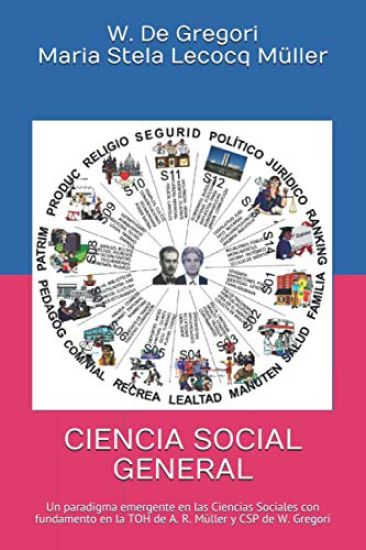
CIENCIA SOCIAL GENERAL Por fin, un mapa del laberinto. Este libro presenta conceptos y herramientas que hacen puente entre todas las Ciencias Sociales y Humanas, adem s de conectarlas con las Ciencias F sicas, desde las part culas elementales y el tomo, donde todo es 3. La ley del 3 es el molde de toda y cualquier realidad, la clave para un nuevo entendimiento de la vida, del juego social y de uno mismo, hasta reformatear las ciencias, el mercado y la convivencia, porque el cerebro tri-uno es el microscopio y el telescopio que facilita ver todo en 3D. Sea pionero/a aplicando la Ciencia Social General para: 1. Crear revoluciones en los 4 niveles de las 3 culturas, para que tanto sus prestantes como sus usuarios alcancen logros proporcionales, y reduzcan la tensi n y la violencia; 2. Dise ar soluciones para control del exceso de oficia-lismo de "los de arriba", maxim cratas empecinados; 3. Hacerse militante h roe del ambiente, de la vida y de la felicidad proporcional para todos los seres del planeta.
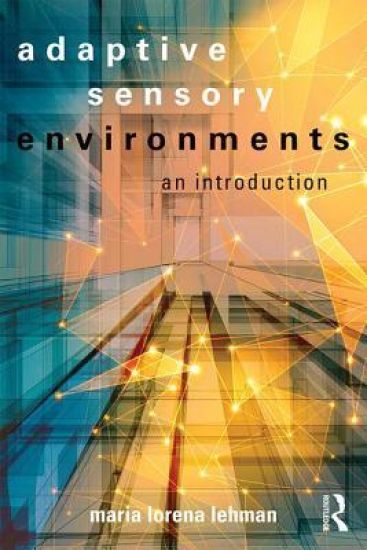
***WINNER OF A NAUTILUS 2017 SILVER MEDAL BOOK AWARD***Adaptive Sensory Environments: An Introduction presents a cutting-edge methodology for adaptive sensory design by fostering an inter-disciplinary approach in which aspects of neuroscience, biophilia, captology, nanotechnology, kinetics, and sensemaking all play critical roles in helping adaptive architecture "tune" to occupants. Furthermore, the book illustrates how adaptive sensory environments transform and uplift quality of life in entirely new ways, by strategically unlocking the potential that technological innovations bring. By teaching scholars, researchers, practitioners, specialists, and consultants how to design architecture that guides what emerging interactive technology can do, it allows them to see deeper into an architectural design, to extend beyond interaction and, ultimately, to build environments that adapt by changing and growing with their occupants’ immediate needs and long-term goals.
***WINNER OF A NAUTILUS 2017 SILVER MEDAL BOOK AWARD***Adaptive Sensory Environments: An Introduction presents a cutting-edge methodology for adaptive sensory design by fostering an inter-disciplinary approach in which aspects of neuroscience, biophilia, captology, nanotechnology, kinetics, and sensemaking all play critical roles in helping adaptive architecture "tune" to occupants. Furthermore, the book illustrates how adaptive sensory environments transform and uplift quality of life in entirely new ways, by strategically unlocking the potential that technological innovations bring. By teaching scholars, researchers, practitioners, specialists, and consultants how to design architecture that guides what emerging interactive technology can do, it allows them to see deeper into an architectural design, to extend beyond interaction and, ultimately, to build environments that adapt by changing and growing with their occupants’ immediate needs and long-term goals.